Here you can browse through my blog posts prior to February 2022. Currently I'm sharing my travel experiences, candid opinions, and what's on my mind solely on my Facebook page. — Rick

For the Love of America, VOTE — And Vote for Joe Biden!

While I freely share my political opinions on this page, I’ve tried to stick to issues and have not explicitly supported one candidate…until now. Today, I’m voicing my support for Joe Biden.

My politics are pretty clear. I have a European-style appreciation for good governance, and I see government as a way for a citizenry to work together for the collective good. Americans are often told there are two choices: big, bad government or good, small government. But Europe has taught me that there’s a third option: big, good government.

I love capitalism (and I’m pretty good at it). And I believe capitalism needs a chaperone, in the form of thoughtful regulation that protects the rights of individuals from the priorities of corporations.

I believe education and health care are as important as our military when it comes to budget priorities to make us safe and strong.
I also understand that, as a country, even in good times, we will always have people on the left and on the right when it comes to debating the role of government. And I believe that the only way to govern effectively is to respect those differences and find workable compromises.

I miss a Republican Party that I can respect. (I voted for Ronald Reagan in 1980.) While I’m a liberal, I love sparring with (and learning from) a principled conservative. For me, the greatness and strength of our country and our democracy is possible only with real, independent journalism and strong governmental institutions led by caring, committed, non-partisan public servants. But our president has identified those very pillars of American life — what he calls “fake news” and the “deep state” — as his worst enemies.

As a traveler and a student of history, I’ve seen how strong societies can fray. And I fear for our democracy. It’s more fragile than we realize. And it is at risk.

That’s why, this year, I believe our choice is more fundamental than partisanship. Four years ago, Donald Trump pledged to “Make America Great Again.” When I survey our national life today, it’s clear to me that we’ve lost so much more than we’ve gained in that time.

If we truly want to make America great again, we need to elect Joe Biden to the White House on November 3. Please join me.
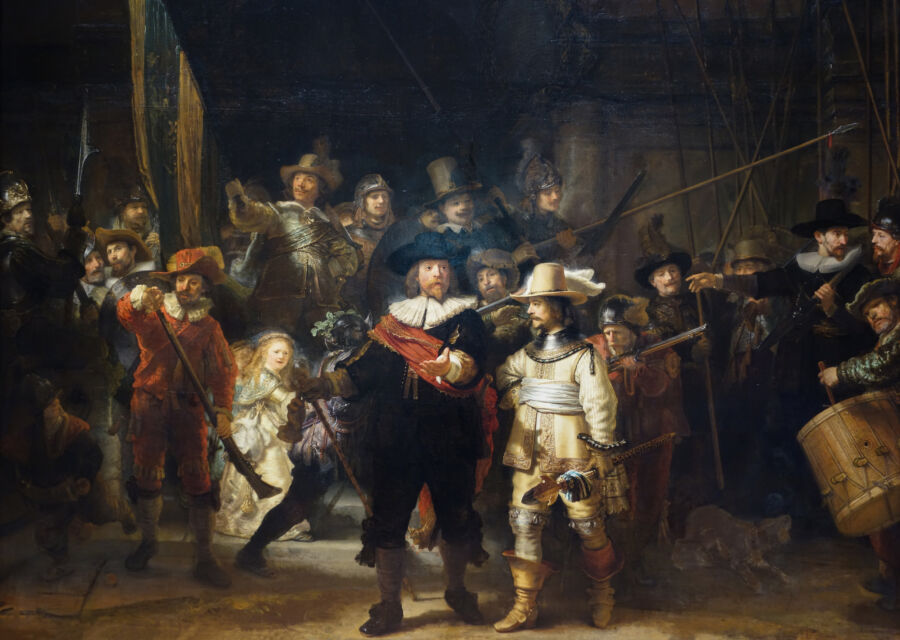
Daily Dose of Europe: Rembrandt’s Night Watch

The Night Watch is Rembrandt’s largest and most famous — though not necessarily his greatest — painting.

As America continues to suffer crisis upon crisis, it has never been more important to broaden our perspectives and learn about the people and places that shape our world. And for me, one of the great joys of travel is seeing art masterpieces in person. Learning the stories behind great art can shed new light on our lives today. Here’s one of my favorites.

Created in 1642, when he was 36, The Night Watch came from his most important commission: a group portrait of a company of Amsterdam’s Civic Guards to hang in their meeting hall.

It’s an action shot. With flags waving and drums beating, the guardsmen spill onto the street from under an arch. It’s “all for one and one for all” as they rush to Amsterdam’s rescue. The soldiers grab lances and load their muskets. In the center, the commander (in black, with a red sash) strides forward energetically with a hand gesture that seems to say, “What are we waiting for? Let’s move out!” His lieutenant focuses on his every order.
Why is The Night Watch so famous? Well, it’s enormous, covering 170 square feet. The guards are almost life-size, so it seems like they’re marching right out of the frame and into our living room.

In its day, The Night Watch was completely different from other group portraits. Until then, subjects were seated in an orderly group-shot pose with each face well-lit and flashbulb-perfect. The groups commissioning the work were paying good money to have their mugs preserved for posterity, and it was ego before artistic freedom.

By contrast, Rembrandt got the Civic Guards off their duffs and showed them doing their job — protecting the city. He added less-than-heroic elements that gave it a heightened realism, like the dwarf and the mysterious glowing girl holding a chicken (the guards’ symbol). Rembrandt’s trademark use of a bright spotlight to highlight the main characters made it all the more dramatic. By adding movement and depth to an otherwise static scene, he took posers and turned them into warriors, and turned a simple portrait into high art.

OK, some Night Watch scuttlebutt: First off, the name “Night Watch” is a misnomer. It’s actually a daytime scene, but Rembrandt finished his paintings with a preserving varnish. Eventually, as the varnish darkened and layers of dirt built up, the sun set on this painting. During World War II, the painting was rolled up and hidden for safekeeping. Over the years, this stirring painting has both inspired people and deranged them. In 1911, a madman sliced it with a knife, in 1975, another lunatic cut the captain’s legs, and in 1990, it was sprayed with acid.

The Night Watch was a smashing success in its day. Rembrandt had captured the exuberant spirit of Holland in the 1600s, when its merchant ships ruled the waves, and Amsterdam was the center of the first global economy. These guardsmen on the move epitomized the proud, independent, and upwardly mobile Dutch. On an epic scale, Rembrandt created the definitive “portrait” of that single generation of people that re-invented the world — the era we call the “Dutch Golden Age.”

This art moment — a sampling of how we share our love of art in our tours — is an excerpt from the new, full-color coffee-table book “Europe’s Top 100 Masterpieces” by Rick Steves and Gene Openshaw. Please support local businesses in your community by picking up a copy from your favorite bookstore, or you can find it at my online Travel Store. To enhance your art experience, you can find clips related to this artwork at Rick Steves Classroom Europe; just search for Night Watch.

Daily Dose of Europe: Ghiberti’s Bronze Doors

Some say that the cultural explosion called “the Renaissance” began precisely in the year 1401, with two bronze panels. They look simple, but they were the catalyst of an artistic revolution.

As America continues to suffer crisis upon crisis, it has never been more important to broaden our perspectives and learn about the people and places that shape our world. And for me, one of the great joys of travel is seeing art masterpieces in person. Learning the stories behind great art can shed new light on our lives today. Here’s one of my favorites.

Florence held a city-wide competition to find the best artist to create a set of bronze doors for the beloved Baptistery. That octagonal building in front of Florence’s main church was dear to the hearts of Florentines. It was the city’s oldest structure, nearly 1,000 years old, where venerable citizens from Dante to Machiavelli to the Medici were baptized.

All the great Florentine artists entered the contest. There was the promising young sculptor Donatello, the goldsmith Lorenzo Ghiberti, and the all-around Renaissance man, Filippo Brunelleschi. They were asked to submit their take on the Bible story of the Sacrifice of Isaac. This was the crucial moment when Abraham, obeying God’s orders, was about to kill his only son as a sacrifice.
The two finalists were Ghiberti and Brunelleschi. It was a tough call. Before reading on, look at each entry panel as if a critic. Decide which one you’d favor.

Brunelleschi (right), put the boy Isaac at center stage, creating a balanced composition. Ghiberti (left) focused on Abraham. Abraham’s face is intense. He pulls the knife back, ready to strike. But just then, the angel swoops in — coming straight out of the panel, right at you, like a 3-D movie — to save the boy in the nick of time. Now that’s drama.

The winner was — drum roll, please — Ghiberti.

That simple contest started a historic chain of events. Ghiberti made the Baptistery doors, which proved so successful that he was asked to make another set for another entrance. These were the famous Gates of Paradise that revolutionized the way Renaissance people saw the world around them.
Ghiberti added a whole new dimension to art — depth. In his Jacob and Esau panel, Ghiberti set the scene under a series of arches. The arches appear to recede into the distance, as do the floor tiles and banisters, creating a 3-D background for a realistic scene. The figures in the foreground stand and move like real people, telling the Bible story with human details. Ghiberti made the viewer part of this casual crowd of holy people. Amazingly, his spacious, three-dimensional scene is made from bronze only a few inches deep.

Ghiberti’s work in perspective would inspire the next generation of painters, who learned to create three-dimensional scenes on a two-dimensional surface.

Meanwhile, Brunelleschi — after losing the Baptistery gig — went to Rome. He studied the Pantheon, and returned to build the awe-inspiring dome crowning the cathedral (or Duomo) of Florence. And Donatello went to work for Ghiberti, learning the skills that would soon revolutionize sculpture. All three of these artists inspired Michelangelo, who built on their work and spread the Florentine Renaissance all across Europe.

And it all began with two bronze panels.

This art moment — a sampling of how we share our love of art in our tours — is an excerpt from the new, full-color coffee-table book “Europe’s Top 100 Masterpieces” by Rick Steves and Gene Openshaw. Please support local businesses in your community by picking up a copy from your favorite bookstore, or you can find it at my online Travel Store. To enhance your art experience, you can find clips related to this artwork at Rick Steves Classroom Europe; just search for Ghiberti.

Daily Dose of Europe: Gaudí’s Sagrada Família

Antoni Gaudí’s most awe-inspiring work is this unfinished, super-sized basilica. With its cake-in-the-rain facade and otherworldly spires, the basilica has become the icon of Barcelona.

As America continues to suffer crisis upon crisis, it has never been more important to broaden our perspectives and learn about the people and places that shape our world. And for me, one of the great joys of travel is seeing art masterpieces in person. Learning the stories behind great art can shed new light on our lives today. Here’s one of my favorites.

Construction on the Sagrada Família began over a century ago (1883) and is still ongoing. The only section finished by Gaudí himself is the Nativity Facade. The four 330-foot towers soar upward, morph into round honeycomb spires, and taper to a point, tipped with colorful ceramic “stars.”

Gaudí’s Nativity Facade gives a glimpse at how grand this structure will be. The four spires are just a fraction of this mega-church. When finished, the church will have four similar towers on each side, plus five taller towers dedicated to the Evangelists and Mary. And in the very center will stand the 560-foot Jesus tower — the tallest in the world — topped with an electric cross shining like a spiritual lighthouse. The grand Nativity Facade (where tourists enter today) will become a mere side entrance. The huge church will accommodate 8,000 worshippers surrounded by a forest of sequoia-sized columns. With light filtering in, dappling the nave with stained-glass color, a thousand choristers will sing.

The Nativity Facade exemplifies Gaudí’s unmistakable style. It’s incredibly ornate, made from stone that ripples like frosting, blurring the architectural lines. The sculpted surface is crawling with life: people, animals, birds, trees, and weird bugs. Two massive columns flanking the entrance playfully rest on the backs of two cute little turtles. Gaudí’s religious vision was infused with a love of nature. “Nothing is invented,” he said, “it’s written in nature.” The church grows organically from the ground, blossoming to heaven.

As a deeply religious man, Gaudí’s architectural starting point was Gothic: spires, “flamboyant” ornamentation, pointed arches, and Christian themes.

The Nativity Facade, dedicated to Christ’s birth, features statues of Mary, Joseph, and Baby Jesus — the “Holy Family” (or Sagrada Família) for whom the church is named.

Gaudí mixed in his trademark “Modernist” (or Art Nouveau) elements: color, curves, and a clip-art collage of fanciful symbols celebrating Barcelona’s glorious history. He pioneered many of the latest high-tech construction techniques, including parabolic arches, like those spanning the facade’s midsection. He molded concrete to ripple like waves and enlivened it with glass and tile. His vision: a church that would be both practical and beautiful.

Gaudí labored over Sagrada Família for 43 years. As with Gothic cathedrals of old, he knew it would require many generations to complete. The Nativity Facade was Gaudí’s template to guide future architects. But he also encouraged his successors to follow their own muses. After Gaudí’s death, construction continued in fits and starts, halted by war and stagnation.

Today, the project enjoys renewed life. The site — funded in part by admissions from daily hordes of visitors — bristles with cranking cranes, prickly rebar, scaffolding, and engineers from around the world, trained in the latest technology. More than a century after Gaudí began, they’re still at it. It’s a testament to the generations of architects, sculptors, stonecutters, fundraisers, and donors who became captivated by Gaudí’s astonishing vision, and are determined to incarnate it in stone.

The hoped-for date of completion? The centenary of Gaudí’s death: 2026. I’ll be there.

This art moment — a sampling of how we share our love of art in our tours — is an excerpt from the new, full-color coffee-table book Europe’s Top 100 Masterpieces by Rick Steves and Gene Openshaw. Please support local businesses in your community by picking up a copy from your favorite bookstore, or you can find it at my online Travel Store. To enhance your art experience, you can find a clip related to this artwork at Rick Steves Classroom Europe; just search for Gaudi.

Daily Dose of Europe: Paris’ Sainte-Chapelle

Notre-Dame has been on everyone’s mind over the last year. But just a short walk away is another stunning Parisian church, with the best stained glass anywhere.

As America continues to suffer crisis upon crisis, it has never been more important to broaden our perspectives and learn about the people and places that shape our world. And for me, one of the great joys of travel is seeing art masterpieces in person. Learning the stories behind great art can shed new light on our lives today. Here’s one of my favorites.

This tiny jewel of Gothic architecture is a cathedral of glass like none other. It was purpose-built by King Louis IX — the only French king who is also a saint — to house Jesus’ supposed Crown of Thorns.

Louis came upon the crown in Constantinople while on Crusade. Convinced he’d found the real McCoy, he spent a fortune to build a suitable chapel to hold it — and paid triple that for the precious crown. Today, the supposed Crown of Thorns is not on display, but the church is, along with its star attraction: stained glass.

You enter Sainte-Chapelle on the somber ground floor, wind your way up a tight spiral staircase, and then pop out — wow! — into a cathedral that seems to be made of nothing more than glowing colors and radiant light.

Fiat lux. “Let there be light.” From the first page of the Bible, it’s clear: Light is divine. In Sainte-Chapelle, the sunlight shines through the stained glass like God’s grace shining down to earth. The dazzling glory of Gothic glows brighter here than in any other church.

Gothic architects used new technology to turn dark stone buildings into lanterns of light. Sainte-Chapelle has only the slenderest of structural columns becoming ribs that come together to make pointed arches to hold up the roof, leaving “walls” of glass. Sainte-Chapelle was completed in a mere six years (Notre-Dame, just a few steps away, took 200), creating a harmonious structure that’s the essence of Gothic.

Worshippers are surrounded by 15 big windowpanes, with more than 1,000 different scenes. These cover the entire Christian history of the world, from the Creation to Christ to the end of the world — 6,500 square feet of glass in all. Each individual scene is interesting, and the whole effect is overwhelming.

Craftsmen made the stained glass — which is, essentially, melted sand — using a recipe I call “Stained Glass Supreme”: Melt one part sand with two parts wood ash. Mix in rusty metals to get different colors — iron makes red, cobalt makes blue, copper makes green, and so on. Blow glass into a cylinder shape, cut lengthwise, and lay flat to cool. Cut into pieces. Fit pieces together by drizzling molten strips of lead to hold them in place. The artist might use, say, blue glass for background, green for clothes, brown for hair. More intricate details — like folds in the robes or the line of a mouth — are created by scratching or painting the glass. Put it all together, and — voilà! — you’ve created a picture. Imagine the painstaking process of making the glass, fitting the pieces together to make a scene…and then multiply it by a thousand.

In Sainte-Chapelle, medieval worshippers could stand immersed in radiant light. They’d gaze upon the crown, ponder Christ’s sacrifice, see the sunlight pouring in like God’s grace as it illuminates Bible lessons in glass…and get a glimpse of the divine.

This art moment — a sampling of how we share our love of art in our tours — is an excerpt from the new, full-color coffee-table book, “Europe’s Top 100 Masterpieces,” by Rick Steves and Gene Openshaw. Please support local businesses in your community by picking up a copy from your favorite bookstore, or you can find it at my online Travel Store. To enhance your art experience, you can find a clip related to this artwork at Rick Steves Classroom Europe; just search for Sainte-Chappelle.