The World’s Most Appreciated Breast (in Verona)

Locals in Verona marvel at how about half of the people who come to their town are here for Juliet. Each year, about 1,600 Japanese tour groups break their Venice-Milan ride for an hour-long stop in Verona just to visit this courtyard, with its famous balcony. And all day long, a steady stream of visitors line up to polish Juliet’s bronze breast in hopes of good fortune in love.

Did Juliet even exist? According to the local information box, “While no documentation has been discovered to prove the truth of the legend, no documentation has disproved it either.”

I enjoy standing in the corner and just observing the spectacle, which was started by a tour guide back in the early 1970s. Sensing cynicism on my part, a local guide challenged me to find the positive in this ritual. So I tried:

Perhaps there’s a hunger for a Juliet in our world. Watching the mobs clamor to polish her breast for a moment or to blow kisses from her balcony, I try to appreciate what she means and to psychoanalyze what she provides as a role model. With Juliet, love will prevail. You can lose and also be a winner. Juliet is brave, tragic, honest, outspoken, timeless, and passionate — a mover and a shaker, a dreamer and a fighter. In a way, this is a pagan temple where the spirit of Juliet gives people something to believe in.

Or…maybe it’s just a simpleminded mob excited about a pile of baloney.

What do you think?

If you can’t see the video below, watch it on YouTube.

Hit the Ground Running in Verona

A fundamental skill for travelers is simply getting around efficiently and economically using public transit. Here are a few train and city bus tips grabbed in a stream-of-consciousness way while zipping from the train station in Verona out to the street to catch my bus to the center (and my hotel).

Time and money are both limited resources. As you’ll see here, you’ll save time by getting adept at using automated ticket machines, and you’ll save money (while losing very little time) by hopping on the bus rather than catching a cab upon arrival. While you won’t always connect this quickly with a bus, you’ll find most cities coordinate their train and bus systems pretty efficiently for those who make the effort to figure it out.

If you can’t see the video below, watch it on YouTube.

Dinner with Franklin, Part 2: Italy’s Violent Love of Tomatoes

Enlarge photo

Enlarge photo

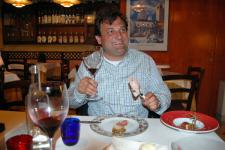
I like eating in a tiny restaurant because you have contact with the chef. It’s like talking to your masseuse as she works. After a day of sightseeing, I sit down to my favorite enoteca in Verona with Franklin, my guide. Our chef consults with us, and we encourage him to bring us whatever he’s most excited about today. Pleased with the freedom to dazzle us, he goes to work.

Just after the antipasti arrive, Franklin’s wife calls and says, “Don’t eat too much cheese or dessert.” Franklin, who’s not thin, surveys our table and considers enjoying with anything less than abandon the enticing parade of food that has just begun. Then he sighs and tells me, “Many people live their entire lives and they do not have this experience.” I say, “That’s a pity.” He says, “Yes. It’s like a man being born and being surrounded by beautiful women, and never making the love.”

I love the way Italians live life with abandon — and how they enjoy their food. As we eat and drink, Franklin opens up about his passion for good eating. He says, “In Italy, you don’t need to be high class to appreciate high culture, cuisine, opera. It’s the only culture I know like this. Here, a heart surgeon talks with a carpenter about cuisine.”

And, as guides tend to do — especially after a little wine — along with the commentary on cuisine, he mixes in culture, history, and politics. I find myself scribbling notes on the paper tablecloth.

Franklin is frustrated with how Italy’s north subsidizes the south. He complains that the south is “corrupt, inefficient, lazy, no organization.” I remind him, “They say here in Veneto, Lombardi, and the north, you are like the Germans of Italy.” He says, “Even today, the south still has its organized crime. With Fascism, the Camorra went to the USA. Mussolini had zero tolerance. And he got things done. That’s one reason why he was popular. And one reason why Mussolini is still popular. Then, after World War II, rather than tolerate communism, the government allowed the Camorra to re-establish itself in Italy.”

I ask him if he enjoyed The Godfather. Franklin says, “I watched The Godfather with a certain pride because of the importance of food in that movie. Especially the scenes with tomatoes. Marlon Brando watched tomatoes ripen. When he said something like, ‘Become red, you bastards,’ to the yellow tomatoes, that took me back to Sicily and the home of my father.”

Our conversation drifts to how modern societies mirror their ancient predecessors — or don’t. Comparing this historic continuity — ancient and today — of Rome, Greece, and Egypt, we agree the biggest difference is Egypt, a relatively ramshackle society that feels a far cry from the grandiosity of the pharaohs and pyramids. Greece, which wrote the ancient book on aesthetics, developed an unfortunate appetite in modern times for poorly planned concrete sprawl. But Rome has the most continuity. Today’s Romans, like their ancient ancestors, are still passionate about wine, food, and the conviviality offered by the public square.

Our chef, Giuliano, comes by, and I compliment him. He recalls my last visit, saying I sat at the same table. I’m always impressed by how people who care remember their clients. He serves thousands of people. Two years later, I come by, and he still knows just where I sat. It’s the same in hotels. I don’t remember which room I slept in last time, but so often the proprietor greets me saying, “I put you in your room…number 510.”

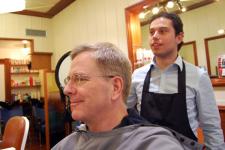
On my last visit to Milano, three years ago, I got a haircut. I remember really enjoying my barber. I needed a haircut on this visit, too, so I walked vaguely in the direction where I thought his shop was. Not sure whether I’d found the right place, I popped in on a barber. It seemed like the one, but I really didn’t know. Ten minutes into my haircut, the barber — having gotten to know my hair — realized he knew my hair and asked me if I hadn’t been here before. He had a tactile memory not of me…but of a head of hair he cut that happened to be mine.

I have a feeling Giuliano will remember my seat the next time I drop into Verona’s Enoteca Can Grande. And I’ll remember to invite my friend Franklin.

Dinner with Franklin

Enlarge photo

I love the way Italians enjoy their food. After visiting all my recommended restaurants in Verona, I sat down at my favorite place, Enoteca Can Grande, with my friend and guide, Franklin. We let the chef, Giuliano, bring us whatever he wanted. Franklin’s a local. He knows the cuisine. And just to see Franklin swoon over the food made the evening even better than the impact of Giuliano’s fine food and wine. Here are a few of Franklin’s comments as the food came and we ate (perhaps some a bit impolite, but all from the stomach end of the heart):

With the first of many small plates, Franklin is delighted. “Raw Piedmont beef, carne cruda. It is like seeing the smile of a beautiful woman after ten years. You never forget her.”

I ask, “Sublime is an Italian word, no?” He says, “Yes, soo-blee-may…this is sublime.” The wine is Amarone della Valpolicella. It is sublime.

Giuliano brings a plate of various cold cuts — glistening in a way that lets you know it’s nothing but the best — and we ponder: If you had to choose between salami and cheese in life, which would you choose? Both agree that it would be a terrible choice…but cheese. Then we nibble the mortadella with truffle, and it complicates the matter. Mortadella is the local baloney — not a high-end meat. But with the black truffle, it’s exquisite. Imagine calling spam exquisite…just add truffle.

And if you had to choose between white and red wine? Franklin says, “I used to smoke, and I compared white wine and red like cigarettes and a good Cuban cigar. And I enjoyed my Cuban cigars.” Then he gets distracted by the herb decorating the next little mozzarella dish. After tasting a sprig, he says, “Yes, fresh… It’s normally served dried. The chef is a genius, brilliant with mozzarella.”

Then comes the best polenta I’ve ever tasted. Italian cuisine is like a religion — and it’s the quality of the ingredients that’s most sacred. Polenta comes in varieties, like white bread and whole-grain bread. This is the darker polenta integrale, using the entire corn. And it comes with anchovies. Anchovies and polenta go together…a good marriage. It’s the simple things — the anchovies, the olive oil, the polenta integrale, and the proper matching of flavors — that can bring the most joy at the table.

Noticing how Franklin polishes every plate, I say, “You even eat the speckles.” He says, “Yes, I would feel like a sinner not to.” And, sipping his wine, he adds, “And to not finish the Amarone — Dante would have to create a new place in hell. Mortal sin.”

Then comes the pumpkin ravioli. I hold the warm and happy tire of my full tummy and say, “Basta.” Giovanni, looking at my Amarone, realizes we need another bottle. He warns us, “Next I bring you a small cheese course.”

Franklin says, “I’m not so religious, but for this cheese, with Amarone, I fall on my knees.” I agree, saying, “In cheese we trust.” He compliments my economy of words and repeats, “Yes, in cheese we trust.” I say, “This cheese plate takes dessert to new heights.” Franklin, playing with the voluptuous little slices, says, “Even if we do not talk, with these cheeses we have a good conversation.”

I support my happy head with my hand as Franklin pours the last of our second bottle into my glass and we move into the parmesan and the gorgonzola. Franklin, taking the last dribble into his glass, says, “If this was my only wine, I could be monogamous.”

It occurs to me we must have tasted thirty different ingredients — all of them top-quality and in harmonious combinations. Franklin again marvels at how the chef was creative and unpredictable without garish combinations — no gorgonzola ice cream.

Giuliano asks if I’d like anything else. I ask, “Dov’è il letto?” Franklin agrees and says, “Yes, a good restaurant should come with a bed.”