As I like to do every couple of weeks, I’m sharing a post from Cameron Hewitt (co-author of many of my Europe guidebooks) today. If you like this intimate slice of Tuscany, be sure to “like” Cameron’s Facebook page. There’s a world of good travel there. In this piece, Cameron inspires us to take some time to slow down, step away from the famous cities and must-see museums, and really connect with salt-of-the-earth Tuscany. Enjoy!
Every night at around 9:30 or 10:00, there’s a knock on the guest room doors at Agriturismo Cretaiole. It’s Luciano — the 75-year-old farmer who owns the place — inviting people down to the veranda for a nightcap. There’s no point fighting it. Yes, you’re tired from your busy vacation. But Luciano has been working the fields all day, and he’s ready to party. You have no excuse.
Trading your pajama bottoms for blue jeans, you make your way to the glass-enclosed patio. Luciano has laid out his little plastic cups, and bottles of his three homemade spirits: grappa (grape brandy), limoncello (grappa infused with lemon rinds), and Vin Santo — the prized “holy wine” that’s made with concentrated grapes, fortified with grappa, then aged lovingly in special casks.
Luciano pours everyone their slug of choice, then puts on his Sinatra records. As the sprits flow and Frank croons the classics, Luciano nudges his guests to the dance floor. Emboldened by the Vin Santo — and by the general aura of Tuscan romance — couples who haven’t slow-danced in eons grip each other and sway to the music. Occasionally Luciano cuts in for a dance of his own.
The old man loves to talk, even though he speaks no English. Despite his guests’ protests that they don’t speak Italian, Luciano just keeps chattering away — making himself understood (more or less) with meaningful eye contact and by speaking slowly.
Recently Luciano discovered the Google Translate app. So now, when he wants to convey a more complex point, he borrows someone’s smartphone. He speaks into it with a measured, gentle ease — his velvety voice submerging the phone in Italian charisma. After a pause, the phone spits out a rough translation in Siri-speak. It’s a jarring juxtaposition. But — like the traditional-meets-modern mix of the agriturismo itself — it just works.

The old man is stubbornly old-fashioned. One of his relatives joked, “Luciano’s idea of progress is getting two new sheep for the farm.” Luciano may be the paterfamilias, but his daughter-in-law, Isabella, is the business brains of the operation. By converting his farm into an agriturismo, she created a bridge between Luciano’s rustic ways and a steady stream of visitors from faraway lands. Now that he’s gotten used to it, Luciano has a newfound purpose in life: connecting with tourists, and proudly sharing his traditions. This old dog is learning some new tricks…and loving it. Well, most of the time.
One day, Luciano invited his agriturismo guests to participate in the olive harvest. A few hardy and curious souls showed up, and put in a couple of hours’ work: spreading out tarps, gently raking plump olives off of spindly branches, then stooping over to gather them up.
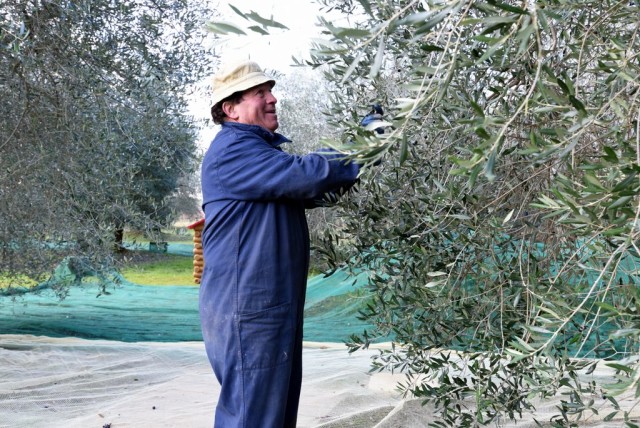
At the day’s end, as the sky became a deep purple, Luciano built a roaring campfire deep in the grove. He pulled out a straw-wrapped bottle of his homemade wine, and began to cut slices of bread to toast on the open fire. He rubbed each crispy slice with garlic, drenched it in a generous dollop of his bright-green, fresh-pressed olive oil, and handed it around. “Bruschetta,” he said. “This is the real peasant cuisine.”

Luciano’s exhausted work crew of tourists huddled around the fire and crunched into our reward for a hard day’s work. But Luciano wasn’t quite as impressed with us as we were with ourselves. “Here’s the thing about this agriturismo business,” he muttered to me with a wink. “It’s an awful lot of turismo and not much agri.”
While people come to Cretaiole for the food, wine, scenery, and cultural activities, I think that when all is said and done, some of their most prized memories come from their time with Luciano. Yes, things would be easier if Luciano learned some English. But I sure hope he never does.


