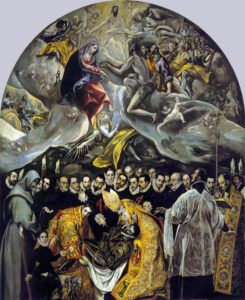
Daily Dose of Europe: El Greco’s “Burial of Count Orgaz”

I know we can’t travel yet, but as you read this and experience this amazing painting, see if you can virtually be there with me — as much as possible…really be there. We’ve entered a simple chapel in the Spanish city of Toledo. We’re standing before El Greco’s most beloved painting, which couples heaven and earth in a way only “The Greek” could.  

As our passports gather dust, our leaders bicker over conspiracy theories, and people struggle to arrange a vaccination, I believe a daily dose of travel dreaming can be good medicine. And for me, one of the great joys of travel is having in-person encounters with great art — which I’ve collected in my book called Europe’s Top 100 Masterpieces. And “Burial of Count Orgaz” is one of my favorites.  

It just feels right to see a painting in the same church where the artist placed it 400 years ago. This 15-foot-tall masterpiece, painted at the height of El Greco’s powers, is the culmination of his unique style.  

The year is 1323. Count Don Gonzalo Ruiz of Orgaz, the mayor of Toledo, has died. You’re at his funeral, where he’s being buried right here in the chapel that he himself had ordered built. The good count was so holy, even saints Augustine and Stephen have come down from heaven to be here. Toledo’s most distinguished citizens are also in attendance. The two saints, wearing rich robes, bend over to place Count Orgaz, dressed in his knight’s armor, into the tomb. (Count Orgaz’s actual granite tombstone was just below the painting.) Meanwhile, above, the saints in heaven wait to receive his blessed soul. 

The detail work is El Greco at his best. Each nobleman’s face is a distinct portrait, capturing a different aspect of sorrow or contemplation. The saints’ robes are intricately brocaded and have portraits of saints on them. Orgaz’s body is perfectly foreshortened, sticking out toward us. The officiating priest wears a wispy, transparent white robe. Look closely. Orgaz’s armor is so shiny, you can actually see St. Stephen’s reflection on his chest. 

The serene line of noble faces divides the painting into two realms: heaven above and earth below. Above the faces, the count’s soul, symbolized by a little baby, rises up through a mystical birth canal to be reborn in heaven, where he’s greeted by Jesus, Mary, and all the saints. A spiritual wind blows through as colors change and shapes stretch. With its metallic colors, wavelike clouds, embryonic cherubs, and elongated forms, heaven is as surreal as the earth is sober. But the two realms are united by the cross at right. 

El Greco considered this to be one of his greatest works. It’s a virtual catalog of his trademark techniques: elongated bodies, elegant hand gestures, realistic faces, voluminous robes, and an ethereal mix of heaven and earth. He captures a moment of epiphany with bright, almost fluorescent colors that give these otherwise ordinary humans a heavenly aura. 

The boy in the foreground points to the two saints as if to say, “One’s from the first century, the other’s from the fourth…it’s a miracle!” The boy is El Greco’s own son. On the handkerchief in the boy’s pocket is El Greco’s signature, written in Greek. One guy (seventh from the left) in this whole scene doesn’t seem to be completely engaged in the burial. Looking directly out at the viewer is the painter, El Greco himself. 

This little moment from Europe — a sampling of how we share our love of art and history in our tours — is an excerpt from the full-color coffee-table book I wrote with Gene Openshaw, Europe’s Top 100 Masterpieces. Please support local businesses in your community by picking up a copy from your favorite bookstore, or you can find it in my online Travel Store.

P.S. – Be sure to check out Rick Steves Classroom Europemy free collection of 500+ teachable video clips. Search “El Greco” for a closer look at the Greek-born artist who painted for a Spanish king, adopted Toledo as his hometown, and conveyed religious themes in a memorable, mystical way. 

And Boys, Bent under All That Tradition, Trudge through the Throngs

I just arrived in Toledo…and it’s holier than ever: Dark El Greco clouds overhead with bright clear horizons, and hail pelting huge masses clogging the streets awaiting the Good Friday procession.

(Eight days in, and I’ve researched Granada, Nerja, Ronda, and Córdoba. My trip is nine parts, thirds broken into thirds: Andalucía, Madrid/Toledo, Basque Country/Galicia; Rome, Tuscany, Florence; and three TV shows in the former Yugoslavia.)

Holy week clogs the streets in Spain. Every city south of Madrid seems to have a Semana Santaschedule booklet listing each of the processions: its home church, where it starts, and where it ends. In Córdoba, they were staggered, leaving every hour or so through the afternoon and lasting many hours each — some into the wee hours.

People lined the streets in anticipation. Cameras on long booms were poised in front of neighborhood churches. In bars, all eyes were fixed on the TVs watching not soccer or bullfighting…but live coverage of their town’s Holy Week procession.

Streets are speckled with dribbled candle wax and sunflower seeds from last night’s procession. Spaniards seem to be voracious sunflower seed-munchers at parades.

In my earlier days, I would have been in hog heaven with all this commotion. On this trip, I have a mission — to review restaurants each night. Last night in Córdoba, I physically couldn’t get through the crowds to the restaurants on my list. So, I joined the scene.

Paraders in their purple-and-white KKK-style cone hats, Crusader swords, and four-foot candles shuffle endlessly. Like American kids scramble for candies at a parade, Spanish kids collect dripping wax from religious coneheads, attempting to amass the biggest ball on a stick for their 2009 Easter souvenir.

Even in our fast-paced and secular world, the rich traditions are strong. While it seems half the population is caught up in the action, I’ve yet to meet anyone really thinking about what Easter is all about. Maybe faith is a private matter. Maybe it’s dead. Maybe I’m talking to the wrong people. Maybe it’s inertia from centuries of moms making you go. Or maybe people just like an excuse for a parade.

The procession squeezes down narrow alleys, legions of drums crack eardrums in the confined space, the local press jostles with tourists for the best photos, kids sit wide-eyed on paternal shoulders, and finally the float itself rumbles slowly by: gilded, candlelit, and crushing bystanders against rustic ancient walls. Parade officials — like holy bodyguards — make sure progress is unimpeded. I look up, and high in the sky is what Good Friday is all about: an extremely Baroque Jesus lurching forward under the weight of that cruel cross symbolically climbing to his crucifixion.

Later, back at my hotel, it occurred to me that the float floated not on wheels but on boys. Unseen and unheralded, bent under all that tradition, a team of boys was trudging for hours through the throngs.

Holy Toledo, the devil’s licking his chops

After a week in central Spain (Madrid, Toledo, Segovia), I’m heading for Ireland.

I like to catch emerging neighborhoods in my guidebooks. Here’s a new listing for my 2007 Spain book: In Madrid, a neighborhood called Lavapies is emerging as a colorful magnet for people looking for the multi-ethnic tapestry of Madrid society enjoying pithy, cheap, seedy yet fun-loving life on the streets. As is the case with most neighborhoods like this, they experience an evolution: so cheap only the immigrants, down-trodden, counter-culture types can live there. The liveliness they bring attracts those with more money who like the diversity and color. Businesses erupt to cater to those bohemian/trendy tastes. Rents go up. Those who gave the area the color in the first place can no longer afford to live there. They move out and here comes Starbucks. For now, Lavapies is edgy, yet comfy enough for most.

This district has almost no tourists. Old ladies with their tired bodies and busy fans hang out on their tiny balconies as they have for 40 years watching the scene. Shady types lurk on side streets.

For food, you’ll find all the various kinds of tapas bars plus great Indian and Moroccan eateries. I list a couple of places that appealed to me…but explore your options. I’d recommend making the entire walk once, then backtrack and eat at the place or places that appeal.

From metro stop “Anton Martin” walk down Calle Ave Maria (on its way to becoming Calle Ave Allah) to Plaza Lavapies (old ladies hang out with the swarthy drunks here while a mosaic of cultures treat this square as a communal living room) and then up Calle Lavapies to Plaza Tirso de Molina (with a metro stop). This newly remodeled square was once plagued by druggies. Now with a playground and flower kiosks, it’s homey and inviting. This is a fine example of the vision for Madrid’s public spaces.

If traveling to Madrid, keep these places in mind: Bar Melos is a thriving dive jammed with a hungry and nubile local crowd famous for its giant patty melts called Zapatillas de Lacon y Queso (because they are the size and shape of a zapatilla or slipper, €7 feeds at least two, Ave Maria 44). Nuevo Cafe Barbieri is a dying breed of smoky mirror cafe with a circa 1940 ambiance playing classical music in afternoon and jazz in the evening and offering its coffee sippers a menu of loaner books (Ave Maria 45). At Calle Lavapies 44, consider a fun cluster of three places: Indian Restaurant Shapla (good €8 menu); Teteria Lakutubia (an atmospheric tea house); and Montes Wine Bar with countless wines open and served by the glass and good tapas (crawl under the bar to get to the WC).

With a good guide, art–even obscure art buried in side chapels–comes to life. In Segovia’s cathedral I found a fun piece in a side chapel. I added this to my guidebook:

The many side chapels are mostly 16th century and come with big locking gates–a reminder that they were the private sacred domain of the rich families and guilds who “owned” them. They could enjoy private Masses here with their names actually in the blessings and a fine burial spot close to the altar. Its many 17th century paintings hang behind a mahogany wood gate imported from colonial America. The center statue is Mary of the Apocalypse (as described in Revelations, standing on a devil and half moon–looks like bull’s horns). Mary’s pregnant and the devil licks his evil chops waiting to devour the baby Messiah.

By the way, only Americans say “Holy Toledo.” Spaniards and the English don’t recognize the phrase. Locals tell me it’s likely from Sephardic Jews (Spanish branch) who emigrated eventually to America. To their American ancestors, Toledo was the most holy Jewish city in Europe…Holy Toledo!

Whenever I find a new eatery with a business plan driven by a chef’s passion, I am one happy guidebook researcher. Here’s my favorite new find for my Toledo chapter:

Adolfo Vinoteca–The highly respected local chef Adolfo who runs a fine restaurant across the street, runs this wine bar in hopes of introducing the young generation to the culture of fine food and wine. The place offers super elegance without the pretension. You can’t go wrong with their short list of gourmet appetizers (€5 each) and fine local wines (€2 to €3 per glass). I’d just throw myself at the mercy of Jonathan, and enjoy the feeling of gourmet slaves in the kitchen bringing you your wildest edible fancies. If the Starship Enterprise had a Spanish wine & tapas bar, this would be it. Wine is sold at shop prices with a €6 cork fee (daily 12:00-24:00, across from the cathedral at Calle Nuncio Viejo 1, tel. 925-224-244).