 |
 |
 |
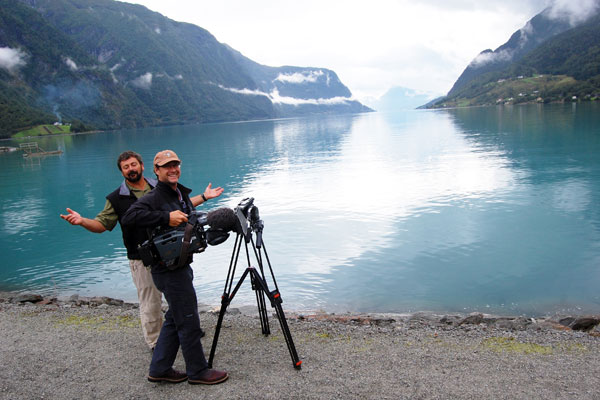
| As a TV producer, it’s a challenge when my crew sees a gorgeous view and I want them to wait for a better view that I know is just up ahead. After driving all day across Norway, from Oslo to the fjord country in the west, we descended from the mountains, and this was our very first fjord sighting. Even though I knew better vistas awaited, the crew had to get out and film the sight. This is the farthest point inland of Norway’s longest fjord — Sognefjord. Enlarge photo |
When the sun came out, we made sure we were in position for vistas like this to show off the fjord’s wonder. Simon Griffith (producer) and Karel Bauer (cameraman) worked tirelessly for 20 days last month, helping me bring home three exciting new shows on Scandinavia. Enlarge photo |
A big part of my research work is running down leads. Most are dead-ends. At the end of a busy day on the fjords, I followed one such lead up a gravelly road to a cluster of 27 abandoned farmhouses — once a goaty gang of farm families, then abandoned, and now coming back to life. Thanks to Lila, who’s monitoring this project, Otternes Farm is a place where travelers can connect with Norway’s past on a breathtaking perch high above Aurlandsfjord. It’s in our upcoming TV show and covered in the new edition of our Scandinavia book. Enlarge photo |
 |
 |
 |
| For years, I’ve told the story about the eureka moment I had as a 14-year-old kid in Oslo’s Vigeland Sculpture Park. I noticed how my parents were loving me so much, and I looked around and saw a vast park speckled with others’ families — parents loving their children just as much. Right then it occurred to me how our world is filled with equally lovable children of God. While I’ve traveled with this wonderful truth ever since, I’ve never been able to capture that feeling on film. And every time I’m in Oslo I try. Enlarge photo |
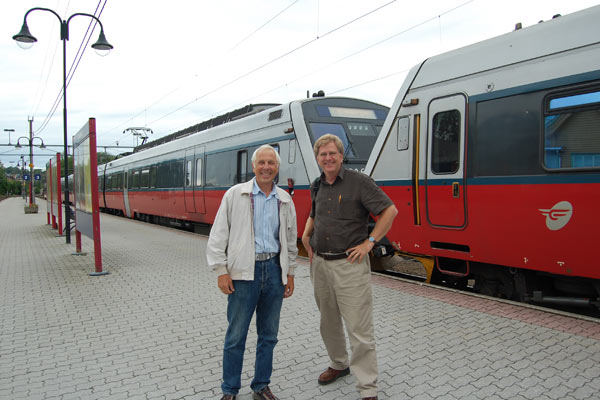
As a teenage ragamuffin vagabond slumming through Europe (with high-school buddy then and co-author buddy now, Gene Openshaw), I’d pop in on relatives in Norway. It was a much-needed depot for a bit of family warmth and some good food (notice the bulging bag Gene is toting). Thirty-five years later, Uncle Thor still meets me at the train station in his little town of Sandefjord. While I no longer need the free food, I still enjoy the dose of family warmth just as much. Enlarge 1973 | Enlarge 2009 |
|
Killing Clichés and Chasing Lens Lice
 |
| Checking in with my Norwegian cousin Kari-Anne and her husband Knute, we got a little dose of the Scandinavian good life — while filming the delightful Oslofjord. Enlarge photo |
Europe is moving beyond its old-time clichés, and I’m weaning myself from these too. In fact, my theme this year, in both TV production and guidebook writing, has been to purge things that are recommended just because they’ve always been there. Sometimes it’s difficult after decades of singing a cultural tune to realize the melody has changed. This year I find myself thinking, “That was big in the 1980s, but…” as I work to keep my take on Europe fresh.
In Norway trolls may still be in the shop windows, but they have no business in a guidebook or TV show. Goofy legends about modern-age buildings having roofs inspired by upturned Viking ships are out. Sweden used to be a porn capital — but so much modern-day freedom in that regard seems to have made that industry passé. I remember when the TV towers in Berlin, Stockholm and Oslo were as breathtaking as Seattle’s Space Needle. Oslo’s is now closed to the public and the others are barely advertised.
There was a time when travelers ventured to Stockholm and Helsinki to see planned suburbs like Farsta and Tapiola — suburbs that organized people as if in juke boxes…and people clamored to get in. No one even talks about these places anymore. In the 1980s it seemed every other tourist in Helsinki was an architect, there to marvel at the modern buildings. Today Helsinki’s once-striking Finlandia Hall, by Alvar Aalto, is only striking out. I’ve always listed the Kon-Tiki Museum in Oslo as a must-see. It was one when it captured the imagination of would-be sea adventurers a generation ago. Today, the museum seems to be going the way of the log boat.
I have also realized that I need to be careful not to romanticize the nobility and intelligence of a people I’m predisposed to be impressed by. It’s so much fun to bump into entire societies that are both good-looking and seem to have it all figured out. You could travel through a place like Norway and think everyone was brilliant and beautiful. But seeing racks of National Enquirer-type tabloids in Bergen — papers as cheesy and idiotic as ours and England’s — reminds me that no society is immune from low-brow culture; there’s a huge market for that everywhere.
Having spent more time in Scandinavia this summer than ever before, I enjoyed a great chance to reconnect with my wonderful relatives. My uncle Thor in Sandefjord is a patriarch with beautiful grandchildren galore. My cousin Kari-Anne is a publisher with a fascinating circle of friends; she lives in Oslo, enjoying the best of Norwegian big-city life. And Hanne, the baby I held while watching the first moon landing, has three kids old enough to stay up late and contribute to our conversation.
Ten years ago, while filming in Bergen, Hanne kept sneaking into our shots. In Norway, she said, those obnoxious types who always try to get into the picture are called “lens lice.” I asked her if she’d like to be a part of the new show we’re filming, and she said, “My lens lice days are over.” (While I strongly disagree, I didn’t argue.)
I spent an evening with Hanne’s family enjoying the fun conversation. We talked about the challenges modern Norway has with immigrants. In this Lutheran corner of Europe, they explained, everyone enjoys the freedom to practice their religion, as long as the practice doesn’t violate Norway’s constitution, which guarantees a range of human rights — including women’s rights, gay rights, and children’s rights (e.g., parents are forbidden to beat their children). Fathers are intimately involved in parenting. In fact, throughout Scandinavia, rather than “maternity” leave, new moms and dads share 16 months of paid leave (dividing it as they like).
Hanne’s kids sat attentively as they soaked up the conversation. Hanne’s 13-year-old daughter speaks English so well that she played a game speaking American with her mom and British with her dad (as that’s how each speaks English with her). I asked her about cigarettes, alcohol, and marijuana. She said she and her friends had no interest in any of that. She explained that the government tried the “bad for your health” line in their education campaigns, and it was worthless. Then the schools started teaching that cigarettes made your skin ugly, stained your teeth, and gave you bad breath. They taught that alcohol lowers your metabolism, making you get fat more easily. This appeal to teenagers’ vanity, rather than their health, was by all accounts wildly effective.
By my small survey, I’ve found that throughout Norway and Sweden there’s extremely little interest in marijuana. People just don’t seem to even be intrigued by it. On the other hand, among young people (other than my relatives, of course), it seems that casual sex is rampant.
I have my vices though, and so does my film crew. We like a good drink after a day’s work. With the cost of alcohol here, we drink beer when we’d normally have a glass of wine. (A glass of beer here costs what a glass of wine would cost elsewhere, and wine costs much more.) And we got addicted to dropping by the ubiquitous convenience stores for a box of Iskaffe (iced coffee) — available for 19 krone ($3), the cost of a reasonably priced latte in a café. I am still fascinated by how this affluent corner of Europe seemingly prices so much of its populace out of restaurant going. Convenience stores fill the gap for people without much money — providing cafeteria lines of whatever you need, to be munched on benches or on the fly.
Norway: Meatloaf and Mellow
 |
| Oslo’s new Opera House is a huge hit. And it has a rooftop that seats 8,000. Enlarge photo |
 |
| We were allowed to film the mayor introducing the band, and then they escorted us out. Tusen Takk! Enlarge photo |
About my “convalescence”: It’s impressive what a couple of quiet days on the Mosel River can do for your spirit and batteries. Thanks for the encouragement. (Perhaps that’s why this blog entry is overdue.) Being in Europe, it can be very hard to just say, “Enough.” As if channel-surfing on a great TV with an infinite number of channels, there’s always something enticing beyond what you can comfortably experience.
My time on the Mosel reminded me of a critical day I spent last year in Athens. We had just produced two exciting shows on Greece. My brain was fried. I was concerned I’d get a cold. I felt like you do when you know getting sick is God’s way of telling you to slow down — and you’re snowballing out of control with an exhilarating project. It was the day before we flew to Iran for our 12-day shoot there, and it would be the most demanding TV production work I think I’d ever done. I needed to be fresh and healthy. I checked out of the last day of shooting in Athens and spent the entire day poolside on the rooftop of our hotel… recharging. And, thankfully, it worked.
We just finished a six-day shoot in Oslo. My plane landed here among flooded lakes. They’d had nothing but rain for a month. When it comes to producing a TV show, Oslo in the rain is just seven kinds of bad. But we had glorious sunshine, and all of Oslo was in bloom for us.
I love Norway — probably because I’m Norwegian. Three of my grandparents grew up in Norway. (Two homesteaded in Edmonton. One was a relatively famous and often-drunk ski jumper in Leavenworth, Washington.) Yesterday I told my producer, Simon, “Everyone looks like my brother.” He was shocked (having traveled with me for 12 years of TV production) and said, “I didn’t know you had a brother.” I don’t. But if I did, they’d look like the guys around us. But it’s more than how they look. It’s how they are. A fun part of travel is to feel a kinship with people from the land of your forefathers.
Norway seems so mellow and content and comfortable and successful. You have to wonder why. And you have to consider that since it’s sparsely populated, it seems nearly everyone’s cut from the same ethnic mold (nearly 20 percent of the population are immigrants, but they seem to live in a parallel world), and there’s plenty of money. Whenever you’re assessing a society (whether Norway, Iran, Alaska, Venezuela, or Texas), if its affluence is based on oil, its policies don’t apply to the rest of the world.
Of course, Norway has a lavish social support system (everyone gets a home, food, money, health care, education, security). While Americans paranoid about these things might call them “socialists,” Norwegians are quite enthusiastically capitalistic. There’s a huge participation in the stock market among Norwegians (they say more, per capita, than Americans). While it’s hard to be poor here, you can be quite wealthy. While ostentatious Norwegians are looked down upon, the wealthy elite who don’t show off are admired.
I’ve long wondered if the incentive to work hard in order not to be poor — which is the active ingredient of capitalism — only works if there are losers. In other words, does capitalism require poverty? But Norway seems to be a land where there are essentially no losers, yet people work hard and the country thrives.
I don’t think we’ve ever filmed in a more laid-back big city than Oslo. At every museum and important place we took our big camera, the attendants just said, “Welcome. Let us know if we can help you.”
Then we went to a concert on the Opera rooftop. (Oslo has a very exciting new Opera House that doubles as a public plaza, with a rooftop that people just have to walk on.) To kick off Oslo’s jazz festival, a hot English group named Antony and the Johnsons (with a lead singer who looks like a cross between Meatloaf and Marilyn Manson) was performing on a stage raft anchored just off the slanting marble slopes of the opera house, and 8,000 people packed the rooftop for the show.
At first we had permission to film. We got there, were escorted to the media stand, and suddenly someone said our permission had been revoked. The security guards turned quite surly, trying to physically escort us out. I suddenly felt like we were dealing with the lackeys of some Batman villain. We tried to discuss the issue, and they treated us like a serious threat to Antony. We told the publicist from the opera house how un-Norwegian the security force seemed. She said, “They were imported by Antony from Britain for this gig.”
Much as I love Norway, goat cheese, and my blond cousins, it seemed I needed to inject some color into my days. Almost every night, we found ourselves walking down a street called Grønland into the immigrant district for food that was both spicy and affordable. Dining streetside, seeing a rainbow of people and a few rough edges, made the world a little less Wonder Bready.
After a week in expensive Norway, I’m comfortable with the notion that up here, beer is wine ($8 a glass). And for coffee, we’d drop by any convenience store and buy an iced latte in a box for $3. It could be some solace to think that the high prices we’re incurring are just helping pay for all that lavish social support everyone here enjoys…but it’s not.
.
Salmon, Shrimp, and Paternal Leave
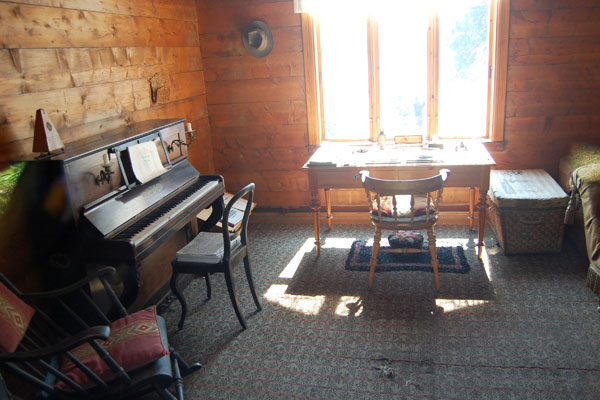 |
| Edvard Grieg gained inspiration a century ago in a fjord-side hut just outside Bergen, in the west of Norway. Enlarge photo |
 |
| The concert hall at Grieg’s home overlooks his composing hut, and the fjord beauty that inspired his romantic music. Enlarge photo |
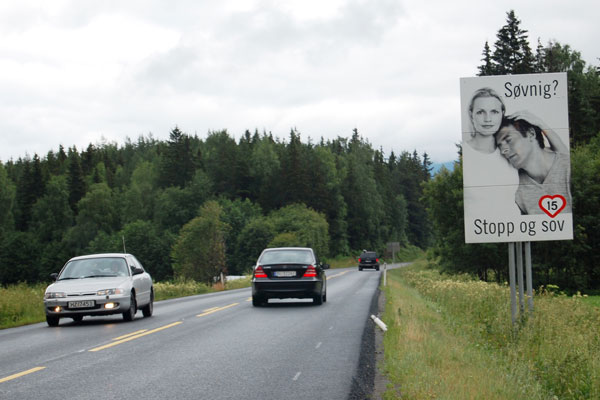 |
| Clever Norwegian road signs remind drivers to be safe with a powerful emotional appeal. Care about your loved ones? Tired? Take a rest. Enlarge photo |
I came to Scandinavia a couple weeks ago intending to both update my guidebook and sharpen my plans for filming here next month. I was fine with my intended Oslo and Stockholm scripts, but worried about a weak fjord country script.
Happily, I come away with piles of exciting ideas for our fjord show, from ginger glacier hikes to zodiac speedboat tours in the mist of waterfalls under towering cliffs. We’ll visit the best stave church in Norway, lonely in a lush valley — its thousand-year-old dragon eves still snarling at evil spirits in the sky. We’ll hike to a tiny, weather-aged log cabin farm hamlet stranded high above the fjords, where goats still find grass. And we’ll film an Edvard Grieg piano concert in a sleek little concert hall with a long black grand piano perched before a huge window to become part of a dramatic fjord setting, including the idyllic cabin where the composer wrote much of his best music. I am just at the mercy of the weather.
The weather has been scorching during this visit. I’d just wash out my shirt and put it on wet. Locals were acting confused, saying, “I can’t even think straight in this heat.” Scandinavians were at the beaches in droves. I noticed in both Helsinki and Stockholm that the former military forts (the Gibraltars of the Baltic: Vaxholm and Suomenlinna) were now parks with families picnicking literally atop 19th-century gun emplacements — places once strategic for national security, and now strategic only for sun worship.
Society here is famously compassionate and well-organized. Highway billboards show a man napping peacefully on his thankful partner, who shares an important message to approaching drivers: “Sleepy? Pull over and take a rest.” Another billboard has a dad driving with his child’s arm snuggly across his chest like a belt. The sign reads, “Buckle up for your family.” I put in a lot of miles safely. I wore my seatbelt and kept myself awake thinking about random stuff. Did you even notice how many people have the initials HH? (Hubert Humphrey, Hugh Heffner, Helly Hanson, Herbert Hoover, Howard Hughes.)
Norway has laced and drilled its way together with an amazing road system connecting fjord country with Oslo. The longest tunnel is 15 miles. When a toll is levied (as it is for cars entering Oslo and Bergen, to keep down traffic), toll booths are antiquated. You don’t stop and pay. A camera takes your car’s photo, and the license plate is matched to your credit card, which is billed. Those new roads zip travelers around quicker, but also make previously tranquil valleys noisier. I had to drop one unfortunate campground with great riverside bungalows from my guidebook. For ten years, it was a fine little budget place to sleep. Now, rumbling trucks trample the tranquility, so it’s out.
Scandinavians speak English so well, most tours at museums and historic sites simply dispense with the local language and locals and tourists-alike hear it in one language: English.
I was at a cousin’s dinner party with a dozen people in Oslo. Because I was there, they simply spoke English. I felt like it was an inconvenience, but it fazed no one. Topics were fascinating: One man, who just wrote a book on FDR (in Norwegian — a market of only 4 million readers), talked with me about the intricacies of American post-WWII politics as no one I’ve ever met. Someone else suggested that, as Norway’s international telephone prefix is 47 and the USA’s is 1, the system must have originated in America. Another observed that Europeans seem more interested in American Indians than Americans are, and asked if that might be because we feel guilty and they have no guilt on the subject. And another observed that Midwest Americans talked louder than other Americans, and wondered if it was for the same reason West Coast Norwegians talk louder than people from Oslo — because they are always trying to be heard above the constant wind.
Norwegians love to vacation in Greece. They agreed with me that Greece may have invented the aesthetics of beauty, but you’d never know it today by driving around the country. One suggested it might be like how England invented the Industrial Revolution, yet has today’s rustiest economy. Perhaps economically or culturally, a society is inclined to rest on its laurels — it’s just human nature.
People seemed very content. Two new parents at the party were debating the various ways to split their paid maternal and paternal leave. There seemed to be little concern about any economic crisis. These Norwegians were just loving their salmon, shrimp, and goat cheese.
Nordic National Galleries: More than a Scream
In the last week, I’ve been in three national galleries: in Oslo, Stockholm, and Helsinki. Each one is a hardened little palace of culture, showing off the nature of the land and the psyche of its people in a proud and central architectural jewel box.
It just seems obvious that a national gallery would give a probing view into a people. Of the many national galleries, Scandinavia’s do this extremely well. (Others that come to mind — like London’s and Washington DC’s — mix it up with more generally great art.) But in a little country (with no history of art-grubbing royalty), in a land where the visitor who hits it on a bad month might wonder why anyone would want to even live up here…much less paint, a national gallery works to show visitors that people who live here are not nuts. (Do you have a favorite national gallery for giving an insight into a particular culture?)
In each case — whether Norway, Sweden, or Finland — the paintings exaggerate the power and awesomeness of nature. In those tangled, plush, tumultuous symphonies of nature, the piccolo section is the country folk — people in traditional peasant costumes, tiny but in sharp focus…surviving with grace. Or, in the most famous painting in Scandinavia, just letting out a bloodcurdling Scream.
Like the Swedes have Carl Larsson, each country has its Norman Rockwells who painted almost photorealistic looks at 19th-century Scandinavian life. Rather than paintings celebrating kings and popes, it’s people’s art — a bridal voyage (perfect to show off the traditional jewelry and formal wear), low church devotion (perfect to show the strength of renegade Lutherans not following the state dictates — until they ran out of patience and moved to Wisconsin), and solid families at work and play.
And the “slice-of-life” scenes seem to just as often be slice-of-death scenes: a stoic family filling their rowboat, oaring in the coffin of a dead daughter, her sister clutching the funeral flowers through the bitter ride, and the harsh season clear on the weathered faces of the heartbroken parents.
And there are the struggles with a puritan 19th-century Protestant society, and the psychological problems that result. Basically (if you spent much time with Edvard Munch), messed-up men who didn’t know how to handle women.
As is the case with so many minor cultures in Europe, the 19th century was a time of resurgence and awakening — Finns holding back Russification, Norwegians distinguishing themselves from the Danes and Swedes. Legitimacy can be founded on epic myths. In each of the galleries, huge murals celebrate the Paul Bunyan beginnings of their nationalities. In The Mid-Winter Sacrifice, the noble Viking king prepares to sacrifice himself to the gods so spring will return and his people will be fed. In The Wild Hunt of Odin,the rowdy horde of Viking-like warriors gallops across the sky, snatching up unsuspecting maidens and the souls of sleepers forever.
I’d suggest that anyone traveling across Scandinavia use each country’s national gallery as a cultural springboard for venturing further from the capital.