For a dirt-floor view of this country, we visited the poor barrio of Batahola, and dropped in on a simple woman with a grandiose name: Señora Nicaragua. Her husband fought for the Sandinistas, and she’s in her fourth decade as a Sandinista supporter. She stays at home, managing a three-generation family of 12 and running a tiny pulpería(“octopus shop” ‘ a Nicaraguan nickname for a corner convenience store that sells enough odds and ends to even fill eight arms). Her shop was crammed into the walled porch of their cinderblock home. While clearly poor, she’s strong, bright, and politically savvy. Talking with her offered an intriguing insight into the thinking of salt-of-the-earth Nicaraguans.
Señora Nicaragua and her husband.
Señora Nicaragua lived through frightening times, as the USA bore down on their revolution. She told of her entire family being terrorized back in the 1980s by the “thunder of the black bird,” as they referred to the US fighter jets that intentionally broke the sound barrier over Managua. She now understands how these caused sonic booms over their heads, to illustrate the power of the US military.
While many Americans remember the Sandinistas for their Marxist leanings, she remembers them for education drives (when Nicaragua became one of the most literate countries in Latin America), accessible health care, and the pride of the 1980s. In her mind, Sandinista Nicaragua was neither pro-communist nor anti-capitalist ‘ just trying to find a third way.
And she remembers the 16 years of “neoliberal” (that is, pro-business) government after Ortega was voted out ‘ when health care and education were privatized, and when literacy plummeted and poor children were humiliated by education becoming unaffordable. Those years were a time when poor people needed to bring their own syringes and bandages with them to the hospital. And she believes that if the same right-wingers were in power a few years later, when her husband had his bout with colon cancer, he could have never afforded the $400 colonoscopy…and would have died. Today, under the re-elected (if watered-down) Ortega, at least people like Señor Nicaragua get affordable health care.
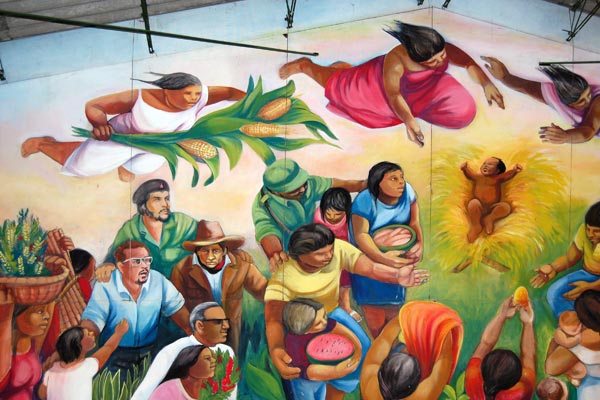
During the days of neoliberalism, Señora Nicaragua and her neighbors gathered in their barrio church to protect its art ‘ fearful that the post-revolutionary police would paint over their Liberation Theology murals. (Nearly all of the stirring murals of the Sandinista era were painted over in the 1990s by the neoliberal government that succeeded them.) Later, while walking through her barrio, we came upon a poster that bragged, “Eradicación de Polio y Somocismo”‘ by working together, they had eradicated both the scourge of polio and the policies of the dictator Somoza.
A Liberation Theology mural decorates the barrio church.
Señora Nicaragua knows Daniel Ortega has betrayed the revolution’s ideals as (she says) power has corrupted him, and she would prefer another candidate for president. And, as is so common with strongmen even beyond Latin America, he’s had his sex scandals. But she understands the Latin American penchant for having strongman governments, and that Ortega ‘ while compromising ‘ is the first Nicaraguan leader with a heart for the poor. For example, she thanks her government for the fact that her son is enjoying a college education. For her, education is the foundation for her society to pull itself up out of poverty.
When asked what she wished for her family for the New Year, Señora Nicaragua said, “Health, happiness, and the blessing of work.”
Traveling in Nicaragua, it helps to have a handle on the country’s recent history. The last 60 years can basically be divided into four periods: pre-revolutionary (1950s-1970s, Samoza family dictatorship, friendly with big landowners and the USA), Sandinista (1980s, with Daniel Ortega’s leftist government fighting the US-funded Contra insurgency), neoliberalism (1990-2006, after the right-wing, business-friendly party defeated the Sandinistas at the polls and the country was ruled by Violeta Chamorro, then Arnoldo Alemán, then Enrique Bolaños), and the return of the Sandinistas (since 2006, during which the ideals of the revolution have been tempered by the need to work with the right). In a nutshell: right, left, right, left over the last six decades.
Daniel Ortega, the ultimate outsider, is now the classic insider. (Photo by Trish Feaster)
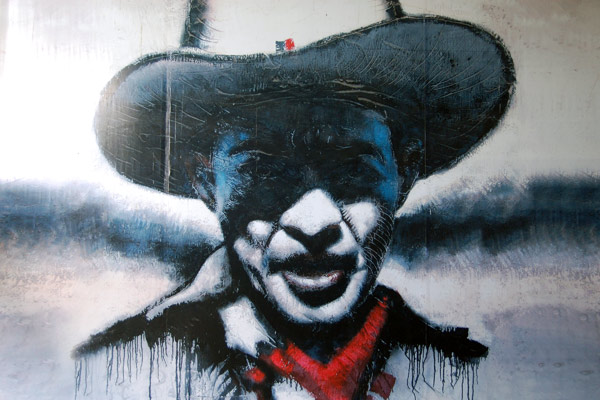
Augusto Sandino.
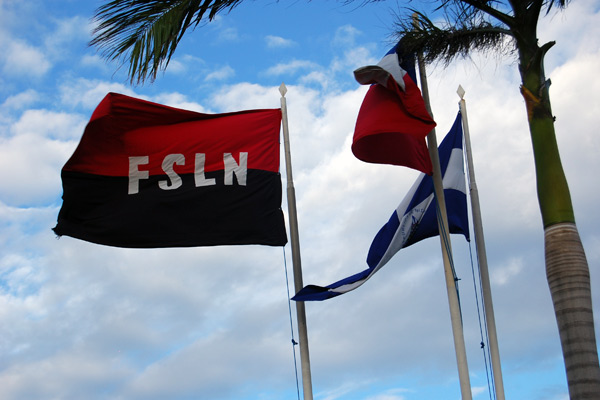
The Sandinistas are here.
Much of this power struggle coincided with the Cold War, and the political players here were pawns in a greater US-versus-USSR, capitalism-versus-communism struggle. Well-intended, patriotic Americans ‘ fearful of the Soviet sphere of influence ‘ felt we should support the pro-US, pro-capitalist factions. And yet, those same factions exacerbated horrific living conditions for the country’s poor. While Marxist, at least the Sandinistas wanted to improve things for the people. The US waded into the fray when the Reagan Administration imposed a trade embargo and financed a counter-revolutionary army, called the Contras, to fight against the Sandinistas. From one way of looking at things, to cheer on the Sandinistas was to support a dangerous communist influence in our hemisphere, and to subvert America’s capitalistic way of life. From another perspective, the Sandinistas were the only thing here that attempted to empower the downtrodden populace…geopolitics be damned. Communism was evil in Eastern Europe…but was it really so evil here in Latin America, where it strove to provide starving people with necessary food and medicine?
The scrappy leader of Nicaragua’s Sandinista Revolution, Daniel Ortega ‘ who stirred the hearts of romantics in the 1980s ‘ is now running the place. Back then, Ortega led an idealistic leftist revolution named for Augusto Sandino, who fought against the US occupation of Nicaragua in the 1920s and 1930s. Ortega’s Sandinista movement (and its political wing, the FSLN party) overthrew the dictatorial, US-backed Somoza regime, which had ruled the country with an iron fist for decades. It was a victory for bleeding-heart liberals the world over: Finally, “the people” had taken over the government. Things could only improve for Nicaragua’s poor.
But Ortega’s election to the presidency in the 1980s ‘ and again in 2006 ‘ has seen his idealistic worldview shifted, as he’s compromised on some of his core values. Today even many of Ortega’s former supporters consider him corrupt and willing to do anything just to hold onto power. Ortega confounded his base with what’s called “El Pacto” ‘ an alliance with his political archenemy, Arnoldo Alemán, to edge other parties out of power. And he reconciled with the archconservative cardinal, Miguel Obando y Bravo, who was once a harsh critic of the Sandinista movement. While campesinos still struggle, the Ortega family enriches itself by fashioning corrupt policies enabling them to virtually own entire industries.
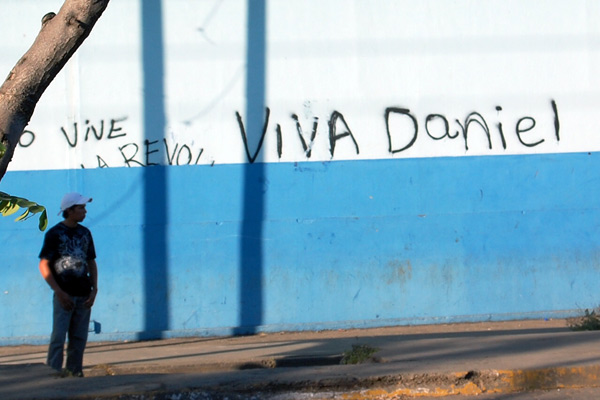
While there’s plenty of desperation these days in Managua, you see almost no angry graffiti. But the city is covered with spray-painted cheers for Daniel Ortega. And yet, the graffiti rings hollow…it has as much soul as a sea of prefab Tea Party banners. This pro-Ortega propaganda appeared all at once, basically overnight, after the president unleashed a battalion of graffiti artists armed with black spray-paint cans to tag the entire city with “Viva Daniel” and “Viva FSLN” (his political party). It’s ugly, and it is a constant reminder of how power corrupts. The broad-based “Sandinismo” people’s movement has morphed into “Danielismo” ‘ a cult-of-personality celebration of one man’s ego.
When asked about this, people here shrug and say, “Well, our leaders are always corrupt and abuse democracy. At least the excesses of Ortega are not as worker- and campesino-brutal as Somoza’s were. Ortega never dropped his political opponents from helicopters into the Masaya Volcano that towers above Managua.”
While Ortega is the current big man, the official signs of national respect (coins, governmental slogans, monuments) ‘ like people’s hearts ‘ cheer not for Daniel Ortega, but for Augusto Sandino. While the Samoza regime killed this inspiration for the modern guerilla movement that would ultimately overthrow them in 1934, Sandino clearly lives in the hearts of the Nicaraguan people.
For me, it’s a personal challenge to come here and, rather than have my preconceptions confirmed, be forced to grapple with an uncomfortable reality. The Sandinistas are in power, and their FSLN flags are everywhere. The “people” have won, and yes, things are better for Nicaragua’s poor. But not all of the promises have materialized. The leader of the revolution seems to have been corrupted by power.
In the 1980s, the political voices of both liberal and conservative churches were stoked by left-wing and right-wing forces with an agenda. But today, after a generation of war ‘ fighting Samoza, and then the USA and the Contras ‘ the Nicaraguan people seem tired of struggle. The Nicaraguan right wing is also exhausted. Once emboldened by what seemed like unconditional support from the USA, it’s so overtly corrupt now that the US government has been revoking the visas of powerful right-wingers. A Nicaraguan elite without access to USA is no longer much of an elite. Stranded in Nicaragua ‘ even with endless money ‘ there’s something hollow about your elite-ness.
It feels like speaking out in either extreme is impolite. With Ortega so cozy with his former enemies, the Church no longer speaking for the poor, and the lack of political anger in the streets, it all seems like the symptoms of society that is, in general, exhausted. While once as agreeable as American Democrats and Republicans, today, it seems Nicaraguan society has found a more pragmatic alternative: cooperation.
This all reminds me of Europe in the 1600s, after a century of Catholics-versus-Protestants religious wars: People just embraced the Baroque, pro-status-quo world of divine monarchs and lofty Church ritual. So much of Central American contemporary history has parallels in European history ‘ affirming my belief that societies are evolving on similar tracks on different timelines.
I don’t know whether the FSLN leaders have been corrupted by power, or simply have no choice but to compromise pragmatically to stay in power in a world where the current of globalization cannot be paddled against. Either way, the ideals and spirit of the Sandinista revolution have blossomed into the society at large. They live in the people we talked to. While Daniel may have jumped ship, the boat of revolution has been cut loose and is still sailing.
This year, I decided to give myself an unusual Christmas present: a trip to Latin America…not to glitzy beaches and touristy mountain resorts, but to gritty cities and slums where I can take the pulse of the people and get up-to-date on complicated socioeconomic issues. In my nine-day trip ‘ basically from Christmas Eve to New Year’s ‘ I’ll spend three days apiece in three different capitals: Managua (Nicaragua); San Salvador; and Mexico City. It takes an odd duck to choose to spend the holidays learning about Latin American politics…but, well, quack quack.
While Europe is my passion and the focus of my work, Latin America has long been an armchair fascination for me. I took my first trip to the region (both Nicaragua and El Salvador) in 1988, during El Salvador’s civil war. I returned to both countries in 1991, after the war ended. And I went back to El Salvador again in 2005. You can read my full journals from these trips too.
Those trips were focused on the hot topics of the day: The totalitarian right-wing government regimes (with ties both to the Reagan/Bush-era US governments, and to American corporate interests); the leftist rebels who fought for the people’s rights; the plucky Liberation Theology movement, which stood up against both the Catholic Church hierarchy and the regimes they supported, but troubled many observers with their rabble-rousing and their ties to the Marxist movement; and the rising tide of globalization and its impact on the crippling poverty of the region.
Checking in with former guerillas — or their orphans — is a good way to learn.
Back then, to my progressive mindset, things seemed so clear-cut: The oppressive, right-wing regimes, and their collusion with big business in the United States to exploit poor people, were evil; the leftist rebels and Liberation Theology movement, and their inspiring resistance to a morally bankrupt system, were good. It was easy to take sides. I titled one of my journals “There’s Blood on Your Banana.” By my return trip in 2005, the guerilla resistance movements had morphed into political parties, but still lacked power. The players and the dynamics seemed largely the same.
This trip will be different. Traveling with my girlfriend Trish ‘ a Spanish teacher who shares my affection for this part of the world ‘ I’m looking forward to working with local guides to get a sense of what’s been going on over the last half-decade. I suspect this trip will challenge my deeply held, admittedly one-sided convictions about the region’s politics (and the USA’s role there).
In preparing for this trip, it’s clear that things are more complicated and muddled now. As idealistic “change”-focused movements have come to power, the pragmatic need to balance complicated interests has made it harder than expected to make
those hopeful dreams of change a reality (not unlike here at home). The once overtly political churches (both those preaching Liberation Theology, and those espousing what I call “Colonial” or “Escape Theology”) seem to have faded in influence. And as globalization shrinks our world
ever more, impoverished people are finding little relief; meanwhile, those who reap the benefits of globalization (both here in the USA, and in Latin America) seem to have fallen out of touch with the
The guerilla meets the corporation — and then what happens?
more desperate fringes of society…a short-sighted detachment from reality that will likely come to haunt us. A trip to countries like Nicaragua and El Salvador makes it clear: Even if you’re motivated only by greed, if you know what’s good for you, you don’t want to be extremely wealthy in a desperately poor world. It’s not a pretty picture.
This all sounds heavy. And it is. The next several blogs will thrill and titillate Latin American politics wonks…but might bore others. My focus isn’t fun-in-the-Latin-American-sun, but really grappling with heavy issues that, in sometimes surprising ways, resonate in our own political climate today. I don’t claim to be an expert in Latin American politics, and I guarantee that I’ll wade into waters where (I admit) I know “just enough to be dangerous.” I look forward to a constructive conversation in the blogs’ comments, but I hope that we can steer clear of knee-jerk opinions, ad hominem attacks, and tit-for-tat bickering. Let’s assume we all care, but come at things from different perspectives created by differing life experiences. The world is changing, and the old “Sandinistas good, Contras bad” mindset ‘ or vice versa ‘ just don’t cover it anymore. (I have to say it can be frustrating to share political insights into complicated struggles based on real travel experiences with people who have strong opinions about a place they’ve never bothered to visit, picked up from radio or TV in the USA.)
I expect this to be a journey of discovery for me…and I’m happy to have you come along.
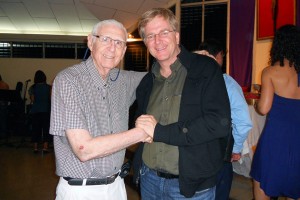
Father Fernando Cardenal with Rick (Photo by Trish Feaster)
For Christmas Eve, I gathered with local worshipers in the humble chapel of Nicaragua’s University of Central America under hard-working fans for Mass. As the band set up and the local congregation gathered, a Downs Syndrome child picked up the mic and entertained all with a hearty Santa-like ho ho ho. That unscripted moment kicked things off with a wonderfully human reminder that people around the world are coming together.
A lanky elderly priest was greeted warmly by the congregation. He was Fernando Cardenal, one of the Sandinista priests John Paul II famously wagged his finger at during a visit to Nicaragua back in 1983 for politicizing the church. Cardenal’s trouble-making message was a Liberation Theology message ‘ that Christians are to be more than charitable. They are to ask why there is poverty and to organize to work for economic justice and dignity in the face of hunger and suffering.
The chapel was filled. It was a bring-your-own-maracas crowd, and with each song the place filled with the happy sound of these shakers. The Lord’s Prayer was sung to the tune of “Sound of Silence.” Before the offering plate was passed, a woman stepped out from her pew to remind everyone that Father Cardenal lives very modestly and to assure all that the offering would go to support the church’s work with the local poor.
My favorite thing about a Central American Mass is the fiesta-like “passing of the peace.” Every time I’m in an American church and that moment in the service comes and people solemnly shake hands, I miss the uproar that breaks out at that moment in Latin America. With mariachi energy the band plays while all attending burst into a rollicking commotion of hugging and exchange of blessings. It just goes on and on. Father Cardenal gave me the warmest of hugs. Knowing of this man’s life work as a Christian revolutionary in Central America ‘ and now holding his frail bag of bones body to mine ‘ touched me in a way that caused me to cry. I don’t know why, but it was an emotional highlight of my trip so far.
While that old Sandinista spirit is a little hard to find these days in Nicaragua, Jesus’ “preferential option for the poor” was woven into the sermon, and the Christmas Mass finished with a rousing Liberation Theology carol. People sang “Merry Christmas, justice and liberty. Merry Christmas, a better world without misery and oppression” (Feliz Navidad, Feliz Navidad, en justicia y libertad. Feliz Navidad, Feliz Navidad, un mundo mejor sin miseria ni opresion). As the song progressed through many verses, the congregation lined up to kiss the baby Jesus in Father Cardenal’s arms. The much-kissed baby Jesus was placed into the, until now, empty manger. And the worshipers dispersed into a city soon to be engulfed in a cacophony of firecrackers.
It’s time to plan holiday travels. I was tempted to go to Italy and enjoy the good life with mittens and a scarf in Rome and Florence, or perhaps do a Barcelona-Madrid-Lisbon loop (as my daughter Jackie did recently ‘ a great itinerary).
But I decided to stay in our hemisphere and head south. My decision: Three days each in Managua, San Salvador, and Mexico City, with Christmas in Managua and New Year’s in Mexico City. I needed some heat…both in the weather, and in connecting with what’s going on with people’s struggles in Latin America.
I just talked with Paul Theroux for my radio show yesterday, and he stressed the importance of not just flying from capital city to capital city. He said that to really connect with a country, you need to cross borders on the ground and travel through the bush.
But I’m doing exactly the opposite ‘ flying to three great capitals. I’d love any suggestions on how I might enjoy and be inspired by my time there. Any ideas? Thanks…and happy Thanksgiving!