Don’t Be Duped — Travel and Talk to People

Flying home, I’m pleased with what we learned and what we have to share. The montage to introduce our one-hour Holy Land special goes like this: “While Jewish Israelis and Muslim Palestinians have overlapping claims and struggle to share it peacefully, this land has a rich and fascinating heritage. We’ll visit Jerusalem, considered by both Israelis and Palestinians to be their historic capital; feel the modern pulse of urban Israel; eat and drink with Jews; and follow in the footsteps of Christ. In Palestine, we’ll harvest olives; visit a local home; see the Tomb of Abraham; learn to wear a scarf with style; follow pilgrims to the place of Jesus’ birth; bob in a very salty sea; hike to an ancient monastery deep in the desert; and feel the energy of an emerging economy. Along the way, we’ll learn about walls, settlements, and the challenges facing the region.” Reading that again, I can see the vivid images we’ll edit together.

While there are no easy answers, actually coming here and experiencing the Holy Land firsthand is the best way to gain context and understanding. Lots of people in the USA seem to think they already know the answers. They’ve learned about it on TV, or from other Americans.

I remember when I first went on a political trip. It was back in the 1980s, to Nicaragua and El Salvador. Seeing me off, my Dad (suspicious of communism) said, “Don’t be duped.” Now, after 30 years of satisfying my curiosity about our world and its challenges by traveling and talking to people, it’s clear to me: The people most in danger of being duped are those who stay home.

I hope that when our program airs (which we expect to happen in spring of 2014, nationwide on public television), you can enjoy, as we did, “The Holy Land: Israel and Palestine Today.”

To celebrate my homecoming tonight, I’ll give a live, free slideshow lecture at 7pm P.S.T. in Edmonds, Washington. You can attend in person (registration required)…or watch the live webcast from anywhere in the world (no registration required). Learn more at Rick Steves – Holy Land: Israel and Palestine Today.

Thanks for following my trip!

DCannon13Summer_0078One of my favorite sequences in the program is a montage of clips showing me connecting with various locals. The theme: Good travel is all about meeting people, talking with them, and learning. In the last few weeks, I’ve learned what Muslims think of Jesus while sitting on a carpet with an imam; talked about raising kids while sipping coffee with Israelis who live in a settlement overlooking the West Bank; and visited with a Palestinian refugee as he clutched the key his parents took with them when their fled their village in 1948, thinking the move would be temporary. I’ve roasted coffee with a Bedouin, talked with soldiers in guard towers, and gained insight into why a proud and independent young woman would choose to wear a hijab.

RS13Summer_0903Our guides were hugely helpful both in Israel and in Palestine. If you are traveling to the region and need help, they are all self-employed, licensed, and happy to schedule time with any visitor: Benny Dagan (dagantrl@inter.net.il) and Abie Bresler (center in photo above, abresler@zahav.net.il) work in Israel. And Kamal Mukarker (left in photo above, kamal_mukarker@hotmail.com) and Husam Jubran (hjubranus@yahoo.com) are ready to be your guides in Palestine. Thanks to Benny, Abie, Kamal, and Husam for some great travels.

RS13Summer_1021We finished our Holy Land special with this close: “In this land — so treasured by Jews, Muslims, and Christians — I’m reminded that the prophets of each of these religions taught us to love our neighbors. And the lessons learned traveling here in in the Holy Land can inspire us all to strive for that ideal. I’m Rick Steves. Keep on traveling. Shalom, Salam, Peace.”

RS13Summer_1047I had a miserable trip…it changed my pre-conceptions. People whose language always sounded to me like terrorists conspiring are actually gentle souls with big challenges. It seems to me there are two sure things: Violence doesn’t work, and neither the Jews nor the Palestinians are going to move. The only workable road is one of peaceful co-existence.


Vacationing in El Salvador and Nicaragua?

I have long recommended, “If you want a meaningful trip to Latin America, consider Managua over Mazatlán.” But I come home thinking that Nicaragua and El Salvador are actually not enjoyable places to visit. I don’t like the dirt, the fear, the pervasive sentiment that poor people should just shut up and make do. I visited the two most popular idyllic countryside towns: Granada in Nicaragua and Suchitoto in El Salvador. Both have a charming, laid-back zone where backpackers can nurse a latte and get online, where rich adventurers can luxuriate in wistful 19th-century colonial elegance, where shops don’t have armed guards, where massages are cheap, and where meek artisans outnumber the beggars. And I visited the major natural wonders (beaches, volcanoes, lake resorts) in each country. Frankly, compared to other options in the region (including Costa Rica and parts of Mexico), there’s not much there.

I spent three days each in Managua (Christmas), San Salvador, and Mexico City (New Year’s). I went first class by hiring local guides with cars for two days in each stop over my nine-day adventure at $250 per day. This enabled me to experience and learn triple what I would have on my own. I stayed in comfortable hotels averaging $80 a night per double: Hotel Europeo in Managua (cozy, with motel-style rooms around a palm-tree garden, pool, and thatched restaurant in a residential neighborhood); Sheraton Presidente Hotel in San Salvador (top-end, where big-shot politicians stay); and Hotel Catedral in Mexico City (beautifully located behind the cathedral near the Zócalo in the colonial center). I’d recommend each one. They each had a wonderful staff and a line on good and fairly priced taxis, and offered a convenient refuge from the intensity on the streets. The guides and hotels were arranged through Augsburg College’s Center for Global Education (which has been my tour organizer for all four of my educational visits to the region).

If you don’t speak Spanish, the language barrier can be more of a challenge than you’ll find in Europe. The fact that you’ll rarely see an English-language newspaper or magazine is evidence that there are so few English-speaking tourists these days. Because things are changing so fast and there’s such a small market, guidebooks struggle to cover your needs accurately.

The food is simple. The service is friendly. The prices are low ‘ even if you’re paying five times the local rate to get things to your standards of safety, comfort, and cleanliness. The souvenirs are rustic and pretty much the same. I scoured the main artisan markets and found crude variations on the same themes. The museums and galleries are humble. And the coffee ‘ even in lands famous for producing coffee beans ‘ makes me homesick. (When relaxing here, my drink of choice is a rum-and-Coke ‘ which is called a Nica-libre rather than a Cuba-libre ‘ in part, I think, because it’s fun to order.)

But the people are endearing. The lessons are inspiring. It’s a land of rapid change. I found myself saying “back in the old days” a lot, referring to experiences gained in the 1990s. There’s something about visiting Central America that stirs a certain traveling soul. As some expats I’ve gotten to know here say about El Salvador in particular, “It’s like a low-grade herpes virus. It gets in you, and you can’t get rid of it.”

While my first visit, in 1988, was to witness and understand an actual war between societal groups, today that struggle has become a political one (strikingly, with the same left-versus-right dynamics as in the USA). The gap between rich and poor, which fueled the revolutions and civil wars of the recent past, now fills the docket in each country’s parliaments. And today, both headlines and peoples’ minds are filled with the struggles caused by that persistent gap ‘ petty crime, the drug war, and gang violence.

In this age of globalization, it seems even when national movements of liberation (like El Salvador’s FMLN and Nicaragua’s Sandinistas…and, some would say, even America’s Obama) gain power, they are not allowed to address issues of structural poverty. I’m wondering if future peoples’ struggles must be transnational. (I find people in Europe and the developing world know more about the 1999 WTO riots in Seattle than Seattleites do.)

Today, forces for economic justice may win their battles. But they face an infinitely more powerful foe than their local elites: a globalized economy. Through corporation-led globalization, there’s been a leap in the power of the developed world over the developing one, and of corporations over nations. And that’s a war no guerilla movement (and perhaps no election campaign) will win.

My nine-day crash course in Latin America issues came with great teachers and the ultimate classroom. In talking with so many local experts, it occurred to me that Americans coming here in search of understanding (like me) want things in black-and-white clarity. And it is way more complex ‘ and therefore frustrating ‘ to people like us. I come home not with the clean answers I sought. But I do come home with a sense of optimism. Pluralistic societies are working things out without war. And, while peace-loving pragmatism can win out over bloody idealism when it comes to economic and social justice issues, the societies of Nicaragua and El Salvador are moving fitfully but steadily forward. You can’t help but fly home from Central America rooting for its beautiful people…and wanting to do more.

Barricaded Safely in Your Hotel

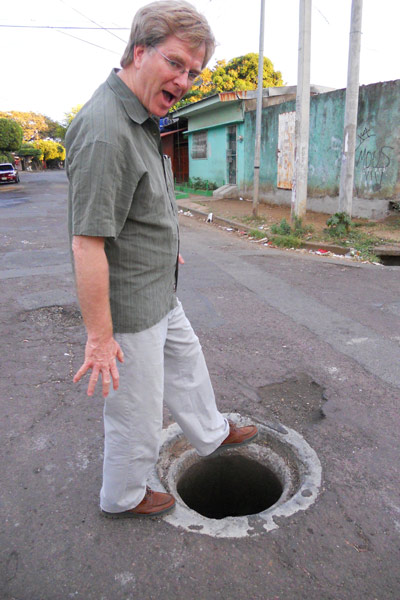
Managua's streets come with surprises. (Photo by Trish Feaster)

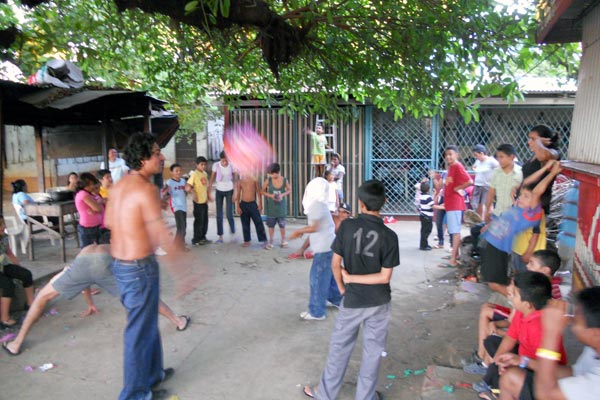
Like ancient Romans got circuses, today's Nicaraguans get a Christmas piñata — both courtesy of governments who care...about their popularity.

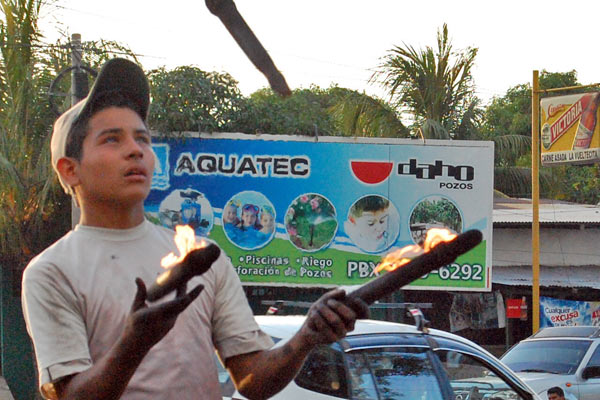
Flame-juggling kids entertain at a Managua intersection for tips.

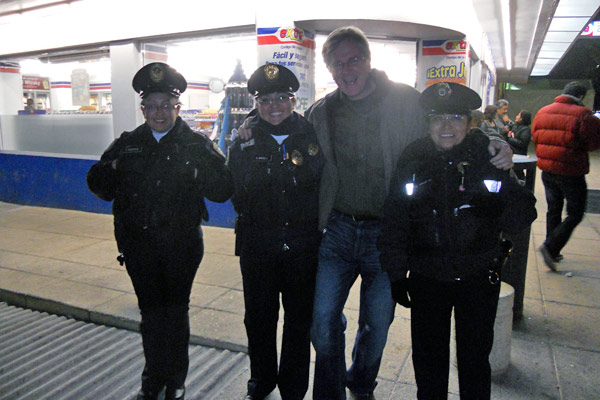
Military police enjoy an easy New Year's Eve in Mexico City.

The saddest thing about visiting Managua and San Salvador is experiencing the fear caused by the violence that comes with extreme poverty in a big city. Every major hotel and nearly every business has an armed guard. It’s unwise to walk around after dark, especially with a big camera. While you’re unlikely to be hurt, the risk is that groups of young thugs might just rob you at knifepoint. I found that, rather than whole safe neighborhoods, there were mostly small islands of safety around malls and fancy hotels. A wealthy tourist (and nearly all tourists here are wealthy, in relative terms) happily pays triple for a taxi that works with the hotels so you know you’re safe. You generally hop from one safe zone to another by cab.

Talking with travelers and residents in these countries, I’ve concluded that the risk for tourists is actually small, but the hype and caution are big. These days, with all the gang action and bloody drug warfare in the news, the image of Mexico and Central America has changed. It’s killing their tourism. Of course, with news media being what it is, if it bleeds, it leads. But a couple we met who spent two months traveling overland throughout Central America experienced nothing like this. When bandits do hit, they corner the victim and demand their valuables, or enter a bus from the front and rear and simply rob everyone on board.

Wandering through one Managua barrio, we kept one eye on the street for Nicaragua’s notorious open manholes. Desperation drives people to steal the lids and sell them as scrap metal. The neighborhood felt pretty desolate. Drivers slow for the omnipresent speed bumps and weave around the open manholes. Apart from a few shops selling odds and ends through barred windows and rustic cantinas serving beers to a rough-looking male crowd, there’s almost no business metabolism.

We came upon a small yard where the neighborhood children were jumping giddily up and down while one swung a stick blindly at a mischievously darting piñata. We enjoyed the scene, but I winced every time the stick viciously cut through the air among all those excited little heads. As I took a photo, a mom came over and suggested I stow the camera for safety. We realized we were in a bad neighborhood, and she ‘ baby in arms and her elderly mother at her side ‘ escorted us to the nearby big street. As we reached a bank with an armed guard out front, she said, “Now you are safe.”

In Nicaragua and El Salvador, there must be more armed guards than military and police forces combined. Nicaraguan security guards make about $1 an hour…and consider it a blessing. We chatted with the guard while watching a grimy kid in the intersection juggling small flaming torches for tips. Whenever a driver stops at an intersection, he is confronted by a battery of children begging, washing your windows, selling little goodies, and entertaining. I marveled at how a society can economize by cutting education. I couldn’t help but think I’ll spend what the guard makes in a day on a taxi back to my hotel, and I spend what that torch juggler hopes to make in a day at poolside for a rum-and-Coke.

Mexico City was the third stop on our visit. I wanted to greet the New Year in one of the world’s biggest cities. While much of Central America has petty crime and gang violence, Mexico is suffering from fear related to its drug war. While border regions in the north are actually seeing lots of bloodshed (Juarez is considered as dangerous as Baghdad), people in Mexico City and the vast majority of Mexico only read about the violence in the news.

Still, violence is the big issue. Out and about for several days in that vast city and celebrating the New Year with throngs in the streets, all I noticed in Mexico City was how the city seems occupied by military police (as opposed to El Salvador and Nicaragua, where private security dominated and there was almost no military presence), and how mellow and in-control things seemed. Subway stations with security cameras and more guards are labeled as “safe stations.” All New Year’s Eve, rather than wish the police gathered on major corners “Feliz Año Nuevo,” I’d say, “Police Año Nuevo”…and they’d return big smiles and answer, “Igualmente” (“Same to you!”).

The lessons I take home? A progressive observer would blame neoliberal (that is, pro-business) policies for contributing to the vast gap between the wealthy and the poor in these countries. A conservative observer would likely blame socialist policies or a lack of law and order. After my experience, it seems that anyone of any political persuasion can agree after traveling in Nicaragua, El Salvador, or Mexico that the fear and violence that wracks a society because of a desperate poor class is bad for the economy and a failure for every strata in that society. While the fear and poverty employ guards and sell razor wire, they also ruin any chance of a healthy tourist industry (potentially a major employer and industry here), and cause beautiful people who want to love and build their country to dream of escaping to the USA.

The Indigenous Potter

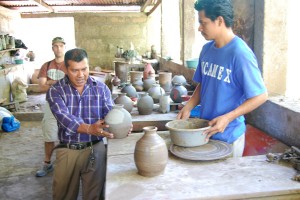
Driving an hour outside of Managua, we visit the town of San Juan de Oriente, where 90 percent of the people are indigenous (of native rather than European descent), and the economy is based on pottery. We meet Valentín López, who is passionate about keeping the pre-Colombian local art alive in his craft. As we sit in his workshop, he dances while his son plays the marimba (a xylophone-like wooden instrument favored among indigenous Nicaraguans). And as he dances, he explains the connection of their craft to their indigenous past.

Potter
Valentín López and his son help keep an ancient indigenous craft alive.

Then we gather around the wheel and he demonstrates the traditional way pottery is made, painted, and burnished. It’s all organic: clay pounded by bare feet, brushes made of a woman’s hair, and giant seeds as burnishers. As his son kick-starts the potter’s wheel, Valentín notes there is no electricity involved ‘ “The gas is rice and beans.” When the boy quickly gets the wheel really ramped up with his muscular leg, he adds, “This town produces very good soccer players.” A recurring theme of his demonstration is how the indigenous potters are in tune with nature. In the US, a potter orders clay on the phone. Here, they hike to the clay pit and gather it themselves.

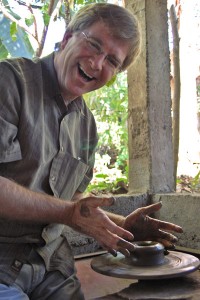
The chance for the tourist to be humiliated follows, and I jump at the opportunity. Climbing into the potter’s chair is like saddling a strange animal. I push the heavy stone wheel with my feet. It’s awkward. With images of Fred Flintstone trying to start his car, I struggle to get it going. My foot nearly gets pinched and dragged by the rough wheel under the brace of the table ‘ which would make me probably the first person to lose a leg to a potter’s wheel.

The potter’s son helps me get the wheel turning with a full head of steam, and then slams a blob of clay onto my spinning work table. I cup it, and it wobbles. He shows me how to be gentle with the clay. As he trickles on some water and guides my fingers and thumbs, the clay comes to life. But my creation is still a clumsy little baby…eventually made elegant, effortlessly, by my teenage teacher.

Giving pottery a spin.

Glancing down the row of eight stations like the one I’m sitting at, all under the shade of a corrugated tin roof, I imagine this cottage industry in full swing. And I appreciate the timelessness of the technology. While the advent of plastic must have done to pottery what the advent of cars did to blacksmithing, indigenous people want vessels that are of the earth, made by hand, and ornamented with the iconography of their ancestors. And, as long as there are indigenous people ‘ even if there are no tourists seeking souvenirs ‘ there will be potters in Latin America.

There’s an indigenous pride throughout Latin America. And, although decimated by European colonialism, the indigenous people of Latin America play a bigger role in contemporary society than Native Americans do in the USA.

The struggles of the indigenous people are an important theme in the political discussion in Latin America today. They are the ones discriminated against in schools, the work force, in the judicial system, and so on. If a Mestizo (mixed-race Latin American) loses his temper or does something violent, rather than say, “The devil made me do it,” he’ll say, “Se me salió el indio” (The Indian just came out of me.) Throughout much of Latin America, to call someone indigenous is an insult. For any indigenous person, a visit to Bolivia or Guatemala ‘ the only two predominantly indigenous countries left ‘ is how they can go back in time.

While indigenous people have distinct languages and cultures, their spiritual outlook is basically the same ‘ from the wilderness of Canada to the southern tip of the hemisphere. While it seems they have embraced Catholicism vigorously, I’ve heard the word “synchronism” repeatedly. The traditional spirituality survives to this day as many indigenous Christians routinely weave pre-Christian customs into their modern religion.

Unfortunately, in most of Latin America, it is the brown people who end up living with discrimination and are destined to live in poverty. I grew up fascinated by Pancho Villa, but always considered him a Mexican bandit. Indigenous Latin Americans refer to him as a hero who stood up against white dominance. As long as indigenous Latin Americans are kept down, my hunch is that the headlines will be filled with the Pancho Villas of the 21st century as they stand up for their rights in an aggressive and often uncompromising modern world.

As I watch Valentín and his son turn, polish, and bake their pottery with a spiritual connection to their ancestors much healthier than the connection I enjoy to my ancestors, I gain a new respect for the strength of indigenous culture in our hemisphere.

Coffee with Maria

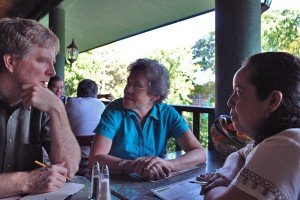
To balance our conversation, we went from poor, maternal head-of-household (Señora Nicaragua) to longtime activist/publisher. We had coffee with María López Vigil, a former nun and now editor of Envío (the monthly magazine of political and economic analysis on Nicaragua, published by the University of Central America). Here are a few insights from our conversation:

Getting up-to-date on Nicaragua with María López Vigil. (Photo by Trish Feaster)

The birth of Liberation Theology as a political power came out of the 1968 gathering of Latin American Catholic Church leaders in Medellín, Colombia. It established a radical doctrine with three key points: 1. Structural poverty is sinful; 2. Violent response to that is just, for the sake of dignity which God intended for all people; 3. God is not neutral ‘ God is on the side of the poor. Medellín (meh-deh-YEEN) empowered peasants throughout Latin America. In El Salvador, where this brand of Christianity was particularly strong, campesinos kept saying, “We follow Medellín” ‘ which caused the befuddled National Guard to look for a person named Medellín.

The revolution used Liberation Theology to stand up against John Paul II, who opposed using religious fervor to win economic justice. Liberation Theology came naturally for Latin America because it’s poor and the only continent with a majority of Catholics. When the Sandinistas won power, the wind went out of the Liberation Theology sails. But its basic message remains embraced by the people: The Church should be about justice, not rituals.

María affirmed the feeling I picked up from others in Nicaragua that today it seems, in general, the Church has lost the revolutionary fervor. Once-activist Christians are spent. They have accepted peace without as much justice as they once demanded. The Mother Teresa approach to things ‘ that a Christian is charitable and helps the poor ‘ has surpassed the Archbishop Oscar Romero approach, which fights for economic justice, asks why there is hunger and desperation in a world of plenty, and organizes the poor. During the revolutionary days, the big question was not, “What’s his political party?” It was, “Is he organized?”

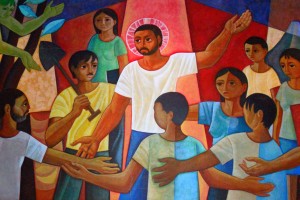
Jesus with an empathy for the working class.

I asked María about globalization, and she said locals seem to accept it like they do the weather. Not liking it is futile and makes no sense. You just have to live with it. In globalization, there are no frontiers or borders for the flow of money ‘ but there are borders for flow of people. This is the crux of why globalization is tough on the poor. María pointed out that there is plenty good about globalization. Ideas have no borders now. That means, for example, women can see examples where women in other cultures have rights. She said globalization ‘ which inspires, motivates, and generates hard questions ‘ has been good for women.

I am particularly interested in the cost of debt relief for the world’s poorest countries. Banks in the rich world don’t just forgive debt to poor countries. They exact a price. According to María, neoliberal structural adjustment exacted on Nicaragua in return for some debt relief has been disastrous on her society. In return for debt relief, health and education were cut back and privatized. (It seems interesting that health care and education will take a hit as the USA attempts to tackle its own debt problems.) María said it was believed that the private sector would better manage health and education ‘ but in reality, in the transition from government to corporation, it just went from one monopoly to another.

When asked what one thing might be fundamental to Nicaragua’s economic success, María said, “Education.” Education is like planting seeds. When done right, the fruit will just keep on coming.