Glasgow is a city where it seems there are two kinds of people: those who live to drink beer and cheer their soccer team, and those who confuse you by having that hard Glaswegian accent yet are cosmopolitan, sophisticated, cultured, and hardworking.
The first Glaswegian I met was from the first group. He was a cabbie who spent the entire ride insulting me for being an American because Yankees don’t go to pubs and drink lots of beer until late at night. If you venture into a rough neighborhood after dark — as I did one night — it seems the entire world is populated by angry people with dead-end lives, like that cabbie. Crammed into bars, they leer at passersby who don’t want to join the mosh pit.
But the next morning, with the sunshine came a world of that second type of Glaswegian: people with vision for making Glasgow an on-the-rise city with a purpose.
 Buchanan Street is part of a Glasgow pedestrian shopping zone called the “Golden Zed” for the way it zigzags through town. Just strolling up this street — listening to buskers, enjoying the people-watching, and remembering to look up at the architecture above the modern storefronts — was a delight.
 Glasgow’s city center has a stretch nicknamed the “Golden Mile.” Rather than letting graffiti artists mess up the vibe with random or angry tagging, the top street artists are given entire walls to paint. These paintings are almost sightseeing destinations in themselves.
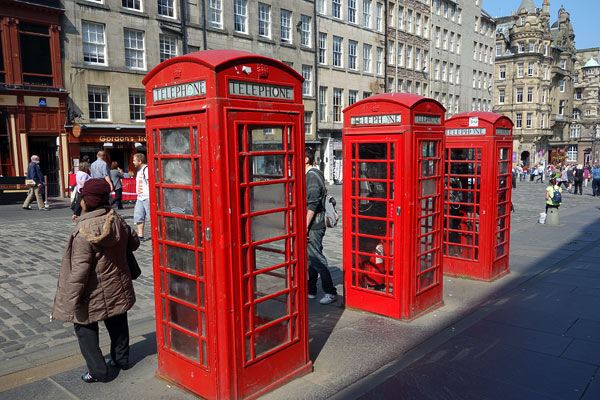 Throughout Great Britain, you can see red boxes on the streets that people back in the 20th century would enter in order to make “telephonic” calls to each other. They would put coins in a slot, turn a rotary dial with a sequence of numbers, and then speak through a device connected to the machine by a flexible pipe. These red boxes (which smelled like urine and doubled as handy places for the neighborhood prostitutes to stick their advertisements) were produced for the entire British Isles by a factory in Scotland. Now they are commonly seen no longer on the streets, but decorating nostalgic pensioners’ gardens.