Video: Glasgow’s Tenement House

It’s day 82 of my 100-day trip to Europe, and I’m in Glasgow, revisiting a great, if offbeat, museum. Something I love about my work: I get the joy of reviewing lots of sights and choosing which ones make it into the guidebook and TV show. While heavily advertised commercial gimmicks like wax museums, torture dungeons, and brewery tours attract hordes of tourists, other sights that take you back in time and connect you intimately with a bygone lifestyle get only a few thoughtful travelers. Some of my highly recommended sights — like the Tenement House in Glasgow (see my description below, excerpted from my Scotland guidebook) — may make people say “Huh!?” But they’re the sights that might just make your day.

I also love the similar museums in Copenhagen (the National Museum’s Victorian Apartment), in England’s Cotswolds (the Earl of Wemyss’ Stanway House), and in Paris (Jacquemart-André Museum).

Which lesser-known sights in Europe have given you that fun, intimate, time-warp experience?

Tenement House

Here’s a chance to drop into a perfectly preserved 1930s-era middle-class residence. The National Trust for Scotland bought this otherwise ordinary row home, located in a residential neighborhood, because of the peculiar tendencies of Miss Agnes Toward (1886-1975). For five decades, she kept her home essentially unchanged. The kitchen calendar is still set to 1935, and canisters of licorice powder (a laxative) still sit on the bathroom shelf. It’s a time-warp experience, where Glaswegian old-timers enjoy coming to reminisce about how they grew up.

Ring the doorbell to be let in. Explore the four little rooms. Imagine a world without electricity (Miss Toward was a late adapter, making the leap to electricity only in 1960). Ask about the utility of the iron stove. Ponder the importance of that drawer full of coal and how that stove heated her entire world. Ask why the bed is in the kitchen. As you look through the rooms laced with Victorian trinkets — such as the ceramic dogs on the living room’s fireplace mantle — consider how different they are from Mackintosh’s stark, minimalist designs from the same period

Cost and Hours: £6.50, April-Oct daily 13:00-17:00, July-Aug from 11:00, closed Nov-March.


Join our traveling community — connect with me on Facebook and Twitter.

Video: The “Scottish” Band Welcomes All the Tribes

Glasgow’s West End is the place to go for live music. And the Ben Nevis Pub was thriving as we spent the evening enjoying the scene with our camera rolling. (I’m feeling the beer, so excuse the swoopy camera moves.)

My agenda for our new public television show was to feature strictly Scottish traditional music. But as the session got going, I learned we had the entire UK in the band: musicians from Ireland, Wales, England, and Scotland — and they were drinking Guinness! At first, I was disappointed. My producer and I even talked about finding a bar with a solid Scottish band. Then our Glaswegian guide, Colin Mairs, pointed out that this is the reality…and it’s a fun one: The tribes are all making music together. And that (as a microcosm of our world in general — or, at least, its potential) is a beautiful thing. When it comes to good travel, being open-minded is as important as packing light.

By the way, this is a great example of a highlight for any visit to Britain: Reach out for info, find out which pubs have music, and make memories. What musical memories have you sparked in Britain’s pubs?


Join our traveling community — connect with me on Facebook and Twitter.

Video: Charles Rennie Mackintosh’s Art Nouveau Tea Rooms in Glasgow

I just joined my TV crew and our local guide, Colin Mairs, for our Scotland shoot. We’ll be here 18 days, filming three new shows for public television. Our first episode features Glasgow. And for architects, a big draw here is the Art Nouveau work of Charles Rennie Mackintosh. Here’s a look at a tea house he designed that makes for some tasty sightseeing. To give it context, here’s the “on camera” we filmed for our show:

These tearooms, opened in 1903, are an Art Nouveau masterpiece by Charles Rennie Mackintosh. Glasgow’s famous hometown architect gave this a spritely modern feel. Tearooms like the Mackintosh at the Willow were hugely popular during the industrial boom of the late 19th century.

During this age of Victorian morals, the temperance movement was trying to discourage the consumption of alcohol. Tearooms like this were designed with an agenda: to be an appealing alternative to eating in pubs.

In addition to giving office workers an alternative to pubs, these tearooms provided a place where women could gather while unescorted — in a time when being out alone could give a woman a less-than-desirable reputation.


Join our traveling community — connect with me on Facebook and Twitter.
 

My Best Boozy Discoveries in Scotland

I’m in Scotland, updating my Scotland guidebook — and I’m realizing that this is a land of booze geeks. Some of my favorite discoveries in Glasgow have been inviting whisky bars, run by people evangelical about Scotland’s favorite drink. (When it rains — as it often does — the showers elicit a cheery “That’s tomorrow’s whisky!” from the locals.)

On my tour around Scotland, I’ve visited a half-dozen whisky distilleries — from the Speyside region (where the iconic Glenfiddich and Glenlivet are produced) to the remote and intimate Talisker Distillery (opened in 1830 on the Isle of Skye).

talisker distillery

The Talisker Distillery. (Photo: Colin Mairs)

Each distillery was situated on a nearly sacred natural spring, and travelers were welcomed by a kilted guide who gave a tour followed by a tasting. I got to assess each and write them up for the next edition of the guidebook.

glenfiddich distillery tour

The Glenfiddich Distillery Tour.

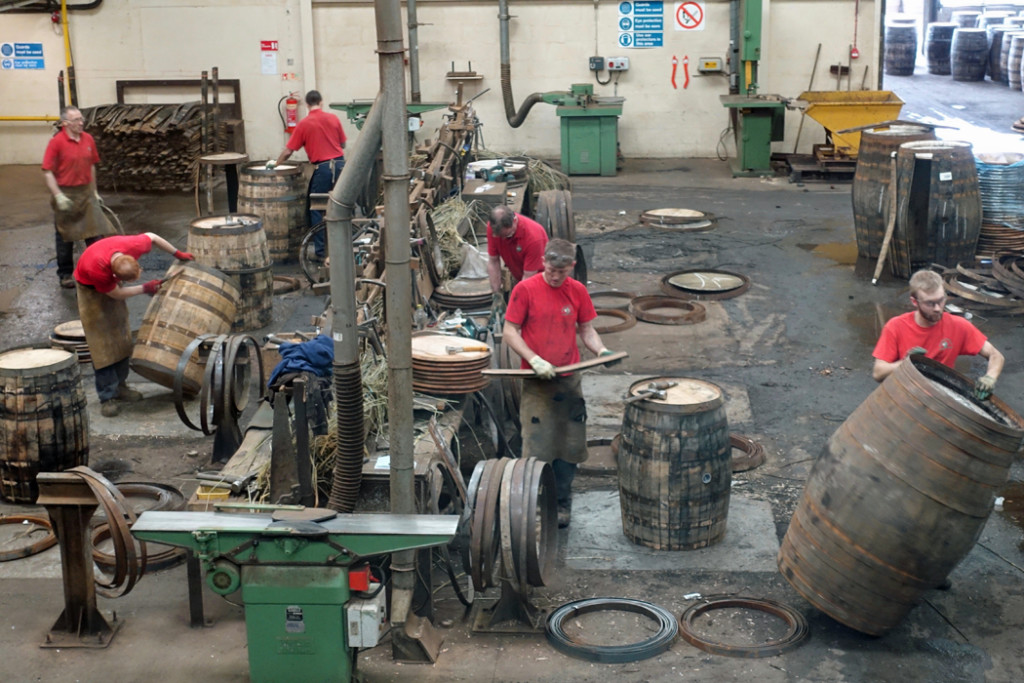
One highlight was the Speyside Cooperage, where I gained an appreciation of the role of oak in the distilling process, and got to watch as the busy coopers made whisky casks.

coopers at speyside

The Speyside Cooperage Visitor Centre.

Throughout my Scottish travels, I enjoyed Tennent’s Lager (“Scotland’s favourite pint”), and I’m adding a tour of their brewery to the guidebook. The Tennent’s Brewery Tour is perhaps the most exciting (if not the most politically correct) new experience in the Glasgow chapter. For three decades, Tennent’s decorated their cans with images of pinup girls who were known (fondly by many) as the “Lager Lovelies.”

timeline with photos of models

A “Lager Lovelies” timeline from the Tennent’s Brewery Tour.


Here’s a sneak peek at the new listing for the Tennent’s Brewery Tour in the upcoming second edition of Rick Steves Scotland:

Tennents Brewery Tour: Tennents, founded in 1740, is now the biggest brewery in Scotland, filling an 18-acre site. They give serious hour-long tours showing how they make “Scotland’s favourite pint” and fill 700 kegs per hour and 2,000 cans per minute (you’ll see more action Mon-Fri). It’s hot and sweaty inside, with over 100 steps to climb on your tour. When you’re done (surrounded by the “Lager Lovelies” —   pinup girls whose images decorated Tennents cans from 1965 to 1991), you’ll enjoy three samples followed by a pint of your choice (£10; tours depart daily at 10:00, 12:00, 14:00, 16:00, 18:00; to reserve, call 0141/202.7145 or book online at tennentstours.com, 161 Duke Street). Bus #41 stops in front on Duke Street and goes to George Square.

This is Day 93 of my “100 Days in Europe” series. As I travel with Rick Steves’ Europe Tours, research my guidebooks, and make new TV shows, I’m reporting on my experiences across Europe. Still to come: Germany, Switzerland, and more. Thanks for joining me here on my blog and via Facebook.

One Final Duty-Free Gauntlet Before Leaving Scotland

This video clip may show what seems like any old airport, but after two weeks in unpolished Scotland, it came as a jolt to me. At Glasgow’s airport, there’s only one way from security to the gates, and it routes you through the duty-free mall gauntlet.

Having survived this, I boarded my plane and settled in for my flight to London Heathrow, where I was connecting to Berlin. But then they announced that there was a fire at Heathrow, and Europe’s busiest airport was completely shut down. I fly a lot, and I’m amazed how rarely I’ve hit a bump in the tarmac like this. Back in the airport, you can imagine the chaotic scene as everyone scrambled to sort out their plans. This is when I’m really happy I use a living travel agent. I simply called her back home and asked her to get me to Berlin any way but through London. I spent the night at the airport hotel ($100), was booked on a flight early the next morning via Amsterdam, and got to Berlin before noon.

If you can’t see the video below, watch it on YouTube.