Don’t Be Duped — Travel and Talk to People

Flying home, I’m pleased with what we learned and what we have to share. The montage to introduce our one-hour Holy Land special goes like this: “While Jewish Israelis and Muslim Palestinians have overlapping claims and struggle to share it peacefully, this land has a rich and fascinating heritage. We’ll visit Jerusalem, considered by both Israelis and Palestinians to be their historic capital; feel the modern pulse of urban Israel; eat and drink with Jews; and follow in the footsteps of Christ. In Palestine, we’ll harvest olives; visit a local home; see the Tomb of Abraham; learn to wear a scarf with style; follow pilgrims to the place of Jesus’ birth; bob in a very salty sea; hike to an ancient monastery deep in the desert; and feel the energy of an emerging economy. Along the way, we’ll learn about walls, settlements, and the challenges facing the region.” Reading that again, I can see the vivid images we’ll edit together.

While there are no easy answers, actually coming here and experiencing the Holy Land firsthand is the best way to gain context and understanding. Lots of people in the USA seem to think they already know the answers. They’ve learned about it on TV, or from other Americans.

I remember when I first went on a political trip. It was back in the 1980s, to Nicaragua and El Salvador. Seeing me off, my Dad (suspicious of communism) said, “Don’t be duped.” Now, after 30 years of satisfying my curiosity about our world and its challenges by traveling and talking to people, it’s clear to me: The people most in danger of being duped are those who stay home.

I hope that when our program airs (which we expect to happen in spring of 2014, nationwide on public television), you can enjoy, as we did, “The Holy Land: Israel and Palestine Today.”

To celebrate my homecoming tonight, I’ll give a live, free slideshow lecture at 7pm P.S.T. in Edmonds, Washington. You can attend in person (registration required)…or watch the live webcast from anywhere in the world (no registration required). Learn more at Rick Steves – Holy Land: Israel and Palestine Today.

Thanks for following my trip!

DCannon13Summer_0078One of my favorite sequences in the program is a montage of clips showing me connecting with various locals. The theme: Good travel is all about meeting people, talking with them, and learning. In the last few weeks, I’ve learned what Muslims think of Jesus while sitting on a carpet with an imam; talked about raising kids while sipping coffee with Israelis who live in a settlement overlooking the West Bank; and visited with a Palestinian refugee as he clutched the key his parents took with them when their fled their village in 1948, thinking the move would be temporary. I’ve roasted coffee with a Bedouin, talked with soldiers in guard towers, and gained insight into why a proud and independent young woman would choose to wear a hijab.

RS13Summer_0903Our guides were hugely helpful both in Israel and in Palestine. If you are traveling to the region and need help, they are all self-employed, licensed, and happy to schedule time with any visitor: Benny Dagan (dagantrl@inter.net.il) and Abie Bresler (center in photo above, abresler@zahav.net.il) work in Israel. And Kamal Mukarker (left in photo above, kamal_mukarker@hotmail.com) and Husam Jubran (hjubranus@yahoo.com) are ready to be your guides in Palestine. Thanks to Benny, Abie, Kamal, and Husam for some great travels.

RS13Summer_1021We finished our Holy Land special with this close: “In this land — so treasured by Jews, Muslims, and Christians — I’m reminded that the prophets of each of these religions taught us to love our neighbors. And the lessons learned traveling here in in the Holy Land can inspire us all to strive for that ideal. I’m Rick Steves. Keep on traveling. Shalom, Salam, Peace.”

RS13Summer_1047I had a miserable trip…it changed my pre-conceptions. People whose language always sounded to me like terrorists conspiring are actually gentle souls with big challenges. It seems to me there are two sure things: Violence doesn’t work, and neither the Jews nor the Palestinians are going to move. The only workable road is one of peaceful co-existence.


Cartooning for the Hungry

For 20 some years, I’ve supported the work of Bread for the World, and when its president, David Beckmann, is in town, it’s always great to catch up with the organization’s work.

This year I decided to share him with the public. I promoted a public “hunger-awareness” event with David Wednesday evening at our Travel Center in Edmonds. I was disappointed that only a handful of people could drop by. But, as it is with people who care about their mission, David presented his news on the fighting-hunger front with energy and passion. His delivery was no less caring than when I saw him at the state capitol in Des Moines, where he addressed a crowd of 500. That’s when he was awarded the “World Food Prize,” celebrating him (and co-laureate Jo Luck of Heifer International) as the most effective people in our country in the fight against hunger during 2010.

One of the eight people in our gathering happened to be David Horsey, Pulitzer Prize-winning political cartoonist for the Seattle Post-Intelligencer. Just today, David shared with me the cartoon and editorial he wrote that describes the passion, compassion, and hard work of David Beckmann and his team at Bread for the World.

At first, the promoter in me was disappointed in the turnout. But this event was a great reminder that we need to do what we believe is right ‘ even if you’re discouraged, have faith that your effort is worth the trouble. Thanks to both Davids. And let’s hope that we can, as a society of caring people, create a protective circle around the poorest of our citizens as we find the smartest way to be a fiscally responsible nation.

The event left me with a wonderful new quote. Thirty-one years ago this week Archbishop Oscar Romero was assassinated in El Salvador. Why? Because he was going around saying this: “Es una caricatura del amor cuando se quiere apañar con limosna lo que se debe por justicia.”(It is only a caricature of love, when one seeks to fix through charity what is owed to justice.)

Vacationing in El Salvador and Nicaragua?

I have long recommended, “If you want a meaningful trip to Latin America, consider Managua over Mazatlán.” But I come home thinking that Nicaragua and El Salvador are actually not enjoyable places to visit. I don’t like the dirt, the fear, the pervasive sentiment that poor people should just shut up and make do. I visited the two most popular idyllic countryside towns: Granada in Nicaragua and Suchitoto in El Salvador. Both have a charming, laid-back zone where backpackers can nurse a latte and get online, where rich adventurers can luxuriate in wistful 19th-century colonial elegance, where shops don’t have armed guards, where massages are cheap, and where meek artisans outnumber the beggars. And I visited the major natural wonders (beaches, volcanoes, lake resorts) in each country. Frankly, compared to other options in the region (including Costa Rica and parts of Mexico), there’s not much there.

I spent three days each in Managua (Christmas), San Salvador, and Mexico City (New Year’s). I went first class by hiring local guides with cars for two days in each stop over my nine-day adventure at $250 per day. This enabled me to experience and learn triple what I would have on my own. I stayed in comfortable hotels averaging $80 a night per double: Hotel Europeo in Managua (cozy, with motel-style rooms around a palm-tree garden, pool, and thatched restaurant in a residential neighborhood); Sheraton Presidente Hotel in San Salvador (top-end, where big-shot politicians stay); and Hotel Catedral in Mexico City (beautifully located behind the cathedral near the Zócalo in the colonial center). I’d recommend each one. They each had a wonderful staff and a line on good and fairly priced taxis, and offered a convenient refuge from the intensity on the streets. The guides and hotels were arranged through Augsburg College’s Center for Global Education (which has been my tour organizer for all four of my educational visits to the region).

If you don’t speak Spanish, the language barrier can be more of a challenge than you’ll find in Europe. The fact that you’ll rarely see an English-language newspaper or magazine is evidence that there are so few English-speaking tourists these days. Because things are changing so fast and there’s such a small market, guidebooks struggle to cover your needs accurately.

The food is simple. The service is friendly. The prices are low ‘ even if you’re paying five times the local rate to get things to your standards of safety, comfort, and cleanliness. The souvenirs are rustic and pretty much the same. I scoured the main artisan markets and found crude variations on the same themes. The museums and galleries are humble. And the coffee ‘ even in lands famous for producing coffee beans ‘ makes me homesick. (When relaxing here, my drink of choice is a rum-and-Coke ‘ which is called a Nica-libre rather than a Cuba-libre ‘ in part, I think, because it’s fun to order.)

But the people are endearing. The lessons are inspiring. It’s a land of rapid change. I found myself saying “back in the old days” a lot, referring to experiences gained in the 1990s. There’s something about visiting Central America that stirs a certain traveling soul. As some expats I’ve gotten to know here say about El Salvador in particular, “It’s like a low-grade herpes virus. It gets in you, and you can’t get rid of it.”

While my first visit, in 1988, was to witness and understand an actual war between societal groups, today that struggle has become a political one (strikingly, with the same left-versus-right dynamics as in the USA). The gap between rich and poor, which fueled the revolutions and civil wars of the recent past, now fills the docket in each country’s parliaments. And today, both headlines and peoples’ minds are filled with the struggles caused by that persistent gap ‘ petty crime, the drug war, and gang violence.

In this age of globalization, it seems even when national movements of liberation (like El Salvador’s FMLN and Nicaragua’s Sandinistas…and, some would say, even America’s Obama) gain power, they are not allowed to address issues of structural poverty. I’m wondering if future peoples’ struggles must be transnational. (I find people in Europe and the developing world know more about the 1999 WTO riots in Seattle than Seattleites do.)

Today, forces for economic justice may win their battles. But they face an infinitely more powerful foe than their local elites: a globalized economy. Through corporation-led globalization, there’s been a leap in the power of the developed world over the developing one, and of corporations over nations. And that’s a war no guerilla movement (and perhaps no election campaign) will win.

My nine-day crash course in Latin America issues came with great teachers and the ultimate classroom. In talking with so many local experts, it occurred to me that Americans coming here in search of understanding (like me) want things in black-and-white clarity. And it is way more complex ‘ and therefore frustrating ‘ to people like us. I come home not with the clean answers I sought. But I do come home with a sense of optimism. Pluralistic societies are working things out without war. And, while peace-loving pragmatism can win out over bloody idealism when it comes to economic and social justice issues, the societies of Nicaragua and El Salvador are moving fitfully but steadily forward. You can’t help but fly home from Central America rooting for its beautiful people…and wanting to do more.

Barricaded Safely in Your Hotel

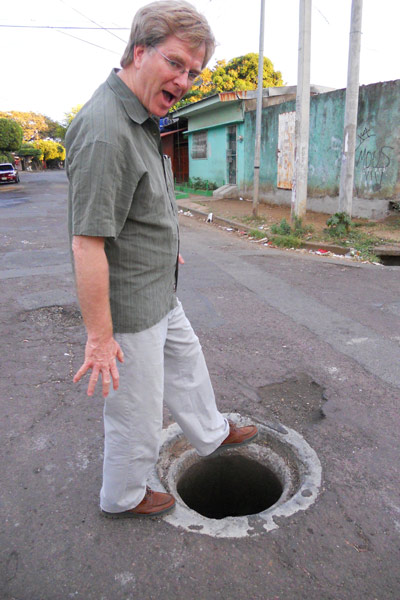
Managua's streets come with surprises. (Photo by Trish Feaster)

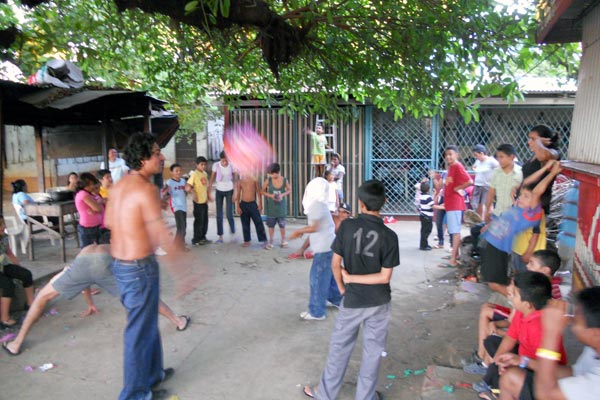
Like ancient Romans got circuses, today's Nicaraguans get a Christmas piñata — both courtesy of governments who care...about their popularity.

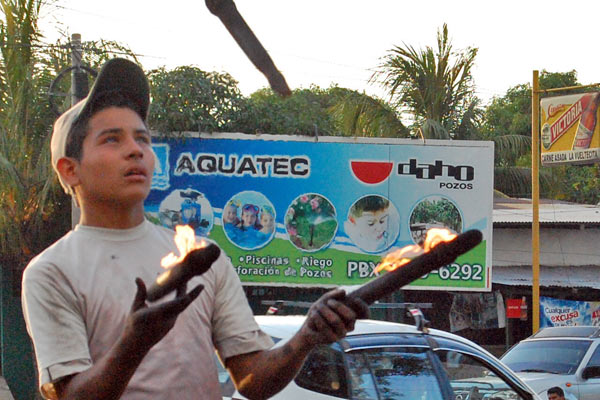
Flame-juggling kids entertain at a Managua intersection for tips.

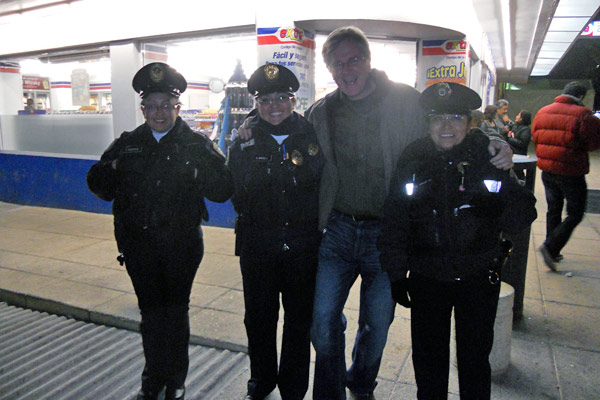
Military police enjoy an easy New Year's Eve in Mexico City.

The saddest thing about visiting Managua and San Salvador is experiencing the fear caused by the violence that comes with extreme poverty in a big city. Every major hotel and nearly every business has an armed guard. It’s unwise to walk around after dark, especially with a big camera. While you’re unlikely to be hurt, the risk is that groups of young thugs might just rob you at knifepoint. I found that, rather than whole safe neighborhoods, there were mostly small islands of safety around malls and fancy hotels. A wealthy tourist (and nearly all tourists here are wealthy, in relative terms) happily pays triple for a taxi that works with the hotels so you know you’re safe. You generally hop from one safe zone to another by cab.

Talking with travelers and residents in these countries, I’ve concluded that the risk for tourists is actually small, but the hype and caution are big. These days, with all the gang action and bloody drug warfare in the news, the image of Mexico and Central America has changed. It’s killing their tourism. Of course, with news media being what it is, if it bleeds, it leads. But a couple we met who spent two months traveling overland throughout Central America experienced nothing like this. When bandits do hit, they corner the victim and demand their valuables, or enter a bus from the front and rear and simply rob everyone on board.

Wandering through one Managua barrio, we kept one eye on the street for Nicaragua’s notorious open manholes. Desperation drives people to steal the lids and sell them as scrap metal. The neighborhood felt pretty desolate. Drivers slow for the omnipresent speed bumps and weave around the open manholes. Apart from a few shops selling odds and ends through barred windows and rustic cantinas serving beers to a rough-looking male crowd, there’s almost no business metabolism.

We came upon a small yard where the neighborhood children were jumping giddily up and down while one swung a stick blindly at a mischievously darting piñata. We enjoyed the scene, but I winced every time the stick viciously cut through the air among all those excited little heads. As I took a photo, a mom came over and suggested I stow the camera for safety. We realized we were in a bad neighborhood, and she ‘ baby in arms and her elderly mother at her side ‘ escorted us to the nearby big street. As we reached a bank with an armed guard out front, she said, “Now you are safe.”

In Nicaragua and El Salvador, there must be more armed guards than military and police forces combined. Nicaraguan security guards make about $1 an hour…and consider it a blessing. We chatted with the guard while watching a grimy kid in the intersection juggling small flaming torches for tips. Whenever a driver stops at an intersection, he is confronted by a battery of children begging, washing your windows, selling little goodies, and entertaining. I marveled at how a society can economize by cutting education. I couldn’t help but think I’ll spend what the guard makes in a day on a taxi back to my hotel, and I spend what that torch juggler hopes to make in a day at poolside for a rum-and-Coke.

Mexico City was the third stop on our visit. I wanted to greet the New Year in one of the world’s biggest cities. While much of Central America has petty crime and gang violence, Mexico is suffering from fear related to its drug war. While border regions in the north are actually seeing lots of bloodshed (Juarez is considered as dangerous as Baghdad), people in Mexico City and the vast majority of Mexico only read about the violence in the news.

Still, violence is the big issue. Out and about for several days in that vast city and celebrating the New Year with throngs in the streets, all I noticed in Mexico City was how the city seems occupied by military police (as opposed to El Salvador and Nicaragua, where private security dominated and there was almost no military presence), and how mellow and in-control things seemed. Subway stations with security cameras and more guards are labeled as “safe stations.” All New Year’s Eve, rather than wish the police gathered on major corners “Feliz Año Nuevo,” I’d say, “Police Año Nuevo”…and they’d return big smiles and answer, “Igualmente” (“Same to you!”).

The lessons I take home? A progressive observer would blame neoliberal (that is, pro-business) policies for contributing to the vast gap between the wealthy and the poor in these countries. A conservative observer would likely blame socialist policies or a lack of law and order. After my experience, it seems that anyone of any political persuasion can agree after traveling in Nicaragua, El Salvador, or Mexico that the fear and violence that wracks a society because of a desperate poor class is bad for the economy and a failure for every strata in that society. While the fear and poverty employ guards and sell razor wire, they also ruin any chance of a healthy tourist industry (potentially a major employer and industry here), and cause beautiful people who want to love and build their country to dream of escaping to the USA.

San Salvador: Lunch in the Barrio, Dinner at the Mall

(Photo by Trish Feaster)

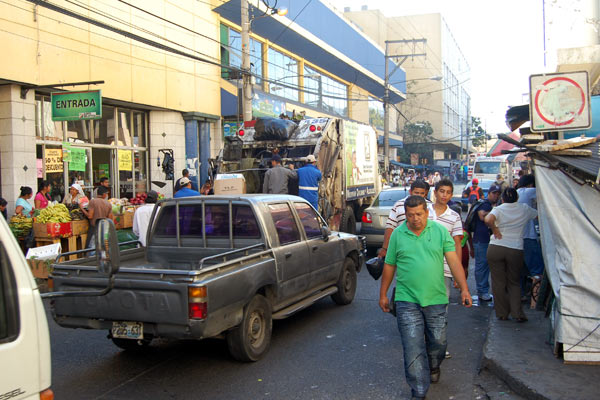
San Salvador's informal economy bullies pedestrians off the sidewalks and into the streets.

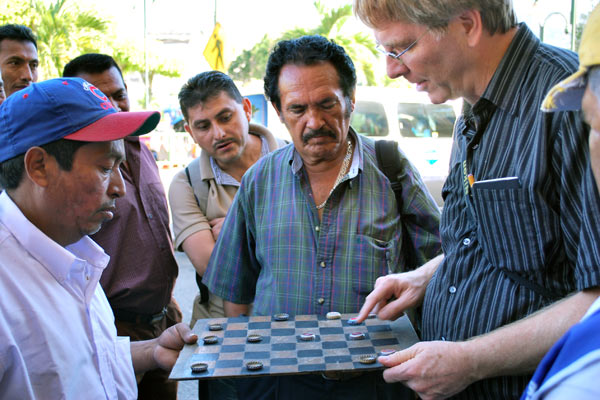
Member-supported checkers game. (Photo by Trish Feaster)

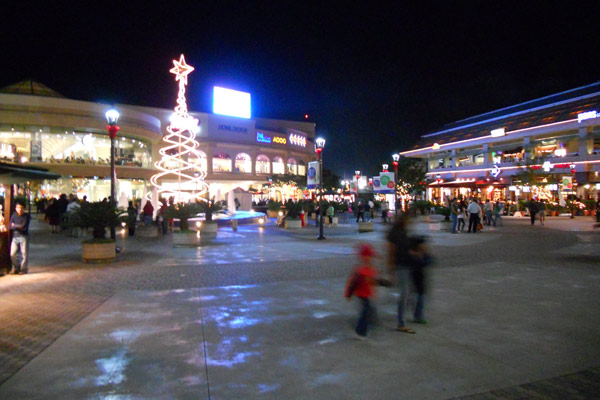
La Gran Vía...imagine, a San Salvador where everyone's rich.

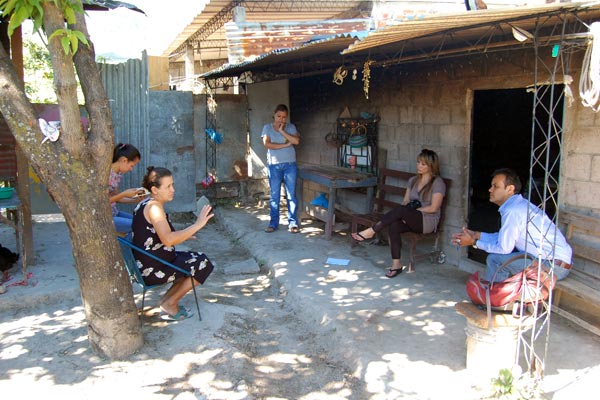
Five years ago, I visited Beatriz, a proud and hardworking woman raising two daughters and living with dignity in the squalor that results from structural poverty. On this trip, I wanted to drop by to get up-to-date with Beatriz and her family. A single mom, she and her two daughters struggle to make ends meet in an ever-tougher economic environment. Her home is a single cinderblock room under a corrugated tin roof with a dirt yard fortified behind a corrugated tin fence. Right down to the hardscrabble chicken roaming the yard, it seemed unchanged after five years.

Beatriz’s daughters are now well into their twenties and, I imagine, would like to be on their own. But that’s not possible. They each work 48-hour weeks and make about $300 per month (that’s about $1.50 per hour). It is typical for girls to work in textile plants sewing garments for international corporations. As part of a globalized labor force, they are competing with the most desperate labor on the planet. These maquiladora plants, while pretty miserable by US standards, are considered a blessing here, as they bring relatively solid jobs to a land otherwise without much industry.

In 2005, Beatriz’s main concerns were government policies and having lost the civil war. The cost of electricity and water had grown manifold, making ends meet tougher than ever. As she was a major figure in my Travel as a Political Act book, I was excited to revisit. It was fun to give her a copy of the book and watch her daughters read the passage about their illiterate mom to her.

We sat down to a lunch of brawny chicken, chicken soup, delicious fresh-ground corn tortillas, and a tall plastic bottle of Coke to share. Their Christmas tree looked a little funny, and they explained that it was the bottom half of a fake tree that they shared with an uncle. They just bent one of the big branches up to make it look like the top of a tree. Like many families, Beatriz’s husband had emigrated to the USA with the promise of sending home money. Eventually the money stopped flowing, and he established his own life in the States. He’s now married again, with a second crop of children.

The driving daily concerns for Beatriz and her daughters is now not the old war against a military dictatorship, but the new war against crime and the rising cost of living. The daughters told of the daily fear they experience riding the bus to work. Routinely thieves stop the bus and enter from each end, extorting all of their valuables. They don’t leave home with anything of value without considering, “Do I want to risk losing this?”

Beatriz explained that the voice of the Church is now gone ‘ a symptom of a society tired of political struggle. People complain that there is no way to organize. Sure, the FMLN is now in power. But every guerilla has his price, their ideals are compromised, and the new leaders are only marginally better than the old.

Leaving Beatriz’s place, we stepped into an urban world where it seems solid jobs are rare and half the workforce is in the informal economy ‘ basically selling things on the street. In fact, in most of the old center of San Salvador, there are essentially no functioning sidewalks. They are taken up by shanty shops jammed against the walls of local businesses, leaving pedestrians to share the streets with cars.

People entertain themselves creatively. I joined one gang of men gathered around a rustic checkerboard. There was no table. They were holding the board up together, playing a game of checkers. It was a spirited gang, using bottle caps ‘ turned either up or down ‘ for pieces. With the end of the game, I was invited to play the winner. It was fun…until my opponent got a “queen,” and I learned that in Central America, the queen has vastly more powerful moves than the “king” where I come from. With his queen on the rampage, I was swept from the checkered battlefield…and finished in no time.

My hunch is that the wealthy elite of a society like El Salvador is hardly mindful of the downtown realities because they can function fine without crossing paths with this ugly side of their society. On previous visits, I had driven through rich neighborhoods and marveled at the designer fortifications behind which people lived. On this trip, I tried to do the same, but, rather than individual mansions, I saw only landscaped roads with walls that protected entire neighborhoods. Even parks were behind fortifications, so rich kids could safely get a little fresh air with armed guards always near.

To get a better look at the wealthier side of this society, we went to La Gran Vía, one of several top-end malls serving San Salvador’s wealthy. These are more than just malls. They function as the city center for people who live in gated communities. For our staff at the hotel, it was clear; La Gran Vía is the obvious place to head if you want to “go out.” The receptionist made sure we knew there was actually a Starbucks there. Safe taxis shuttle guests back and forth. The mall had the fantasy aura of Disney World, with a happy pedestrian boulevard flanked by two floors of restaurants, shops, children’s playgrounds, and a multistory garage filled with very nice cars. Little sightseeing trains took visitors on the rounds. A children’s version of the train had spinning tea cup cars for the kids to spin on while they wound through the happy crowds. The Starbucks had a bigger terrace than any I’d seen ‘ clearly a place to see and be seen.

Our La Gran Vía dinner was in a T.G.I. Friday’s-type place serving great Mexican food. We saw barely an American anywhere in San Salvador, and La Gran Vía was no exception. We ended up sharing a drink with a Salvadoran couple. It was clear that in our two days of sightseeing, we had experienced more of San Salvador’s pithy core than these residents had in years. They peppered us with questions about their own city. As they considered it so dangerous to go downtown, it mystified them.

We capped our La Gran Vía night at the cinema, enjoying a comedy alongside Salvadorans for whom razor wire (rather than broken glass lining the tops of their walls) is a status symbol. The schedule made it clear which movies were in “versión original” ‘ with subtitles ‘ and which were dubbed. Most American films were subtitled. Tickets were a third the US price ($4), and, of course, once the lights went out, we were right back in the States (a nice thing about going to the movies when you’re traveling in intense areas).

Sitting in that air-conditioned comfort munching on popcorn, my mind wandered back to Beatriz’s dirt floors and handmade tortillas. Actually experiencing contrast makes abstract lessons picked up in our travels not only concrete and human, but lasting.