 |
|
|
 |
|
|
|
|
|
|
 |
 |

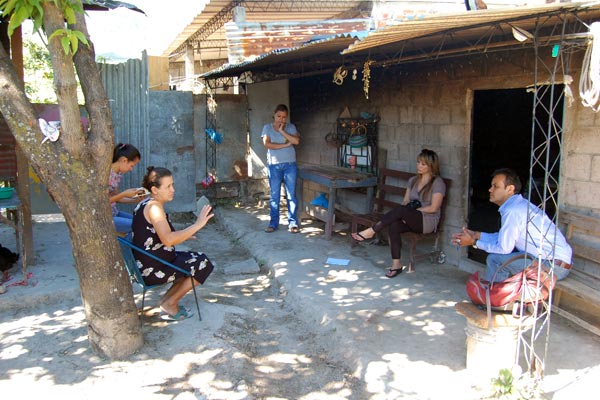
Five years ago, I visited Beatriz, a proud and hardworking woman raising two daughters and living with dignity in the squalor that results from structural poverty. On this trip, I wanted to drop by to get up-to-date with Beatriz and her family. A single mom, she and her two daughters struggle to make ends meet in an ever-tougher economic environment. Her home is a single cinderblock room under a corrugated tin roof with a dirt yard fortified behind a corrugated tin fence. Right down to the hardscrabble chicken roaming the yard, it seemed unchanged after five years.
Beatriz’s daughters are now well into their twenties and, I imagine, would like to be on their own. But that’s not possible. They each work 48-hour weeks and make about $300 per month (that’s about $1.50 per hour). It is typical for girls to work in textile plants sewing garments for international corporations. As part of a globalized labor force, they are competing with the most desperate labor on the planet. These maquiladora plants, while pretty miserable by US standards, are considered a blessing here, as they bring relatively solid jobs to a land otherwise without much industry.
In 2005, Beatriz’s main concerns were government policies and having lost the civil war. The cost of electricity and water had grown manifold, making ends meet tougher than ever. As she was a major figure in my Travel as a Political Act book, I was excited to revisit. It was fun to give her a copy of the book and watch her daughters read the passage about their illiterate mom to her.
We sat down to a lunch of brawny chicken, chicken soup, delicious fresh-ground corn tortillas, and a tall plastic bottle of Coke to share. Their Christmas tree looked a little funny, and they explained that it was the bottom half of a fake tree that they shared with an uncle. They just bent one of the big branches up to make it look like the top of a tree. Like many families, Beatriz’s husband had emigrated to the USA with the promise of sending home money. Eventually the money stopped flowing, and he established his own life in the States. He’s now married again, with a second crop of children.
The driving daily concerns for Beatriz and her daughters is now not the old war against a military dictatorship, but the new war against crime and the rising cost of living. The daughters told of the daily fear they experience riding the bus to work. Routinely thieves stop the bus and enter from each end, extorting all of their valuables. They don’t leave home with anything of value without considering, “Do I want to risk losing this?”
Beatriz explained that the voice of the Church is now gone ‘ a symptom of a society tired of political struggle. People complain that there is no way to organize. Sure, the FMLN is now in power. But every guerilla has his price, their ideals are compromised, and the new leaders are only marginally better than the old.
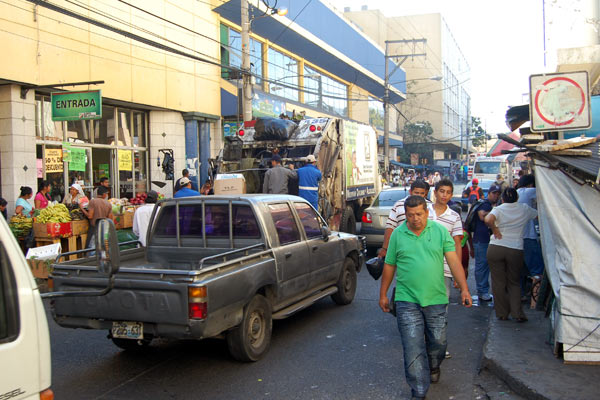
Leaving Beatriz’s place, we stepped into an urban world where it seems solid jobs are rare and half the workforce is in the informal economy ‘ basically selling things on the street. In fact, in most of the old center of San Salvador, there are essentially no functioning sidewalks. They are taken up by shanty shops jammed against the walls of local businesses, leaving pedestrians to share the streets with cars.
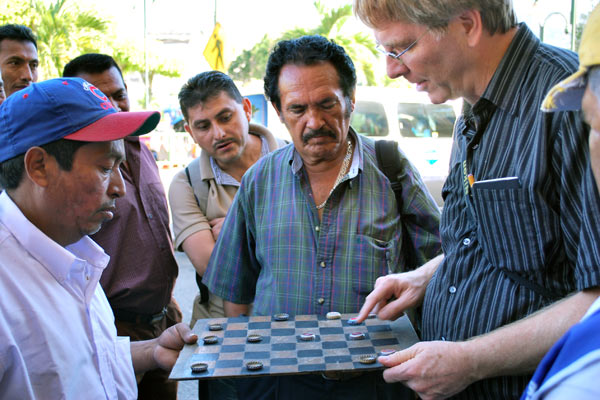
People entertain themselves creatively. I joined one gang of men gathered around a rustic checkerboard. There was no table. They were holding the board up together, playing a game of checkers. It was a spirited gang, using bottle caps ‘ turned either up or down ‘ for pieces. With the end of the game, I was invited to play the winner. It was fun…until my opponent got a “queen,” and I learned that in Central America, the queen has vastly more powerful moves than the “king” where I come from. With his queen on the rampage, I was swept from the checkered battlefield…and finished in no time.
My hunch is that the wealthy elite of a society like El Salvador is hardly mindful of the downtown realities because they can function fine without crossing paths with this ugly side of their society. On previous visits, I had driven through rich neighborhoods and marveled at the designer fortifications behind which people lived. On this trip, I tried to do the same, but, rather than individual mansions, I saw only landscaped roads with walls that protected entire neighborhoods. Even parks were behind fortifications, so rich kids could safely get a little fresh air with armed guards always near.
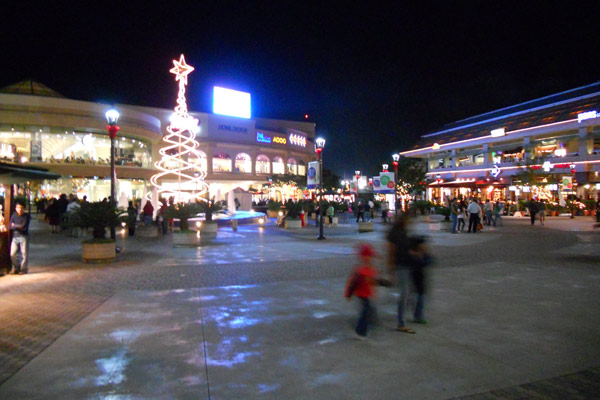
To get a better look at the wealthier side of this society, we went to La Gran Vía, one of several top-end malls serving San Salvador’s wealthy. These are more than just malls. They function as the city center for people who live in gated communities. For our staff at the hotel, it was clear; La Gran Vía is the obvious place to head if you want to “go out.” The receptionist made sure we knew there was actually a Starbucks there. Safe taxis shuttle guests back and forth. The mall had the fantasy aura of Disney World, with a happy pedestrian boulevard flanked by two floors of restaurants, shops, children’s playgrounds, and a multistory garage filled with very nice cars. Little sightseeing trains took visitors on the rounds. A children’s version of the train had spinning tea cup cars for the kids to spin on while they wound through the happy crowds. The Starbucks had a bigger terrace than any I’d seen ‘ clearly a place to see and be seen.
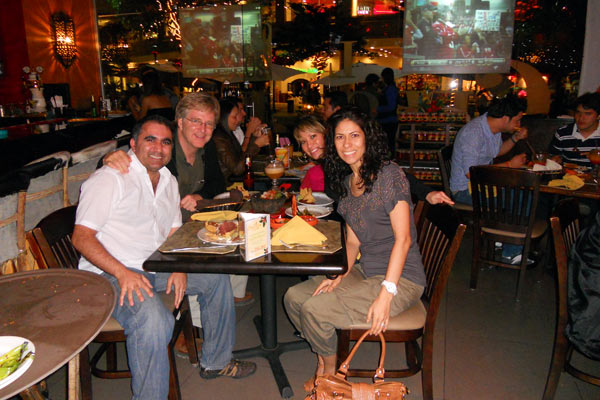
Our La Gran Vía dinner was in a T.G.I. Friday’s-type place serving great Mexican food. We saw barely an American anywhere in San Salvador, and La Gran Vía was no exception. We ended up sharing a drink with a Salvadoran couple. It was clear that in our two days of sightseeing, we had experienced more of San Salvador’s pithy core than these residents had in years. They peppered us with questions about their own city. As they considered it so dangerous to go downtown, it mystified them.
We capped our La Gran Vía night at the cinema, enjoying a comedy alongside Salvadorans for whom razor wire (rather than broken glass lining the tops of their walls) is a status symbol. The schedule made it clear which movies were in “versión original” ‘ with subtitles ‘ and which were dubbed. Most American films were subtitled. Tickets were a third the US price ($4), and, of course, once the lights went out, we were right back in the States (a nice thing about going to the movies when you’re traveling in intense areas).
Sitting in that air-conditioned comfort munching on popcorn, my mind wandered back to Beatriz’s dirt floors and handmade tortillas. Actually experiencing contrast makes abstract lessons picked up in our travels not only concrete and human, but lasting.
It is amazing how the mall looks like one down the street. I also saw in Costa Rica a big difference between the rich and poor. I was shocked flying over San Jose to see all the Barios. I am always confused by the fact that Americans are not really greatful for what we have. Complain and complain and create problems. We have such huge opportunity in this country, even with a high unemployment rate. I talk to people everyday that are middle age and they are just going to let their unemployment run as long as it can before they even look for a job. I think Americans really can work a lttle harder and contribute a little more to the greater good. Be Thankful for what we have because you really can`t change it for the rest of the world.
you don,t play chess? queen reigns.. recommend you read the history of chess through the ages and cultures…
Rick, Am loving these posts; so interesting and so different. Thanks for taking the time to share this with us.
In one of the pictures I can see that Rick carry his passport visibly, walk freely and without protection the streets of El Salvador, talk with a friendly and beautiful young sisters and their mother, play fearless with Salvadorian`s people, and he looks like enjoying the warm weather, the experience, the city and the ambience ,
Nice contribution
One can see the poverty – wealthy split in the US. It sometimes makes me ill. We have the elite who also do not venture beyond their wealthy enclaves. The New Yorker did a wonderful little article on the Mayor a couple of weeks ago in dealing with a simple thing like snow. Nice article Rick.
Rick, excellent posting…I have family in Ciudad Juarez, Mx and it just the same. Just one thing-Hispanics do not really use the word “Barrio”. That is a Chicano word. Rather, in Mexico, you use the name Colonia or Fraccianimiento (or Fracc for short). Fracc means neighborhood without the economic value judgement in the word Barrio.
Hey Larry, Rick was playing checkers, damas inglesas is what my Mexican students called it, and it really is a much more interesting game than our checkers. Thanks, Rick, for your posts. One must truly love the cultures and peoples of Latin America to speak critically and from the heart.