Having Fun in Copenhagen

Flying from Amsterdam to Copenhagen is like connecting sister cities — bikes, canals, lots of construction work, slick and extensive infrastructure, and people who really know how to have fun.

As I mentioned earlier, my two-month summer trip has five sections: Germany guidebook research, filming in the Netherlands, Scandinavia guidebook research, filming in Berlin and Prague, and finally guidebook research in Poland. I’m just kicking off part three and ready for some Scandinavian travel fun. Join me for the next two weeks as I offer my latest travel tips from in and around Copenhagen, Stockholm, Oslo, and Bergen. First up: Copenhagen.

In cities like Copenhagen, I enjoy tuning into the little details of everyday life. For example, the pølse (hot dog) is fast, cheap, tasty, and — like its American cousin — almost worthless nutritionally. Even so, what the locals call the “dead man’s finger” is the dog Danish kids love to bite. Danes gather at pølsevogne (sausage wagons) for munchies and pølsesnak — the local slang for empty chatter (literally, “sausage talk”).  If you join them, you can study this institution — and maybe pick up on some societal insights, as well. Denmark’s “cold feet cafés” are a form of social care: People who have difficulty finding jobs are licensed to run these wiener-mobiles. As they gain seniority, they are promoted to work at more central locations. Traditionally, after getting drunk, guys stop here for a hot dog and chocolate milk on the way home — that’s why many of these stands stay open until the wee hours.

Wandering Copenhagen’s harborfront, visitors are struck by the many young people out drinking in the streets. There’s not more beer consumption here than in the US; it’s just out in public. Many young Danes can’t afford to drink in a bar (where the tax on serving booze is astronomical), so they “picnic drink” their beers in squares and along canals, spending a quarter of the bar price for a bottle from a nearby kiosk. In my guidebook’s self-guided walk of Copenhagen, I encourage my travelers to drop by Nagib’s kiosk (a block from the popular wharf at Nyhavn) and grab a cold $2 beer to join in the scene. It was fun meeting Nagib, as for years, he’s had a steady stream of Americans dropping by to buy a beer…as dictated by some mysterious guidebook writer.

Appreciating local culture extends to sightseeing, as well. When you’re traveling, don’t just seek out the Van Goghs in Sweden, the Rembrandts in Scotland, or the Titians in Spain. Instead, open up to the local artists. In Norway, check out Munch. In Vienna, go for Klimt. And in Prague, give Mucha a look. All over Copenhagen, you’ll see the swoon-worthy art of the great Danish Neoclassical sculptor Bertel Thorvaldsen. This local Canova’s work is in the cathedral, in the palace, and packing a museum dedicated entirely to his statues right next to the palace. Do you have a favorite underrated national artist that we should keep on our list when in that artist’s homeland?

Copenhagen is a city of lovely spires and public spaces. As in many towns, once-formidable fortified walls and moat systems have morphed into peaceful, lake-filled parks. In the maps of these cities, you can see the “star fort” shapes centuries after the last cannon was retired. Copenhagen does a particularly good job of utilizing land formerly spent on defense to make the city a wonderful place to live. Wandering through these parks, you can understand why Danes usually top the list of the world’s most content societies.

spiral-spire-Church-of-our-Savior-Copenhagen
Once a mighty military base, today this Copenhagen district is a park…with bastion-shaped hills and moat-shaped lakes.
topless-Danes
Anywhere in Scandinavia, when the sun’s out, so are the people. Topless Danes were turning heads in the harbor.
copenhagen-polsevogne-hot-dogs
All over Copenhagen, mobile hotdog stands sell the traditional pølse. After a long day of weenie sales, this man is ready to roll home and take a break.
Nagib-beer-kiosk
Nagib is happy to sell my readers a bottle of beer to sip harborside for just 10 kronor — that’s about $2…a huge bargain in Danish terms.
Bertel-Thorvaldsen-cupids-arrow-statue
Local artists — often largely unknown outside their native lands — are a treat just waiting to be discovered. In Denmark, I’m in the mood to be pricked by the cupid’s arrow of Thorvaldsen.

Northern European Cruise Ports — A Springboard for Action

Our two cruise ports guidebooks (for both the Mediterranean and Northern Europe) are derived from our existing country guidebooks. To make them, we tailor existing chapters from these guidebooks to the needs of the independent-minded cruise traveler and assemble them in special editions so people can buy a single book rather than several to cover their itinerary. And my main research focus on this trip will be the ports.

Northern European ports lend themselves to independent travel. In many cases (including certain ports in Tallinn, Bergen, Oslo, and Copenhagen), they’re right in the city center and an easy walk from the sightseeing action — and when they aren’t, there’s good public transportation to the center of town. The ports themselves are generally not pretty, but mighty — industrial zones giving you a very honest look at the workings of these great cities. (Photos by Trish Feaster, see her blog – The Travelphile.com.)

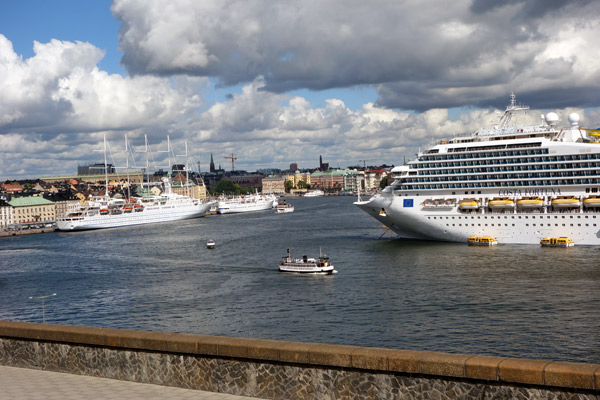
This is Stockholm, where, as in many cities, there's a cruise dock in the center and a bigger one a bus ride away. Smaller and more expensive ships often dock right downtown, while most of the full-sized ships dock in the industrial zone farther out. You almost never drop anchor and use tenders to get ashore in Northern Europe — although in this shot, a big ship has dropped its hook just off Stockholm’s Gamla Stan (old town).
This is Stockholm, where, as in many cities, there’s a cruise dock in the center and a bigger one a bus ride away. Smaller and more expensive ships often dock right downtown, while most of the full-sized ships dock in the industrial zone farther out. You almost never drop anchor and use tenders to get ashore in Northern Europe — although in this shot, a big ship has dropped its hook just off Stockholm’s Gamla Stan (old town).
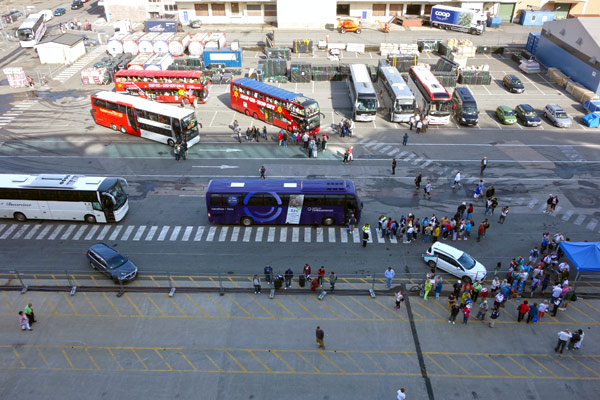
Cruise ports work hard to organize the masses. There are clear charts of each port (like this one for Copenhagen), shuttle buses if necessary, small temporary tourist information tents that are set up when a ship is in, and even painted lines in the pavement that take the guesswork out of getting to and from the town center.
Each ship dumps off thousands of tourists, raring to have the best seven or eight hours possible in each port. Just off the gangplank, you’ll find several options: Tour buses awaiting those who signed up for ship-sponsored excursions (the standard option); hop-on, hop-off buses for budget and independent travelers (all-day, $25 tickets cover a 90-minute loop with a recorded narration, and include hop-off-and-on privileges as buses come by about every 20 minutes all day); public buses dedicated to connecting cruisers with the town center; and taxis (both standard and minibus — economical for small groups).
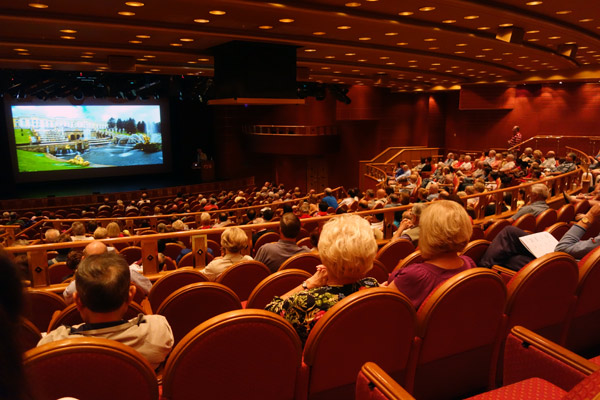
Princess Cruise Lines puts a big effort into helping its cruisers be prepared for each port (better than the other lines I’ve sailed with). On the Emerald Princess, our ship lecturer was John Lawrence, who has decades of experience cruising Northern Europe and knows each port intimately. Each evening, John gives a talk to a full theater about the next day’s port of call. That talk would then air repeatedly on the ship’s TV station. John even provided a live, guided narration of the most scenic stretches of island scenery we passed (like the archipelago we sailed through leaving Stockholm).
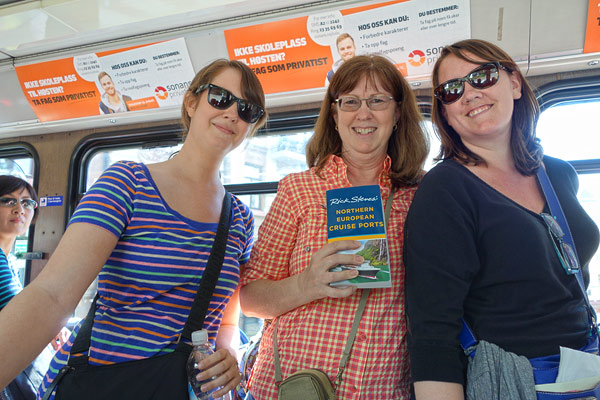
As I had to have my hot-off-the-press copy of our Rick Steves' Northern Europe Cruise Ports guidebook expressed to me in Copenhagen, I was surprised to find this family with the brand-new book in hand. After two years in print, our Rick Steves' Mediterranean Cruise Ports guidebook is already the leading seller for that region. It’s my hope that this book will be a hit, too. Judging from the fun these travelers were having with the help of our new book, I think we’re on the right track.
As I had to have my hot-off-the-press copy of our Rick Steves’ Northern Europe Cruise Ports guidebook expressed to me in Copenhagen, I was surprised to find this family with the brand-new book in hand. After two years in print, our Rick Steves’ Mediterranean Cruise Ports guidebook is already the leading seller for that region. It’s my hope that this book will be a hit, too. Judging from the fun these travelers were having with the help of our new book, I think we’re on the right track.
In each city, when it comes to tour guides, it’s all hands on deck when a cruise ship docks. I tagged along on this young man’s tour on a cruise excursion from Warnemünde (Germany), and he was great. Perhaps I enjoyed it so much because he seemed like he could be my son.
If there are 3,000 tourists relaxing on vacation, it’s because there are over a thousand crew members working day and night to keep them fed, watered, and clean. I have always been very impressed by the crews of our ships. Most are from the developing world and work very hard for low wages plus tips to support families they left behind. Our ship was staffed by several dozen nationalities, but mostly by Filipinos. Most ports have a special lounge for crew members, who make a beeline there to get online cheaply and connect with loved ones back home. Tourists are welcome to use the same cheap Wi-Fi service at these port lounges (which is a big help, as on-ship Wi-Fi is notoriously expensive and slow).

Wonderful Copenhagen

I’m kicking off the next phase of my summer research rounds, taking our brand-new Northern European Cruise Ports guidebook out for a test drive. My cruise starts from Copenhagen. But, because I enjoy the city so much, I arrived a couple of days early to squeeze in some sightseeing.

Some cities lend themselves to bike touring better than others — and Copenhagen is the best of any. The first thing I did upon checking into my hotel was to rent one of their bikes. That was my mode of transportation for our entire stay, and we also booked a city tour by bike (with Mike, recommended in my guidebooks) that was thoroughly enjoyable. The tour finished at the ever-popular Little Mermaid.

bike-tour
Researching my guidebooks, I am determined to do as many of the activities we recommend as I possibly can. On this trip, I spent a delightful hour on a Bike Mike tour of Copenhagen. A fun part of taking a small, local, independent tour (walking or biking) is that you feel like you get to know a local who is generally a fun and opinionated character. (Mike Sommerville, at http://www.bikecopenhagenwithmike.dk/, offers a good three-hour guided bike tour of the city daily at 10:30.)

mermaid
Copenhagen’s beloved Little Mermaid is 100 years old…but she’s only been beloved for 60 years. She sat on her rock basically ignored for four decades until Danny Kaye sang “Wonderful, Wonderful Copenhagen” in the Hans Christian Andersen movie, and the Danish tourist board decided to make her the symbol of the city. Today, while kind of underwhelming on her rock, she draws a steady stream of tourists to the pier at the edge of town to snap photos.

Later on my visit, I crossed paths with one of our tour groups. I can recognize our groups out on the streets by the fun-loving nature of the tour members and the ease and joy they seem to exude as they follow their guide across town. It just happened that their guide had arranged an ambush on the way to their dinner by none other than good old Hans Christian Andersen.

hans-christian-andersen
I was walking my bike with the group, chatting with Åsa (our Scandinavia tour guide), when this wonderful gentleman interrupted us and invited us to sit on the steps of the old city hall so he could tell us his story. And he is a wonderful storyteller.

Hans-and-Rick
Watching the faces of our group enjoy the surprise visit from Hans Christian Andersen on their first evening walk across Copenhagen reminded me how much I enjoy my work. To be part of a team that brings so many travel memories to so many good American travelers makes working fun. (Photo by Trish Feaster. Read her blog at The Travelphile.com.)

Hans-Hans-and-Rick
Copenhagen’s Hans Christian Andersen is Richard Karpen, whose friendship I’ve enjoyed for over a decade. He’s one of those guides who simply love to share their passion for history and culture…and that’s a perfect fit for our groups. After his half-hour street theater monologue for our enthralled group, he bid the group farewell and walked off into the city. Then I got to join HCA for dinner. Richard’s tours are a great value — for details, see Copenhagen Walks.com (Photo by Trish Feaster.)

Denmark: A Pitch ‘n Putt Course Sparsely Inhabited by Vulcans

I’ve been in Denmark filming for a week now. When in the Netherlands, I have a running joke with Simon (my TV director). We say, “Everything’s so…Dutch.” Now, in Denmark, we say, “Everything’s so…Danish.” While our Copenhagen show is featuring a thriving metropolis, our Danish Countryside show features cuteness.

Danes enjoying the trendy new part of Aarhus (where a once-paved-over river is now revealed and lined by popular eateries).
Enlarge photo

And Denmark is, simply, cute — cute, cute, cute. The place feels like a pitch ‘n putt course sparsely inhabited by blonde Vulcans. Poll after poll lists them as the most content and happy people on the planet. And it’s flat. Going over a huge suspension bridge and enjoying a vast territorial view, I realized how rare it is to get a “high wide” shot of the countryside. The place is so flat that we’ve been climbing silos and pulling over on the crests of bridges to get the best “high wide.”

We were at the local Disneyland: Legoland, a wildly popular place featuring 58 million Lego bricks built into famous landmarks from around the world. (They claim if you lined them all up, they’d stretch from here to Italy.) The place was crawling with adorable little ice-cream-liking, blonde children. Even with piles of sugar, it was so mellow. Kids were holding their mothers’ hands learning about the Lego buildings, or smiling contentedly as they whipped around on the carousel.

In the middle of the countryside, the newly paved roads are lined by perfectly smooth bike lanes — one for each direction. Even in the countryside, there are more bikes than cars. No one’s uptight. We got in a little traffic jam — everyone takes it in stride. Damn those Danes.

I’ve been wondering how the Danes pull it off. I think their success relates to the free rider problem and the social contract. I don’t think many Americans can conceptualize the “free rider problem.” Basically: If I do it, I can get away with it; but if everyone does it, the system will collapse. So when deciding how to act, Danes take into consideration what would happen to their society if everyone cheated on this, sued someone for that, took advantage of that technicality, freeloaded here, or ignored that rule there.

Europeans trade off individual-ism for social-ism. The Danes seem to take it to an extreme. I don’t know how well I’d fit in here, to be honest. But I am so intrigued. Danes are famous for not jaywalking. At 3 a.m., they still stop for a red light. When I jaywalk elsewhere, I do so thinking people will appreciate my lead and follow me. When I jaywalk here, Danes look at me like I’m a bad influence on the children present.

People laugh politely when I ask if they speak English, responding, “Of course I do.” Conversation flows easy. Here are a few comments I’ve heard this week:

“In Denmark, you have to work quite hard to find a crack to fall through. A few people with alcohol problems manage to be homeless. Yes, we are the most contented people. We pay, on average, 50 percent taxes — yes, worker or big shot, we pay about 50 percent. Of course, we get lots for that. We’ve had national healthcare since the 1930s. We know nothing else. If I don’t like the shape of my nose, I pay to fix that. But all else is taken care of. All education is free. And university students get $800 a month for living expenses for up to six years. When there is a student demonstration, it’s generally for more pocket money. We Danes believe a family’s economic status should have nothing to do with the quality of the healthcare or the education their children receive. I believe in the US, you pay triple per person what we pay as a society for healthcare. Your system may be better for business…but not better for service. Essentially, we already have the euro — it’s just divided not into 100 cents, but into 7.5 crowns. The Danish kroneris fixed to the Euro at that rate.”

When I saw the tombstone store with Tak for Alt (“Thanks for Everything”) pre-carved into the stones, I figured it was a message from the dead one after a very blessed life in Denmark (like “That’s all, folks”). But I learned today that it’s a message from those bidding their loved one farewell (like “rest in peace”). Still, I think when a Dane dies, they (more than their loved ones) should say, “Tak for Alt.”

No Clogged Arteries in Copenhagen

I’m filming a new TV show this week in Copenhagen. This city has impressed me in many ways.

Copenhagen’s new subway is silent, automated (without a driver), trains go literally every two minutes, and it’s on the honor system — there are no turnstiles.

The streets in Danish towns are so quiet (most city centers are pedestrians-only) that I don’t talk to my friends from a distance…I walk over to whisper to them.

An angry young man at the train station was barking into his mobile phone…and it occurred to me that in a week in this country, those were the only angry words or shouting I had heard.

Twice in this city, my trip has nearly been cut short as I step from a taxi or sidewalk into the bike lane. I am aware of cars, of course, but there is a third dimension zipping along silently between pedestrians and drivers: Danish bikers.

London and Paris have taken lanes away from drivers to make bike lanes, but they go virtually unused. Somehow Copenhagen has it figured out. During Copenhagen’s rush hour, there are literally more bikes on their roads than cars. I look at a square in the town center, and there are 50 bikes parked (which blend into the scene almost unnoticed) and absolutely no cars. Congestion is less, parked cars don’t clog their arteries, and people are in shape. A new trend I just noticed is that fancy business hotels provide visiting guests with loaner or rentable bikes.

I was reviewing my TV production plans with a senior official from the Danish Tourist Board. Suddenly his mobile phone rang with a cartoonish voice for a ring tone, warning in an urgent Danish voice: “Hello, it’s the Prime Minister, Rasmussen. Don’t answer this call. It’s a bad man and he’s sitting with a bunch of terrorist friends and they’re planning to do something very bad.”

Later, I asked a Danish friend about the controversial cartoon image of Muhammad that offended so many Muslims. She said it’s all in fun. “We’ll take the heat, but you have to have a sense of humor. Our prime minister — who half our country loves and half our country despises — is caricatured as a caveman. He laughs, and we love him even more.”

Side-tripping north by train to Frederiksborg Castle, we film me saying, “A fun part of exploring Denmark — or just about any country in Europe — is enjoying the efficiency of the great train system.” As usual, I need about six or eight “takes.” My local guide is laughing as I work. I ask him why, and he says our train is running five minutes late, and everyone on the train around me is muttering “no, no, no” each time I say my line. Clearly, it’s all relative. While there are two trains a day serving my hometown, these trains go six times an hour and Danes here go through life never wishing they had a car — but they still complain. My friend says, “We Danes are spoiled. We love to complain.”

But, apparently, Danes end things on a more appreciative note. Today I passed a shop selling tombstones, and noticed the most common words pre-etched into the marble were Danish for “Thanks for everything.”