From time to time, we share a random video to fuel your travel dreams. In this clip from my TV episode about Copenhagen, I visit Ny Carlsberg Glyptotek, one of Scandinavia’s top art galleries. Join me as I explore the museum’s Wintergarden, ancient collection, and 19th and 20th century French and Danish art.
Getting Sentimental in the Copenhagen Train Station
This little clip — shot just minutes before catching my train to Sweden — explains why the Copenhagen station, back in 1969, gained a special place in this traveler’s heart.
The alternative community of Christiania
For me, a fun part of any visit to Copenhagen is dropping in on the alternative community of Christiania.
In 1971, the original 700 Christianians established squatters’ rights in an abandoned military barracks just a 10-minute walk from the Danish parliament building. A generation later, this “free city” still stands — an ultra-human mishmash of idealists, hippies, potheads, non-materialists, and happy children (600 adults, 200 kids, 200 cats, 200 dogs, 2 parrots, and 17 horses). There are even a handful of Willie Nelson-type seniors among the 180 remaining here from the original takeover. And an amazing thing has happened: The place has become the third-most-visited sight among tourists in Copenhagen. Move over, Little Mermaid.
“Pusher Street” (named for the sale of soft drugs here) is Christiania’s main drag. Get beyond this touristy side of Christiania, and you’ll find a fascinating, ramshackle world of moats and earthen ramparts, alternative housing, cozy tea houses, carpenter shops, hippie villas, children’s playgrounds, peaceful lanes, and people who believe that “to be normal is to be in a straitjacket.” A local slogan claims, “Kun døde fisk flyder med strømmen” — “Only dead fish swim with the current.”

Stepping into this squatter town of 800 people, you feel like you’re entering another world. As you walk in, the sign welcomes you to Christiania. When you leave, the flipside of that same sign says, “You are now entering the EU.”

Tourists are entirely welcome at Christiania, because they’ve become a major part of the economy. Visitors react in very different ways to the place. Some see dogs, dirt, and dazed people. Others see a haven of peace, freedom, and no taboos. Locals will remind judgmental Americans (whose country incarcerates more than a quarter of the world’s prison inmates) that a society must make the choice: Allow for alternative lifestyles…or build more prisons.

Christiania loves marijuana. And it hates needless restrictions and laws. But there are nine strict rules in the community. Among them are: no cars, no guns, no explosives, and no hard drugs.
For the first few years, junkies were tolerated. But that led to violence and polluted the mellow ambience residents envisioned. In 1979, the junkies were expelled — an epic confrontation in the community’s folk history now — and since then, the symbol of a fist breaking a syringe is as prevalent as the leafy marijuana icon. Hard drugs are emphatically forbidden in Christiania.

Pusher Street was once lined with stalls selling marijuana, joints, and hash. Residents intentionally destroyed the stalls in 2004 to reduce the risk of Christiania being disbanded by the government. Now there’s a small stretch of Pusher Street dubbed the “Green Light District” where pot is being openly sold. Signs announce three rules here: 1. Have fun; 2. No photos; and 3. No running — “because it makes people nervous.”
Scandinavian Royals
Scandinavia feels like Europe’s most modern corner. But unlike Germany, France, Italy, or Greece, the Scandinavian countries all still have their royal families.
Norway, Sweden, and Denmark are all constitutional monarchies. Their royal families know they are anomalies. But as long as they don’t embarrass the citizens who pay for their jeweled lifestyles with stupid scandals (like Spanish and English royals have done in recent decades), pragmatic Scandinavians seem to like the idea that figurehead monarchs do the fancy VIP receptions and ribbon-cutting ceremonies… and their prime ministers get to focus on the serious governing.
Seeing this system working well — and seeing ours not (when our country’s appetite for a glittering human symbol of our government is incompatible with its insistence that our rulers are not above the rules) — I can understand why Scandinavians continue to enthrone kings and queens. And as for sightseeing, all those palaces, crown jewels, and glittering processions add some razzle-dazzle to the traveler’s day.
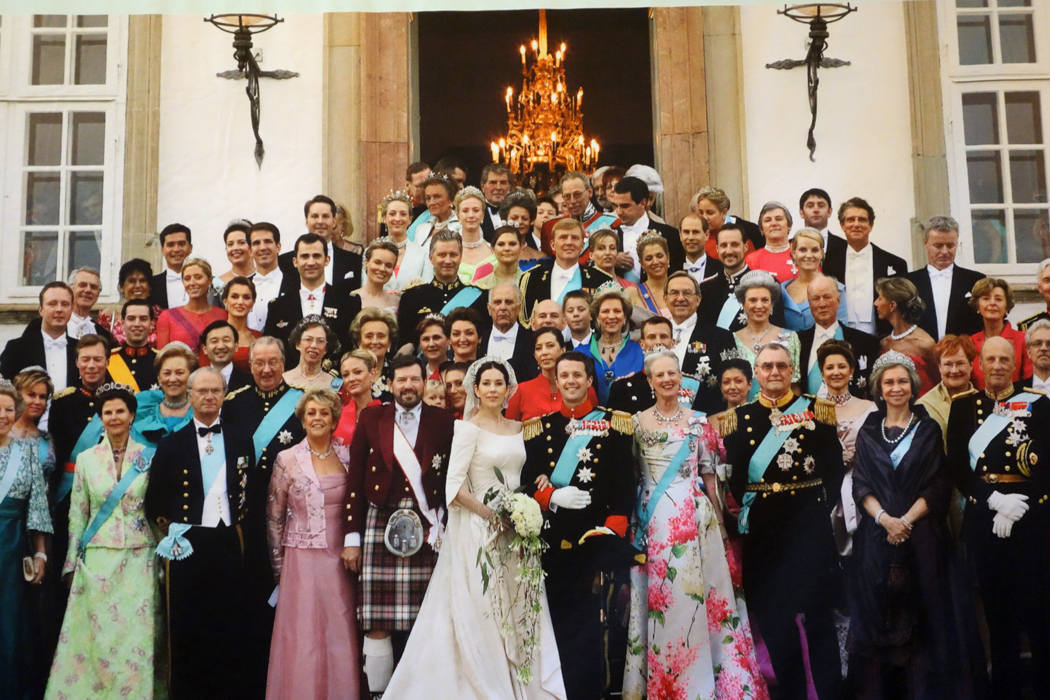
Touring a palace in Copenhagen, I enjoyed this photo of an extended royal family gathering, which included blue-blooded royals from all over Europe. Danish royals are particularly adept at marrying their children into other royal families. That used to be a key to a country’s well-being. These days, I think it just means that you have to put on the tux a little more often. Denmark’s King Christian IX was famously nicknamed the “father-in-law of Europe”— his children eventually became or married royalty in Denmark, Russia, Greece, Britain, France, Germany, and Norway.

In Copenhagen, much of your sightseeing involves Denmark’s royal heritage — like here, at Amalienborg Palace. While Queen Margrethe II and her husband live quite privately in one of the four mansions that make up the palace, the twin mansion just across the cobbled square is open as a museum, which I found particularly interesting. It displays the private studies of the four kings who ruled Denmark from 1863 to 1972 (the immediate predecessors of today’s Queen). Each room affords an intimate and unique peek into Denmark’s royal family. They feel particularly lived-in — with cluttered pipe collections and bookcases jammed with family pictures — because they were.

Many countries have one dominant figure in their history — a big and charismatic personality who really shaped the place. Denmark’s larger-than-life king was Christian IV, who ruled for 60 years in the 17th century and created modern Denmark. This painting decorates the chapel that holds his tomb in the cathedral at Roskilde. The king was a large man who also lived large. A skilled horseman and avid hunter, he could drink his companions under the table. He spoke several languages and gained a reputation as outgoing and humorous. His lavish banquets were legendary, as were his romantic affairs. This painting shows Christian IV wearing his trademark eye patch. He lost an eye to some shrapnel in a sea battle and, according to legend, pulled out the shard and made it into an earring for his mistress. Great he was… until his many wars impoverished his once-mighty country.
The ‘Wrong Side of the Tracks’ in Copenhagen
With the affluence of our time, all over Europe, once-scuzzy neighborhoods on “the wrong side of the tracks” are becoming gentrified. (In fact, here in Copenhagen, the trendiest new area for dining and nightlife fun is the old Meatpacking District, just a couple of blocks behind the main train station.) Stepping into the station, I’ve long heard the martial melodies they play on loudspeakers at its back door without giving it a second thought. Then, with the help of a guide, I learned the reason for the regimented march beat. This video clip explains: