Whenever I see a Tesla, I feel a streak of envy and think, “Wow, cool car…but really expensive.” When I saw a Tesla in Bergen, my guide surprised me by explaining that in Norway, it’s not expensive at all. This video clip explains.
Norway’s Whaling Industry
As I explored Bergen’s old Bryggen trading quarter with my guide, the topic of whales came up. Of course, Norway’s whaling industry is controversial among animal-rights groups. With this little clip, Sue makes the case for her country’s whalers. What do you think?
Beautiful Bergen
Bergen is permanently salted with robust cobbles and a rich sea-trading heritage. Norway’s capital in the 13th century, Bergen’s wealth and importance came thanks to its membership in the heavyweight medieval trading club of merchant cities called the Hanseatic League. Bergen still wears her rich maritime heritage proudly. Here are some snapshots of my latest visit.
 Bergen’s popular funicular climbs 1,000 feet in seven minutes to the top of Mount Fløyen for the best view of the town, surrounding islands, and fjords all the way to the west coast.
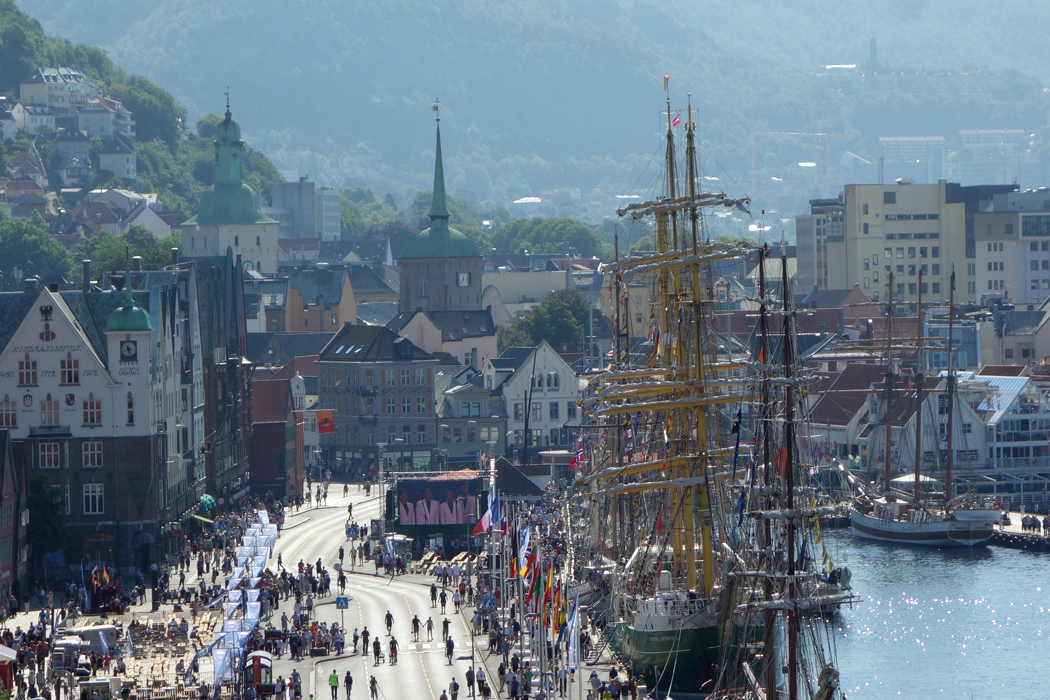 Protected from the open sea by a lone sheltering island, Bergen is a place of refuge from heavy winds for the giant working boats that serve the North Sea oil rigs. (Much of Norway’s current affluence is funded by the oil it drills just offshore.) Bergen is also one of the most popular cruise-ship ports in northern Europe, hosting about 300 ships a year and up to five ships a day in peak season. Each morning is rush hour, as cruisers hike past the fortress and into town. During my recent visit, it was the Tall Ships Festival — which added color and crowds to the mix.
 Part of the joy of travel is seeing local families out just enjoying their city and spending time together. A classic scene anywhere in Scandinavia is blonde tots playing with colorful Legos (made by a Scandinavian company, of course). Here in Bergen’s main square, kids were in Lego heaven with giant tables full of parts to piece together.
Swinging through Norway, from Stave Church to Stave Church
Sometimes I wonder why I lug my bag through airports, following my own recommendation to pack light enough to carry on and avoid checking any bags on international flights. It can be a drag, dragging your bag through airports.
But last week, flying to Bergen, I remembered the joy of having everything with you. I got from Seattle to Copenhagen on time and began loitering, knowing I had a bit of layover. Then I remembered to check the departures board. Sure enough, a plane was leaving for Bergen in 20 minutes — too early to have booked legally from Seattle…but giving me plenty of time to hike on over to the gate, ask if I could be put on, and be told, “Sure.”
I got to my Bergen hotel two hours before planned and enjoyed a jumpstart on my Norway time — a lovely evening in a salty port town where magic hour lasts until 11 p.m.
I’ve been traveling to Europe for 30 years, and teaching travel for 25. I have to be careful that old ideas nailed into my teaching structure don’t live on when they should die. I’ve always said that “younger locals speak English.” I’ve noticed here in Norway that, these days, older locals do too. It’s been an entire generation now since English became the dominant language of travel. And many of us “young travelers” are a generation beyond that, as well — and now essentially everyone speaks English (at least in Norway).
My big lesson in Bergen: Sights are underwhelming, but the guided tours included in almost every admission bring the topics — from composer Edvard Grieg to dried cod to leprosy — vividly to life, making your visit well worthwhile.
After a few days in Bergen, I grabbed a car and headed into fjord country. While travelers swing from castle to castle through Germany, in Norway we seem to swing from stave church to stave church. Medieval Norway was essentially a society built of wood. Devastating fires were commonplace. Bergen had 50 major fires. Oslo had 17. Finally, in the 17th century, a king decreed that in the big city, building would be done by brick and stone rather than wood, and that streets would be made wide to provide fire breaks.
The only grand architecture surviving from Norway’s Middle Ages is wooden churches — built like upside-down Viking ship hulls supported on each corner by staves, or thick posts. While originally built a thousand years ago, they have mostly been burned down and soullessly rebuilt, or cluttered up with 17th-century bell towers and windows. See two or three, and they start getting old. Still, you can’t bypass them. They are about all there is for a tourist taught to look for architectural remnants of a civilization’s past.
The key to really enjoying Norway is to understand that nature is its real draw. Norway’s story is the story of a people’s struggle to live comfortably in a harsh natural world. They leave little beyond pitch-covered wooden stave churches as proof that they’ve been here for ages. Everything else is gone, like a masterpiece on an Etch-a-sketch.
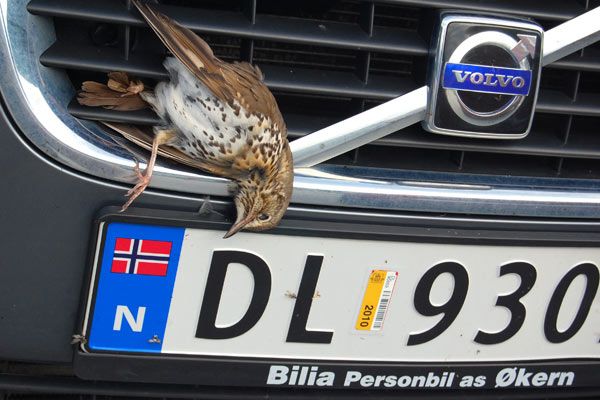
I kept thinking how it’s man and nature here. Driving along fjords — diving for a pull-out each time a car approaches — I remember how I always feel it’s a very dangerous place to drive. Not because of traffic (there’s very little), but because of the scenery. It’s tough to keep your eyes on the road. At the mouth of one fjord, a cute bird flew in front of me and never came out. Later, on a ferry crossing, I noticed people gathering around the front of my car — pointing at a bird still in my grill. It was a great conversation-starter until, on the third ferry ride, I finally pried her off.
The tourist season here is short — just July and early August. In the summer, restaurants and hotels need to scramble like chipmunks to survive the winter. Wondering how that affects the employment scene, I noticed that most of the employees were seasonal. On the front line were cute Norwegian kids visiting home for the summer from big-city studies to be with family and help out, as it’s all hands on deck. And behind the scenes, immigrants cooked and cleaned. Local hoteliers and restaurateurs figure tourists don’t come to some cute fjord village to be served goat cheese by a guy from Pakistan or fishballs by a gal from Romania.
If you haven’t had a chance to read my daughter Jackie’s blog, she’s just a click away — well into a wonderful adventure with her best girlfriend in Spain and Portugal. Check it out while I scramble up some old Norse tales from the fjordland.
 |
 |
 |
| The fairest stave church in Norway? Hopperstad or Borgund. Hopperstad overlooks Sognefjord in the town of Vik. Enlarge photo |
Of Norway’s many stave churches, just see one or two. Borgund is my choice—no fjord, but in a pristine, remote setting, with the best adjacent museum. Enlarge photo |
Norwegian design, carved in wood, to decorate a church door circa 1050. Enlarge photo |
 |
 |
|
| Nice lines; the Vikings built some sleek ships. Enlarge photo |
This bird and I were both distracted by the fjord scenery on Highway E16…then bam! Enlarge photo |