 |
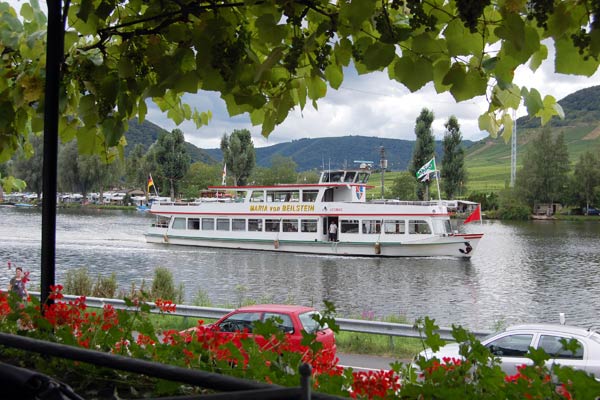
| Need a good place to recharge? Try the terrace of the Hotel Lippmann, overlooking the Mosel River in Beilstein, Germany. Enlarge photo |
 |
| Jonas Lippmann made sure I took things slow and easy for a couple days. But I refused to wear his van Gogh hat. Enlarge photo |
I’m feeling a bit burned out. Researching a string of big cities (Bergen, Oslo, Stockholm, Helsinki, and Tallinn) is physically and mentally exhausting, and it’s frustrating because there’s just never enough time to do the job I want to do.
I gave myself a week to simply travel in Germany. Stepping off the plane in Berlin, I remember feeling strangely like I had just been let out of prison. I was entering a new country without a long list of hotels, restaurants, and museums to check. I was free.
But I was also just spent. Knowing I had my TV crew flying to meet me in a week, I needed to rest.
For my big-city German stops, I let the tourist board arrange hotels and guides for me. In each city, I had local guide for half a day and a big business-class hotel. These were splurges I wanted to try (but not pay for), and places, it turns out, I’d never recommend. Each time I plopped onto a new hotel’s bed, I reaffirmed my belief that a hotel’s personality and location trump its glitziness.
These places, while fancy, had no personality (too big for any of the employees to have any idea who owns the place that employs them) and were in lousy locations (designed for conventioneers, people with cars, or those who didn’t think twice about hopping into a taxi to go anywhere). For me, to be in a hotel where I can’t just step out the door and immerse myself in the charm of my destination is a disaster. I expect to be in a glassy high-rise surrounded by freeway interchanges in Houston, but not Germany.
My Köln hotel was distant from the cathedral and old center. At first I was disappointed about it. I was so tired, I needed to just take a slow walk. Strolling aimlessly among cars, trees, sky, and pavement, I realized the bad location was a blessing in disguise. I was in Germany, and it was as mundane as suburban Anytown, USA: the same humble people, same ethnic mix, same feeling that everyone was struggling together to make it.
To make time for a longer walk, I paid extra at the launderette for the attendant to wash, dry, and fold my clothes. I returned a bit early and just watched her lovingly fold my shirts and tuck my socks into themselves, and slide it all back into my rumpled plastic bag. She did this work all day long with grace. Next door was an empty phone and Internet shop — where foreign laborers come to call home cheaply. The Turkish man who ran it stood outside his door staring at the traffic and the blocky architecture built on the cheap in the 1950s after WWII bombings.
Feeling solitary and pensive, I stepped into a church for a quiet moment. Like everything else around me here in Köln, it was rebuilt after World War II. It was concrete with fake mortar painted on to make it look like the fine stone original. Only a little of the original medieval glass survived, leaving the once-vivid Biblical messages fragmented — mostly replaced by drab, Tupperware-colored glass with no story to tell. The church seemed almost dead. With the lack of religiosity in Germany today, I wondered if the bombings occurred now, whether anyone would care enough to rebuild the place.
From Köln, I felt like I needed to actually convalesce. I’ve never felt so fried. In fact, I almost vowed to schedule a weekly day of rest in my future travels. (We’re not designed to ignore that commandment.)
When I think convalesce in Europe, certain places come to mind: Ærøskøbing in Denmark, Walaker Hotel on Norway’s Sognefjord, Varenna on Italy’s Lake Como, Hallstatt in Austria’s Salzkammergut Lake District, and Beilstein on Germany’s Mosel River.
The nearest of those places: Beilstein — just two hours away by train. Beilstein is the Mosel River’s “Sleeping Beauty town.” Without good road access until recently, it never really got any modern development. Today it’s just grape vines, cobbles, fancy door knockers, the smell of dank back alleys, and Mosel River views. Midday, its charm is trampled by too many tourists. But early and late, it’s a dream…just right for convalescence.
I spent an hour before dinner on the terrace of Hotel Lippmann. Sipping my sprightly white wine, I gazed at the tiny two-car ferry sliding on its cable back and forth across the river. Its slow, monotonous rhythm and the peaceful bikers that came and went with each landing were mesmerizing.
Jonas, who runs my hotel, serves wine and not beer. He explained that people who would stay away because there is no beer are people they don’t want anyway. He serves homemade bread with tubs of Schmaltz (greasy pork lard). I asked him if he knew Barry Manilow. He said yes. I said, “Schmaltz is to butter what Barry Manilow is to music.” Jonas said, “Ja,schmaltzy.”
My room, which faced the river, had a small terrace. A rumble shook my room, waking me on my first morning. Stepping outside, I saw a massive barge filled with coal lumbering by. In a moment, it was gone, and I was left with the peaceful essence of the Mosel: across the glassy river, the little ferry was parked. Above it a church spire stuck like a slate spike through a hill cloaked in a green corduroy of vineyards. As if animating some symphony to the direction of a cosmic conductor, a huge and orderly flock of black birds sloshed back and forth like sound waves across the fields and around the spire. That kicked off a soothing Beilstein day.