Travel Lessons from Germany’s Black Forest

I’m just wrapping up a trip through Germany, France, and Switzerland and I’ve got lots of travel lessons to share with you over the next several days. First up is the Black Forest. (Stay tuned for more tips from Alsace, Verdun, Strasbourg, the great Swiss cities, and Lausanne — and then I’ll be packing you along on a cruise across the Mediterranean!)

The Black Forest (“Schwarzwald” in German) is a range of hills stretching along the French border from Switzerland for about 100 miles to the north. Ancient Romans found the thick forests here inaccessible and mysterious, so they called it “black.” Germans and tourists alike are attracted to this most romantic of German regions — famous for its mineral spas, clean air, hiking trails, cheery villages…and cuckoo clocks. There seems to be a region-wide competition for the biggest cuckoo clock of all, and it can get pretty touristy. At this roadside attraction, tourists — often with wiener dogs in tow — stop, pop in a coin, and watch the cabin-sized clock spring (sluggishly) to life.
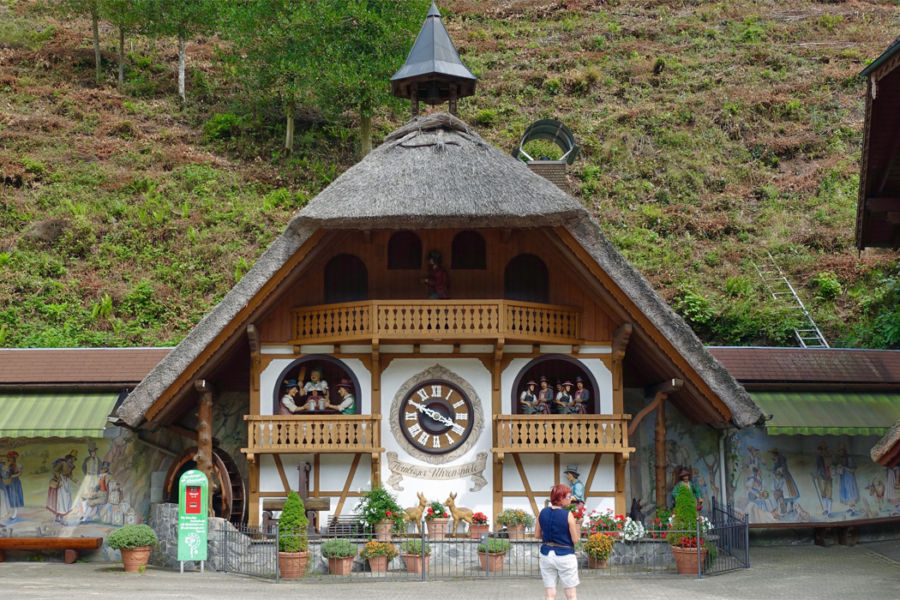
giant cuckoo clock

Until the last century, the Schwarzwald was cut off from the German mainstream. The poor farmland drove medieval locals to become foresters, glassblowers, and clockmakers. Today, the Black Forest is where Germans come to recuperate from their hectic workaday lives, as well as from medical ailments — often compliments of Germany’s generous public health system. (When I try to explain the debate over national health care in my country — so rich, yet so greedy —my German friends can only respond, “cuckoo cuckoo.”)

I visit the region regularly to research and update my Germany guidebook. While finding good places to sleep wasn’t on my research list this time, I stumbled onto a wonderful place in Baden-Baden that I just had to check out and add to the book.

Baden-Baden is the major spa town of the Black Forest and, while pretty touristy, it has a delightful abbey that also operates as a guesthouse. Lichtentaler Abbey, an active Cistercian convent founded in 1245, welcomes the public into its tranquil, gated world. And since 1245, here in what they call “a school for the service of the Lord,” the Cistercians have embraced the teaching of St. Benedict: to live with moderation, show compassion for all, be unselfish, and follow the Golden Rule. The abbey has survived nearly eight centuries of threats, including the suppression of monasteries in Napoleonic times and the destruction of both world wars. When you walk through its gate into the courtyard, cradled by trees and so peaceful, you sense that the place is blessed.
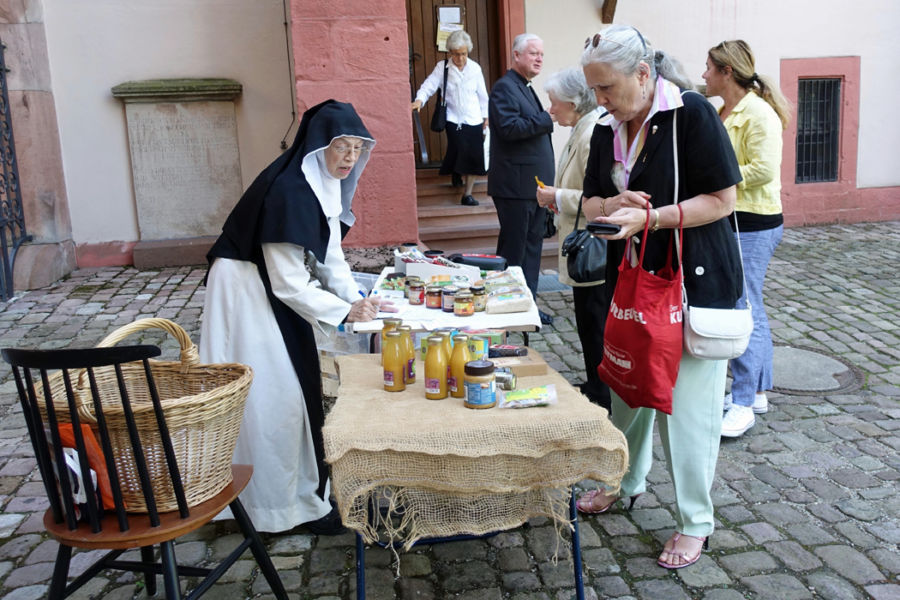
Nun selling cookies

As they have for centuries, nuns at Lichtentaler Abbey sell the things they make and cook.

Here’s the new guidebook listing for the abbey’s guesthouse:

Kloster Lichtenthal Guesthouse lets you be a part of the peaceful cloistered world of a working Cistercian abbey, and your money supports the work of the sisters here. Its 45 monastic-chic rooms offer meditative simplicity under historic beams. Their rooms with only a sink (and access to modern bathrooms down the hall) cost about a third less than the en-suite rooms. As this is an abbey, there is no TV and no Wi-Fi. When the abbey gate closes at 20:00, you feel quite special (tel. 07221.5049119, gaestehaus@abtei-lichtenthal.de).

Freiburg and Baden-Baden vie to be the leading home-base city for those visiting the Black Forest. While Baden-Baden has an old spa-and-casino elegance, Freiburg is much younger and livelier. I explored Freiburg with Simone Brixel, a local guide who always makes my visits much more enjoyable and meaningful.

Simone Brixel and Rick Steves

The Feierling microbrewery is a top local hangout in Freiburg. On warm summer evenings, their biergarten across the street offers cool, leafy shade, great beer, cheap dishes of cold cuts, and a bustling atmosphere. But when the rain hits, everybody scrambles.

Feierling in rain

In the last few years, Germany has experienced freakishly hot and muggy summers. Routinely, the day is hot and muggy and then, just when people are sitting down to dinner in the beer gardens, a monsoon-type thunderstorm unleashes buckets of rain and diners grab their mugs and scramble. When you feel that weather pattern coming on (a tiny version of what flooded Houston)…don’t get too comfortable. It never used to be this way.

rain on beer hall table

My new favorite small town in the Black Forest (to rival Staufen) is little Wolfach. Nestled in the forest on the Kinzig River, the town is essentially one delightful main street lined with fountains, fine facades, and inviting shops and cafés. While things are livelier on market days (Saturdays and Wednesdays), the whole place generally feels like it’s on Valium.

Wolfach

At a museum in a castle at the south end of Wolfach, visitors can learn about the town’s history as an old logging town. In centuries past, log rafters were a big part of this town’s economy — the German equivalent of American cowboys who went wild on payday after herding their cattle to market. They’d lash together hundreds of logs into rafts as long as football fields and float them all the way to Amsterdam, where they were sold to Dutch shipbuilders and used as foundation pilings.

Staufen, another cute little Black Forest town, has long been a favorite of mine. Just a half-hour south of Freiburg, it is hemmed in by vineyards and watched over by the ruins of its protective castle. A quiet pedestrian zone of colorful old buildings and reasonably priced hotels once made it a delightful home base for exploring the southern trunk of the Black Forest. But on this visit, I found a town in crisis. Here’s how I wrote it up for the next edition of my Rick Steves Germany guidebook:

Geothermal Probe Sinks Staufen: A few years ago, Staufen proudly embarked upon a green and innovative plan to drill 460 feet down and tap into a geothermal power source. For a few weeks, things worked great. Then buildings started to show cracks. Catastrophically, the drills pierced a layer of anhydrite, breaking into an underground reservoir. When the anhydrite came into contact with water, it became gypsum and expanded, causing much of the town to sink and then rise. Buildings were breaking as the ground shifted up to four inches a year. The entire town’s underground infrastructure needed to be dug up and replaced and hundreds of buildings were suddenly structurally unsound. Insurance companies and the government are at an impasse for the cost and no one can sell anything. It’s a terrible mess. On the broken facade of the town hall, a big Band-Aid reads, “Staufen darf nicht zerbrechen” (“Staufen will not be broken”). Best wishes to the people of beautiful little Staufen as they work through this tragedy.

staufen sign

Video: The Black Forest’s Lothar Trail — An Up-Close View at Nature’s Healing Process

Exploring the Black Forest High Road (just south of Baden-Baden), we came to a section of that venerable forest that’s healing from a devastating hurricane. In 1999, Hurricane Lothar tore through here, bringing down 50,000 acres of the Black Forest in just two hours. Germany decided to let nature heal itself and built a family-friendly, half-mile-long boardwalk (Lotharpfad) through the park so people can connect with the slow-motion spectacle and cheer nature on. It’s a delightful 20-minute circular walk, easily accessible from a free parking lot.

This is the kind of fun I’ve been discovering all summer as I’ve been updating my various guidebooks with the help of local guides — like Simone Brixel (Black Forest Tours), who you see in this clip. Danke, Simone!

Baden-Baden: Globalization and Leaky Borders

Enlarge photo

To commemorate the Smithsonian Presents Travels with Rick Steves magazine — now on sale online, and at newsstands nationwide — Rick is blogging about the 20 top destinations featured in that issue. One of those destinations is the German spa resort of Baden-Baden.

Germany’s spa town of Baden-Baden is a fun and relaxing place to splash around in a thermal bath. But, as with many resort towns, a more substantial history bubbles just beneath the surface. And, in the case of Baden-Baden, that history still has ripples today.

After the czars banned gambling, many Russians flocked to Baden-Baden, creating their own little Russian enclaves. (Many lost their fortunes, borrowed a pistol, and did themselves in on the so-called “Alley of Sighs.”) While the Russian expat community dwindled for a while, in recent years (after the end of communism), ultra-wealthy Russians have sought out safe property investments all over Europe…and Baden-Baden has re-emerged as a favorite destination. Russians have bought up property here like crazy. You’ll see Russian on multilingual signs around town. On my last visit, the lady who ran the launderette spoke German and Russian…but no English.

This is worrying to locals. The mayor — saying his town must either take action or let itself become essentially Russian-owned — recently declared that Russians were no longer allowed to purchase Baden-Baden real estate.

With immigration a persistent and complex issue in the USA, it’s good to remember that we’re not the only nation struggling with how to handle the realities of race, class distinctions, foreign investment, and use of government services. I see the same challenges all over Europe.

A vast suburb of Tallinn, Estonia, is filled with Russians. They were planted there during Soviet rule, and — although Estonia is now its own independent nation — they still refuse to embrace the local language, Estonian. They live as a separate, Russian-speaking community within Tallinn.

Norwegians — who pride themselves on not being racist — are upset with unemployed Pakistanis living in their country who, they say, don’t share the Norwegian work ethic, but take advantage of the luxurious Norwegian welfare state. I sense that Norwegians don’t know how to discuss this issue comfortably.

I was just in Gibraltar, and the buzz there was about a $20 million mosque built with money from the Middle East for the humble local community of 900 Muslims workers.

Just as people with less money go to work in wealthy lands, people with more money turn their vacation and retirement funds into maximum joy and comfort in cheaper places. I have a friend who’s a retired postman living very comfortably on his meager pension in southern Portugal. A Venetian friend of mine is excited about her new holiday home in Tunisia. No crowds, great beaches, very cheap — she said Tunisia is all the rage among Italians. Belgians have staked out their enclave in Spain’s Costa del Sol — just one more community where the stray Spaniard complains that some eateries don’t offer menus in Spanish. Americans are buying fixer-uppers in droves in rural Italy. And they’re doing it with the encouragement of a government that appreciates the economic boost these romantic Frances Mayes-wannabes bring to regions that need expat newcomers to keep from withering.

There are immigration issues everywhere you travel. Second-generation Turkish Germans can honestly say “Ich bin ein Berliner.” Construction work throughout France would slow to a trickle without Polish builders. While many are now careful to refer to Gypsies as “Roma,” there’s still not enough money to build a Holocaust memorial in Berlin to this group, which suffered a genocide that was comparable, in many ways, to what happened to the Jews.

Like the Swiss are afraid of minarets, the French are afraid of women with covered heads, and America is afraid of a leaky southern border, a lot of anxiety is driving current legislation in all these countries. In Europe, as in the USA, it’s hard to talk about immigration and race issues for fear of offending people. But one thing is clear: Race and immigration concerns are not unique to any one country, and they are here to stay.

While travel may not give us answers, it does give us perspective and a clear sense that we will all ultimately live together…whether we like it or not. The other day, a frightened white woman asked me to sign a petition, saying, “We’ll soon be in the minority.” As a traveler, I know “we” already are in the minority on this planet…and that’s fine with me.

Naked Cartoon Characters in Germany

Yesterday, in two hours, I saw more penises than I’ve seen in the last two years. All extremely relaxed…and, I must say, I was struck by the variety.

Since the Roman emperor soaked in the mineral waters of Baden-Baden, the German spa town has welcomed those in need of a good soak. And it’s always naked. In the 19th century, this was Germany’s ultimate spa resort, and even today the name Baden-Baden is synonymous with relaxation in a land where the government still pays its overworked citizens to take a little spa time.

I happened to be here when one of our tour groups was in town. I told the guide what a great opportunity for her group to enjoy the spa. She said, “No one’s going. They can’t handle the nudity.”

It’s long been a frustration with me as a guide — getting Americans into spas with naked Europeans. My first time was with my wife and some German friends — a classy, good-looking young couple. We were swept into the changing area with no explanation. Suddenly they were naked and I felt like Road Runner just beyond the cliff’s edge. Then — we eased up, and got naked. It’s not sexy…simply open and free.

Whether on a Croatian beach, in a Finnish sauna, a Turkish hammam, or a German spa (I can’t come up with an English example), a fun part of travel can be getting naked with strangers. (Am I right here? What travel memories can you share?)

For me, there are delightful road bumps in my intense research schedule–wonderful God-sent detours where I put away the schedule and notes and simply enjoy the moment. The Friedrichsbad in Baden-Baden is one of those fine little breaks. And today, I needed it: city after city, still reeling from Berlin, with lots of inputting into my laptop. I don’t care how far behind I am in my writing. Now it was spa time.

Wearing only the locker key strapped around my wrist, I weighed myself — 92 kilos. The attendant led me under the industrial-strength shower — a torrential kickoff pounding my head and shoulders…obliterating the rest of the world. He then gave me slippers and a towel, ushering me into a dry heat room with fine wooden lounges — slats too hot without the towel. Staring up at exotic tiles of herons and palms, I cooked. After more hot rooms punctuated with showers came the massage.

Like someone really drunk, going for one more glass, I climbed gingerly onto the marble slab and lay belly-up. The masseuse held up two brillo-pad mitts and asked, “Hard or soft?” In the spirit of wild abandon, I said “hard,” not even certain what that would mean to my skin. I got the coarse brillo-pad scrub-down.

I was so soaped up, he held my arms like a fisherman holds a salmon so I wouldn’t slip away. As if my body was any different to him than the dozens he rubs down every day, funny thoughts went through my mind. It was still extremely relaxing.

Finished with a Teutonic spank, I was sent off into the pools. Nude, without my glasses, and not speaking the language, I was gawky. On a sliding scale between Mr. Magoo and Woody Allen, I was everywhere. Steam rooms, cold plunges…it all led to the mixed section.

This is where the Americans get uptight. The parallel spa facilities intersect as both men and women share the finest three pools. Here, all are welcome to glide under exquisite domes in perfect silence like aristocratic swans. Germans are nonchalant, tuned into their bodies and focused on solitary relaxation. Tourists are tentative, trying to be cool…but more aware of their nudity. Again, there’s nothing sexy about it…just vivid life in full flower.

A beautiful woman glides in front of me. Like a female flotilla, her peaceful face and buoyant breasts cruise by, creating barely a ripple. It occurs to me that I wouldn’t mind talking to her. But you don’t really just start up a conversation with a naked stranger. What would you say–“Nice domes”? Then she starts walking into the men’s section. Perfect. I whisper to her, “Excuse me, that’s the men’s section.” She was from Texas…and appreciative.

The climax is the cold plunge. I’m not good with cold water — yet I absolutely love this. You must not wimp out on the cold plunge.

Then, the attendant escorted me into the “quiet room” and asked if I’d like to be awoken at any time. I told him at closing time. He wrapped me in hot sheets and a brown blanket. No, I wasn’t wrapped…I was swaddled. Warm, flat on my back, among twenty hospital-type beds — only one other bed was occupied…he seemed dead. I stared up at the ceiling and some time later was jolted awake by my own snore.

Leaving, I weighed myself again: 91 kilos. I had shed 2.2 pounds of sweat. It would have been more if tension had mass. Stepping into the cool evening air, I was thankful my hotel was a level two-block stroll away. Like Gumby, flush and without momentum, I fell…slow motion onto my down comforter, big pillow puffing around my head like the flying nun. Wonderfully naked under my clothes, I could only think, “Ahhhh. Baden-Baden.”