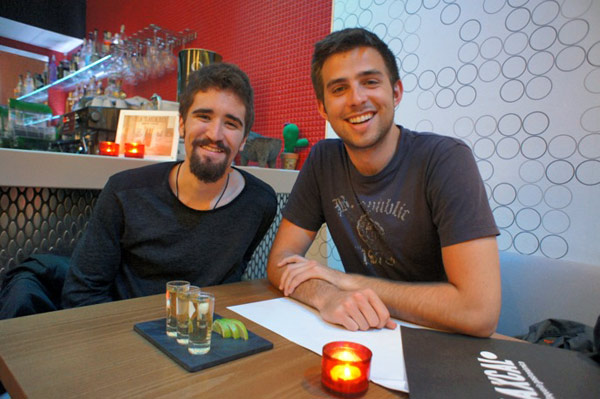
My son Andy’s company, Weekend Student Adventures, organizes three-day, $250 weekends for students on foreign study programs in Europe. I love marketing tours and travel (that’s what I do). And I’m really impressed by Andy’s promotional video clips, which capture the difference between his millennial market and my older travel market. You can check out more than 80 of Andy’s little video clips on Facebook.
Watch a few of these to get a feel for how students traveling on a shoestring enjoy the artistic, cultural, and edible highlights of Europe…what turns them on and what sells tours (if you’re marketing to 20-year-olds). The good news: The joy of travel for students today is as vivid as ever, and you don’t need to be rich to enjoy it. Think of all the students embracing life in Europe in 2015…and thousands of them are doing it with Andy’s help.
My son, Andy Steves, runs his own tour company. His mission: to help American students in foreign study programs enjoy smart, experiential, and inexpensive three-day weekends. The students never have classes on Friday, and discount airlines make it easy to fly just about anywhere for $50 round-trip. So, Andy’s company, Weekend Student Adventures, offers €200 three-day tours all over Europe. He’s taken literally thousands of students on great trips in the past few years…to rave reviews. See WSA on facebook – https://www.facebook.com/wsaeurope?ref=ts&fref=ts.
My son, Andy, spends more time than I do in Europe. But we rarely connect because his tours run during the school year and I’m normally in Europe in the summer. However, Andy just finished his tour season and was able to drop by and hang out with the crew and me while we filmed for four days on Italy’s Cinque Terre. Though Andy had other things to do during the day, each evening he managed to show up…just in time for dinner. I was happy to have Andy dining with us for two nice meals on camera for this episode.Andy has become a workaholic tour organizer…just like his Dad. Well, not quite as bad. But this moment, with both of us on our beds and hard at work on our laptops, with the wonder of the Riviera just a block away, struck me as interesting.Seeing Andy off at the Monterosso train station was really fun — and tear-jerkingly beautiful for his proud Dad. Andy is an amazing traveler who, I’m sure, knows his angle on European travel better than anyone.
Exactly one generation ago, I was giving talks all over town for free to let people dreaming about European travel know how to travel smart…and to talk up my guidebooks and tours. Today, my son Andy is doing much the same thing.
For 20 years we took Andy to Europe every year for a family vacation and to break up the time I was away from the family while working. I didn’t think Andy was paying attention. Now, just a few years out of Notre Dame, Andy is essentially living in Europe and running his own tour program (and I’m keeping a wary eye on what could become a formidable competitor).
Actually, as his dad, I am really proud of what Andy’s doing as he teaches college kids how to get the most travel experience out of their foreign-study semesters abroad. Andy spends the early part of each semester on a blitz tour of European campuses that host Americans, giving his student travel talks to new arrivals. School administrators welcome Andy onto their campuses because they understand that there’s a huge educational potential in their students taking full advantage of the three-day weekends (there’s no class on Fridays) by traveling–and Andy can teach them how. With discount airlines these days, a cheap, three-day weekend anywhere in Europe is simply a matter of going online and booking a discount flight and a youth hostel.
Of course, like me, Andy’s teaching has an ulterior motive–to let potential tour members know about the tours he offers: three-day “Weekend Student Adventures” to cities like Barcelona, Budapest, Paris, Rome, and Krakow (for around $250 each). Andy and his band of student guides have enriched the study-abroad experiences of literally thousands of American students who have signed up on his WSA tours.
If I may be a proud dad, check out this video clip of my son teaching at a campus in London.
If you can’t see the video below, watch it on YouTube.
My son, Andy Steves, continues to build his Weekend Student Adventures tour program, offering American students in Europe three-day weekend tours of the top cities for about $250. (I got to be an assistant tour guide supporting Andy with one of his groups in Barcelona, and I can personally attest that his tours have to be about the best deal going for students looking to have a fun and well-organized weekend.) His bestselling trips each year are the famous festival weekends: Carnevale in Venice, Easter in Rome, Queen’s Day in Amsterdam, and St. Patrick’s Day in Dublin. These are the times when lifelong memories are created.
Andy’s St. Patrick’s Day weekend is almost sold out, as about a hundred students will join him and his Irish guides on the only day when anyone can be an honorary Irishman. Here’s Andy’s take on the celebration:
Historically, the first St. Paddy’s Day parades started popping up about 250 years ago in NYC and Boston; Irish soldiers would march through the streets on this day to reconnect with their roots. While at some point today’s celebration morphed into one that has little to do with the man it’s named after, I believe the day still presents an opportunity for millions around the world to reconnect with their Irish identity. With 37 million Americans claiming Irish ancestry (8 times the current population of Ireland itself), it makes sense that the biggest parades happen in the States: NYC, Boston, Chicago, and Savannah. But Ireland isn’t far behind. And what better and more authentic way to celebrate being Irish than on the streets of Ireland itself? Last year I was there as over 600,0000 revelers come in to Ireland’s capital to celebrate the weekend, wearing green and kissing lots of Irish maidens.
It took Ireland until the year 2000 for the Irish Department of Tourism to recognize this opportunity, but now they’re embracing the festive event as a way to pump up their economy. They’ve titled the weekend of celebrations “The World’s Friendliest Day,” and this year for the first time, they are inviting the general public to participate in the parade along with 17 bands and hundreds of performers from around the world.
While the parade and festivities are quite mainstream by now, my favorite place to be is off the beaten path next to a toasty wood oven in a little Irish pub near O’Connell Street, listening to an impromptu “trad” session. I love being around a group of locals singing the songs they’ve sung their entire lives. The musicians playing aren’t there for any reason besides the love of their musical repertoire and the convivial atmosphere. It doesn’t hurt that the local audience knows every single word of every single song they play. Old and young alike gather in pubs like these all across Ireland to create an atmosphere that I find absolutely unique to this country. This spirit is the reason I love coming back again and again.
Wherever you find yourself this St. Patrick’s Day weekend, my merry band of student travelers and I will be raising one of the 12 million pints of Guinness to be consumed around the world to you and all that is green. Slainte!
If you know any students studying in Europe, Andy has a great program worth checking out. Click on over to WSAEurope.com to see what he’s offering.
“This is my friend, Diego who I met through airbnb.com. I had a great time staying with him in his very comfortable apartment while in Barcelona. And at only 25 euros a night, a great value and great travel.”
I just spent a weekend at the NAFSA: National Association of Foreign Study Advisors convention in Houston with my son, Andy. I was actually working for Andy at his booth, and enjoyed seeing how, in two years, he has really established himself in the minds of university foreign study program advisors across the USA.
As Andy (with his Weekend Student Adventures business) is more hands-on with student and budget travel than I am these days (he lives out of hostels running his business from his laptop in Europe for half the year), I ran the script for my upcoming three-part series on travel skills by him. (I’ll be updating my ten-year-old travel skills shows this summer, for debut on public television this fall.)
I gave Andy my rough script, and he shared some great comments on how I can be more up-to-date and tuned in to the way younger people travel. Here are Andy’s suggestions:
Bikes: While there are many public bike rental systems across Europe that work very well for locals, often times they require “chip and PIN” debit cards, and even national social security numbers to set up an account. For this reason, it’s unlikely your American viewers will be able to get in on the great deal if only in town for two or three days. For instance, in Barcelona, you need to have a national ID card to subscribe to the service (€45/year), and then your rides are free for the first 30 minutes. Locals take longer jaunts by checking in and out at multiple stations along the way before the time goes over the limit.
Credit Cards vs. Debit Cards: Using a credit card almost always comes with a higher percentage transaction fee compared to a debit card — 5 percent compared to 2.5 percent or so. Keep in mind that your daily withdrawal limit is in US dollars, but you have to convert that to euros — they’re different!
Recreational Reading: When discussing how to prepare for your trip, make a point to include listening to podcasts, too. There are great podcasts about all sorts of topics related to your upcoming trip.
Car Rental: For a backpacker, renting a car is hardly ever the cheapest option for getting around. The daily fee may be enticing, but the inevitable extras make it far more expensive then you were led to believe. You’re paying for your independence through tolls, gas, and parking. Remember, Europe is dotted with automatic speed guns and cameras that will issue a ticket and track you down even across the pond. I got photographed speeding and got a $100 ticket with a $100 service charge added on by my rental company.
Estimating Metric: For rough conversion from kilometers to miles, two-thirds does it: 30 kph is 20 mph, 100 kph is 60 mph. For Celsius, room temp (71 degrees F) is 20 degrees C.
Internet and Phoning: Cybercafés are getting more and more dated. Most travelers use Wi-Fi devices — in either cafés or hostels. Smartphone users beware the huge fees when you roam. Before my plane takes off from the States, on my iPhone I switch “on” Airplane Mode, switch “off” Cellular Data, and switch “on” Wi-Fi. This prevents me from racking up hundreds in phone bills for data usage. “International data plan” options offered by your provider are hardly ever a good deal.
Communicating with Loved Ones Back Home: Skype and FaceTime are key and cheap (or free). If you are both online and have iPhones, you can enjoy a FaceTime connection across the street or across the ocean for the same price — free. Otherwise, Skype is a good standby. In either case, the key is having a good Internet connection, as you have to be online.
Events: Take your trip to the next level by paying attention to and researching event schedules on the route you want to travel: sporting events, concerts, festivals, special exhibits, and other celebrations are invaluable experiences that will really make your trip unforgettable. Chasing down events that interest you help you connect with locals who share the same passion, whether it’s catching the Tour de France, or experiencing a special photography exhibit by your favorite photographer.
Beggars: Along with thieves, a common distraction technique is for young women to beg for you to sign a seemingly reasonable petition (like “against drugs”). These are just ways to distract you while their partners pick your pocket. Never stop for them.
Dress Code: European adults generally don’t wear shorts, no matter how hot it gets. If blending in is a priority, bring your swimsuit, but leave the shorts at home.
Hosteling: References to IYHF (the International Youth Hostel Federation) are dated. People book hostels through Hostelworld.com. Hostel rooms are generally either mixed or female-only — no exclusively male dorms. CouchSurfing.com and Airbnb.com are both popular these days. I don’t think I’d ever follow a local who picks me up at a train station home. Airbnb.com is safer — you can agree on the price, cash never trades hands (it’s done automatically), and you can read reviews to make sure it’s what you’re looking for.
Free Walking Tours: While you don’t get a licensed guide, and your “guide” is generally an expat student who has memorized a script, these “free” tours can be a great value. They are advertised all over the place, provide little personal attention, and are often entertaining, but emphasize stories over the strictly academic. They’re known to take some liberties with historical events and characters. And they are based on tips. You will be hit up really hard for a tip. Still, I use them all the time and enjoy them.
Cheap Flights vs. Sleeping on the Train: People don’t sleep on the train like they did in the old days. In your TV show, you should do a bit on discount flights: how to find a budget flight, search engines, booking flights online, encountering a difficult experience at the airport, how to play their games (baggage fees, fees for checking in at the airport, printing boarding passes before to save on more fees), etc. Also, be sure to factor in additional costs for the transfer between the airport and downtown. Some flights may cost €20, but the bus to and from the airports costs €35.