I’m done traveling for the year, but other members of my staff are still in the field. While I regroup from 100 days in Europe, I invited my frequent collaborator Cameron Hewitt to share some posts from his blog. Cameron has traveled about as much as me this year, updating our guidebooks in Italy and France, and turning our already strong material in Scotland into a stand-alone Rick Steves Scotland guidebook (due next spring). While Cameron and I are in perfect sync in terms of travel styles and priorities, he gives voice to the next generation of Rick Steves travelers. If you like Cameron’s insights, you can read much more on his travel blog, and you can also follow Cameron on Facebook. — Rick
Debunking Braveheart in Stirling
by Cameron Hewitt
It’s fun to tie recreational viewing to your travels. Here in Scotland, I’ve been watching everything from Highlander to Outlander. In Stirling, I re-watched Braveheart for the first time in two decades. And do you know something? It’s terrible. Mel Gibson’s much-assailed Scottish accent may very well be the most authentic thing about the film.

The town of Stirling has strong ties to the real William Wallace. From Stirling Castle, you can see Abbey Craig, the knob of land where Wallace and his troops surveyed the battlefield the night before they clashed with the English. Today it’s capped with a Romantic-era monument celebrating Wallace, filled with insightful exhibits that tell the real (non-Braveheart) version of events.

Looking out from the Wallace Monument, you can see the almost 360-degree bend in the River Forth, including a newer stone version of the original, wooden Stirling Bridge. In the Battle of Stirling Bridge, William Wallace and his ragtag Highlander forces hid out in the forest overlooking the bottleneck bridge until the perfect moment to ambush. Thanks to the tight quarters and the element of surprise, the Highlanders won an unlikely victory.
Watching Braveheart, you get an entirely different version of events: armies lining up across an open field, with blue-faced, kilted, berserker Highlanders charging at top speed toward heavily armored English troops. The filmmakers left out the bridge entirely, calling it simply “The Battle of Stirling.” Oh, and the blue facepaint? Never happened. A millennium before William Wallace, the ancient Romans did encounter fierce fighters in Caledonia (today’s Scotland) who painted their faces (the Picts). But painting faces in 1297 would be a bit like WWII soldiers suiting up in chain mail.
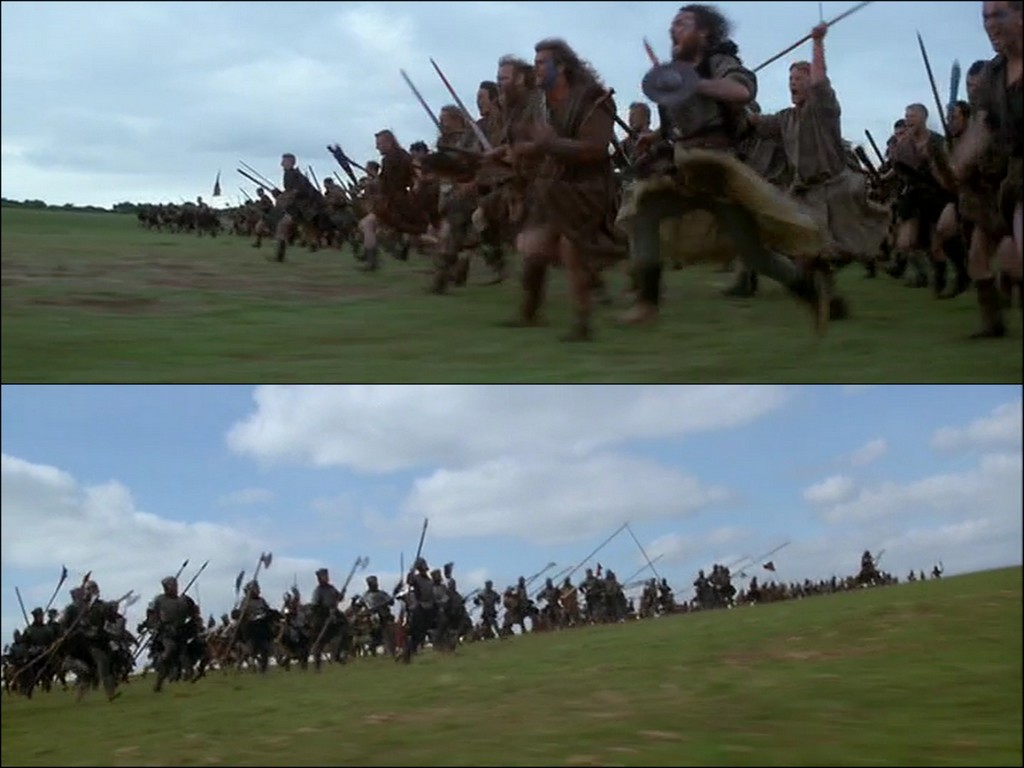
Braveheart takes many other liberties with history. William Wallace did not vengefully kill Andrew de Moray for deserting him at Falkirk (Moray fought valiantly by Wallace’s side at Stirling, and died from battle wounds). Robert the Bruce did not betray Wallace to the English. And William Wallace most certainly did not impregnate King Edward II’s French bride…who was 10 years old, not yet married to Edward, and still living in France at the time of Wallace’s death. (Entire websites are dedicated to outlining the many other inaccuracies in the film.)
Also, the modern notion of national “Freee-dooooom!” was essentially unknown during the divine-right Middle Ages. Wallace wasn’t fighting for “democracy” or “liberty”; he simply wanted to trade one authoritarian, aristocratic ruler (from London) for another authoritarian, aristocratic ruler (from Scotland).
Even the film’s title is a falsehood: No Scottish person ever referred to Wallace as “Braveheart,” which was actually the nickname of one of the film’s villains, Robert the Bruce. After his death, Robert’s heart was taken (in a small casket) on a crusade to the Holy Land by his friend Sir James Douglas. During one battle, Douglas threw the heart into an oncoming army and shouted, “Lead on, brave heart, I will follow thee!” Apparently, Mel Gibson must have heard this story and appropriated it. It’s a bit like if Stephen Spielberg, when making the film Lincoln, said, “I know that nobody actually called Abraham Lincoln ‘Old Hickory.’ But it sure has a nice ring to it…”

The Scottish people I talked to have mixed feelings about Braveheart. They appreciate the boost it gave to their underdog nation’s profile on the world stage — and to its tourist industry — juuuust enough that they’re willing to look the other way when it comes to the liberties the film takes.
I’m not saying to skip Braveheart, or other fact-based fictional movies. I’m just saying don’t assume that you really understand the history just because you’ve watched Mel Gibson’s Hollywood version of it. For an armchair historian, one of the joys of travel is going to places like Stirling and getting the real story.
Greetings,
Most Americans are probable unawares of all the struggles of the Scots. Thanks for your interesting insights.
You know you can always tell a Scot…
But you can’t tell him much…
Jeff
(Rick’s Doppelganger)
Lakeland Highlands
Florida
I work in Hollywood. If you think our version of William Wallace was bad, you should have seen what Shakespeare did to Joan of Arc. ;)
Braveheart still a great movie, despite the inaccuracies. Made me delve further into Scottish history. Remember it’s Hollywood. Have you seen “Abraham Lincoln: Vampire Killer”? Now that’s accurate.
It also repeats one of the common misunderstandings in Hollywood that medieval warfare consisted mostly of wild crowds charging towards each other. In reality, most warfare at the time consisted of prolonged sieges. The rare open pitched battles more closely resembled rugby scrums and the body counts were usually surprisingly low.