Celebrating Homecoming with a Good Cigar?

 finished my trip with a sprint — updating Bruges and Brussels in a frenzy and using the flight home to input my notes. Getting home was wonderful — seeing family after nearly two months away…finally catching up with Anne…enjoying the last days before empty-nesthood as Jackie, our youngest, is heading off to Georgetown University in three days…and Andy is heading back to Notre Dame in a week.

Our last nights with Andy were particularly fun, as he shared photos from his semester abroad. (I was envious of the fun he had — which we’ll be sharing in a series of entries here shortly.) He’s so excited about the experience, that he’s building a website to share and organize information for other students making weekend trips from their European study home bases.

Travel has gotten Andy into the ritual of appreciating fine cigars. It’s both strange and fun having a 21-year-old son sit on the deck and teach you how to appreciate a good Cuban cigar. Sophisticated as he was in explaining the qualitative differences in cigars from various Latin American countries, he admitted it was un-cool to smoke it right down to the very end. (And sophisticated as he was, I was struck by the fact that this 21-year-old cigar aficionado with the burny fingers had never heard of a roach clip.)

Andy’s youthful sophistication intrigues me. When we met up in London, I took him out to dinner and squirted oil all over my shirt while ripping the head off a shrimp. Andy looked at me and said something like, “Not staining your shirt when you’re eating out is a lifestyle.” Then he shared a highlight of his London stay with me — a cigar lounge. He took me into his favorite, and together we shopped for the best cigar money could buy. (He also showed me how willingly cigar salespeople can slip the ring off a Cuban cigar and slip the cigar into a tin from a country not weathering an American embargo, and suddenly you have no way of knowing where that tobacco actually came from.) Andy knows how to make that effete scene and feel like it’s not forced.

One great thing about doing my work in Europe is that I’m out of touch with the day-to-day challenges back in my office. My first few days back home are always spent getting briefed on things. Tim, my radio producer, announced that (in just our third year on the air) our radio show is now carried weekly by 99 stations. He gave me CDs of new shows (with guests like Salman Rushdie, David Sedaris, Lord John Alderdice, and others) that are just better than ever. We must have a party when we crack 100 stations.

The best news of my homecoming was about our Iran show. The network offered our one-hour special to the public television system and well over a hundred stations responded enthusiastically, saying they’d run our show. Only seven said, “No, thanks.” This means this January, we’ll have our Iran show running in nearly every major city in the USA. Now we set about finishing the show, and I am busy turning my Iran blog and photos into a companion booklet.

Within days of my return, our staff enjoyed a sunny, annual office picnic. It seems like just a couple years ago when there were 20 of us and only a few little kids. Now there are 70 — with probably 30 kids old enough to toss water balloons and whack a piñata.

John Knox, Mickey Mouse and a very big boy

Here’s a batch of photos shares a little of the fun I had in the last two months in Europe. I’ve also added a few photos to the last dozen or so blog entries you may enjoy reviewing.

At the John Knox House in Edinburgh a fun little dress up corner let me play out my Great Reformer fantasy.
Enlarge photo

In a York churchyard a family illustrates how a picnic can become a great budget dining experience if you find the right place to picnic.
Enlarge photo

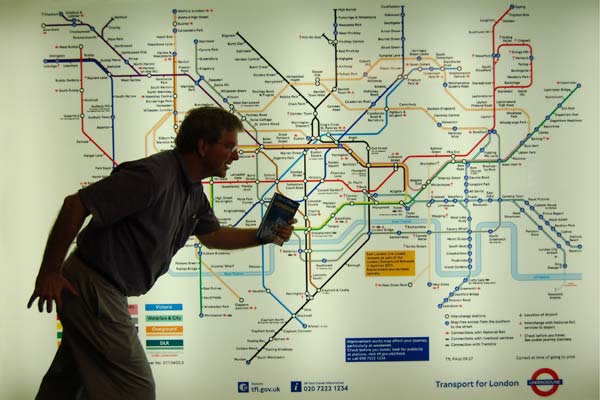
Armed with a well-stocked Oyster Card, London’s Tube can be one of the best tools to enjoy London efficiently and economically.
Enlarge photo

The thought-provoking London tee-shirt is an example of the edgy take many Europeans have on Globalization.
Enlarge photo

The Big Boy helps make the Aros museum in Arhus, Denmark one of Europe’s more entertaining artistic experiences.
Enlarge photo

Everyone gets around better by bike in the Netherlands.
Enlarge photo

Warrior Pigeons and Savage Mushrooms

A few more “leftovers” from my recent trip:

While traveling on business — especially while filming — I have the time figured out very carefully and always have necessary reservations to keep things moving smoothly. In Denmark, leaving the Isle of Ærø early one morning as we began a demanding day of filming — and proud of my ability to read the sign — I directed us into a line for the ferry that said “reservation.” I felt smart…until all the other lines emptied into the ferry and I realized I put us in the “no reservations” line. We nearly didn’t get onto the boat.

A couple days later, I left Denmark with a 20-kroner coin in my pocket — worth about $4. It occurred to me that I couldn’t think of a nation that had a smaller “biggest coin” than the USA. (Europe’s 2 euro coin is worth over $3. Canada has a $2 coin.) What does it say about a nation that can’t get used to a coin worth more than 25 cents? We’ve tried 50-cent and one-dollar coins, but they just don’t work. (Now, don’t think this comment is anti-American…it’s an innocent question, neither pro- nor anti-USA.)

In Denmark, things are so costly that it seemed people consume more sparingly. The society is designed in a way that encourages people to consume less, chew slower, and just sip it. A glass of beer costs $10. A cup of coffee can cost $7 — and refills are unheard of. I think they know they could make more money if they embraced the “Big Gulp” track and started super-sizing things. But the collective decision is not based on what’s good for the economy. A Costco economy is just not Danish.

Susanna, who runs a gorgeous little B&B on the Isle of Ærø, hosts lots of travelers from both my guidebooks and my Scandinavia tours. She observed that nearly 100 percent of those with my guidebook are Democrats, while those taking my tours are half Democrats and half Republicans. Hmmmm.

While beer costs a fortune in Denmark, it’s half the price and twice as good in Belgium. Good beer has been a theme of mine in Belgium. Everywhere else, it seems you order what’s on tap for the best local brew. Here, the experts remind me that because there is such a vast selection of beloved specialty beers, there is not enough quantity consumed of any single brew to keep kegs from going old and stale. Therefore, the connoisseurs prefer their beer in the bottle.

Wandering around Brussels, I found a monument to “Au Pigeon Soldat WWI” at the end of St. Catherine’s Market. Imagine, honoring the men who cared for the pigeons that played an important role in a world war.

One evening I ordered wild mushrooms because of their evocative name in French: champignons sauvages.

Lessons Learned in an Amsterdam Coffeeshop

I was just in the Netherlands researching the new edition of my guidebook on Amsterdam and getting up-to-date on the “coffeeshop” (i.e., marijuana) scene. Regardless of how you might hate or love marijuana and what you think about American laws, it’s fun to try to understand the Dutch system. Here’s what I learned just last week.

When tourists call an ambulance after smoking too much pot, Dutch medics just say, “Drink something sweet and walk it off.” Amsterdam, Europe’s counterculture mecca, thinks the concept of a “victimless crime” is a contradiction in terms. Drive under the influence of anything and you’re toast. Heroin and cocaine are strictly illegal in the Netherlands, and the police stringently enforce laws prohibiting their sale and use. But, while hard drugs are definitely out, marijuana causes about as much excitement as a bottle of beer.

Throughout the Netherlands, you’ll see “coffeeshops” — pubs selling marijuana, with display cases showing various joints or baggies for sale. The minimum age for purchase is 18, and coffeeshops can sell up to five grams of marijuana per person per day.

Because of laws prohibiting the advertising of marijuana, you need to take the initiative and ask to see the menu. In some places, there’s actually a button you must push and hold down to see the menu illuminated. And the menu looks like the inventory of a drug bust.

Americans with no reason for paranoia play hide and seek in an Amsterdam coffeeshop.
Enlarge photo

The big news on the coffeeshop scene is the new nationwide smoking ban. These laws pertain to tobacco smoke, but not marijuana smoke. But the Dutch, like the rest of Europe, mix their marijuana with tobacco. It might seem strange to an American, but if a coffeeshop is busted…it’s busted for tobacco. Shops are mixing a kind of herbal tea as a tobacco substitute for joints. Coffeeshops with a few outdoor seats have a huge advantage, as their local customers can light up outside. And shops without the outdoor option are in for an extra challenge, as many local smokers would rather get their pot “to go” than smoke it without tobacco at their neighborhood coffeeshop.

Pre-rolled joints are now sold pure, with the non-tobacco “hamburger helper” herb mix, and with tobacco. The pure marijuana joints are much easier to buy now than just a year ago. Some shops sell individual joints (€2-5, or about $3-7.50). Others sell only small packs of three or four joints. Shops sell marijuana and hash in pre-rolled joints and in little baggies. Shops have loaner bongs and “smoke-free” inhalers, and dispense cigarette-rolling papers like toothpicks.

While Dutch law allows for shops to keep an inventory of up to 500 grams, the wholesale dimension is the famous “grey area” in the law. It’s just left out of the equation. Most shops get their inventory from the pot equivalent of home brewers or microbrewers. Shops with better “boutique suppliers” get the reputation for having better-quality weed (and regularly winning the annual Cannabis Cup). The tax authorities don’t want to see more than 500 grams (about a pound) on the books at the end of each accounting cycle, and shops lose their license when found with too much in stock.

A shop could retail a ton of pot with no problem, as long as it maintains that tiny stock and refills it as needed. Amsterdam’s mayor, understanding that this just has the city busy with small-time deliveries, has proposed doubling the allowable inventory level. The reason the inventory level is kept so small: They want shops to stay small and not become bases for exportation. Providing pot to neighboring countries would bring more international pressure on the Netherlands to crack down on its coffeeshop culture.

The other legal trend is that licenses are not being renewed in some neighborhoods as the city wants to maintain a certain smattering of shops and not have too big a concentration in any one area.

The Dutch are not necessarily pro-marijuana, but they do believe that a prohibition on marijuana would cause more problems than it solves. Statistics support the Dutch belief that their system works. They have fewer hard drug problems than other countries. And they believe America’s policy is based on fear, misinformation, and electoral politics, rather than rationality. And, after a 10-year track record, the Dutch have found that their drug policy does not result in more pot smoking. Statistically, Americans smoke twice as much pot as the Dutch (per capita).

Tonight It’s Leftovers

I’m just wrapping up this trip. And my refrigerator is cluttered with still-edible blog scraps. So tonight, we’re having leftovers.

Just like Americans used to clap when a plane landed safely after a long flight (back in the 1970s), on two successive Turkish Air flights I noticed that Turks clap today as they land safely.

English drivers monitor their driving record carefully to maintain their favorable insurance rating. Moving violations are given various points (e.g., 3 points for speeding). When they get 12 points, Brits loose their license. Points stay on their record for four years. Everyone I talked to in Britain was nursing their record along with somewhere between 3 and 6 points.


London’s emerging Manhattan at Canary Wharf.
Enlarge photo

Back when Britannia ruled the waves, London’s Canary Wharf was the world’s biggest shipping harbor. Then it became a run-down wasteland. Now it’s hosting my nomination for Europe’s most impressive urban development. London is shifting east. There’s a whole new Tube network evolving east of London. The 2012 Olympics will be the district’s coming-out party, as most of the events and venues will be there. Wandering around the Docklands (Tube: Canary Wharf) was like finding a slick, futuristic Manhattan with an English accent.

I found the English were really caught up in the American presidential campaign. They say this is in part because of the popularity of the TV series The West Wing,which has educated an entire generation of Brits on American politics, and is still very popular in the UK. When I told an English friend I thought American travel to England was down, he disagreed, saying, “Americans are still coming to the UK because as Americans are less popular in the world, England is a refuge…a place where Americans can tell if people are talking about them.”

When I meet backpackers, I quiz them on shoestring travel in 2008. Most find rooms via www.hostelworld.com, which lists and assesses the countless hostels that house people who don’t stay in hotels. And most are enjoying Europe on $80 a day.

I’ve never seen a car with a bumper sticker on it in Europe. Why are we so into bumper stickers, while sticking what you think about something on your car never even occurred to any European?

I don’t make a habit of responding to comments on this blog, but Ken’s question (responding to my previous entry), implying that I was contributing to the Russian Bear’s economy and image by choosing this “monumental” time to start our tour program there, deserves an explanation. Yes, we have just added a Best of the Baltics tour that includes St. Petersburg in Russia. And it happens to be our best-selling tour right now. (You can find out more about this new itinerary on our 2009 Tourswebsite.)

Like most people, I didn’t anticipate the Russian aggression against Georgia. But, to answer Ken’s concern, this breaking development makes me more enthusiastic about a tour including Russia, rather than less enthusiastic.

I believe many people, when confronted with an enemy, are predisposed to shut off communication, hunker down, and fight. And I believe that when you travel into “enemy territory,” you can make connections that help encourage understanding and dispel fears. (That’s why I took our film crew to Iran this spring.) I believe people-to-people communication (along with the costly-but-successful US battle of economic attrition and our hard military stance) helped us get through the Cold War with the USSR without it going hot.

We will always have enemies and people whose goals are at odds with ours. While interviewing Lord Alderdice, Member of Parliament and architect of the Irish peace, for my radio show (which will air on the weekend of September 6), I learned that the only alternative to needless wars (which ironically make us weaker on the international scene) is perpetual negotiation and compromise and creative waging of peace — which, I believe, will make us stronger.