|
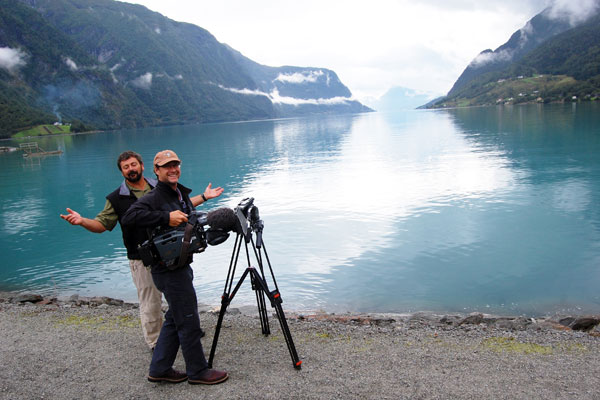
Checking in with my Norwegian cousin Kari-Anne and her husband Knute, we got a little dose of the Scandinavian good life — while filming the delightful Oslofjord.
Enlarge photo |
Europe is moving beyond its old-time clichés, and I’m weaning myself from these too. In fact, my theme this year, in both TV production and guidebook writing, has been to purge things that are recommended just because they’ve always been there. Sometimes it’s difficult after decades of singing a cultural tune to realize the melody has changed. This year I find myself thinking, “That was big in the 1980s, but…” as I work to keep my take on Europe fresh.
In Norway trolls may still be in the shop windows, but they have no business in a guidebook or TV show. Goofy legends about modern-age buildings having roofs inspired by upturned Viking ships are out. Sweden used to be a porn capital — but so much modern-day freedom in that regard seems to have made that industry passé. I remember when the TV towers in Berlin, Stockholm and Oslo were as breathtaking as Seattle’s Space Needle. Oslo’s is now closed to the public and the others are barely advertised.
There was a time when travelers ventured to Stockholm and Helsinki to see planned suburbs like Farsta and Tapiola — suburbs that organized people as if in juke boxes…and people clamored to get in. No one even talks about these places anymore. In the 1980s it seemed every other tourist in Helsinki was an architect, there to marvel at the modern buildings. Today Helsinki’s once-striking Finlandia Hall, by Alvar Aalto, is only striking out. I’ve always listed the Kon-Tiki Museum in Oslo as a must-see. It was one when it captured the imagination of would-be sea adventurers a generation ago. Today, the museum seems to be going the way of the log boat.
I have also realized that I need to be careful not to romanticize the nobility and intelligence of a people I’m predisposed to be impressed by. It’s so much fun to bump into entire societies that are both good-looking and seem to have it all figured out. You could travel through a place like Norway and think everyone was brilliant and beautiful. But seeing racks of National Enquirer-type tabloids in Bergen — papers as cheesy and idiotic as ours and England’s — reminds me that no society is immune from low-brow culture; there’s a huge market for that everywhere.
Having spent more time in Scandinavia this summer than ever before, I enjoyed a great chance to reconnect with my wonderful relatives. My uncle Thor in Sandefjord is a patriarch with beautiful grandchildren galore. My cousin Kari-Anne is a publisher with a fascinating circle of friends; she lives in Oslo, enjoying the best of Norwegian big-city life. And Hanne, the baby I held while watching the first moon landing, has three kids old enough to stay up late and contribute to our conversation.
Ten years ago, while filming in Bergen, Hanne kept sneaking into our shots. In Norway, she said, those obnoxious types who always try to get into the picture are called “lens lice.” I asked her if she’d like to be a part of the new show we’re filming, and she said, “My lens lice days are over.” (While I strongly disagree, I didn’t argue.)
I spent an evening with Hanne’s family enjoying the fun conversation. We talked about the challenges modern Norway has with immigrants. In this Lutheran corner of Europe, they explained, everyone enjoys the freedom to practice their religion, as long as the practice doesn’t violate Norway’s constitution, which guarantees a range of human rights — including women’s rights, gay rights, and children’s rights (e.g., parents are forbidden to beat their children). Fathers are intimately involved in parenting. In fact, throughout Scandinavia, rather than “maternity” leave, new moms and dads share 16 months of paid leave (dividing it as they like).
Hanne’s kids sat attentively as they soaked up the conversation. Hanne’s 13-year-old daughter speaks English so well that she played a game speaking American with her mom and British with her dad (as that’s how each speaks English with her). I asked her about cigarettes, alcohol, and marijuana. She said she and her friends had no interest in any of that. She explained that the government tried the “bad for your health” line in their education campaigns, and it was worthless. Then the schools started teaching that cigarettes made your skin ugly, stained your teeth, and gave you bad breath. They taught that alcohol lowers your metabolism, making you get fat more easily. This appeal to teenagers’ vanity, rather than their health, was by all accounts wildly effective.
By my small survey, I’ve found that throughout Norway and Sweden there’s extremely little interest in marijuana. People just don’t seem to even be intrigued by it. On the other hand, among young people (other than my relatives, of course), it seems that casual sex is rampant.
I have my vices though, and so does my film crew. We like a good drink after a day’s work. With the cost of alcohol here, we drink beer when we’d normally have a glass of wine. (A glass of beer here costs what a glass of wine would cost elsewhere, and wine costs much more.) And we got addicted to dropping by the ubiquitous convenience stores for a box of Iskaffe (iced coffee) — available for 19 krone ($3), the cost of a reasonably priced latte in a café. I am still fascinated by how this affluent corner of Europe seemingly prices so much of its populace out of restaurant going. Convenience stores fill the gap for people without much money — providing cafeteria lines of whatever you need, to be munched on benches or on the fly.