Vernazza: Barnacles, Lorenzo, and a Scraggly Vagabond

To commemorate the Smithsonian Presents Travels with Rick Steves magazine — now on sale online, and at newsstands nationwide — Rick is blogging about the 20 top destinations featured in that issue. One of those destinations is the Cinque Terre, on Italy’s Riviera.

When I first described and recommended Italy’s Cinque Terre in the late 1970s, there was almost no tourism here. The economy was sluggish…and so were the people. Sitting in doorways seemed to be a major pastime. Menus were humble and in one language. I remember local wine sold in bottles without labels — very cheap and not very good. (And back then, “very cheap and not very good” was just fine with me.) It was a world apart, where few spoke English and the American traveler was rare. Its remoteness was the foundation of its poverty.

Today its remoteness is a draw. The five (cinque) towns are affluent, and the region is a national park. Now it seems to be on the itinerary of almost every tourist in Italy. Fancy restaurants abound, as do boutique hotels. There’s a fascinating metabolism here — because of the prime location, tourism brings locals their livelihood as reliably as the tides bring nourishment to barnacles.

Many Cinque Terre seniors who can afford to live elsewhere, do. They see the rustic nature of the towns as more of a negative than a positive. In fact, a big trend in the Cinque Terre is elderly apartment-owners moving into the big city for a more comfortable place to live out their golden years. They hire Eastern Europeans to manage their apartments, renting to tourists who arrive with each train.

On my first visit to the Cinque Terre town of Vernazza, I couldn’t afford a good restaurant meal. But I met a gentle restaurateur named Lorenzo. I’ll never forget how he looked at me, a scruffy backpacker who rarely was served a hot meal. Knowingly, he said, “Sit. You must be hungry. I’ll feed you.” I sat. And he did. Caring strangers I met in my vagabond days of travel, like Lorenzo, left a lasting impression on me. I think I see people more positively than I otherwise would have, if I had never been in need and never ventured far from home. In fact, perhaps being in need far from home is something more risk-averse people should let happen once in a while.

Shortly after my visit, Lorenzo died — in the prime of his life — a victim of cancer. For twenty years, his daughter Monica has been my best friend in Vernazza. When I look into her piercing eyes, I see Lorenzo’s compassion and love. And I’m happy to bring my groups to Monica’s family restaurant — to eat on the same castle-view perch I did back when Lorenzo wore all the hats in his little restaurant and fed scraggly vagabonds.

Every year, we need to update our guidebook listings on the five Riviera ports that make up the Cinque Terre. Because locals are so eager to get into our guidebook (considering all the business it brings), the Cinque Terre assignment can be a challenge. Like, I imagine, a boxer finds going 12 rounds exhilarating, I find it exhilarating to fend off the wanabees and collect the gems of the Cinque Terre worth recommending.

The powerful appeal of these five unique villages gives an intensity to everything about tourism here. Locals need to make their money (they shut down in the winter), travelers need to have the time of their lives, and I need to get it right for the guidebook. With my hectic research schedule and the busy lives of local chefs, one of my favorite moments is around 11 p.m., when both the chefs and I have finished our work for the day. They sit at bars with small tables facing the sea, having a strong drink and a cigarette. I take a slow walk without an agenda, no camera or notepad…just being in the Mediterranean town of my dreams. All of us are savoring the place we work to share with travelers…a little chunk of Europe that we love, season after season, as much as anyone.
Living with David

Enlarge photo

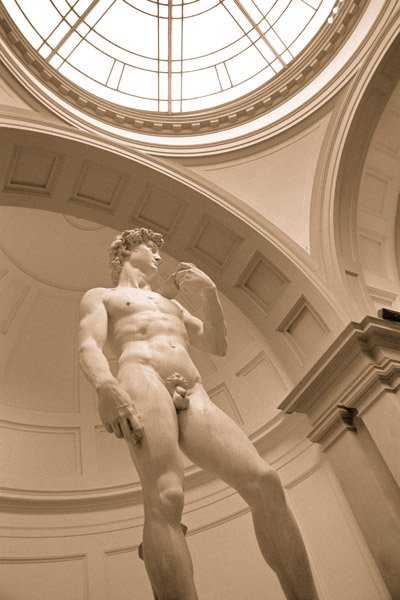
To commemorate the Smithsonian Presents Travels with Rick Steves magazine — now on sale online, and at newsstands nationwide — Rick is blogging about the 20 top destinations featured in that issue. One of those destinations is actually a work of art: Michelangelo’s David, in Florence.

Some people are not impressed by beauty. They can still enjoy art. I love the thought that art is more than beauty. It’s the closest thing to a time-tunnel experience we can have in our travels. Really. It can take you back. But only if you know the context in which it was created. Who paid for it and why? What was going on at the time? Was the artist just earning a paycheck, or did he have something to say? Were he and his patron in synch or at odds?

Of course, when you look into the eyes of Michelangelo’s David, you’re looking into the eyes of Renaissance Man. Sizing up the giant of medieval darkness, man at the turn of the 16th century had decided he could triumph and step into the modern age. It’s humanism, and it’s also local pride. Michelangelo sculpted David in a time when city-states were proud. Florentines were a particularly proud bunch. While the people of Siena might take a statue they believed brought them a plague, break it into bits, and bury it all around the city of Florence, people in Florence would urinate into the river as if they were peeing on Pisa — a rival town just downstream. David was an apt mascot for proud and confident Florence. God blessed David, enabling him to slay the much stronger giant. And God blessed Florence, enabling it to rise above its crude city-state neighbors.

Other art also takes you traveling and takes you back. Albrecht Dürer’s Self-Portrait, the first of its kind, is of a proud dandy — a cultural leader who deserved respect and good pay. He had just traveled to Italy, where painters were better respected than in his homeland Germany, and where they were given more esteem and more money.

Vincent van Gogh’s Potato Eaters takes you to a humble home of a farm family in 1885 in Belgium. Five salt-of-the-earth peasants with bony fingers share a lamp and a plate of potatoes. Van Gogh knew these people. Before being a painter, he tried to be a pastor. He lived, worked, and clearly empathized with poor miners and farmers. He cared about their lot in life, portraying them gnarled and ugly…but noble at the same time. And with this painting, his first masterpiece, he takes us there.

A helpful mindset when enjoying art in your travels is to imagine the reality of the artist and of the people for whom the art was created. If they had never seen a photograph, a movie, or never traveled. If they believed that God threw lightning bolts when he was angry. If they thought women were evil, Caesar was God, or pewter goblets represented the good life. Munch’s Scream doesn’t just scream. It screams for a reason.

Sword-Fern Fantasies

Enlarge photo

To commemorate the Smithsonian Presents Travels with Rick Steves magazine — now on sale online, and at newsstands nationwide — Rick is blogging about the 20 top destinations featured in that issue. One of those destinations is actually a collection of castles across Europe.

The list of favorite castles I collected and described for the Smithsonian ended up being mostly Europe’s glorious castles. These were the kind that were so foreboding, they made a petty kingdom’s debilitating defense budget a good investment in the long run, creating a defensive bastion so formidable that no one even attempted to take it.

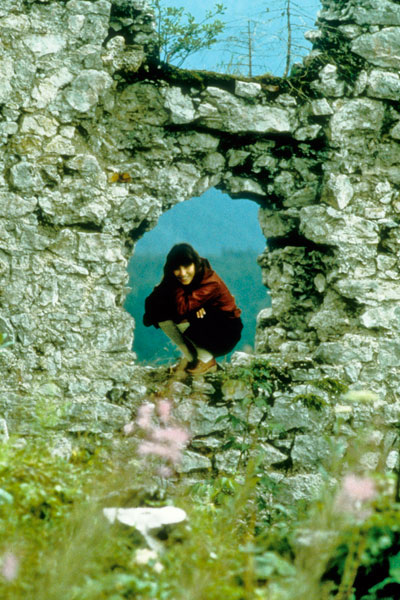
But behind the touristic glorious castles are the forgotten inglorious castles — just evocative, stony husks with no plaster or paint, broken stairways, and open skies rather than rooftops. All across Europe, the fragrant lichen of history eats at the corpse of castles as they rot away unnoticed on hilltops. Climbing through waist-high weeds on rubble collapsed and corralled by surviving walls, you can break off a spiky frond and live a sword-fern fantasy.

While time strips away the plaster, it leaves enough to evoke the days of feudalism. Castles were built on the backs of peasant labor — forgotten people who had no option in life but to subsist under the rule of a corrupt and petty ruler and carry rocks when told to. Moss seems to prepare stones for the fall they’ve waited centuries for. A dark spiral staircase leads to a tentative lookout over what was a floor. Bat dung drifts high in the dark stretches of the staircase. Standing gingerly at the top of the stairs, you look out. Before you stretches no floor. Across the expanse is the most finished element of the castle: the still-tidy square holes into which hand-hewn floor beams were stuck. What became of the beams and all they supported?

Peering through arrow slits, you look away from your castle perch. Imagine the now-overgrown terrain, once shaved to create a no-man’s land, where no enemy could find cover as he approached.

Underground tunnels lead away from the shell of a castle. Crouching as I advance, I reach a place far from the castle, just a few feet under the shaved no-man’s land. Here is where explosives would be packed, ready to surprise advancing forces and blow them to smithereens if they dared approach this fortress.

Looking up from outside at the surviving wall, I see a pair of stones jutting out high above me, now supporting only the memory of an outhouse. I imagine updrafts that once blew onto noble butts. I imagine enemies that once eyed this toilet hole as the possible Achilles’ heel of an otherwise impenetrable castle.

Ruined castle appreciation isn’t for everyone. I guess it’s a guy thing…to peer, wonderstruck, over the shoulder of a guide who lowers a lamp on a rope into a dungeon that has only one way in or out — a mean-spirited hole in the ceiling. Stories of knights sleeping in wooden boxes filled with hay in dank ground-floor rooms evoke scenes of these men struggling night after night to find some warmth.

With the same boorish conversation and little else to amuse, I can imagine the appeal of alcohol in feudal times. There’s certainly evidence of drunkenness. Keyholes on mighty doors came with iron guides that funneled the key of an inebriated lord into place. All he had to do was locate his key, hold it in front of him, fall onto the door, and when the key landed in the hole, give it a turn.

The advent of the cannon forced castles to crouch rather than stand tall. And pre-cannon castles, standing tall atop hillocks, visited with the heavy breathing that comes with a steep hike, stoke the imagination of any traveler. And with imagination properly stoked, these humble and forgotten ruins too can rival Europe’s great and famous castles.

Photos: Rick’s Latest Trip

Nikos runs Albergo Doni, one of my favorite hotels in Venice. He and I have a ritual of taking our photo with our last photo each time I drop in. We just get better looking every year.
Enlarge photo
The Barber of Venice. For 20 years Benito’s been in my guidebook — the only barber I recommend in Europe. He gives lots of my readers, young and old, a wearable souvenir.
Enlarge photo
Anywhere in Italy, surveying the luscious vegetables in the market is a kind of gastronomic foreplay warming you up for a fine dinner tonight.
Enlarge photo
Taking a break from my research chores in Venice, I tested a few of our audio tours. They worked like a charm which made me very happy. They are clean, easy to follow, and make the sightseeing experience a joy…if I do say so myself. Our new Rick Steves Audio Europe program—with scores of free audio tours and trip-related interviews — is just about ready for prime time (see iTunes/podcasts/Rick Steves).
Enlarge photo
A ritual grounding — barefoot on the pavimento alla Veneziana (my hotel’s traditional flooring) and my soul knows it’s back in Venice.
Enlarge photo
Stuck in Venice because of the volcano’s ash…let’s drink to Iceland!
Enlarge photo
My Ravenna guide took me to the barber who does her little boy’s hair. I said “just a trim” in my best Italian and he proceeded to give me the shortest haircut I’ve ever had in my entire life.
Enlarge photo
Eating dinner with Franklin, we embraced life with gusto (and our mouths).
Enlarge photo
Chef Giuliano gave me and Franklin a meal we’ll never forget.
Enlarge photo
There’s a new hit show on Sky TV in Italy. It’s by some American hotshot and called Europa di Rick.
Enlarge photo
What a crazy experience: sitting in an Italian living room with Italian friends watching me with a deep and raspy Italian-dubbed voice telling Italians about their own country.
Enlarge photo
Simon Griffith and Peter Rummel join me to shoot a piece of the Rock. We just wrapped up a great two week shoot in Spain, Gibraltar, and Morocco. Stay tuned for an hour-long special on Andalucia in October.
Enlarge photo
Flying from Gibraltar directly to Indiana, I joined our family to celebrate our son Andy’s graduation from Notre Dame. Degrees in Italian language and literature and industrial design from a great school. Congratulations Andy Steves! Look out world!
Enlarge photo

Dingle

Enlarge photo

To commemorate the Smithsonian Presents Travels with Rick Steves magazine — now on sale online, and at newsstands nationwide — Rick is blogging about the 20 top destinations featured in that issue. One of those destinations is Dingle, Ireland.

Kathleen was old and frail, but picked up her step as she led me to the small-town cinema. She declared, “Tom Cruise is a wee little guy.” Everyone was all abuzz about where he and Nicole Kidman had slept.

I was in the town of Dingle, on the west coast of Ireland. And tonight, in Dingle’s homey theater, it seemed the entire town had gathered to watch the premiere of Far and Away — a movie that was partly filmed right here in Dingle. As the movie played, each time a bit player from the village appeared on screen, a rowdy uproar erupted. Knowing where to look in the movie, you could see telephone poles decorated like trees.

The movie depicted tough times — the 1890s, when impoverished people from villages like Dingle flocked to the New World in pursuit of a better life. These days, of course, Dingle is riding high on Ireland’s economic resurgence. But all it takes is a pensive stroll through the fields to remember the earlier pain and struggle of this land. Picking up a clod of earth, my friend Tim, Dingle’s retired police chief, explained how even the dirt had to be made by struggling peasants — sand and seaweed carried here by human beasts of burden from the distant shore.

Dingle’s a humble town. Each day, it feels like the main business is rolling out the empty kegs and rolling in the full ones. They claim to have more pubs per capita than any town in Ireland. And each evening, I walk around the block like a guy choosing a dance partner, considering where I’ll enjoy a pint.

Dingle’s town mascot has long been a dolphin named Fungie. This playful dolphin is thoroughly milked to stoke tourism. But to me, it seems that Fungie just brings people to town for the wrong reason. You don’t come to Dingle to see a freak dolphin; you come to experience a Gaeltacht town.

A Gaeltacht (a place where Gaelic — the traditional Irish language — is spoken) is a kind of national park for the traditional culture. As a Gaeltacht, Dingle gets special subsidies from the government. A precondition of this financial support is that towns use their Irish (Gaelic) name. But Dingle (or An Daingean in Irish) has voted down this dictate from Dublin. I think changing it back to An Daingean would be true in principle to the Gaelic movement, but just plain bad marketing. (It’s fun to say Dingle, but An Daingean — pronounced “on DANG-un” — is hard to say and to spell.) As a compromise, signposts spell it both ways.

The tip of the Dingle Peninsula is marked by a chalky statue of a crucifix. It faces the sea, but it seems like about half the time, it’s actually facing a cloud with zero visibility being whipped by sheets of rain. I imagine cows here have thicker eyelids, evolved over centuries of sideways rain. The Gallarus Oratory, a 1,300-year-old church made only of stone, is famously watertight — unless the rain is hosing in sideways. I’ve been splattered inside. I’ve crept over the Conor Pass with zero visibility, ragamuffin sheep nonchalantly appearing like ghosts in the milky cloud. I’ve huddled in farmhouses abandoned in the great famine of 1848, awaiting a chance to step out. Yes, the weather is a force on the west coast of Ireland. But when the sun comes out, everything rejoices.