Baden-Baden: Globalization and Leaky Borders

Enlarge photo

To commemorate the Smithsonian Presents Travels with Rick Steves magazine — now on sale online, and at newsstands nationwide — Rick is blogging about the 20 top destinations featured in that issue. One of those destinations is the German spa resort of Baden-Baden.

Germany’s spa town of Baden-Baden is a fun and relaxing place to splash around in a thermal bath. But, as with many resort towns, a more substantial history bubbles just beneath the surface. And, in the case of Baden-Baden, that history still has ripples today.

After the czars banned gambling, many Russians flocked to Baden-Baden, creating their own little Russian enclaves. (Many lost their fortunes, borrowed a pistol, and did themselves in on the so-called “Alley of Sighs.”) While the Russian expat community dwindled for a while, in recent years (after the end of communism), ultra-wealthy Russians have sought out safe property investments all over Europe…and Baden-Baden has re-emerged as a favorite destination. Russians have bought up property here like crazy. You’ll see Russian on multilingual signs around town. On my last visit, the lady who ran the launderette spoke German and Russian…but no English.

This is worrying to locals. The mayor — saying his town must either take action or let itself become essentially Russian-owned — recently declared that Russians were no longer allowed to purchase Baden-Baden real estate.

With immigration a persistent and complex issue in the USA, it’s good to remember that we’re not the only nation struggling with how to handle the realities of race, class distinctions, foreign investment, and use of government services. I see the same challenges all over Europe.

A vast suburb of Tallinn, Estonia, is filled with Russians. They were planted there during Soviet rule, and — although Estonia is now its own independent nation — they still refuse to embrace the local language, Estonian. They live as a separate, Russian-speaking community within Tallinn.

Norwegians — who pride themselves on not being racist — are upset with unemployed Pakistanis living in their country who, they say, don’t share the Norwegian work ethic, but take advantage of the luxurious Norwegian welfare state. I sense that Norwegians don’t know how to discuss this issue comfortably.

I was just in Gibraltar, and the buzz there was about a $20 million mosque built with money from the Middle East for the humble local community of 900 Muslims workers.

Just as people with less money go to work in wealthy lands, people with more money turn their vacation and retirement funds into maximum joy and comfort in cheaper places. I have a friend who’s a retired postman living very comfortably on his meager pension in southern Portugal. A Venetian friend of mine is excited about her new holiday home in Tunisia. No crowds, great beaches, very cheap — she said Tunisia is all the rage among Italians. Belgians have staked out their enclave in Spain’s Costa del Sol — just one more community where the stray Spaniard complains that some eateries don’t offer menus in Spanish. Americans are buying fixer-uppers in droves in rural Italy. And they’re doing it with the encouragement of a government that appreciates the economic boost these romantic Frances Mayes-wannabes bring to regions that need expat newcomers to keep from withering.

There are immigration issues everywhere you travel. Second-generation Turkish Germans can honestly say “Ich bin ein Berliner.” Construction work throughout France would slow to a trickle without Polish builders. While many are now careful to refer to Gypsies as “Roma,” there’s still not enough money to build a Holocaust memorial in Berlin to this group, which suffered a genocide that was comparable, in many ways, to what happened to the Jews.

Like the Swiss are afraid of minarets, the French are afraid of women with covered heads, and America is afraid of a leaky southern border, a lot of anxiety is driving current legislation in all these countries. In Europe, as in the USA, it’s hard to talk about immigration and race issues for fear of offending people. But one thing is clear: Race and immigration concerns are not unique to any one country, and they are here to stay.

While travel may not give us answers, it does give us perspective and a clear sense that we will all ultimately live together…whether we like it or not. The other day, a frightened white woman asked me to sign a petition, saying, “We’ll soon be in the minority.” As a traveler, I know “we” already are in the minority on this planet…and that’s fine with me.
Sunday Morning, Vienna-Style

As I walked out of my hotel in Vienna on Sunday morning, I realized I was in a city with a rich culture you can almost inhale, and a vivid history you can almost touch. I decided to max out on culture.

At about 9:00, I dropped by the Hofburg’s Imperial Music Chapel. The Vienna Boys’ Choir was singing, as they do each Sunday morning throughout their season. I didn’t actually see the boys — no one in the church did — as they sang like angels from the loft in the rear. But, like you don’t need to look at the sun to know it’s there on a beautiful day, you don’t need to see the boys to enjoy their delicately beautiful music. Their voices blended perfectly with the scene in front of us, as sunshine streaming through the windows made the Baroque starburst of gilded statuary truly seem to burst over the altar.

Energized, I ducked through a royal passageway and paid about €20 for a standing-room spot to see the much-loved Lipizzaner Stallions prance to some more music in the Emperor’s chandeliered Baroque riding hall. (It occurred to me that they prance in 4:4 time, but not 3:4 — even though this is the city of the waltz.) I enjoyed the show as much — and with a view just as good — as those who booked far more expensive seats long in advance.

Ready for more music, I strolled a hundred yards to the Augustinian church for Mass, where I sat above silver urns containing the hearts of centuries of Habsburg emperors. This being Vienna, the service came with a complete choir and an orchestra, and today wowed worshippers with the spiritual confidence of Anton Bruckner’s Mass No. 3 in F Minor.

After lunch under palm trees in the emperors’ conservatory, I dropped into the adjacent hothouse, a wonderland of butterflies. Enjoying the fluttering antics of these butterflies — most of which seemed drunk on the fermented banana juice they licked from the brown and sweating banana slices in their breakfast dish — is a Vienna tradition for me.

Enlarge photo

Enlarge photo

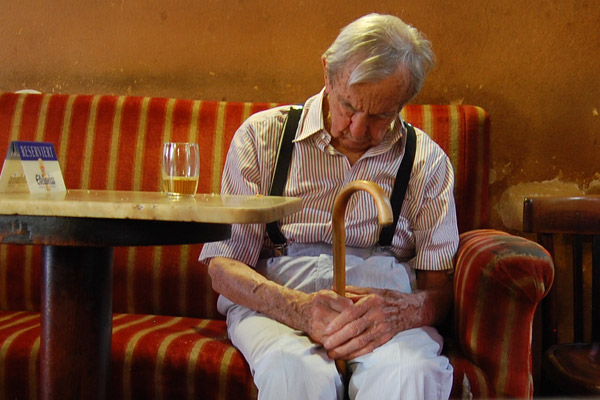
Then, for coffee, I pulled up a chair in the smoke-and-coffee-stained Café Hawelka, where intellectuals like Leon Trotsky once stewed. The decor was circa-1900. Old man Hawelka himself was snoozing on a Biedermeier chair near the bar. His granddad could well have served a Mélange (as they would have called their cappuccino) to Trotsky, Hitler, Stalin, Klimt, or Freud — all of whom were rattling around Vienna when the chair I was sitting on was made, bought, and put in this café. I pondered how, in the last days of the era of Europe’s family-run empires (essentially all of which died with the end of World War I), Vienna was a place of intellectual tumult.

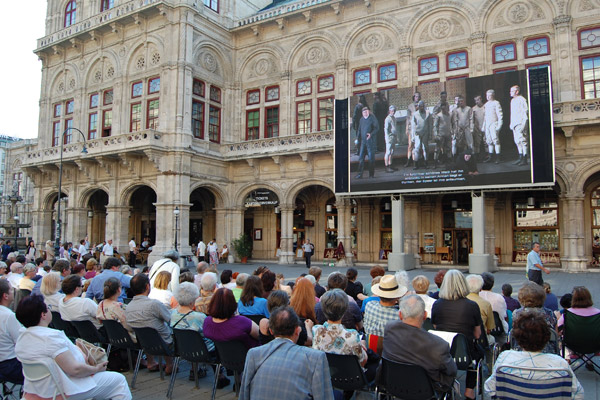
And my day was just half over. The Vienna Opera — arguably the world’s greatest — was performing Wagner’s Tannhäuser in the afternoon. No ticket? No problem. In good Vienna style, it was being projected outdoors for the rest of us in all its Teutonic glory, live on a huge screen. Arriving early to get a good seat, I waited with the people of Vienna — marveling at the potential richness of life, and how as I travel, I can experience much of its best.

Awaiting the start of Tannhäuser, I thought about how accessible all this was. Two musical Masses and this opera experience — free. Horses — $30. Butterflies — $6. Lunch under the palms — $20. Coffee and cake with sleeping Herr Hawelka — $7. As I reviewed all I had experienced today and the people I had rubbed shoulders with, I thought again — a theme for me this month — how much happiness there is in our world if you choose to see it. I’m not saying to ignore the problems. I’m saying to get out there, strive to keep things in perspective, and embrace not what turns you off, but what turns you on.

Prague Trumps Rothenburg

Enlarge photo

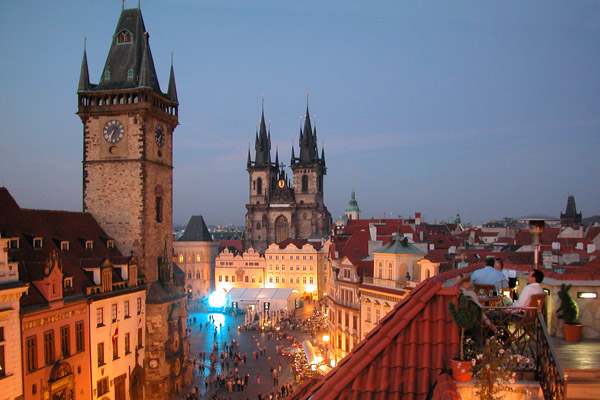
To commemorate the Smithsonian Presents Travels with Rick Steves magazine — now on sale online, and at newsstands nationwide — Rick is blogging about the 20 top destinations featured in that issue. One of those destinations is Prague, Czech Republic.

I’m currently on a Central European swing, updating my guidebooks: Budapest, Prague, Vienna, Munich. Being back in Prague reminds me of how that city first broke down the Iron Curtain in my guidebooks many years ago.

On a research trip back in the 1990s, I was on a train heading to Rothenburg to update the ultimate medieval town in Germany, as I did nearly every year. For a decade, I’d been diligently visiting to check the woodcarvings, walk the old wall, visit the toy museum and the medieval crime-and-punishment museum, and check in with old friends who run the hotels and restaurants that serve the town’s hordes of tourists. The work was almost mechanical. Socially, it was a happy homecoming. The ramparts and cute lanes were filled with my readers, who cheered me on. I loved going to Rothenburg.

This was just a couple of years after the end of the Cold War. The obvious new frontier of European tourism was the mysterious East. The former Warsaw Pact countries were now wide open and eager to welcome Western travelers. I knew that sooner or later, I’d tackle the region and expand my guidebook coverage there. But it was overwhelming, and, psychologically, it was easy to just keep redoing the Rothenburgs of Western Europe. I was daunted by the job — a bit lazy…dreading the unavoidable truth that if I was to cover Europe, I would now need to stretch east.

I was rattling down the tracks in the direction of Rothenburg, when I realized the very train I was on would end its run in Prague. I started comparing the value of spending the next three days in Rothenburg versus doing a groundbreaking research stint in Prague. I stayed on that train and didn’t get off until the Golden City of a Hundred Spires. I jumbled my itinerary a bit to accommodate the new job, and what followed was one of the most exciting and rewarding weeks of research I can remember. I left with Prague now in the realm of what we covered.

That first Prague chapter needed a home, and the only home we had for it was splicing it into our existing Germany, Austria & Switzerland guidebook. What was called “GAS” in my office would now be “GASP.” (Over the years, GASP became GAS, then GA…until finally there were separate guidebooks for each of the four destinations, including Prague.)

With the beautiful co-author partnership of Honza Vihan (our good friend and super guide from Prague), Prague joined the elite league of cities that merited their own Rick Steves guidebook (along with London, Paris, Venice, Florence, and Rome). Cameron Hewitt took this Czech nucleus and expanded into another five countries (which I termed the “Louisiana Purchase” of Europe) — Poland, Slovakia, Hungary, Croatia, and Slovenia — co-authoring my Eastern Europe guidebook, and then two others (on Croatia & Slovenia and Budapest). Today Eastern Europe is fully integrated into our Europe-wide program, with four different guidebooks and six different bus tour itineraries.

And it all started in that year when Rothenburg went unresearched and a seed was planted in Prague.

Heat Wave in a Budapest Ruin Pub

Enlarge photo

Enlarge photo

Budapest’s trendiest clubs are called “ruin pubs.” Inhabiting ramshackle old buildings in the city center, they feel like a gang of squatters made a trip to the dump yesterday and grabbed whatever was usable, moved in today, and are open for business tonight. Enjoying a drink here, I’m reminded of creatures that inhabit discarded shells in a tide pool. The formula really works. With the come-as-you-are atmosphere, these clubs attract people who make a point not to be “fashion slaves.” And, for the traveler, it’s easy to meet people in a Budapest ruin pub.

I end up sitting with Peter (who designs ruin pubs), Laura (who works at a hotel), and Sandra (whose father’s company, “Heat Wave,” introduced pornography to Hungary after freedom in the 1990s). I say how much I like the shabby lounge atmosphere of a ruin pub, and Laura declares that this one, Szimpla (which means “Simple”; Kazinczy utca 14, www.szimpla.hu), is the mecca of ruin pubs in Budapest. Sandra agrees, but is distracted when Miss Hungary walks by. With a little disdain, she says, “There’s Miss Hungary — a beauty brat with a Gucci handbag, and nobody notices her.”

Ruin pubs come with a bit of communist kitsch. The twentysomethings that love these lounges were little kids during the last years of communism. Too young to understand its downside, they have fond memories of the good times, when the pace of life was slower and families were tighter-knit. Ruin pubs sell nostalgic commie soft drinks along with the cocktails. Peter buys everyone a round of spritzes (rosé with soda water). He’s excited about the new ruin pub he just designed across town, and wants us to go there. I comment on how well the design works. He explains how these clubs are the soul of underground culture here. It’s the anti-club: flea market furniture, no matching chairs, a mishmash of colors. It’s eclectic, designed to be undesigned. On hot nights, the pubs spill out into shoddy courtyards, creating the feeling of a cozy living room missing its roof…under the stars.

Everyone seems to smoke. Here, where no one’s a fashion slave, not being a fashion slave creates a similar burden. Peter demonstrates the different ways you can smoke a cigarette in a counterculture enclave. First he does the affected “Beauty Queen” smoke, then the calculated “Godfather” smoke. Finally, gulping the cigarette in the middle of his lips, he does the “Working Smoker,” saying, “You smoke with big lips.”

Laura is talking with Sandra in Hungarian about her dead relationship. There’s nothing there, but she’s afraid to leave. When I join the conversation, she shifts to English and says it’s like she has sexual anorexia. Her boyfriend and she are drifting apart. She wants him to watch Sex and the City, and says, “To understand the soul of a woman, you must watch Sex and the City.” This topic gets Laura and Sandra talking about how Hungarian men aren’t as good as men from other cultures — not considerate, not thoughtful in conversation, and so on. I explain to her the concept of “the grass is always greener on the other side of the fence.” She says we’re talking beds, not fences, and doesn’t buy my theory.

Politics are in the air all over Europe, with everyone looking at Greece’s economic disaster and wondering what to do. Hungarians are used to making not much money, but having the government pay for things. While Budapest is better off, in the east of the country, people still make horrible wages and expect the government to cover the essentials. The government provides, but things are supplemented with tips. Health care is a good example of this heritage of communism. Hungarians insist on complete coverage — with no co-pay. Technically, they get it. But everyone knows the system only works with the help of “pocket money” — people actually pay cash tips to their doctors in order to get an appointment and have their concerns taken seriously. That’s how it was in communist times. And that’s how it remains today.

In 1989, with the “spontaneous privatization of the society,” the Communists in power had the inside track and grabbed up the lion’s share of the country’s economic equity. Therefore, today, the former Communists are the privileged capitalist class and, ironically, these former “defenders of the proletariat” are now defenders of industry and corporate interests. Young people, who have a Tea Party edge to their politics, are wary of any promises that are populist and founded on deficit spending. They are tired of electing politicians who tell them what they want to hear. They see other former-communist countries doing better than Hungary in fiscal discipline.

Old people are inclined to vote Communist, and young people want the new austerity. In a recent election, young people joked about how to stop your Granny from voting. Pop stars were making videos: Lock her in her bedroom, send her on vacation, ask her to babysit for a couple of days. Or be straight with her and convince her to vote for her granddaughter’s future. Thanks to Greece, populism is has taken a big hit in Eastern Europe.

You Can’t Flush Tallinn

Enlarge photo

To commemorate the Smithsonian Presents Travels with Rick Steves magazine — now on sale online, and at newsstands nationwide — Rick is blogging about the 20 top destinations featured in that issue. One of those destinations is Tallinn, the capital of Estonia.

Visiting a tiny land like Estonia, I’m impressed by the resilience of a small nation. How can just over a million Estonians survive the centuries wedged between Russia and Germany? With the agenda of tyrants to the East and West, I’d think Estonia would fare like a sheet of Kleenex in a flushing toilet.

And not every tiny land survives. There are countless sister cultures that are simply gone or nearly gone today. (For example, Livonia, in this same Baltic region, or the Sorbs of Germany.) But the pride and strength itself of nationalities like Bulgarians, Montenegrins, Kosovars, Icelanders, Estonians, and Basques as they maintain their traditions and language in the brutal (if not flushing) demographic currents of the 21st century is an inspiration.

With our new TV series, I find myself highlighting the Basques, Montenegrins, and Estonians. Come to think of it, even Norway (with about the population of Alabama) is a mighty mite, and we’re doing two shows on that country. Maybe, subconsciously, these days — when the media work to homogenize us all, globalization tries to convince us that selling our souls is the only option, and material values have become “too big to fail” — I’m in the mood to celebrate the cultural underdogs.

So here’s to the 1.25 million people who speak Estonian, the 700,000 people who speak Basque, the 150,000 people who speak Montenegrin, and the 5 million people who speak Norwegian. And here’s to traveling to a place where you can hear Estonians, Basques, Montenegrins, and Norwegians — in their own language — drink to your travels.