Mostar, Yugoslav Banks, and War Damage

Enlarge photo

To commemorate the Smithsonian Presents Travels with Rick Steves magazine — now on sale online, and at newsstands nationwide — Rick is blogging about the 20 top destinations featured in that issue. One of those destinations is Mostar, in Bosnia-Herzegovina.

Whether in Mostar or elsewhere, former war zones offer powerful sightseeing. Thankfully, in Europe, they are rare.

I remember that in the 1970s, lots of World War II damage still awaited repair throughout Germany. With the disparity of wealth between Eastern and Western Europe during the Cold War, in the 1980s it was striking to see how the West had bulldozed and rebuilt virtually every bit of damage, while the East was still pockmarked with dreary WWII souvenirs. Of course, the town centers of the East were dolled up for visitors. Back then, the tourists didn’t see the reality of a society without the economic wherewithal to entirely rebuild 40 years after the war unless they ventured out into the suburbs, where strafed plaster and broken concrete were still commonplace.

Traveling in Northern Ireland a few years ago, you’d see little actual destruction, but you would see the poverty resulting from the Troubles, and angry political murals. And even those are much less commonplace these days.

And, of course, the only actual war fought on European soil since World War II was the war precipitated by the break-up of Yugoslavia. Driving through the interior of Croatia, you can still see damage from the war in the early 1990s. Touristy places along the Dalmatian Coast were generally unscathed. The glaring exception, Dubrovnik, has already been thoroughly rebuilt — a prerequisite for it to regain its happy-go-lucky position as the former Yugoslavia’s top tourist attraction.

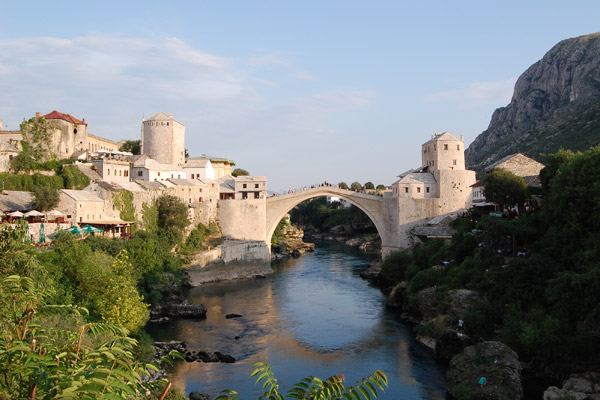
For many travelers, the European destination where they’re most likely to see war damage on a massive scale is Mostar, in Bosnia-Herzegovina. A major reason why the city has been slow to rebuild is that most property owners had big mortgages on their buildings…so the actual “owners” were the banks. With the outbreak of war, people obviously stopped making payments on evacuated and bombed-out buildings. The bank assumed ownership. And, as Yugoslavia fell apart, so did its national bank. It costs a lot of money to rebuild, and — with ownership not being clearly established — there’s little incentive for anyone to spearhead the rebuilding efforts. Consequently, the bullet-speckled facades fester unrepaired.

But on my last visit to Mostar, I noticed that several formerly damaged buildings had been fixed. As these perplexing ownership issues are cleared up, physical reminders of 1993 are being plastered over — just as the literal and psychological scars of war among the people of Mostar are fading. That’s why traveling to Mostar — especially over time — is particularly powerful…at once tragic and uplifting.

Blooming Bratislava: An Hour Downstream from Vienna

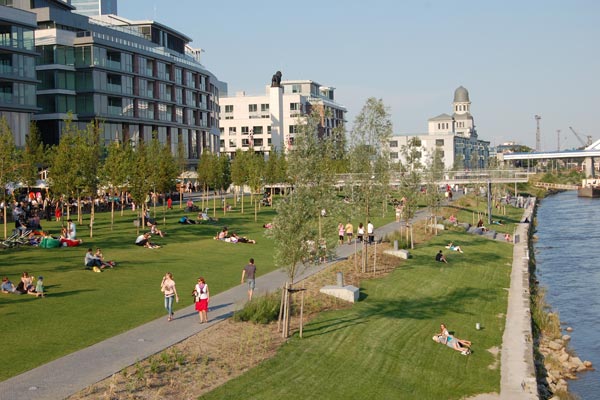
One of the big surprises of my travels this summer has been Bratislava, the capital of Slovakia. Bratislava sits on the Danube less than an hour’s train ride from Vienna, and a short hop from Budapest. A desolate ghost town just a few years ago, today Bratislava is arguably the fastest-changing city in Europe.
Enlarge photo

Enlarge photo

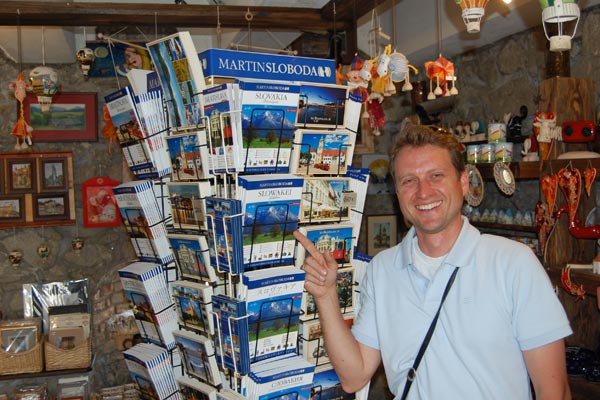
I spent a day visiting Bratislava with Martin Sloboda, a local tycoon of a guide (www.msagency.sk). He writes the town’s dominant guidebook (on sale at spinning racks in nearly every shop in town), shoots the photos for postcards (on the next spinning rack), organizes the visits of the luxurious Tauck tour groups when their Danube cruise ships dock in town, and is the local tourist board’s choice for an escort when a VIP visits. He’s a fine example of the youthful energy and leadership responsible for the success story of Slovakia.

Martin explained to me why people who were between 15 and 25 in 1989 are most successful today, and the leaders of Slovakia. Throughout the communist period and in post-communist Czechoslovakia, there was no real political diplomatic class among Slovaks (because Czechs dominated Czechoslovak government). But when Slovakia peacefully split off from the Czech Republic in 1993’s “Velvet Divorce,” many young Slovaks returned from the West and quickly took the helm, filling that void. Today Slovakia’s wealthy class is about 40 years old, largely free from the old boys’ network (most of whom stayed in the Czech lands). This trend played out in recent election, where for the first time, no former communist was sent to government (unique in Eastern Europe). The new “Dream Team,” as many locals call the people in power now now, is liberal on social issues but realistic — decidedly not populist — on economic issues, as if inspired by the Greek fiasco (in fact, Slovakia has opted not to give bailout money to Greece).

Spending a day with Martin to update our Bratislava chapter, I was able to fine-tune our existing coverage. I also picked up lots of new ideas. Here’s an example of the kind of raw material I came away with, most of which I hope to massage into our existing chapter to make its coverage more complete:

The Danube divides Europe’s two biggest mountain ranges: the Alps of Western Europe, and the Carpathians of Eastern Europe. Slovakia (and Bratislava is particular) has long been a bridge between East and West.

When Budapest was taken by Ottoman Turks in the 1500s, the political and religious elite of Hungary retreated to Bratislava — far from the Ottomans and close to Vienna, but still within greater Hungary, at an easy-to-defend location on the Danube. Bratislava hosted 19 coronations between 1563 to 1830. In fact, the last Hungarian coronation was not in Budapest, but in Bratislava.

In 1760s, the Ottoman threat was gone, and the strategic military importance of Bratislava was over. Habsburg Empress Maria Theresa needed a comfy palace. She wanted her daughter Christina to stay close, so she made her son-in-law Albert the Viceroy of Hungary so that they’d set up here. That’s why Bratislava has a fine Habsburg palace and a strong Vienna connection.

A third of the Slovak population emigrated to the US between 1880 and 1914. There were lots of deserters during World War I — opting to fight against rather than with Hungary. Even today, Hungarians lament loss of their old capital, Bratislava, from the post-World War I Treaty of Trianon. Meanwhile, you could say that historic Hungarian cultural oppression of the Czechs and Slovaks led to the creation of modern Czechoslovakia, as those smaller groups sought safety in numbers after World War I.

The United States has long been a big supporter of Czechoslovakia. Between the world wars, Czechoslovakia was the only democracy and had the best economy in this part of Europe.

Because of its location nearly on the border with Austria (and the West), Bratislava has many bomb shelters, built during the tense times around the Cuban Missile Crisis. Today these make ideal venues for clubs — right in the town, but powerfully soundproof.

Why is it hard to think of any great Slovaks? During the time of Czechoslovakia (1919-1993), every time a Slovak excelled in culture or politics or sports, they were considered “Czech” by the rest of the world. (For example, the leader of the 1968 Prague Spring uprising against the Soviets, Alexander Dubcek, was actually Slovak.) As of 1993, suddenly Slovaks could celebrate their own heroes without the confusion.

Bratislava was a damaged husk from after World War II until the end of communism in 1989. The communist regime cared only for the future — they had no respect for town’s heritage. In the 1950s, they actually sold Bratislava’s original medieval cobbles to cute towns in Germany that were rebuilding with elegant Old World character after World War II.

With the fall of communism in 1989 began a nearly decade-long process of restitution: The government needed to sort out who had rights to the buildings, and return them to their original owners. During this time, little repair or development took place (since there’s no point investing in a property until ownership is clearly established). It’s hard to imagine today that as recently as the 1990s, Bratislava’s old center was basically a dangerous ghost town.

By 1998, ownership had finally been sorted out, and the Old Town was made traffic-free. Bratislava has been reborn — life has returned with a vengeance in the last decade. The only decrepit buildings left in Bratislava are run-down only because they still have ownership issues.

Slovakia’s huge armaments industry collapsed after communism, leaving it in quite a deep economic hole. But the country’s central location — with 300 million consumers living within a day’s truck drive — is ideal for industry. It didn’t take long for the gap left by armaments to be filled by carmakers. Today Slovakia, with five million people, produces one million cars a year. That makes them the world’s top car producers, per capita. Its business environment and relatively unregulated employment code make it easy to hire and easy to fire employees — which is good for business. Strikes don’t plague the country.

While the rural parts of the country have dismal unemployment rates, Bratislava has only 2.5 percent unemployment. The measure for standard of living as it relates to local costs puts Bratislava at #10 among European cities. Among post-communist nations, only the Slovaks and the Slovenes have the euro, with Estonia on deck. This is testimony to the wise economic policies the Slovaks have chosen, rather than the populist sweet talk and promises so common elsewhere.

Slovak kids have incredible opportunity — unprecedented in this nation’s history. Because of the EU’s Erasmus program, Slovak young people can apply to universities like Cambridge, and be treated like a Brit. And yet, many choose to stay right here. Bratislava at night is lively; the very young center thrives. While it has lots of university students, there are no campuses as such — so the Old Town is the place where students go to play.
Rail Wonks

A particular joy of my job is collaborating with people who really love their work. We employ 70 people at ETBD, and they amaze me with the passion they have for their niche in our travel-teaching machine. Russ goes to Asia to be sure work conditions are right for the people making our bags. Dave draws maps for our guidebooks, and in his free time, draws maps to people’s homes so everyone can get to the party. Laura is so excited about the new Central Europe Triangle railpass. And Julie won’t rest until the handouts for our next Turkey class are right up-to-date.

In Europe, I work with people who have that same passion. My guide friends can’t simply walk down the street — they have to explain to me why the plaster is being peeled away to show the old wattle-and-daub, or how the church spire is so low because the Soviets wouldn’t let it be higher than their war memorial. And Alan, who runs the EurAide desk at the Munich main train station (a great service to anyone traveling by rail), can’t wait to fill me in on the latest train news.

Alan is the ultimate rail wonk. For twenty years, I’ve dropped by when updating my Germany guidebook… and for twenty years, he’s been passionately helping travelers, one by one, catch the right train for the right price. It exasperates him that I just drop in unannounced, but that’s how I work in Europe. Last week I popped in, and there he was, patiently getting a Korean backpacker with a German railpass a ticket from the German-Czech border to Prague. He said, “Come back at noon, and I’ll take you to a great beer garden for lunch — one you can put in your book.” (We have an ongoing joke that he only takes me to his favorite places on the condition that I don’t tell anyone.)

At noon, we walk a few blocks to the Park Café beer garden. It’s so hot in Germany that literally no one is eating indoors. If your restaurant doesn’t have outdoor seating, you might as well not open up. The Park Café, with a sprawling beer garden and a little fake beach complete with sand and lounge chairs, is thriving. Alan calls it “Little Berlin,” as Berlin is really into fake beaches. (This is a big trend throughout Europe. Cities with no beaches — from Paris to Copenhagen to Vienna — now have sandy summer “beaches” dumptrucked in. These are a hit for Europeans city-bound in the heat of summer.)

I’m not a Radler (beer with 7-Up) type of guy, but this light refresher is the choice for both of us on this hot day. After we each guzzle about a third of our liter mugs and zip through a little small talk, Alan gets right down to his wonk-ish passion: rail news.

Pulling out a packet of questionable Eurailpasses, he tells me that the big news this year is how dishonest rail travelers may be the doom of traditional railpasses as we know them. Alan holds up one pass and says, “This is the pass of Mr. Chen. He came to me, I looked at his pass, and I knew it wasn’t his. I said, ‘You’re not Mr. Chen’…and he ran out of my office, leaving me with this doctored-up pass.”

Alan tells me that unscrupulous railpass-users — especially Australians and Asians — are erasing and re-writing the dates on their flexipasses in epidemic numbers. The European train officials are trying to counter this by requiring everyone to keep the pass in its original jacket and log each journey on the itinerary page attached. But no one obeys. Travelers in Germany know that cops here — shy about being considered “Gestapo-like” — are reluctant to enforce things too harshly. So in Germany, these new railpass regulations go completely unenforced.

Leaving Alan, I continue my research. My staff organizes and distills the mountain of feedback our readers send us, and I spend a lot of time running down places to eat and sleep that our travelers recommend. I eat dinner at a nondescript neighborhood bistro next to my hotel because someone reported that the food is great, and Youssef and Monika — who run the place — are charming. The place seems unexceptional. Skeptical, I give it a whirl…then the food comes. It’s delicious. Monika has such a pleasant way. When Youssef (the chef from Tunisia) finishes his last order, he sits down at my table and we get into a discussion. I’m loving the place — conviviality-plus. I surprise Monika and Youssef by calling them by name. They wonder how I knew. I tell them about my work, and how someone ate here and recommended them. I get out my pencil to write it up…until Monika says, “But we are closing in two months.” Heartbreak. (If you happen to be in Munich before the end of August, check out Das Kaffeehaus, near the train station at Pettenkoferstrasse 8.)

I’ve had people in the States ask me for reassurance that Europe won’t become Muslim in a generation (as some fear-mongers are saying). I say that’s nonsense, and don’t give it a second thought. But, while at Youssef and Monika’s restaurant, I see lots of extremely conservative Muslim women clad in black. I ask them about it. Youssef says Dubai and Yemen are on holiday, and people there love to vacation in Germany. Two moms — draped in black on this hot evening — drop into the restaurant. They’re making an ice-cream run with their kids. I start up a conversation with the 10-year-old boy and ask him, very clearly, “Do…you…speak…English?” He looks at me like I’m nuts and says, “Of course I do.”

Being on the road humbles me. It connects me with our world. It’s where I get my news. It makes me feel good about humankind.

Gimmelwald: Getting to that World Apart

Enlarge photo

To commemorate the Smithsonian Presents Travels with Rick Steves magazine — now on sale online, and at newsstands nationwide — Rick is blogging about the 20 top destinations featured in that issue. One of those destinations is Gimmelwald, in the Swiss Alps.

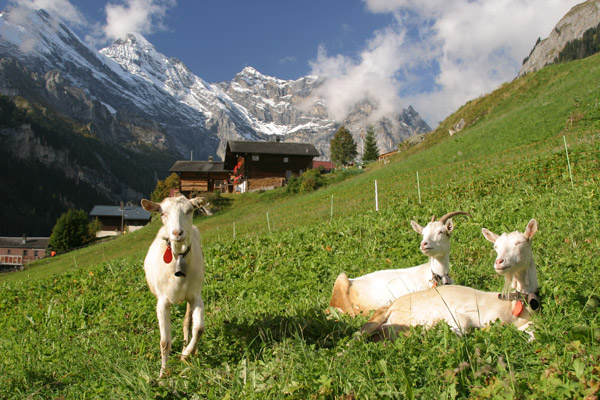
A great challenge in travel research is finding destinations that are a world apart. Gimmelwald, that remote and impossibly idyllic village high in the Swiss Alps, is a classic example. Parking you car in the valley floor and riding the cable car up is like going through a looking glass. You car shrinks, your stomach flip-flops, you look over the valley like a hang-glider, then suddenly you’re deposited — as if from a magical glass bubble — into another world. It’s a place where the air feels different — where the only noises are bees, bugs, and birds perusing alpine flowers, paddling water spilling from a hose into the hollowed-out log that keeps the cows watered, and gnome-like men sucking gnome-like pipes while chopping firewood.

Many of my “Back Doors” give this sensation. That’s probably why they appeal to me in the first place. It takes a little extra effort to reach them: Hallstatt (reached by lake ferry from the tiny train station buried in a forest east of Salzburg), Civita de Bagnoregio (you walk to it up a donkey path, then through a medieval gate, to enter a classic hill town an hour north of Rome), Salema (beyond the Portuguese resort of Lagos, near the far-southwest tip of Europe, at the end of a dirt road), Ærøskøbing (a traffic-free, ship-in-a-bottle dream town a ferry ride away from Svendborg in Denmark), and Inishmore (on the Aran Islands, off the rugged West Coast of Ireland). What place in Europe gives you that “world apart” feeling, and why?

Munich: German Flags and Georg

Enlarge photo

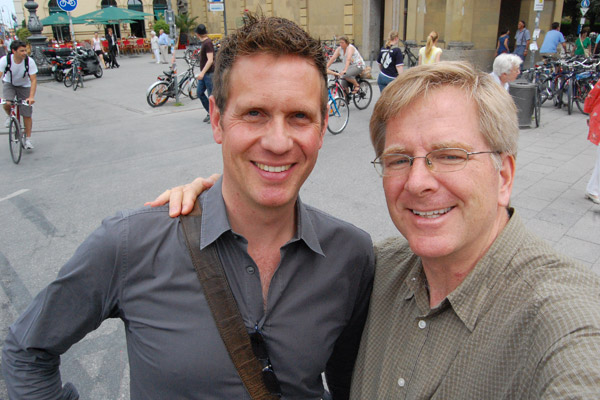
I love my times with Munich local guide Georg Reichlmayr — pronounced like a bad guy on Rat Patrol. Rrrrreichlmayr. We got together recently, just after Germany had beat Argentina in the quarterfinal in the World Cup, and everyone was out, going crazy. I enjoy seeing Germans wave their flag, which — with their difficult 20th-century history — they only do for football victories.

Marveling at the chaos in the streets, Georg says, “We won the game…lock up the cats!” I joke that people who were patriotic in the 1930s might be rummaging around in attics and basements, muttering, “There must be a flag around here somewhere.”
I’ve got a long list of restaurants to check for my guidebook. Post-Fussball victory, it’s not a great night for that, as everyone’s partying and it’s tough to get a fair gauge on the normal energy of the place. I complain that I have an imbalance of restaurants, with too many beer gardens and beer halls. Georg admits that’s a problem in Munich — it has an abundance of great beer halls and a shortage of fine restaurants without the noise and suds.

We pop into the Heilig-Geist-Stüberl — literally the “Holy Ghost Pub.” I always read my description before entering a place, then stow the book and see if it rings true. In my guidebook, it’s described like this: “Heilig-Geist-Stüberl is a funky, retro little hole-in-the-wall where you are sure to meet locals (the German cousins of those who go to Reno because it’s cheaper than Vegas, and who consider karaoke high culture). The interior, a 1980s time warp, makes you feel like you’re stepping into an alcoholic cuckoo clock.”

Georg cracks up about the last three words. Stepping inside, it’s perfectly described. It’s hard to get out, but I have to be very disciplined — one drink can kill your research momentum.

We pass an Apple Store — open late and thriving, just like those in American malls. Then we see a bookstore with big reading lounges. Georg says these are all the rage here. I say, “Bookstores providing a ‘third place’ have long been popular in the US.”

A few blocks later, a guy at a curbside table hollers at me. He’s a US soldier stationed at Grafenwöhr. He says they give everyone landing there from the States a copy of the Rick Steves issue of Smithsonian magazine as a welcome gift and encouragement to get out and see Europe while they’re here. I tell him sales have been great (Smithsonian thinks they will sell out of their double-sized print run), but I didn’t realize we were getting distribution at US military bases in Europe. It’s a great bit of news.

Talking with the soldier gets Georg going on Germany’s involvement in Afghanistan. He muses, “What are we doing in Afghanistan? Let’s give the baby a name” (a wonderful German phrase for our “Let’s call a spade a spade”). I say, “You’re there to make America your friend.” He says, “Of course. We’re not defending Oktoberfest. The Taliban is no concern of ours. This last Oktoberfest came with extreme security — the most I saw. Why? Because Germany is in Afghanistan.”

A bit later, seeing someone walk by with a T-shirt reading, “Costa Rica: no army since 1948,” Georg says, “I think America would be more a super power without an army. With no army at all. Think of what you could do with your money instead.” I explain to Georg that you cannot seriously discuss that issue in the USA. He says, “Yes, I know. We have a long history of important families like Krupp making vast fortunes on armaments.”

With our work about done, we stop by Georg’s favorite beer hall, Der Pschorr. At the Hofbräuhaus, they have a big wooden keg out on display, but draw beer from huge stainless-steel dispensers. At Der Pschorr, every few minutes you hear a whop! as they tap a classic old wooden keg. Hearing this, every German there knows they’re in for a good fresh mug.

Enlarge photo

In a beer garden, you’re surrounded by big women in uplifting dirndls. Georg confirms that German men don’t favor petite women. These famously low-cut outfits seem designed for German Rubenesque tastes. With the euphoria associated with the World Cup games, there are flags flapping everywhere. A beermaid with German flags painted above her cleavage joins us to take our order. I can’t resist saying, “Nice flags.” I don’t think…it just comes out. Nice flags. She looks at Georg and says, “Warum sagen alle Männer das Gleiche?” (Why do all men react the same?). Georg says, “Weil du sie genau dort trägst” (Because you put them right there).

I ask if they sell half-liters. Georg says, “This is a Biergarten, not a kindergarten”…and he orders us each the standard full Mass, or liter glass (about a quart, nearly what we’d call ein pitcher — but for one person).

Conversation flows like the beer in these beer halls. I mention that Austria just went smoke-free in restaurants this month. Georg thinks they’ll fight it. I marvel at how many people still smoke despite the comically blunt “smoking kills” warnings on cigarette packs. And he can’t resist commenting on America’s love affair with guns. “In European eyes, this America and private guns is something very funny. In the supermarket, kaboom, you defend yourself with a gun.” He doubles over in laughter. Recovering, he admits, “In a different aspect, we are mad, too. In Germany, every man has the right to go as fast as he wants on our roads. All Europe has a speed limit except in Germany. That’s our gun. Not even the Social Democrats dare to have speed limit discussion. Only the Greens do. It’s guns for you, speed for us, and smoke for Austrians. And Italians…they vote for Berlusconi. Berlusconi just bought a Botticelli. Like Mussolini owning a Rafael. They shouldn’t let it happen.”

To Georg, having guns everywhere and the death penalty seems incongruous. He marvels, “You have the death penalty and you give people the right to have a gun. To join the EU, you can’t even talk about the death penalty. It is so fundamental. The state does not kill people. That’s one reason why Turkey can’t get in to the EU. But we kill ourselves without guns. On a night like this, when Germany wins a World Cup match…tomorrow we read about more dead on our roads. The Autobahn is safe. It’s the countryside roads — they are suicide.”

Then, whop! Another keg is tapped as this night of German flags, high-volume conversation, and Georg’s favorite beer seems to be just starting.