9/11 and Other Numbers

This month we Americans — all 300 million of us — remember the tragic loss of 2,973 lives, when terrorists attacked our nation. In the more than 3,000 days since that terrible event, hardly a day has gone by when 9/11 hasn’t colored our response to what life has dealt us since. We have mourned together the loss of these innocent victims of this horrible act. And we have been reminded of the fragility and preciousness of each of those lives. I think it’s safe to say that the loss of these nearly 3,000 Americans has changed each of us in some way. And our collective response to the tragic event has changed us even more.

On this ninth anniversary of 9/11, as I remember our loss, I challenge myself to consider other human tragedies that have occurred since then — the loss of lives, the causes, the grief, and how they might have been avoided or minimized. I meditate on proportionality; on our response to each of these tragedies — and on how the desperation and suffering of the poor, dark, and dirty, uncovered by news media, plays out in our hearts.

In 2004, more 4,000 people — mostly civilians — died during the Second Battle of Fallujah in Iraq.

Each year since 2001, between 11,000 and 17,000 Americans have died in alcohol-caused car accidents.

Every day, more than 25,000 poor children die from diseases rich children don’t get.

Every year since 2001, an average of 30,000 Americans — most of them innocent victims — have been killed by firearms.

Since 2007, Mexico has lost more than 22,000 people to the war on drugs.

In 2010, an earthquake in Haiti killed nearly 230,000 people. In 2005 and 2008, earthquakes in northern Pakistan and China’s Sichuan Province took approximately 75,000 and 70,000 lives, respectively. These earthquakes likely would have caused far less death and destruction in lands with First World building codes.

In 2004, an estimated 230,000 people perished in the Indian Ocean tsunami. In 2008, more than 130,000 people died when a cyclone swept through Myanmar.

Since 2003, about 300,000 have been killed in Darfur.

Imagine the horror in little Honduras when Hurricane Mitch struck 12 years ago. Approximately 20% of that nation’s 7 million people were left homeless, while 70% of the country’s transportation infrastructure was demolished. Mudslides killed more than 6,000 people. In a horrifying instant that few of us here in the US even noticed, a land with 3% of our population lost more than double the people we did on 9/11.

As we remember 9/11, some might think it wrong to ponder how and why we pay attention to human tragedy near and far. I’ve been thinking about how good and caring people notice suffering selectively — by proximity or race or religion and how and why we respond to some and not to others.

I think of who the innocent victims were in New York on 9/11 and how their loved ones have grieved. Then I think of the loved ones who survived each of the other tragedies listed…and how they grieved. A New York office worker crushed in concrete…a Honduran family drowned in mud…an Iraqi child riddled with shrapnel…a Californian widow joining Mothers against Drunk Driving.

On this anniversary of 9/11 (as I try to ignore the sick media circus of Quran-burning threats), I think of those who lost loved ones on that terrible day. And I also can’t help but think of a million poor Afghan refugees barefoot and cold in tents just over the Pakistan border as another winter sets in — collateral suffering with barely an army blanket of compassion tossed their way. It’s a thoughtful time…I hope.
The Spain Show Title Finalists

What a great response to my request for ideas on a better title for my Spain show. Thanks a lot. My favorites so far: Spanish Serenade, Spanish Splendor, Viva España, Spellbinding Spain, The Spirit of Spain, and Spain: Sunny, Spicy, Spectacular.

All of these fit the program. Do you have a favorite?

Spain Show Needs a Name…Please Help

I’m producing a new special on Spain, and its working title is Rick Steves’ Spanish Fiesta. I’m sure there’s a better name out there, but I can’t come up with one.

Last year my show with a working title of Mediterranean Hopscotch was given a much better name (Mediterranean Mosaic) by our blog friends. I’d love your creative help again. The description is below. I need to keep it to four or five words. Thanks a lot.

The two-hour special adventure covers the quintessence of Spain: From pilgrims trekking to Santiago to the bulls running through Pamplona, from dazzling Moorish palaces to flamboyant flamenco revelry, and from a never-to-forget paella feast to sparkling sherry poured with an intoxicating love of life, Rick Steves’ Spanish Fiesta will shake your castanets like nothing else.

Photos: Rick’s Summer 2010 Trip

(Note: If you are one of the few who do not immediately see the images below, keep scrolling down until they appear.)

As I do every year, I spent four months in 2010 wandering around Europe, looking for something good to eat and a safe place to sleep.
Enlarge photo

Bratislava, capital of Slovakia and just an hour from Vienna by train, bus, or boat — and a wonderful side-trip — is the comeback kid among European capitals. Its entire Danube riverfront is well on its way to becoming a delightful people zone.
Enlarge photo

In a pub in Prague with my musician and tour guide friends, we sat next to Count Schwarzenberg, the newly elected charismatic playboy who finds himself a key player in the new Czech government. Considered by many the new political hope for that country, he sat down with his young staff to find the best way to implement their vision.
Enlarge photo

The saddest thing I witnessed all summer was in Vienna at the famous pastry shop, Demel. At precisely 7:00 pm they lock their doors and dump all the unsold cakes and pies on their luxurious shelves into big plastic garbage bags.
Enlarge photo

The hottest new sight in Munich is BMW-Welt, the showroom and museum at the BMW car headquarters and factory (with the city subway zipping visitors from downtown to literally its doorstep in minutes). The sweeping architecture invites you into a state-of-the-art interactive showroom and its adjacent museum. It’s enough to make anyone a car buff.
Enlarge photo

Sleeping in airports can be amazingly comfortable. And the price is always right.
Enlarge photo

A fun new tote bag on sale in Vienna reveals all, making X-rays at the airport unnecessary.
Enlarge photo

There are new challenges that come with Europe’s insistence on being ahead of the USA in many techie areas. As it moves quickly to a cashless society, many European machines accept only credit cards that come with a chip. And, as American banks are sticking with the magnetic strip, that means American cards don’t work in these cases. (Little challenges like these make a good guidebook all the more helpful.)
Enlarge photo

I got all excited when, in a great little restaurant in St. Jean-de-Luz in French Basque country, the owner of the place whispered into my ear, “You might be interested that the last wife of Pablo Picasso, Françoise Gilot, is sitting just over there.” She was in town with her own art exhibit. Quite elderly, she seemed full of vigor and style. While tempted, I didn’t invade her privacy for a closer photo. Amazing to think that from 1945 to 1953 she was the muse (and corralled the sexual energy) of Picasso.
Enlarge photo

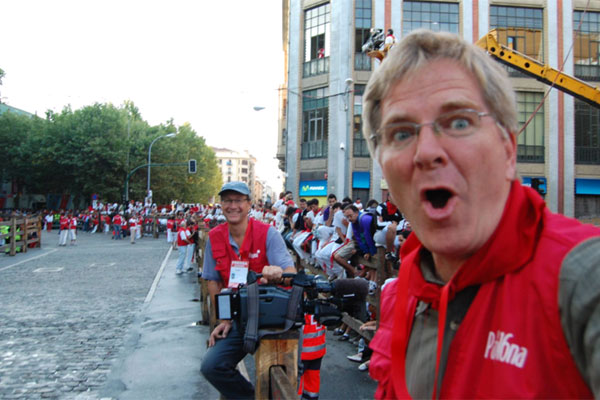
With bright-red press vests, my cameraman Karel Bauer and I enjoyed front-row spots to film the Running of the Bulls in Pamplona for a new TV show. The show is part of our new series — 11 shows debuting nationally on PBS this fall. Stay tuned!
Enlarge photo

The city of Pamplona knows how to keep things organized, as the biggest and wildest party in Europe seemed to be perfectly run.
Enlarge photo

Filming in Pamplona, we had plenty to shoot and lots of drunken troubadours to entertain us…even if strumming only the neck of a guitar.
Enlarge photo

The year 2010 was Holy Year in Santiago de Compostela. And that meant at each Mass they swung the massive incense burner, the botafumeiro. In mid-Mass, I caught a priest being more of a tourist than a priest. I hope he doesn’t get in any trouble for his lack of focus.
Enlarge photo

After years of seeing groups of tourists rolling oddly through towns on Segway tours, I finally took one. While they are expensive (nearly $100) and not really the most efficient way to “tour,” I must admit the experience is lots of fun. After a 10-minute training session, gyroscopes spinning, we roll into the city. In Paris there are plenty of quiet lanes and parks and bike paths to Segway on.
Enlarge photo

For 10 days in England I prioritized my limited time to actually have the experiences — take the hikes, see the shows, follow the audio tours — produced by various sights. One thing I learned: A hike is about the best three hours you can invest when in places like the Cotswolds and the Cumbrian Lake District, where you’re there to enjoy the natural wonders. Hiking Catbells — a ridge trail leading all along and over a small mountain overlooking the lake called Derwentwater in the Lake District — was a highlight of my summer.
Enlarge photo

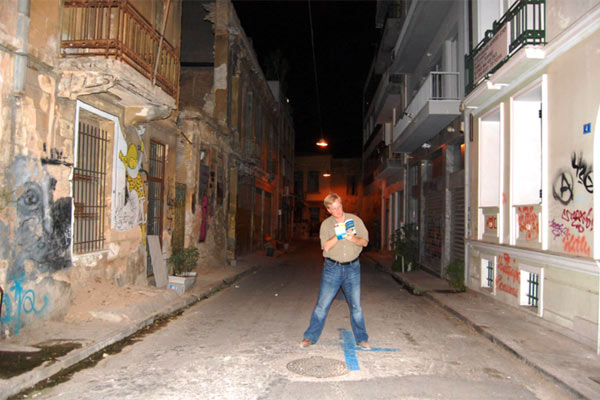
Being in Athens is generally a battle between you and a million cars. But if there in mid-August during a sweltering heat wave, you have the streets literally all to yourself. Athens was eerily quiet during the midday heat.
Enlarge photo

My vote for the best new sight in Europe: Athens’ Acropolis Museum. With great architecture, great presentation, and an inspirational setting, it looks straight across at the actual Acropolis. I think the National Archaeological Museum, long the dominant museum in town, will see a dip in its attendance.
Enlarge photo

I love to meet enthusiastic history teachers inspiring their students to enjoy the rubble of ancient Europe. Here in Athens’ ancient Agora, a teacher was a bit over-the-top in his desire to bring those ruins to life. On that visit, I was inspired myself to help out by producing more audio tours. We’ll produce four new Athens tours (Acropolis, Agora, National Archaeological Museum, City Walk), three for Vienna (Ringstrasse, City Walk, St. Stephen’s Cathedral), one for Salzburg (City Walk), and maybe even a narrated Rhine tour for train and boat travelers.
Enlarge photo

I reaffirmed and stoked my love of the island of Hydra last month. Just two hours by fast ferry from Athens, this island is a wonderland. Frisky shuttle boats zip you to remote beaches from where peaceful trails lead you back into town.
Enlarge photo

Hard at work in Europe. Here I am, bravely visiting Greece during its economic meltdown. With my eyes closed, enjoying both the breeze and the sun, I’m thinking of the many people who opted out of visiting Greece because of hysterical news coverage. I’m pondering how each of us has a choice in how we lead our lives. I thought how fear is for people who don’t get out much and how glad I am to be finished with TV news — to no longer be held captive by a news media with so much time and so little to say.
Enlarge photo

Home sweet home. I’ve been away for four of the last five months. Now, travel research done until next year, I’m thankful to have such a wonderful place to call home.
Enlarge photo

Greece’s "Economic Crisis" and Its Effect on Travelers

Enlarge photo

I just got back from eight days in Greece — Athens and the island of Hydra — updating my guidebook there. Before my visit, people were concerned that my trip would be complicated by the country’s “economic meltdown.” (A magazine I write for didn’t want to run my article on Greece, fearing that it would inspire its traveling readers to venture into trouble.) As has been my standard operating procedure lately, I wanted to go to Greece to get beyond the media hysterics and see for myself the truth — to experience firsthand the effect of Greece’s economic problems on travel there. Greece remains an enjoyable place to travel, but it does help to have some background in what’s going on there.

There’s no doubt that Greece has its economic problems. It has lived beyond its means, worked too short, retired too early, consumed too much, produced too little, enjoyed too much job security, created a real-estate bubble with overvalued properties, and funded too much on a growing deficit. Many other countries (including the United States) are plagued by these same problems, but Greece is an extreme case, with extreme consequences.

The Greek government is scrambling to salvage their economy. They’re getting more serious about collecting taxes. And those taxes are higher: From the beginning to the end of 2010, the Greek VAT (Value Added Tax, a national sales tax) will incrementally rise from 19 percent to 25 percent. This means everything people consume will cost more, because 25 percent of what they pay is going to the government to rescue the economy. Complicating matters: Many businesses have gone bankrupt because of the crisis, so there’s less competition — which means higher consumer prices.

What about all that violence in the streets? Strikes and demonstrations have long been a way of life in Greece. Most Greeks see a general strike as an excuse for an impromptu holiday. But there is a tiny anarchist fringe element that knows a peaceful demonstration or rally by teachers or doctors at Athens’ parliament building will have media coverage. And a handful of troublemakers will “come out to play with their friends” (as locals term it), and things become violent. Like back home, when it comes to TV news, “if it bleeds, it leads”; Greek and international media outlets embrace anything violent and exaggerate it. People who don’t get out much overreact, offering anarchists behind those actions huge rewards.

What’s the future? Greeks are optimistic by nature. They realize they’ve dug themselves into a pretty deep hole. But they also know they’ll get through their “tough economic times.” And they understand that a reality check — which will come with some brutal belt-tightening — is necessary. The biggest culprits of Greece’s notorious largesse are government employees. They have cushy jobs, 100 percent job security, and great benefits. In the public’s eye, they get in, make too much money, and — because they know they can’t be fired — just luxuriate away their work lives in worry-free comfort. There’s a huge anger about economic scandal and corruption, as maddening cases fill the news almost daily.

Simply put, Greece’s adjustments to its new economic reality won’t be fair. For instance, if you turned 60 in 2009, you’re comfortably retired. If you turned 60 in 2010, you’ll need to work seven more years. People are angry about that, but there’s nothing they can do. Young, well-educated, multilingual people feel that they’re overqualified for what Greece has to offer, and are tempted to go abroad for employment to match their skills. This potential “brain drain” of bright young people is yet another of the many challenges the new Greece will be dealing with.

What about the practical effect on tourists? Strikes are nuisance strikes — just a day or two here and there, and generally not prolonged. Regardless of the economic challenges, people still need to get to and from the islands, and they still need services once on those islands.

There will be destructive attempts to grab headlines and express anger at corporate and government sources of local frustration. (Anarchists burned two Starbucks in Athens. Other branches, realizing they were targeted, closed up shop.) But, as of this writing (August 2010), the violence is relatively easy to avoid. Unlike the frightening, random “suicide bombings” of marketplaces that we hear about in the Middle East, in Greece, any violence has been done with notice and generally at off-times — they’ll call the newspaper at 4 o’clock in the morning, just before they bomb an empty bank building (their target is the institution itself, not the people inside). And virtually all demonstrations or acts of violence have taken place solely within one small, high-profile area of central Athens, and have not affected the main tourist attractions (islands and ancient sites) elsewhere in Greece.

I had a great visit to Greece. Based on my mid-2010 experience on the ground in Athens and out in the islands, Greece is the same old place. My company is taking more tours through Greece then ever (our 2010 program is particularly hot), and they’re bringing home happy customers. The museums are still open. When I asked a Greek friend about his, she responded, “Why would we close the Acropolis? It would make no sense. Tourism is an important part of our economy. People pay to see it. That’s why they are here.”

In my mind, the biggest impact of the crisis on anyone considering visiting Greece is the satisfaction you’ll get from contributing to the economy of a nation dealing with tough times, and the joy that comes with a tourist industry that really appreciates your presence.

If there’s a positive outcome from all of this, it’s that Greece’s economic irresponsibility has inspired politicians and political movements across Europe to get real with their economics. In the US, throughout Europe, and elsewhere, the cautionary tale of Greece has sparked a sweeping realization that government pork, corporate corruption, and personal production relative to consumption needs to be re-calibrated.

As many American travelers are nervous about visiting Greece, I plan to put a version of this blog entry in the 2011 edition of my Athens guidebook. Please share your thoughts on this issue. What’s the impact of the crisis on tourism in Greece, and how should this impact our plans to travel there in 2011?