Rome Is a Pain in the Knees

As you read this, I’m in Rome, updating my guidebook and running into lots of happy travelers. I’ve been here just 48 hours, and the Eternal City is pelting me with experiences.

For centuries, pilgrims have been climbing the Scala Santa on their knees. And for decades, I’ve been watching them. (These are the “Holy Stairs” of Pontius Pilate’s palace that Christ climbed the day he was condemned. Emperor Constantine’s mother Helena brought the staircase home to Rome after a trip to the Holy Land in 334. I can imagine Constantine rolling his eyes and saying, “Mom, bring home smaller souvenirs!”)

Yesterday, a voice inside me said “do it!” and I tried the climb myself. Knees screaming, weathered faithful struggling up the staircase with me, fresco of a crucified Christ high above, I climbed the 28 wooden steps. With each polished step, I learned a bit about both the bone structure of my knees and the value of pain when praying.

Last night, in an entirely different mindset, as I was finishing up a fine meal with a Roman friend, he paused to savor his glass of grappa. I tried my best to enjoy the local firewater, and failed. Sipping the grappa, Stefano instructed me: “You must not be in a hurry when taking a grappa!” He then shared with me his ultimate joy: having a glass of grappa with a Tuscan cigar on his sailboat halfway to Corsica. (A Cuban cigar tastes better, but on a sailboat, “the wind will smoke it for you” ‘ so a slower-smoking Tuscan best completes the scene.)

From holy stairs to sacred firewater, I’ll be reporting all month from Italy on this blog and my Facebook page. Join me, and I promise some fun and vivid insights into my favorite country.

A Different Way to Trim the Budget

As Wisconsin-type protests are threatening to break out all over the USA ‘ and regular people are taking huge hits because, as we are being constantly told, “our country is broke” ‘ many are becoming concerned that money spent on our military is money denied other needs in our society. And that comes with a human cost. Reading in The Atlantic, March 15 issue, about how the USA plans to spend $900 billion to buy and operate a fleet of 2,400 new F-35 fighter jets ‘ and then hearing how our country has no money for public-employee benefits, schools, parks, and so on ‘ got me going. (I completely support the USA having the military wherewithal to take swift and decisive action when necessary, and I support our support of the rebels in Libya. But the time has come when the domestic cost of our military budget needs to be considered.)

People in Minnesota are taking action. At breakfast in Minneapolis last week, a friend of mine shared a resolution Minnesotans are giving to their state legislature in hopes of balancing their state budget not by stripping away services to poor and middle-class people, but by reconsidering our military budget. Like many good ideas, it’s courageous but (sadly) probably futile. Still, these numbers are hard to refute. Here’s the resolution:

Whereas Minnesota is faced with a $5 billion budget shortfall; and,

Whereas past budget cuts have resulted in painful reductions in essential services and future cuts would further erode the quality of life for and, in fact, endanger the lives of many citizens; and,

Whereas many cities and communities in Minnesota are laying off police, firefighters, teachers and other essential employees; and,

Whereas past budgets have been balanced by cutting social services, under investment in essential infrastructure, and other measures that push the crisis onto local governments and the poor; and,

Whereas Minnesota taxpayers even during these times of economic crisis and fiscal austerity are poised to pay approximately $26 billion over the next two years for their share of the Defense Budget of the Federal government; and,

Whereas Minnesota taxpayers alone have already spent more than $27.5 billion, and will spend $8.4 billion more over the next two years for the ongoing wars in Iraq and Afghanistan; and,

Whereas 58 cents of every dollar of federal discretionary spending is devoted to military purposes; and,

Whereas military spending priorities at the national level negatively impact budgets and quality of life at all levels of government and society; and,

Whereas our nation desperately needs to better balance its approach to security to go beyond military defense and include the economic, social, and environmental needs of our communities, state, and nation;

Therefore be it resolved that we call on Senators Klobuchar and Franken, and Representatives Walz, Kline, Paulsen, McCollum, Ellison, Bachman, Peterson and Cravaack as well as President Barack Obama, to shift federal funding priorities from war and the interests of the few, to meeting the essential needs of us all.

All statistics are available from the National Priorities Project.

Imagine the impact of US military expenditures on your state’s budget. Maybe you’ve fantasized about winning the lottery. You could do the same for your state if somehow our country (which spends as much as the rest of the planet combined on weapons) became only modestly militaristic and hammered a few extra swords into plowshares.

Talking about the dollars wasted on the military incenses many good security-minded Americans. But I believe the irony of our age is that our military itself ‘ because of the way it bleeds us economically and frays the fabric of our society ‘ is actually becoming a threat to our national security. Yes, that’s irony. What is it about the sacred cow of military spending in today’s USA? Thoughts?
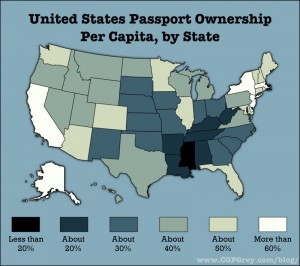
The Passport Map: Who Travels Among Americans

US Passport MapI always thought that if someone wanted to counter the agenda of the forces in our country peddling fear and make America more progressive and open to the world, they would simply give people determined to build walls passports and plane tickets. I’ve also thought that about the best investment the rest of the world could make in the interest of everyone’s well-being would be to establish a fund to give each American a trip to a foreign land of their choice (not Canada) upon graduation.

This map shows a hard-to-refute correlation to percent of population with passports and political persuasion. It also shows a economic correlation between those who travel and those who don’t. I’m not sure what conclusions to draw from this, but it is thought-provoking. Does travel make someone more savvy about politics or more mixed up? Or is this just a quirky coincidence with no real meaning?

TV Bloopers: An Integral Part of Rick Steves’ Europe

I learned from my own school of hard knocks that life is too short to work with people you don’t enjoy. I want to work hard, collaborate with great talent, and have fun in the process. And I’ve found, from a practical point of view, that if you’re not having fun when producing a travel show, the actual show will suffer.

I’ve spent 800 days in the last 20 years filming. We’ve made some good TV, and I’ve suffered a lot of bloopers in the process. Here’s a collection of just a few of my screw-ups, offering what I hope you’ll find is an interesting peek into the fun we had filming our latest series. Watching this, I’m thankful for how Simon Griffith (our producer/director) and Karel Bauer and Peter Rummel (our cameramen) make this work both gratifying and so enjoyable. Starting next month, I meet the crew in Italy as we begin filming our next series. This year, God willing, we’ll produce nine new shows ‘ our most ever in a single year. Stay tuned…for more bloopers.

If you can’t see the video below, watch it on YouTube.

Cartooning for the Hungry

For 20 some years, I’ve supported the work of Bread for the World, and when its president, David Beckmann, is in town, it’s always great to catch up with the organization’s work.

This year I decided to share him with the public. I promoted a public “hunger-awareness” event with David Wednesday evening at our Travel Center in Edmonds. I was disappointed that only a handful of people could drop by. But, as it is with people who care about their mission, David presented his news on the fighting-hunger front with energy and passion. His delivery was no less caring than when I saw him at the state capitol in Des Moines, where he addressed a crowd of 500. That’s when he was awarded the “World Food Prize,” celebrating him (and co-laureate Jo Luck of Heifer International) as the most effective people in our country in the fight against hunger during 2010.

One of the eight people in our gathering happened to be David Horsey, Pulitzer Prize-winning political cartoonist for the Seattle Post-Intelligencer. Just today, David shared with me the cartoon and editorial he wrote that describes the passion, compassion, and hard work of David Beckmann and his team at Bread for the World.

At first, the promoter in me was disappointed in the turnout. But this event was a great reminder that we need to do what we believe is right ‘ even if you’re discouraged, have faith that your effort is worth the trouble. Thanks to both Davids. And let’s hope that we can, as a society of caring people, create a protective circle around the poorest of our citizens as we find the smartest way to be a fiscally responsible nation.

The event left me with a wonderful new quote. Thirty-one years ago this week Archbishop Oscar Romero was assassinated in El Salvador. Why? Because he was going around saying this: “Es una caricatura del amor cuando se quiere apañar con limosna lo que se debe por justicia.”(It is only a caricature of love, when one seeks to fix through charity what is owed to justice.)