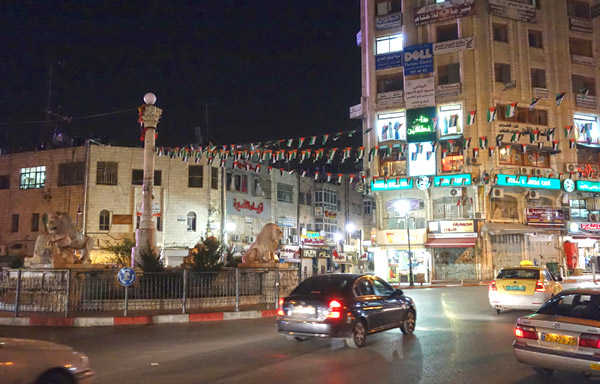
Ramallah is the boom town of the West Bank. As, bit by bit (under the settlement policy of Israel), the likelihood of East Jerusalem being the capital of Palestine is fading, Ramallah is emerging as the de facto capital of the country. It feels secular and relatively sophisticated, and there’s no question that it’s Palestinian. The PLO headquarters is here. Yasser Arafat is buried here. And it’s busy with NGOs and international agencies working on Palestine’s problems. As many Palestinian Americans have moved back home and live here, there are lots of American accents. The city of 70,000 people sits at about 3,000 feet above sea level. Its name means “God’s Mountain,” and it was cold when I was there. As it lacks the trouble-causing religious sites — and is more liberal and cosmopolitan than other Palestinian cities — it was the most relaxed place in the country for me.
Coming into Ramallah, a road was closed off with chunks of broken concrete. A few tires were burning in the distance. And a group of teenage boys were throwing rocks at an Israeli police station. It’s what some kids do here for a little “excitement” after school.
Ramallah is considered the most cosmopolitan city in the country; there’s nightclubs and fun after dark.
In Ramallah I slept at a friendly and comfortable hotel called Beauty Inn. Their breakfast was delightful.
Sadly, Christian churches throughout the Middle East are suffering from the rise of extremist Muslim groups. The Lutheran church in Ramallah is built like a fortress.
My guide, Iyad Shrydeh, took me to everyone’s favorite ice cream joint, Rukab’s, for a bowl of delightfully stretchy Palestinian ice cream.
Downtown Ramallah was the most sophisticated, cosmopolitan, and relaxed urban scene I found in Palestine.
Perhaps the number one sight in Ramallah is the tomb of Yasser Arafat. While, to many, Arafat is just a terrorist, regardless of what you think of him, he was instrumental in raising awareness of the plight of his people. I found that, while many Palestinians believe Arafat squandered some opportunities for peace that they would love to have now, nearly all respect him as an important leader who committed his life to forging a free Palestinian state.
Yasser Arafat led the Palestine Liberation Organization and — whether you consider him a terrorist or a statesman — he raised awareness of the struggles of his people.
In the Balata Refugee Camp, mothers send their sons out for chicken, and they bring home a very fresh bird ready to cook. The boy selects a bird from the cage. The butcher slits its throat, drains it, and tosses the bird into a spinner to remove all its feathers. Then he guts it, washes it, and puts it in a plastic bag. The cost: about $4 a bird. Palestinians call the spinner a “ma a’ta” — the same word they use for the turnstile they have to go through at various security checkpoints. To them, whether you’re a chicken or a human being, the ma a’ta robs you of your dignity. Warning: There’s some graphic content in this butcher shop video.
If you can’t see the video below, watch it on YouTube.
There are camps throughout the West Bank where refugees from the Israeli/Arab wars live. The biggest, with over 23,000 people, is in Nablus. It’s across street from Jacob’s Well, where Christians believe a Samaritan woman offered Jesus some water and he revealed to her that he was the Messiah. (One of the only surviving Samaritan communities lives today in a tiny, tight-knit group on a hilltop above Nablus.) While the camp’s original, three-by-three-meter platting for tents survives, the actual tents were replaced by concrete structures long ago — and these go up many stories. The density is horrible, and there’s little privacy. It’s a land of silent orgasms.
This political art, typical of paintings decorating the wall separating Israel and Palestine, comes with powerful symbolism: Along with the Dome of the Rock (sacred to Muslims), the broken wall, and the olive branch, is a key — what refugees took with them when evacuating their hometowns decades ago.In several places around Palestine you see big keys symbolizing the determination of refugees who left Israel to return to their home villages.In the very poor refugee camp of Balata kids don’t have computers or the Internet at home. But they can spend a few pennies at the Internet shop on the main street. I popped in to see the action. Nearly all the boys were playing violent shoot-‘em-up computer games. One cute little boy turned to me and said, “Shalom.” Another, just as cute, turned away from his terminal, looked up at me, and said, “F*** you, rich man.” Part of me was impressed.
Nablus hosts the Balata Refugee Camp. With more than 23,000 registered refugees, it’s the largest United Nations-administered refugee camp in the West Bank, and it’s now 63 years old. While most Palestinians would disagree, some point out that Israel has had many refugees and assimilated them into their prosperous society while Palestine — and the Arab world — keeps the West Bank refugee camps in squalor in order to stir public opinion against Israel. Others point to the horrible conditions here as an example of the injustice Palestinians are living with every day. Regardless of your perspective, one thing is true: In 1948, when the families now living in Balata left their homes in Israel, they thought it would be for a short time. They locked up and took their keys. They still keep those keys — and they still hope to return.
If you can’t see the video below, watch it on YouTube.
Nablus is the second city of the West Bank in population and, like so many cities in the Middle East, it goes way back. The name is an Arabic version of its original name, Neapolis (New City) — it was founded by Roman Emperor Vespasian in A.D. 72. It’s a socially conservative city and feels that way. They say if you go to Egypt you must see the pyramids, and if you go to Nablus you must eat kunafeh — a shredded wheat, cheese, and syrup-soaked delight. I’m not one to put desserts in the category of ancient wonders, but kunafeh was the tastiest treat I’ve encountered so far in the Middle East. I made a point to eat it everywhere I could.
My guide, Husam, took me to Tanoreen, which must be the best restaurant in Nablus, where we enjoyed a fine city view and a local feast — chicken and vegetables cooked in a fire pit…and sweet kunafeh.Like any Palestinian city, the skyline of Nablus is dotted with black water towers. Palestinian buildings can be identified by the gear on their roofs. While Israeli settlers have running water whenever they like, Israel controls and limits water service in the Palestinian Territories. Consequently Palestinians have black water tanks on their roofs and top them off whenever the water is running. Each community has its concerns: They say the first thing an Israeli considers when building a house is a bomb-hardened safe room, and the first thing a Palestinian considers is building a cistern. Along with solar panels, Palestinian rooftops also sport satellite disks to connect to Arab and international satellites, which serve as their window on the world.
Nablus was considered a capital of terrorism during the Second Intifada. Its residents hit Israel hard, and Israel hit back hard. Its old town streets still show bomb damage. Today, Nablus feels unrepentant, and the town center is decorated with posters of what locals call martyrs. Looking into the eyes of these young men (many of them just teenagers) and seeing how they are portrayed heroically in such posters — and then imagining the anger and hopelessness of the poor street kids today — made me feel sad…and not very optimistic. But there’s always ice cream.