Rick Steves’ Radio Gets the Gold

This year the Society of American Travel Writers recognized my public radio show Travel with Rick Steves with a prestigious Lowell Thomas Award Gold Medal. While perhaps not as well-known as my guidebooks and television show, my weekly radio show is one of my favorite endeavors. Rather than being the guide, I get to be the curious traveler–I act as a conduit between experts on travel/cultural topics and my traveling listeners.  We’re in our eighth year and air on over 200 stations, so I’m thrilled this show and its talented production crew are getting the recognition they deserve. Here’s a huge thanks to the show’s producer–Tim Tattan–and his production assistants–Sarah McCormic and Isaac Kaplan-Woolner. This show is great because of their hard work and expertise.

In particular, the award committee recognized our 2012 Mother’s Day episode that followed a mom as she relocated her family to a village in Croatia, an American raising her first child in Paris, and a tribute to my own mother after her death in 2011. You can listen to it below.

Our weekly program is available free to any public radio station, so if your station isn’t airing it, ask them why. You can also go to my radio show to browse our archive and subscribe to our podcast. All my interviews are a simple click away.

Congrats again to Tim Tattan and his staff for crafting a beautiful program.

Even More Vintage Photos: European Tours Edition

In 2013 we took over 16,000 North Americans through Europe on more than 600 tours. But a few years ago, 100 travelers in one year was a goal hard to imagine. Here are a few photos from those days:

I escorted this small group along on a big tour, serving as an unofficial guide within the confines of a typical, 50-person bus tour. Our motto was, “If you feel the urge for an American-style breakfast, beat it to death with a hard roll.” It was during these early trips on mainstream, cheap, big-bus tours that I dreamed up my tour program--it inspired me to start leading my own tours.
I escorted this small group along on a big tour, serving as an unofficial guide within the confines of a typical, 50-person bus tour. Our motto was, “If you feel the urge for an American-style breakfast, beat it to death with a hard roll.” It was during these early trips on mainstream, cheap, big-bus tours that I dreamed up my tour program–it inspired me to start leading my own tours.
In the mid-1970s --while my group was sitting through a waltz concert--I was having a drink in this Viennese cafeteria, thinking that this was lame travel. There’s got to be a more honest and experiential way for Americans to enjoy Europe. It was in moments like these that I compared the potential magic of travel to the standard experience most American tourists were getting. I decided there was a big need for a better option, and I wanted to provide it.
In the mid-1970s –while my group was sitting through a waltz concert–I was having a drink in this Viennese cafeteria, thinking that this was lame travel. There’s got to be a more honest and experiential way for Americans to enjoy Europe. It was in moments like these that I compared the potential magic of travel to the standard experience most American tourists were getting. I decided there was a big need for a better option, and I wanted to provide it.
This was one of the first Europe Through the Back Door tours, back when I wore plaid in Europe. The standard breakdown: me and eight women.
For years my entire tour program consisted of me driving a series of minibuses around Europe. Picnics were a big part of our diet.
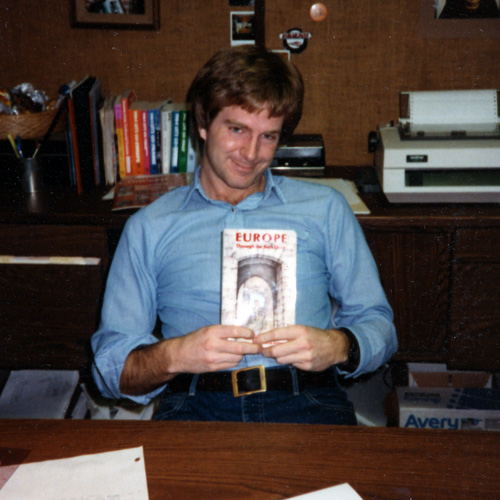
After leading tours for a few years, it occurred to me that I could take the strategies and skills I employed in leading tours and incorporate them into a guidebook. That way, independent travelers could travel smarter on their own. Glassy-eyed, like a mother embracing a newborn infant, I’m cradling the fourth edition of Europe Through the Back Door--still warm from the press. After three amateurish, self-published editions, this was the first done with a publisher.
After leading tours for a few years, it occurred to me that I could take the strategies and skills I employed in leading tours and incorporate them into a guidebook. That way, independent travelers could travel smarter on their own. Glassy-eyed, like a mother embracing a newborn infant, I’m cradling the fourth edition of Europe Through the Back Door–still warm from the press. After three amateurish, self-published editions, this was the first done with a publisher.

More Vintage Rick Steves Photos

It was so much fun reading your comments on my “Hipster” slideshow, that I dug up a few more vintage photos to share over the coming days. I hope they bring back memories of your vagabonding and backpacking days of travel like they did for me. I also hope they inspire you to start planning your next vagabonding adventure. As the saying goes, today is the good old times of tomorrow.

This is about the only photo I have of my first trip to Europe. It was 1969, and I was a 14-year-old nerd with my mom just outside Vienna on the border of Hungary. I was with my parents visiting piano factories. (The best and most expensive piano in the world, Bösendorfer, is made in Vienna.) Our host--the piano salesman--is in the window. And the man on the left enthralled me with a story of how he personally witnessed the assassination of Austrian Archduke Ferdinand in 1914, which kicked off World War I. I was so wonderstruck hearing this vivid story from this amazing character, that I fell in love with history (eventually majoring in it a few years later in college). And I realized, “Hey, this travel stuff is fun.”
This is about the only photo I have of my first trip to Europe. It was 1969, and I was a 14-year-old nerd with my mom just outside Vienna on the border of Hungary. I was with my parents visiting piano factories. (The best and most expensive piano in the world, Bösendorfer, is made in Vienna.) Our host–the piano salesman–is in the window. And the man on the left enthralled me with a story of how he personally witnessed the assassination of Austrian Archduke Ferdinand in 1914, which kicked off World War I. I was so wonderstruck hearing this vivid story from this amazing character, that I fell in love with history (eventually majoring in it a few years later in college). And I realized, “Hey, this travel stuff is fun.”
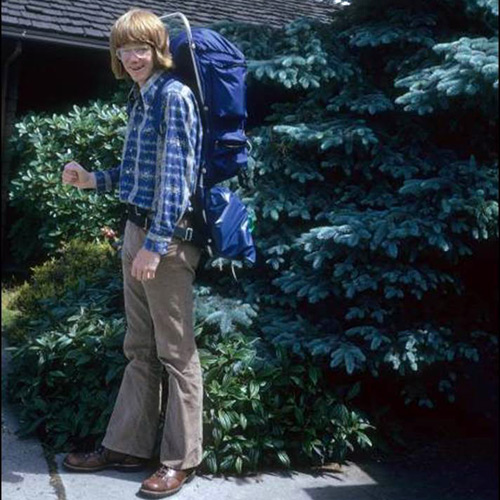
It’s June 20, 1973, the day after graduation from high school, and I’ve filled the biggest backpack I can find with needless stuff. I’m ready to fly to Europe for my first trip without any parents. It would, in retrospect, be the best European trip of my life.
A few years after our graduation trip through Europe, Gene and I headed off to India. This photo was taken on the way home--in Frankfurt after sleeping on the airport floor using my new sitar as a pillow.
A few years after our graduation trip through Europe, Gene and I headed off to India. This photo was taken on the way home–in Frankfurt after sleeping on the airport floor using my new sitar as a pillow.
My favorite country in the world to travel in is India. It rearranges your cultural furniture and wallops your ethnocentricity. But, I think the experience is too personal to lend itself to my style of travel teaching. In Europe I can systematize smart travel. In India--it’s just you, the beggars, the monsoon, and God. When riding an elephant in India, always carry an umbrella. Back then, I wore clothes you could literally wash, wring out, and put on while still wet. It was monsoon season anyway. (I remember being so enthralled by this elephant ride that I pulled my legs up a split second before the elephant crunched into a concrete landing dock. Quite shaken up, I realized I came within a moment of losing both my legs in India.)
My favorite country in the world to travel in is India. It rearranges your cultural furniture and wallops your ethnocentricity. But, I think the experience is too personal to lend itself to my style of travel teaching. In Europe I can systematize smart travel. In India–it’s just you, the beggars, the monsoon, and God. When riding an elephant in India, always carry an umbrella. Back then, I wore clothes you could literally wash, wring out, and put on while still wet. It was monsoon season anyway. (I remember being so enthralled by this elephant ride that I pulled my legs up a split second before the elephant crunched into a concrete landing dock. Quite shaken up, I realized I came within a moment of losing both my legs in India.)
I’ve long used this photo to illustrate how good travel requires meeting people. “If you see four cute guys sitting on a bench, ask them to scoot over.” I’ve been saying this for 30 years...and it still works. Find something...anything to talk about (like black socks and the joy of lots of pockets).
I’ve long used this photo to illustrate how good travel requires meeting people. “If you see four cute guys sitting on a bench, ask them to scoot over.” I’ve been saying this for 30 years…and it still works. Find something…anything to talk about (like black socks and the joy of lots of pockets).

Rick Steves: The Original Hipster

Last month, the New York Times ran an article about hipster fashion trends that claimed sarcastically that “the Rick Steves look is next.” While I’m honored to be mentioned in any article discussing pop culture, I must respectfully disagree with the author. The Rick Steves look isn’t the NEXT hipster fashion trend–it is, in fact, the CURRENT fashion trend. While I generally lay low when it comes to making fashion statements, I believe these photos prove that I was the Original Hipster. Don’t you agree?

Children of the Sixties and Seventies, I’m sure you have similar photos of yourselves–whether hitchhiking through Europe or just hang out at home. Dig them up, and post them on my page. Let’s show the younger generation that they should have been listened to their parents’ fashion advice all along.

Groovy Travels!

Cargo short shorts and black digital watches
Rick Steves Hipster Fashion Tip: Tribal print vests
Rick Steves Hipster Fashion Tip: Mop hair and journal writing
Rick Steves Hipster Fashion Tip: Leather bomber jackets and being surrounded by women’s underwear
Rick Steves Hipster Fashion Tip: Pinky rings (look closely)
Rick Steves Hipster Fashion Tip: Headphones and bad wine
Rick Steves Hipster Fashion Tip: Grey fedoras and high waisted jeans
Rick Steves Hipster Fashion Tip: Tight T-shirts
Rick Steves Hipster Fashion Tip: Studded black belts with black socks

My Time with the Peanut Queen of Alabama

As a little way to clean my palate between trips, I enjoyed a short lecture tour around the USA this last week–giving talks in the Midwest (Sioux Falls, Fargo, and Des Moines), New York (Albany and Rochester), and Alabama (Auburn). At these locations I found myself talking to (and with) librarians at their regional convention; TV and radio station staff and their supporters; venerable women’s club members at their lecture series; and professors, administrators, and foreign-study program staff at universities. I met people both proud of their cities and curious about the world.

While I was hired to share what I’ve learned through my travels, I enjoyed learning from the people who hired me to teach. In Alabama I explained how the anti-USA graffiti travelers encounter is not really anti-USA or anti-USA ideals, rather, it’s anti-aggressive US trade policies. For instance, in struggling countries throughout the developing world, hardline First World trade tariffs allow poor countries to export raw materials but often not finished goods. In other words, if you grow peanuts, you can sell raw peanuts but not peanut butter. Discussing this over dinner, my host told me back when America was living under British rule, farmers in the South dealt with the same kind of structural poverty. They could produce cotton but not refine it into textiles. Being forced to sell the raw material to England so the English could make the serious money stoked local anger–and likely anti-English graffiti.

Crossing from Georgia into Alabama, I noticed huge fireworks emporia along the freeways. I said that where I live, fireworks are only sold in the weeks leading up to the 4th of July. My host explained that in Alabama fireworks are on sale all year long. “Rednecks like to blow things up all the time. Why wait for the 4th of July?” he said. The fireworks draw lots of people from neighboring states too.

Alabamians have a particular kind of pride. When I asked about the freeway exit to “Phenix City,” they said that’s just how they spell “Phoenix.” They added, the next time I come, I must spend some time on the Gulf Coast, which they called “the Redneck Riviera.” And driving back into Georgia they had a good laugh at how, at the border, the sign still reads, “Welcome to Georgia, Home of the 1996 Olympics.”

I enjoyed a wonderful day at Auburn University, and before my lecture I was given a “golf-cart tour” of the campus by two wonderful young people whose responsibility is to show prospective students around. Here’s a little video clip which splices in a particular Alabama love of peanuts.

If you can’t see the video below, watch it on YouTube.