Dutch Dikes: Keeping the Netherlands Dry for 700 Years

While dikes are a Dutch cliché (right up there with tulips and wooden shoes), they’re also an essential part of the Netherlands’ history and contemporary life. Roughly half of the land and half of the people here in the Netherlands are below sea level. And our new television show about the Netherlands includes a segment on these marvels of Dutch engineering.

The Netherlands is bounded by the North Sea. Where there are no natural dunes to keep the sea out, the Dutch have built mighty barriers, or dikes, to protect their farms and communities. For 700 years, the Dutch have been developing their skills at keeping this country dry. It’s a constant battle. And with climate change and rising sea levels now a reality, the work is that much harder and more expensive.

Each of our shows begins with a goofy little bit (called a “tease”) where I say a something about the destination, then reveal the location in a fun way. For our Netherlands show tease, I stood on a chair and said, “Hi, I’m Rick Steves, back with more of the best of Europe. The people here claim if you stand on a chair, you can see all across their country. We’re exploring the best of the Netherlands. Thanks for joining us.”

I was so happy with what we shot. Then, as we were driving away, I realized it would have been stronger if I added “this country is so small and so flat, they say if you stand on a chair…” But it was still a fun bit.


rick-steves-netherlands-farmerWhen it came time to stand on the chair and say my line, Rolinka drove into the neighboring farm hamlet and had no trouble finding us the perfect chair for our needs. In fact, the friendly farmer brought two chairs so that we’d have a choice.


rick-steves-on-chair-on-dikeMy line about standing on a chair to see all the way across the Netherlands is a joke. But from way up here, you really can see for miles.


netherlands-north-sea-dike-with-ship-spewingModern dikes work hard — as they have for centuries — to preserve drained and reclaimed Dutch land.


Dutch-ship-spewing-sludgeEven with an impressive dike already in place, the Dutch are moving mountains of sand and mud to fortify their dikes and protect the next generation. Famous for both their frugality and their foresight, the Dutch are investing billions of euros as climate change makes its costly impact felt on sea-level communities here and around the globe.

Sailing the IJsselmeer

We’re sailing to the fishing village of Marken in a hundred-year-old fishing boat. A few of these venerable boats survive. This one earns its keep by hiring out to visitors…and, in the case of this motley crew, putting them to work.

The Netherlands Big and Small: Rotterdam and Marken

For our new Netherlands TV show, we’re going big and we’re going small — from minuscule Marken to muscular Rotterdam. In this country of contrasts, century-old boats, glassy skyscrapers, and public urinals all have their place.

Two of the cutest and most touristy towns in the Netherlands are Volendam and Marken (both about half an hour north of Amsterdam, and popular day-trip destinations for bus tours). While I can’t handle the big-bus mass tourism of Volendam, I love cute little Marken.

During my scouting trip this spring, I met a club of men who love to sail their hundred-year-old fishing boats on the inland sea — so we arranged for them to sail us from Volendam to Marken. It was great filming and great fun. Our boat, from 1905, was filled with heritage. Our friends explained how their vessel has no built-in keel (as you’d expect on a typical sailboat) because the waters here are too shallow. Instead, it has a side keel, which can be dropped and hoisted by rope and lashed into place as needed. Originally, the boat was run by a skeleton crew of two: a captain and a boy. They’d go out for five days of fishing…then come home on Sunday to go to church.

There was what looked like a historic old saying painting on to the boat’s galley door (which I’m sure countless tourists had photographed because it looks salty and rustic). But it actually says, “If you want to be poor, use this boat for fishing. If you want to be wealthy, use it for tourism.” Classic Dutch humor and candor.

When doing a TV show on the Netherlands, it’s a temptation to make everything seem all cute and sweet — like Marken. After all, I finish the script by saying, “Traveling here, sooner or later, you’ll find yourself exclaiming, ‘Everything’s just so… Dutch!’” But the country has long been a mighty trading power, and no show on the Netherlands would be complete without the huge, no-nonsense port of Rotterdam.

Mighty Rotterdam has a gleaming skyline and Europe’s largest port. It’s a reminder of the Dutch knack for international trade. Locals say that while the money is spent in Amsterdam…it’s made here in Rotterdam. They boast that shirts in Rotterdam are sold with the sleeves already rolled up.

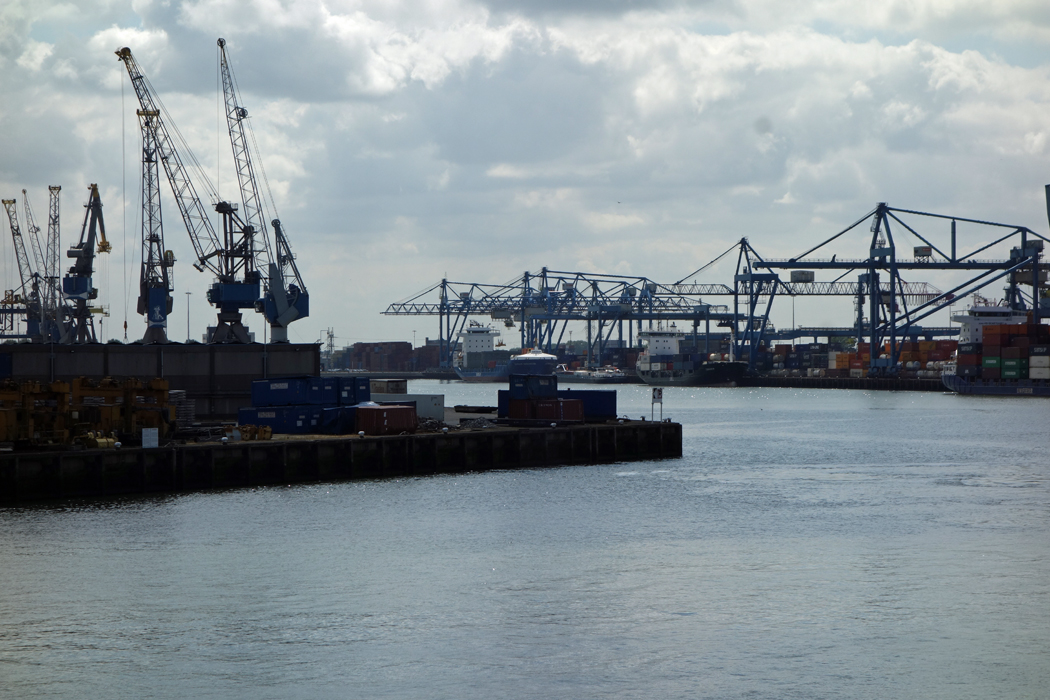
Rotterdam’s harbor is the third-largest in the world. The port handles 35,000 ocean-going vessels each year — that’s almost a hundred ships a day. While most of these ships sail the open seas, this is where the Rhine River meets the ocean. And from here, riverboats — filled with either tourists or cargo — can go all the way through Europe to the Black Sea.

Speaking of big cities, in my 3,200-word Amsterdam script, I wanted to bring up the theme of toleration. My challenge: to artfully weave together marijuana, prostitutes, pilgrims stopping by on their way to Plymouth Rock, hidden Catholic churches, the Holocaust, Anne Frank, and the Dutch Resistance. I wanted to be challenging, but without abusing my bully pulpit. It was a fun writing challenge, and I think it worked. I started the section of the show with this “on-camera,” zoomed in close to my face: “Every corner of Europe comes with a unique flavor and cultural surprises. Small-is-beautiful Holland feels quintessentially European. It’s charming. It’s progressive…” — then, stepping out from behind a public urinal on the street as the camera zoomed out — “…and, with the local passion for tolerance, it’s occasionally shocking. Prepare for some differences: curbside urinals. Prostitutes who are unionized, taxed, and regulated. And coffeeshops that sell marijuana.”


rotterdam-skylineRotterdam was bombed flat in World War II. But rather than rebuilt quaint (as most Dutch towns did), Rotterdammers embraced the chance to go in another direction: bold modernity.

rotterdam-harbor

You can appreciate the immensity of Rotterdam’s mighty port with a harbor tour, which we filmed for our show. While it was OK, the similar harbor tour in Hamburg is far more impressive. What are your favorite harbor experiences in Europe?


Sailing-Volendam-MarkenWe hitched a ride on this traditional Waterland sailboat from Volendam to Marken.


Amsterdam-public-urinal-cleaningAmsterdam’s public urinals are kept very clean — and ready for American film crews to incorporate into their scripts.

Filming Great Art in Amsterdam

One of the great joys of producing our TV series is the chance to be all alone in Europe’s greatest museums when they’re closed (usually early in the morning). In Amsterdam, we were in both the Rijksmuseum and the Van Gogh Museum from around 8 a.m. until 10 a.m., when they open to the public.

While we have the place to ourselves, the clock is ticking — we generally have about 90 minutes before the public pours in. An escort from the museum sticks with us every minute, making sure we stay within our permitted bounds. The cameraman shoots the art every which way to cover the script. It’s wonderful to have the privacy with the art to get the fine work done, and then have a few minutes with the public to get wide shots that show these temples of art filled with the faithful.

Invariably, I don’t know exactly what I’ll be saying on camera until I’m there and we survey what we’re about to shoot. Then I scramble to write and memorize my lines. Writing all alone in front of Rembrandt’s fabled Night Watch was a treat. Here’s the bit I just wrote — first off camera (because it’s easy to “cover” the content by showing details from the painting), then on camera (for material that’s harder to illustrate, so it makes more sense for me to say it directly to the camera):

[28] In Rembrandt’s Night Watch, we see another group portrait. But rather than the standard stiff pose, this one bursts with energy. It’s the local militia, which was also a fraternity of business bigwigs — a kind of Rotary Club of the 17th century. They tumble out of their hall, weapons drawn, ready to defend the city. While it’s creative and groundbreaking in its composition, some of those who paid the artist — like this guy — were probably none too pleased.

[27, on camera] This art is really all about money. The Dutch worked hard and were brilliant traders, and the wealthy had plenty of money…to match their egos. Here, artists earned their living not working for the Church or a king, but by painting portraits for local big shots.


Rick-Steves-Nightwatch-RijksmuseumSitting all alone in front of a great work — like Rembrandt’s Night Watch — the words come easy to this travel writer.


Filming-Vincent-van-GoghThis is the typical scene when filming in a great art museum. Our lighting floods old paintings with brightness, making colors and details pop like even local guides and museum art historians have never seen. But I’m always on pins and needles that someone will come and say “no lights.” When necessary, Simon holds a big piece of black cloth up to stop any glare — especially important when glass covers a canvas.


van-gogh-crows-in-wheat-fieldIn Wheat Field with Crows, one of Vincent van Gogh’s last works, the canvas is a wall of thick paint, with roads leading nowhere and ominous black crows taking flight. Overwhelmed with life, Vincent walked into a field like this one… and shot himself.


van-gogh-roots-amsterdamMost guides and guidebooks love to perpetuate the idea that Wheat Field with Crows was Van Gogh’s final work. It just fits with the story of his suicide. But art historians now believe that this painting, Roots, was Vincent’s last work.

Aalsmeer Flower Auction

One of the joys of our TV production is that I get to actually visit the places and do the things that I recommend in my guidebooks. For instance, on the second morning of filming our Netherlands TV show, we got up at 6 a.m. to catch the Aalsmeer Flower Auction at its busiest.

A hundred buyers click their computers as trainloads of flowers roll through the auction hall. Just outside, a keystone-cops commotion of delivery cars makes sure all the flowers get to their locations that same day — anywhere in Europe. Our cameraman, Peter, got to take a ride on one of these carts to film the point-of-view of a load of flowers.