All this week, I am sharing a behind-the-scenes look at the production of my new public television special, “The Holy Land: Israelis and Palestinians Today.” In this clip, we visit the the Children’s Memorial at Yad Vashem.
When considering the horror of the Holocaust, it’s hard to really imagine the extermination of six million people. And it’s hard to imagine that roughly a quarter of these people, slaughtered like animals, were children. The Children’s Memorial helps make it real.
“The Holy Land” has already aired on stations in several locations. Many other stations, such as WTTW 11 in Chicago and KCTS 9 in Seattle, plan to air it soon. Call your local public television station to find out when you can see it too.
All this week, I am sharing a behind-the-scenes look at the production of my new public television special, “The Holy Land: Israelis and Palestinians Today.” In this clip, we visit Yad Vashem, in Jerusalem.
Yad Vashem is the most important Holocaust memorial in Israel. In its Hall of Names, a vast archive surrounds a powerful collection of faces of people killed during the Holocaust. Of the roughly six million Jews murdered, about half have been identified by surviving family and friends. Pages of their testimony are archived here. The purpose of it all: to give as many victims as possible, whose deaths were as ignominious as their killers could manage, the simple dignity of being remembered. With our “Holy Land” TV production, we wanted to show context for today’s tensions. And the Holocaust is certainly part of that big picture.
“The Holy Land” has already aired to great success on stations in several locations. Many other stations, such as WTTW 11 in Chicago and KCTS 9 in Seattle, are excited to air it soon. Call your local public television station to find out when you can see it too.
All this week, I am sharing a behind-the-scenes look at the production of my new public television special, “The Holy Land: Israelis and Palestinians Today.” In this clip, we sit down to our first lunch while scouting TV production in the Crusader town of Akko, Israel. We were treated to a typical and colorful array of mezze-style plates: delightful dips, soups, and salads that are a daily edible reminder of how fertile Israel is. A few months later, we were at the same table with our crew and the camera rolling. Delicious.
“The Holy Land” has already aired to great success on stations in several locations. Many other stations, such as WTTW 11 in Chicago and KCTS 9 in Seattle, are excited to air it soon. Call your local public television station to find out when you can see it too.
Many of you know that I am a board member of NORML and an advocate for marijuana policy reform. And if you’ve understood my position, you know that I’m not in this to be “pro pot.” I am involved to end an expensive, racist, and counter-productive prohibition as wrong-minded and costly to our society today as the prohibition against alcohol was back in the 1930s.
An exciting new documentary movie called “Evergreen” tells the story about how my friends and I helped legalize, tax and regulate marijuana in my home state of Washington. (And is the closest I’ll ever get to “starring in a movie”.)
Since the last election, my state, along with Colorado, considers responsible adult recreational use of marijuana a civil liberty. And now, we are working to legalize marijuana in Alaska and Oregon. If you would like to get involved in this work (which I consider good citizenship), here’s a great opportunity to support us. Simply join NORML with a donation of $50 and they’ll send you a free DVD copy of “Evergreen.”
In what I call “the lower 48” states, hundreds of thousands of people—not rich white guys but black and poor people—are arrested each year for marijuana possession. But, in Washington and Colorado, thousands who would have been arrested are not, saving our states millions of dollars and avoiding untold heartache. Great things are happening as our country is, step-by-step, ending the war on marijuana and undoing the prohibition of our age. We have exciting momentum. There’s lots more to do. That’s why I’m donating these DVDs to NORML for this campaign. And that’s why I’m packing up and heading to Oregon next week for an intense week of media and lectures in ten different cities.
Since 1980, we’ve been producing guidebooks. My first book was self-published. I gently drove the precious little bundle of 256 lovingly typed pages (with white-out fixes and ballpoint-pen drawn maps) to Ed Wise, the owner of Snohomish Publishing. A couple of weeks later, I took delivery of 2,500 copies of my first edition of Europe Through the Back Door. I stacked the boxes along the side of my piano-recital studio, where family members could sit on them–if there were no seats left–when their children performed.
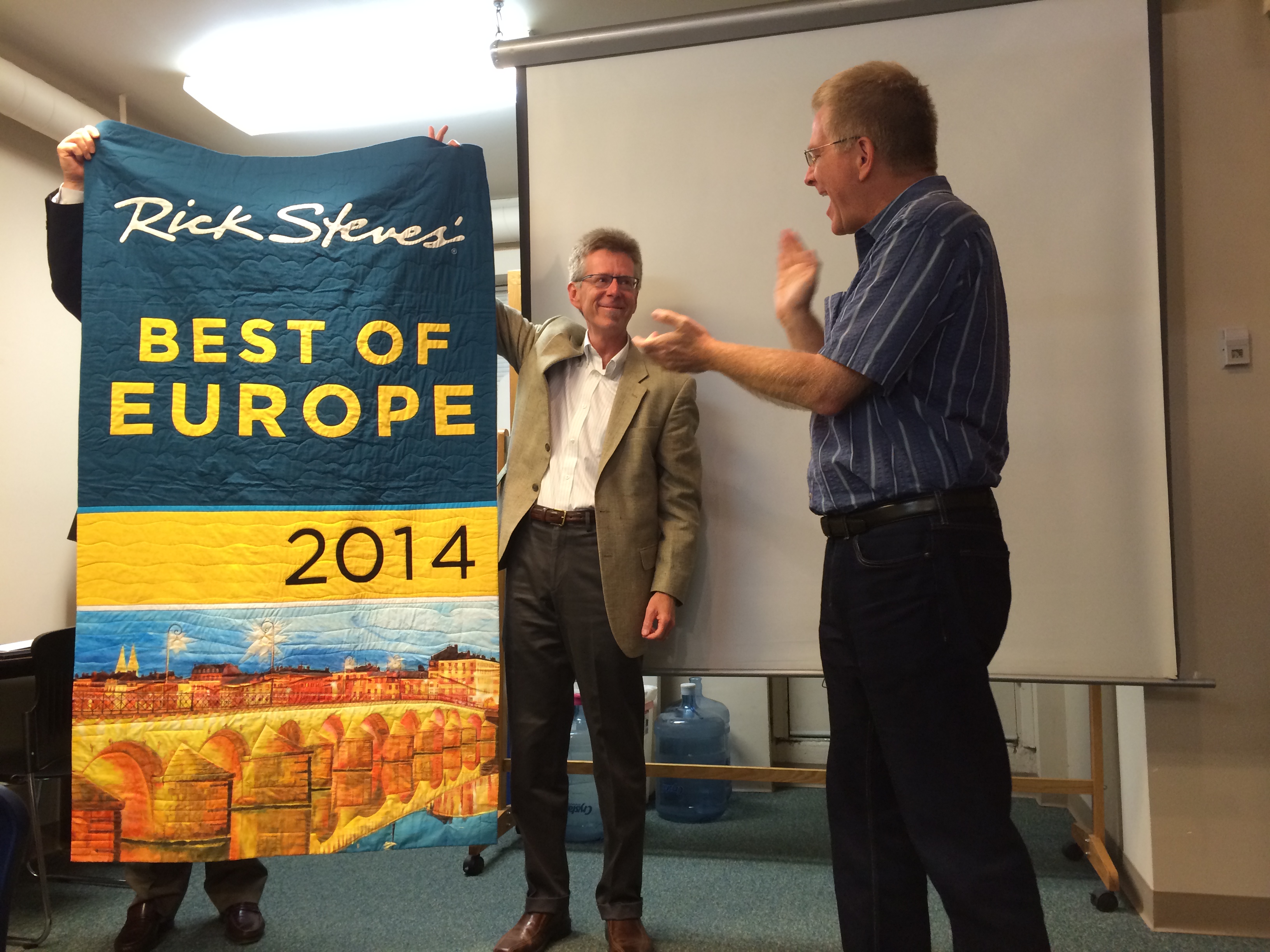
Flash forward 34 years: I’m hosting a monthly all-staff meeting as about 60 of my co-workers are gathered together. And we have four guests joining us from our printer, Friesens, an employee-owned company located in the little town of Altona near Winnipeg in Canada. They have traveled here to Edmonds to present us with a delightful handmade quilt of one of our book covers—a tradition when they print a million books for an author and publisher. (While we don’t have a single title that sells in that range, Friesens has collectively printed a million of our guidebooks.)
Photo: Patricia Feaster
As our guests explained how thankful and proud they are to print our books, and how their little town of 3,500 includes 500 people who work in their plant, I enjoyed the beautiful thought that it takes a village to bring a guidebook to our travelers, too. And the people who make sure the pages are in order, the covers are crisp, and that the right paper stock is in supply are as critical as the researchers in the field and the sales reps who visit the bookstores.
It’s fun to work in an age of dramatic change. And we’re leaders in our field in electronic guidebooks. But I remain “a print guy.” Fortunately, the print market for guidebooks is steady and we’re selling more books in print than ever before. Of all the travel guidebooks sold in the last six years in the USA, our market share has more than doubled—from about 8% to about 18%. And for that we have a lot of people to thank… including you! Thanks for helping keep our Canadian friends in Manitoba busy and us as well. And happy travels.