Guest Post: Pasta-Making Night at the Agriturismo

As I like to do every couple of weeks, today I’m sharing a post from Cameron Hewitt (co-author of many of my Europe guidebooks). If you like this tasty slice of Tuscany, be sure to “like” Cameron on Facebook.

In this post, Cameron captures both the sweet life of rural and traditional Tuscany as well as how American travelers can actually experience it. While in practice this entry includes a recipe for a special pasta, it’s also (and more importantly) a recipe for good living in disguise. Once again, Cameron, you inspire me to not just travel…but to travel well. Enjoy!

At Agriturismo Cretaiole, Thursday night is pasta night. Guests return from a busy day of tooling around Tuscan hill towns and wineries to make pasta — specifically, the local hand-rolled noodles, called pici.
cameron-italy-tuscany-cooking-class-cretaiole-009

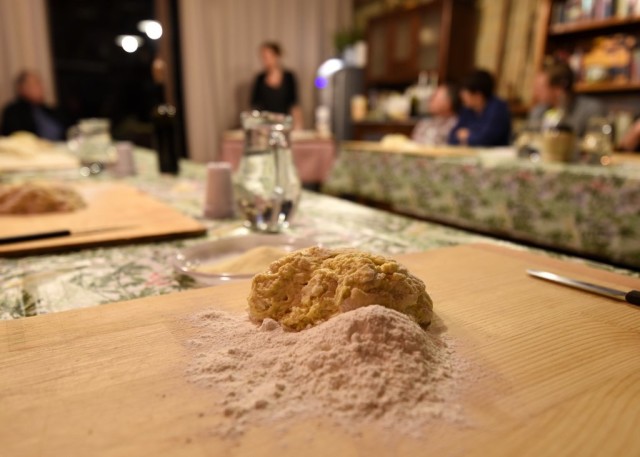
After a lively week of group bonding, all of the guests pack into the glassed-in veranda. They squeeze behind rustic tables with a hubbub of anticipation. In front of each small group is an oversized, rough-wood board with just the right texture for rolling noodles.

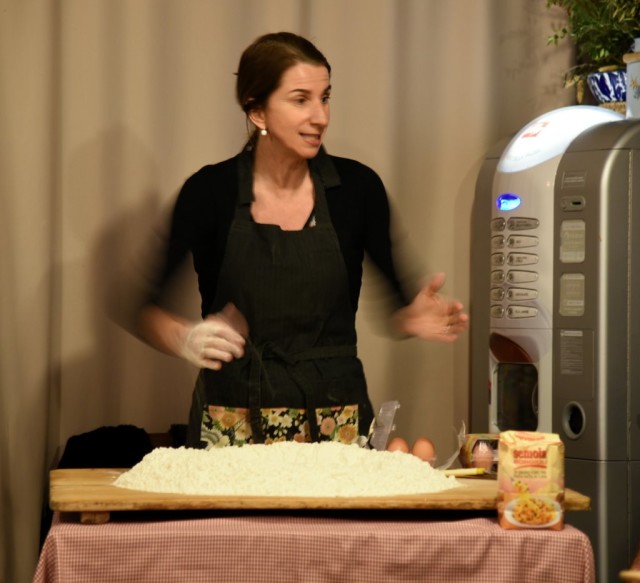
In one corner of the room, our agriturismo host, Isabella, stands at a small table and addresses the group. The board in front of her is piled high with a 10-pound mountain of flour. She explains — with the seasoned confidence of someone who’s taught hundreds, maybe thousands, of travelers how to make perfect pasta — the precise procedure.
cameron-italy-tuscany-cooking-class-cretaiole-003

First, she dredges out a crater in the top of her flour mountain, turning it into a volcano. Into this precarious container she cracks eight eggs. She gingerly beats the eggs with a fork, gradually sprinkling in water — a few drops at time — as she pulls in more and more flour from the lip of the crater. With each stir, the sea of eggy goo threatens to breach the fragile walls. But gradually, liquid turns to solid. And with one last vigorous stir, it becomes a mound of sticky dough.
cameron-italy-tuscany-cooking-class-cretaiole-006

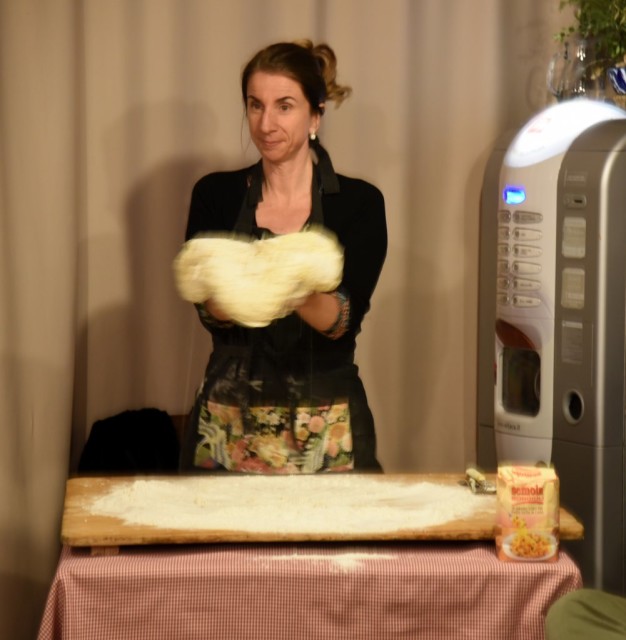
It’s time to knead. Isabella carefully explains the importance of keeping the “cut” — or, in more pleasant terms, the “smile” — facing you at all times. After each knead, you rotate the dough a quarter-turn, then repeat. It’s a steady rhythmic, motion — like waves crashing on a beach: Pull, push, push, rotate. Pull, push, push, rotate.

Each family huddles around their communal wad, taking turns. Isabella circulates through the room, gently correcting our awkward technique. “Done?” someone asks her. She sticks an accusing finger deep into the center of the seemingly finished ball of dough, and withdraws a sticky fingertip. “Not done yet,” she says. “Keep going.”

Finally, the dough is ready, and it’s time to make the pasta. Pici (pronounced “pee-chee”) are peasant noodles. Pici are hand-rolled — not neatly extruded from a metal tube. But it’s deceptively tricky to master.
cameron-italy-tuscany-cooking-class-cretaiole-041

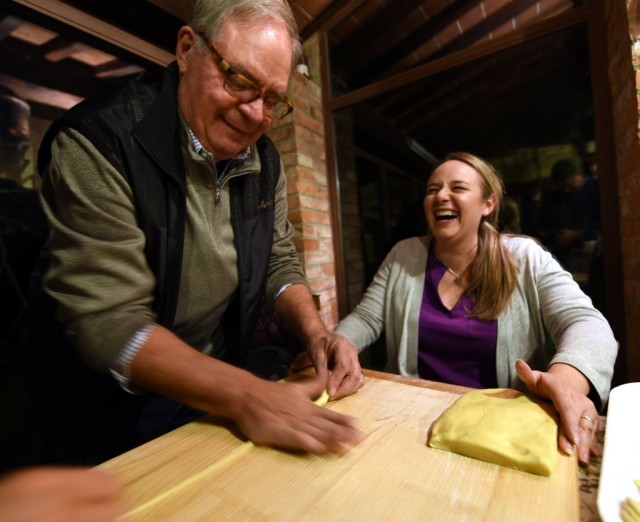
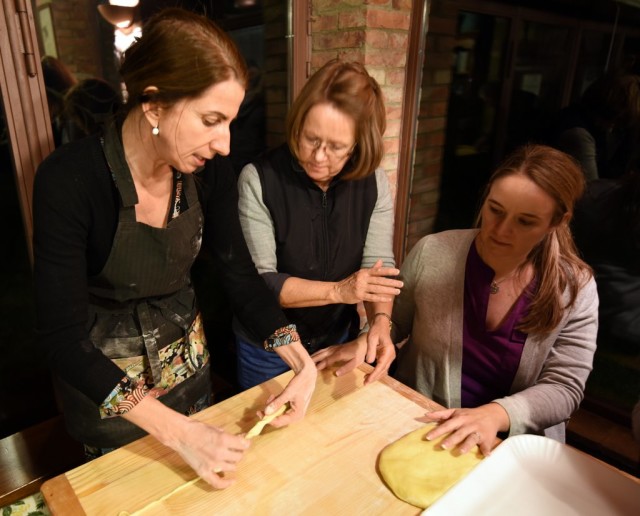
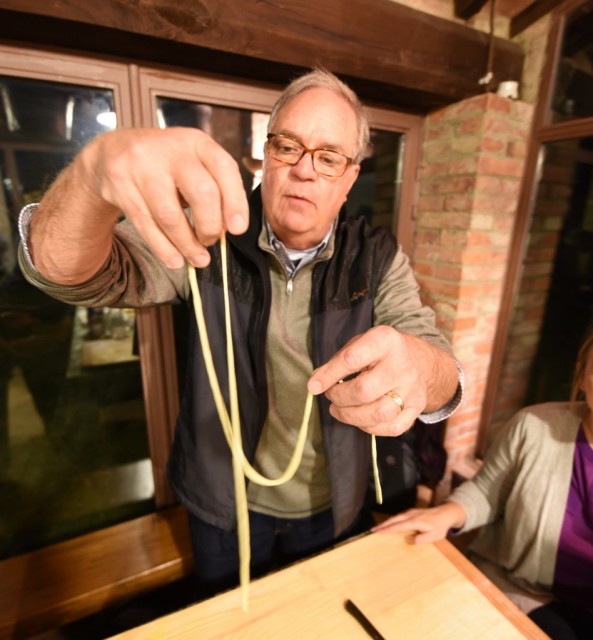
Here’s the technique: Cut off a hunk of dough, hold it in your left hand, and roll it with your right.  Continually massage the dough with the heel of your hand against the cutting board, always gently tugging on the dough clump to tease out a strand. It’s harder than it sounds. Too little pressure, and you get thick, inedible ropes. Too much pressure, and it breaks into bits. But if you do it right, you get pasta shaped like a four-foot-long earthworm. This is where those special boards come in: They offer just enough texture to provide friction for rolling the pici, but not so much that it sticks.
cameron-italy-tuscany-cooking-class-cretaiole-029

Families take turns rolling their pici, offering each other tips and encouragement. Some people go fast. Others go slow. Some pick up the technique immediately, churning out long strands of perfectly uniform noodle. Others can’t quite get the hang of it, and spend most of their time pinching together broken strands…while nervously eyeing Isabella across the room, hoping she doesn’t notice.
cameron-italy-tuscany-cooking-class-cretaiole-036

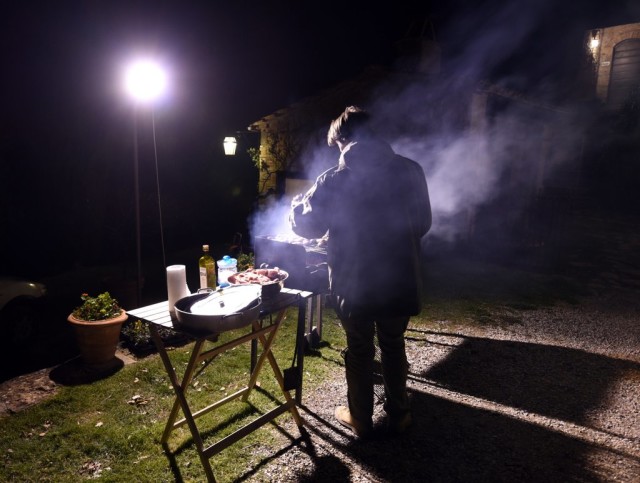
I take a break to head outside, where I find Isabella’s husband Carlo at the grill. His roaring fire has died down, and he’s repositioning his glowing coals. Carlo gently nestles his pork sausage and ribs onto the hissing grill.
cameron-italy-tuscany-cooking-class-cretaiole-057

In the little garden shed nearby, Isabella has brought a 20-gallon pot of water to a rolling boil. To season the noodles, Isabella pours three generous handfuls of coarse salt into the water. It tastes as salty as soup. Then she drops in the handfuls of pici, which squirm around the bubbles like miniature eels.

In just five minutes — when the water starts to foam up — it’s done. Isabella tosses the pici with some meat ragù she’s been simmering all day long, then takes the giant, overflowing, stainless-steel bowl back to the veranda.

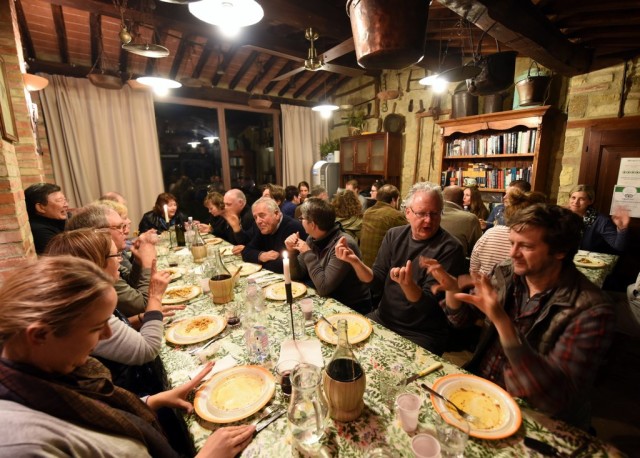
At Cretaiole, pasta night is also potluck night. Each guest brings down a salad, side dish, or dessert they’ve prepared in their apartment. Some use it as an opportunity to try out recipes they’ve picked up at cooking classes this week: a radicchio salad with pecorino and fennel, or a lightly sweetened, simple ricortta. Others import favorites from back home — my mother-in-law’s apple crisp (made with Tuscan apples) is a hit.
cameron-italy-tuscany-cooking-class-cretaiole-058

Settling in to a delicious (and hard-earned) dinner, the Cretaiole guests chatter and drink and eat and laugh. Old Man Luciano shows up, clutching bottles of Vin Santo and grappa that he’ll be sharing later in the evening. Once-strangers, now-friends animatedly discuss all they’ve experienced this week. That great art museum in Siena. That stunning scenery from the drive to Monticchiello. Adorable Milli, our canine companion who sniffed out truffles during our hike through a wooded valley. People swap the Italian words they’ve learned and the Italian gestures they’ve mastered.

Digging into my pici, I screw my index finger deep into my cheek, then wave my hand alongside my head: Delizioso! The noodles we made are firm but tender. Each noodle clings to just the right amount of flavorful ragù, exactly as it was designed to do. As time stands still around this convivial dinner table — so far from home, yet so familiar — it’s clear why here in Tuscany, the traditional ways are still the very best ways.

Learn More About Cuba Before Your Trip

My trip to Cuba was a fascinating and memorable way to kick off 2016. And sharing it with you (and reading so many insightful comments) has been a joy. I hope you enjoyed traveling with me during the last 30 or so posts. If you missed any posts along the way, you can find them all right here on my blog.

Rick Steves and Cuban man with cigars

To put the many questions to rest: While I enjoyed the experience and highly recommend travel there, I have no plans to lead tours, write a guidebook, or film a TV show on the island.

If you live in the Seattle area and want to learn more, I will be giving my 90-minute Cuba talk on March 28 at Town Hall Seattle ($5); and on April 2 at the Edmonds Center for the Arts (free). A filmed version of this talk may also be available later online. Stay tuned.

It’s my hope that this Cuba series has inspired you to consider traveling there yourself. For a complete and practical listing of the B&Bs we slept in, the restaurants that we’d recommend, and our sources of information — as well as more posts about our Cuba trip — visit Trish Feaster’s blog, The Travelphile.

Thanks again for adventuring with me…and happy travels!

Wrapping Up Cuba

The American visiting Cuba gains an appreciation for the resilient joy and spirit of its people, and takes home memories of a time warp free of the strip-mall banality of the rich world. Venturing here offers a chance to befriend a poor and struggling island society that is, in its own way, an inspiration…and headed for breathtaking change. And as the wheels of my Aeroméxico plane left the Havana airport tarmac, I hoped to someday soon return to find a society that has kept the good in its heritage while gracefully and gently joining the family of nations in an aggressive global economy.

Fidel Castro

Fidel Castro, the human embodiment of Cuba’s Revolution, survives…but just barely. People I met didn’t know exactly where he was and figured he’s alive, but no longer coherent. Even so, it seems that Cuba’s Revolution survives because of the stature of Castro. We asked many times, “What happens here after Fidel and Raúl Castro are gone?” The answer: “Nobody knows what will happen.”

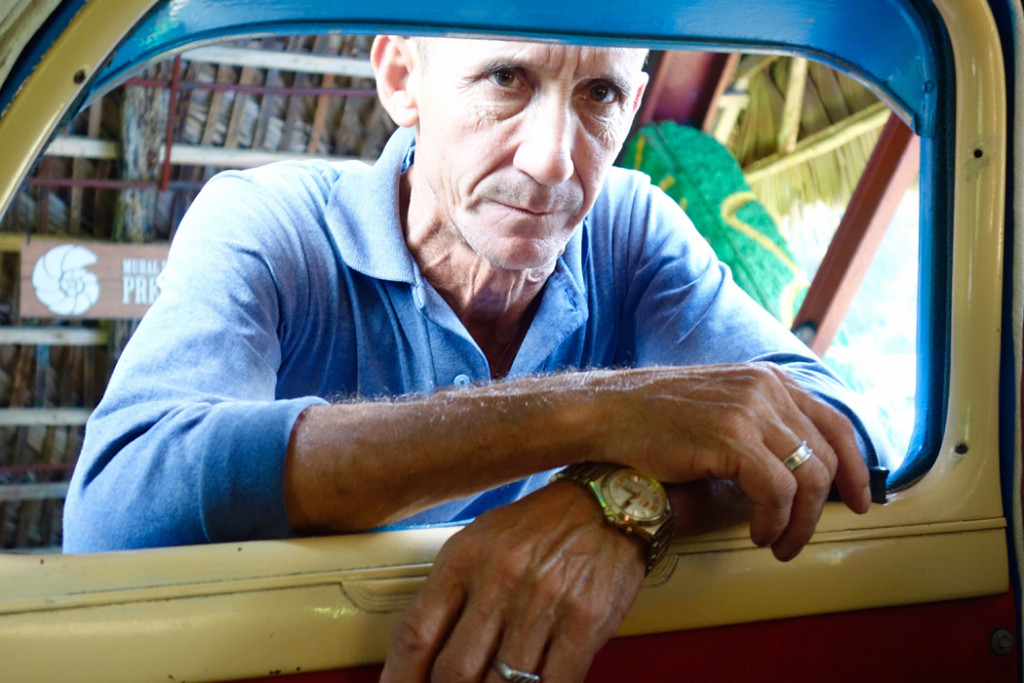
Cuban man

Photo: The Travelphile

Sure, the Cubans are poor in material terms. But they are no poorer than other Latin Americans. And they have a strength of character, national pride, and human dignity that is unique in this region.

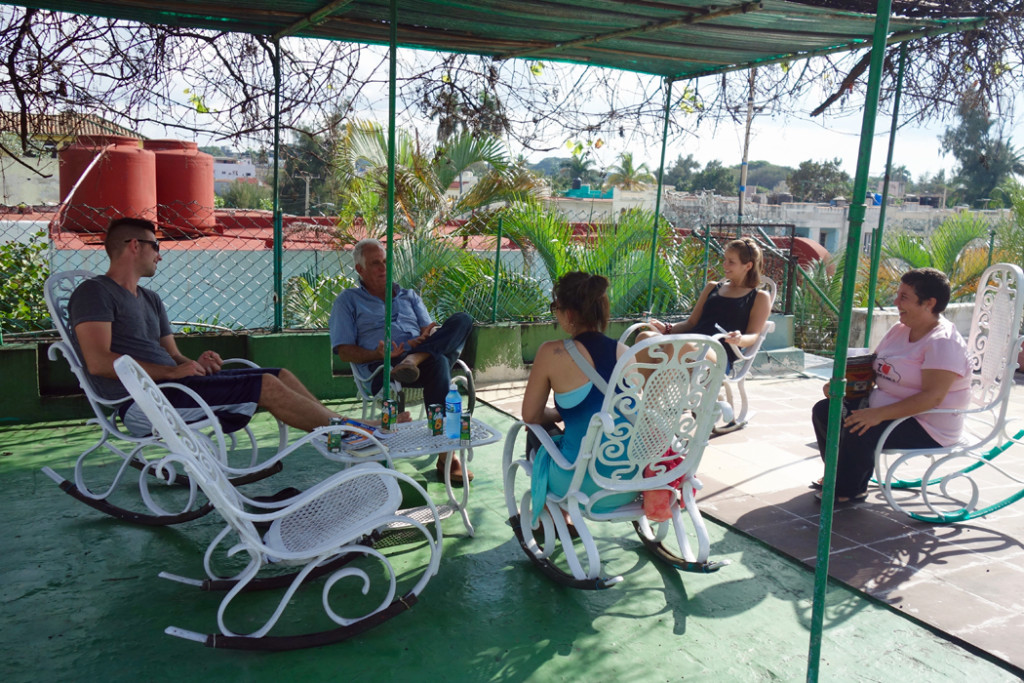
Family on rooftop

Photo: The Travelphile

Cubans are free to talk politics, and they love doing just that. We spent hours on the rooftop of our B&B talking with our hosts. The conversations were wide-ranging and full of memorable quotes: “Cubans are great athletes. We earn more Olympic gold medals, per capita, than any other country.” “When you give people things for free, they don’t value it.” “We don’t throw away anything. We just repair it and repair it and repair it.” “Resistance and dissident movements get no traction in Cuba, because people here assume they are funded by the CIA to destabilize our country.”

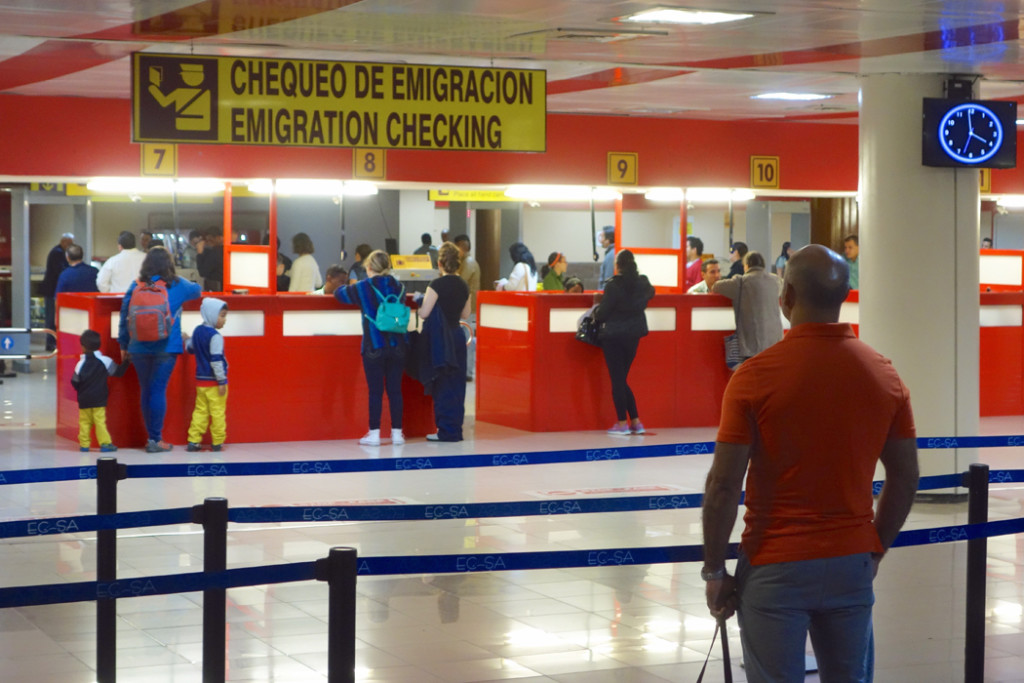
Airport customs

I traveled to Cuba completely legally, but through Mexico. My government knew exactly what I was doing, because whenever I prearranged or paid for something (even via London or Canada), a form popped up making me declare that I had a general license to travel in Cuba. (Of the 12 acceptable categories, I simply had to declare that I was on “professional research.”) Returning home, we flew from Havana to Mexico City (departing at about 6:00 am, no departure taxes, very straightforward…like any flight). Then we flew from Mexico City to Houston. At Houston, US Customs hardly looked at me. I pleaded, “But I’ve been in Cuba. I bought souvenirs, too.” The man in the uniform just said, “Welcome home.”

Rick Steves with passport

Photo: The Travelphile

(It’s my hope that this Cuba series has inspired you to consider traveling there yourself. For a complete and practical listing of the B&Bs we slept in, the restaurants we found that we’d recommend, and our sources of information — as well as more posts about our Cuba trip — visit Trish Feaster’s blog, The Travelphile.)

A Wild New Year’s Eve Party in the Havana Barrio

A highlight of our Cuba trip was ad-libbing our New Year’s Eve party. It worked out perfectly — we made friends, got invited into a private apartment, drank rum, and learned how to dance with a huge and friendly family. To make it even better, we ended up crashing an expensive rooftop hotel party for rich world elites…which was pretty bleak. That affirmed that the fun is best with the locals. Happy New Year!

(It’s my hope that this Cuba series has inspired you to consider traveling there yourself. For a complete and practical listing of the B&Bs we slept in, the restaurants we found that we’d recommend, and our sources of information — as well as more posts about our Cuba trip — visit Trish Feaster’s blog, The Travelphile.)

Happy New Year’s Eve in Havana

Anticipating a Cuban New Year’s bash, tourists gather in Havana’s old town. The cathedral square is filled with tables, as servants scamper to keep the breeze from destroying their handiwork with the napkins. Leaving the touristic center, we walk three blocks into a barrio — with buildings aging like melted sugar cubes and people who, it seems, view the world from their ramshackle doorsteps. I made a friend and was invited into a party I’ll never forget.

Rick Steves and Cuban party host

Peeking into a once-grand entryway, now draped in poverty, I saw masses of creative wiring creating a confused black web above broken building material coated with grime. A ramshackle spiral staircase led into what seemed like a dark attic — but I knew was many floors of apartments, each with a family primed to enter the New Year. Given the political quaking in Cuban-American relations, I suspect that 2016 could be a year to remember.

Marveling at the play of light — rays streaming through cracks, highlighting random corners of the otherwise dark space — I realized it was perfectly monochrome. As I steadied my camera against the door to compensate for the low light, a man suddenly stepped into the space.

Wearing a blue-and-black-striped shirt, with crucifix bling dangling from his neck, he looked like a young, miniature Arsenio Hall. The bright-blue stripes along with his toothy smile popped in all that black and gray.

He said, “Me llamo José.” We talked and shared our feliz año nuevo wishes. Americans are still an oddity here, so that stoked the conversation. José was heading up that haunted-house spiral staircase to his family’s party, and invited us along. Knowing that this is the kind of opportunity you travel for, we accepted.

Rocking chairs spilled out onto the third-floor landing, providing an alternative space for the old boys to gather. Drawn to the bright light of the family room — a big space for cooking, eating, and lounging — we were welcomed into a four-generation scene. (Generations pile up quickly, as girls have kids early. José was 39 and already a grandfather. He didn’t like that his 13-year-old daughter had a child…but what can you do?)

Rick Steves family with Cubans

Photo: The Travelphile

I’ve enjoyed many situations with very poor people partying. But this scene seemed different. I sense the ratio of education to per capita income here is the highest among the poor of any place I’ve ever traveled. These people spoke English and eagerly taught us to rhumba. With the conversation raging, the brother showed me his smartphone with quotes from Abraham Lincoln in Spanish. He translated one roughly: “The best form of justice is not always the best politics.” Cuba has plenty of poor, but regardless of any family’s ability to pay, they’ve all been to school.

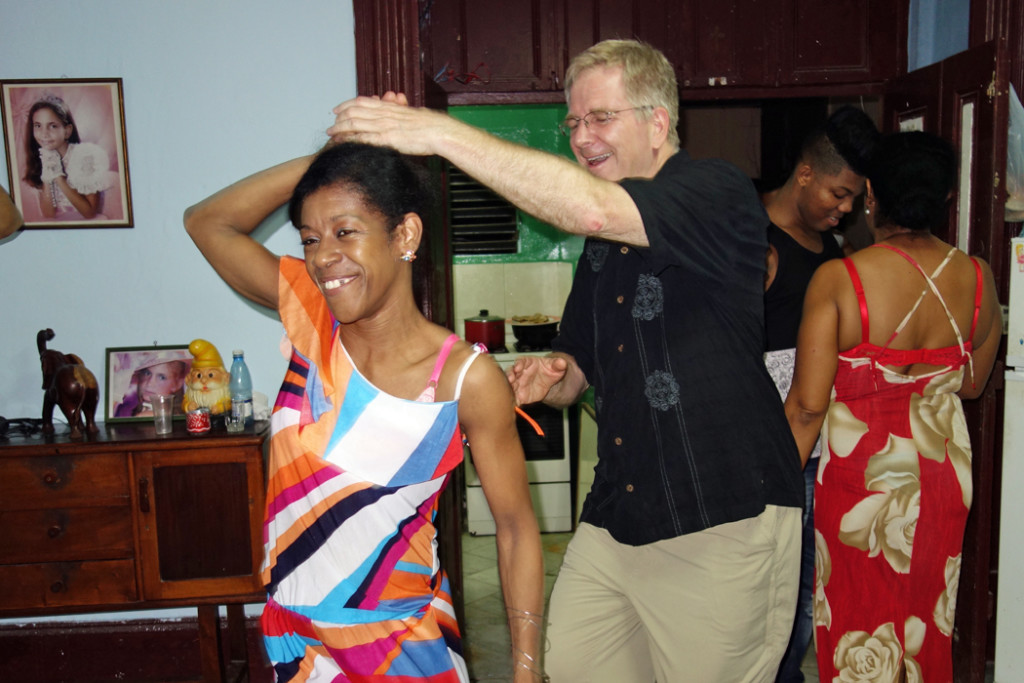
The only thing being served was straight rum in tiny glasses. A boom box played while all danced. Little kids were busy learning dance moves from the older ones. A ten-year-old Michael Jackson wannabe was happy to teach the visiting tourists the steps. The patriarch proudly snapped photos. (My next post is a video of all the fun.)

Rick Steves dancing with Cuban woman

Photo: The Travelphile

Getting some quiet, I stepped out onto the balcony. From that corner perch, the grimy city stretched in four directions. Nearly all the action seemed to be families gathered in homes — certainly more affordable than going out.

When midnight struck, everyone crowded onto that balcony to enjoy the local tradition of pelting anyone clueless enough to be out and about with garbage and water.

Havana hotel

Photo: The Travelphile

Later, we walked six blocks back to Cuba’s towering capitol building (a knockoff of ours in Washington DC — but, they boast, “one meter taller”). Across the street, we climbed to the rooftop of a hotel and crashed a classy $50-a-plate dinner with a band playing poolside. The patrons seemed dreadfully bored, and the contrast between this scene (with over-the-top food and party favors for about a month’s local wages) and the humble apartment where we had enjoyed our New Year’s was thought-provoking.

Out after midnight in a Havana barrio, we felt perfectly safe, except for potholes and passing bici (bicycle taxis) in the dark streets. Jumping into a taxi, I said, “Miramar” (the neighborhood of our B&B). He said, “Twenty CUC” — that’s about $20. I said, “Ten.” He said, “No, this is a 1956 Pontiac…fifteen.” I said, “OK.” He said “Feliz año nuevo,” and we rumbled home…capping a New Year’s Eve I’ll long remember.

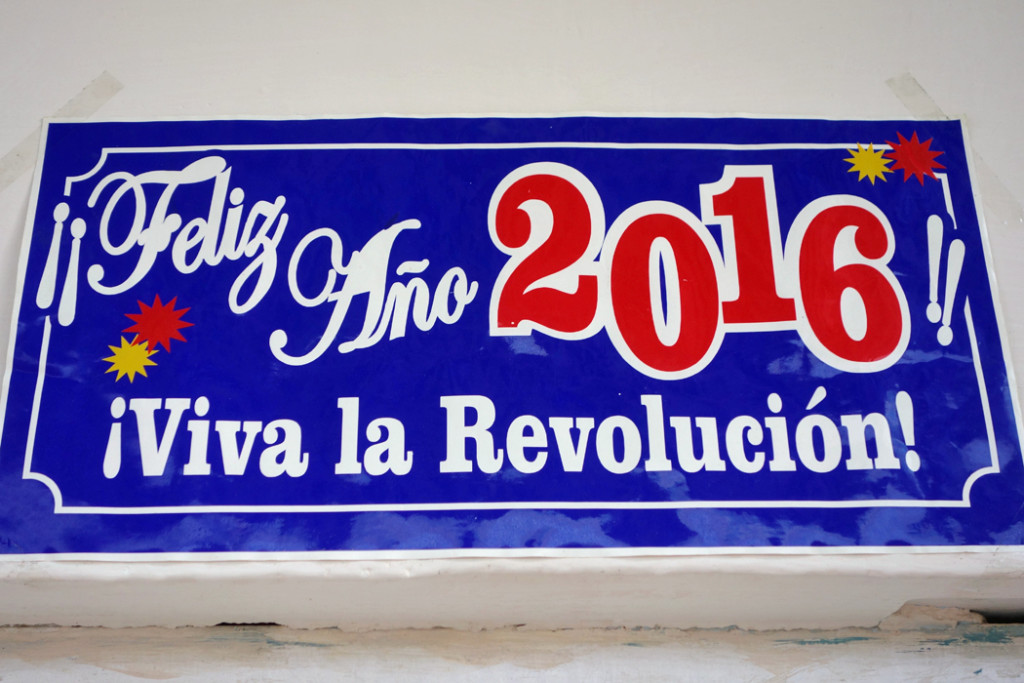
New Year Banner