Gimmelwald: Getting to that World Apart

Enlarge photo

To commemorate the Smithsonian Presents Travels with Rick Steves magazine — now on sale online, and at newsstands nationwide — Rick is blogging about the 20 top destinations featured in that issue. One of those destinations is Gimmelwald, in the Swiss Alps.

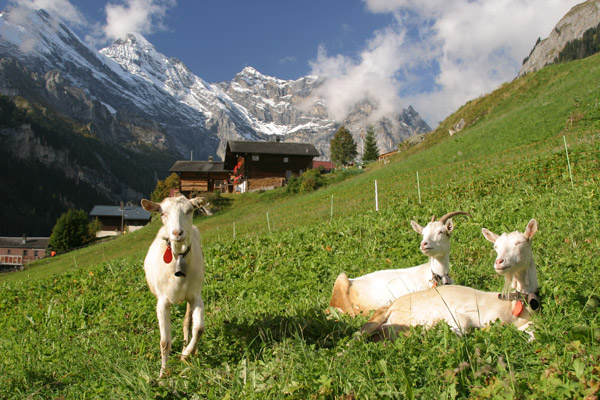
A great challenge in travel research is finding destinations that are a world apart. Gimmelwald, that remote and impossibly idyllic village high in the Swiss Alps, is a classic example. Parking you car in the valley floor and riding the cable car up is like going through a looking glass. You car shrinks, your stomach flip-flops, you look over the valley like a hang-glider, then suddenly you’re deposited — as if from a magical glass bubble — into another world. It’s a place where the air feels different — where the only noises are bees, bugs, and birds perusing alpine flowers, paddling water spilling from a hose into the hollowed-out log that keeps the cows watered, and gnome-like men sucking gnome-like pipes while chopping firewood.

Many of my “Back Doors” give this sensation. That’s probably why they appeal to me in the first place. It takes a little extra effort to reach them: Hallstatt (reached by lake ferry from the tiny train station buried in a forest east of Salzburg), Civita de Bagnoregio (you walk to it up a donkey path, then through a medieval gate, to enter a classic hill town an hour north of Rome), Salema (beyond the Portuguese resort of Lagos, near the far-southwest tip of Europe, at the end of a dirt road), Ærøskøbing (a traffic-free, ship-in-a-bottle dream town a ferry ride away from Svendborg in Denmark), and Inishmore (on the Aran Islands, off the rugged West Coast of Ireland). What place in Europe gives you that “world apart” feeling, and why?

Euro Experiences from NW to SE — Part III

Let me stoke your travel dreams for 2009 by sharing some of my favorite European experiences, roughly from northwest to southeast. Maximizing the experience is a dimension of smart budget travel that’s just as important in challenging times as saving money. Imagine these…

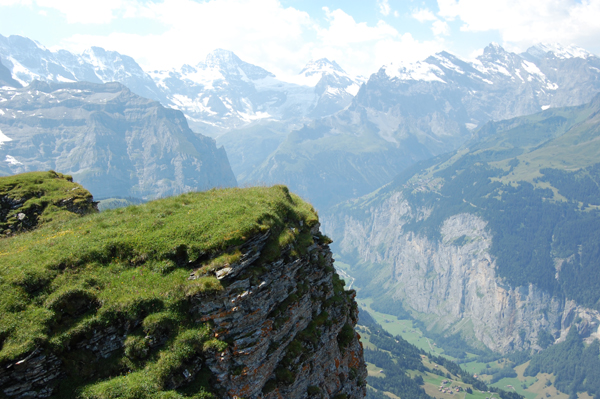
High above Interlaken in the Swiss Alps, hike the narrow ridge from Schynige Platte to Faulhorn. As you tightrope along the ridge, lakes seem to stretch all the way to Germany on your left, and the Eiger, Mönch, and Jungfrau cut like broken glass into the sky on your right. Listen for the haunting legato tones of an alphorn just ahead, announcing that the helicopter-stocked mountain hut is open. It’s just around the corner, and the coffee-schnapps is on. That’s enough to make a Lutheran raise his hands and holler hallelujah.

Pump up your adrenalin in the same Swiss Alps on a rented mountain bike. Tiny service roads, paved smooth as a mansion’s driveway, are designed for the little hay wagons of farmers. While these scenic lanes are off-limits to cars, they are wide open for (and a hit with) bikers.

At the bottom of the Lauterbrunnen Valley (just south of Interlaken), drop by the rough and not-very-inviting Pub Horner. It’s the unofficial clubhouse for base jumpers—the hangout for those daredevils who exasperate local farmers by jumping off sheer cliffs, miscalculating with their little parachutes, and smashing messily into the fields below. Have a beer with these guys, begin to understand their passion for an adrenaline rush, and gain some appreciation that life may be short, but it’s not cheap for these amazing thrill-seekers.

Get as high as you can mechanically in Europe, riding the cable car from the French alpine resort of Chamonix to Aiguille du Midi. Up there, at 12,600 feet above sea level, just climbing a few steps gets you winded. The air is thin. Perfect strangers do the halfway to heaven tango, and people are giddy as they marvel at Europe’s tallest peaks around them. You can almost reach out and pet the white head of Mount Blanc just across the way.

Cheered on by the Gnomes of Gimmelwald

Every two years my guidebook research brings me to my favorite corner of the Swiss Alps, as I visit my friends who run the little places that accommodate my traveling readers in the tiny village of Gimmelwald.

Walter, who runs Hotel Mittaghorn, is 82 now…slowing down but shuffling on. To most people, he just giggles and muses about this and that incomprehensibly. But it all makes sense to Walter. Tim from Britain looks after Walter and the hotel. Tim’s in a brace after a parasailing accident. Hard landings seem to make him seem shorter each year I visit. We have our annual meeting to lighten Walter’s workload. A new fire regulation cuts his hotel capacity to 15 — a blessing. Later, in the village center, I meet a stream of Walter’s guests…all thrilled to stay at Hotel Mittaghorn.

Down in the town, I drop in on Olle and Maria, the school teachers who share the 120-person village’s single teaching position. They cut me some hard alp cheese as we review their B&B business. Maria says she doesn’t understand why, in 12 years, they’ve never had a black visitor from the US. She promises to give a free room to the first black American family that comes. I wandered how that offer would look in my guidebook. I joked I wanted the offer for all black people for an entire year. (Anyway…if you’re a black American, you’ve got a free room here in paradise!)

I drop in on Esther, the dynamo farm girl who now, with her expanded guesthouse, has the biggest business in the village. She asked if my describing her place as an “upscale mini-hostel” wasn’t a bit off. I agreed.

Esther also rents rustic spots across the street in her barn. She’s received some complaints, and was concerned we were overselling it in the guidebook. She asked, “Shouldn’t we call it a ‘stable?’ And you should tell of the smell and the flies. Americans don’t handle flies well. It smells like a barn — manure. You must tell them directly.” With my new, more frank write-up, I told her, “If anyone complains, it’s their own fault.”

Enlarge photo

My favorite visit in the village is the Mountain Hostel run by Petra. After dark it’s a glowing light of travel happiness in this sleeping village. It was filled with a likable, well-scrubbed gang — kids any parent would be thrilled to see their teenager hanging out with. Everyone seemed to be instant friends. I meet a Jeremy, a 15-year-old with his dad. He was immersed in a raucous world of 18-to-25 year-olds with the world by the tail. This was his first hostel…we celebrated the fact. A college student from San Diego with big hair, “carpe diem” tattooed on his underarm, and a determination to be a great high-school teacher, joined in the conversation. All agreed the world needs more “Dead Poets Society” teachers. The topic turned to whether history as taught in the USA is ethnocentric. A woman who left her five-year-old daughter sleeping in the barn (swatting flies), said, “I’m a history teacher”…and joined in the conversation.

I met with Petra — sitting in the kitchen while she cooked up her famous pizzas. She grew up by the hostel in the next village, and remembered loving the way American couples called each other “honey.” She married local boy Wally, and they did wonders making the Gimmelwald hostel the money-less mountain-lovers’ El Dorado it is today. As a courageous woman with a vision, she ruffled village feathers. Her father-in-law never even visited the work of Wally and Petra for years.

Petra’s only request for the next edition of the guidebook: Shame the guys into splitting lumber for the wood-heated hot tub. I stepped out back to a gleeful gang of happy hikers in a half-barrel-design hot tub. Standing in the tub posing for photos, they looked like a bundle of white asparagus. As I always say, “If heaven isn’t what it’s cracked up to be…send me back to Gimmelwald.”

Enlarge photo

An artist sketched a funny cartoon entitled “The Adoration of Rick Steves” with hostellers using my guidebook like the Bible. And it occurred to me: If any place was a springboard for my career, it was this hostel back in the 1970s.

When I first came in 1976, goats lived downstairs. Bent old Lena (who sounded like a goat when she talked) would hobble over once a day and collect two francs. Today it may cost 25 francs to sleep here — but Gimmelwald hostel provides the same magic. I told Petra she should have a photo of Lena on the wall. She pointed to the space above the bar…and there she was.

Lena’s gone. There’s not only a shower…but a hot tub. And a generation after me, the essential magic of slumming it in the Alps is unchanged. Walking home through the darkness, I could almost hear the gnomes of Gimmelwald cheering me on. My work brings me great joy.

Base Jumping In Lauterbrunnen

Enlarge photo

I’m in for the night. I’m on the valley floor. From my balcony, the view matches the 19th-century etchings I enjoyed earlier today. The bright moon gives the cliffs an edge. New floodlighting sparkles on Staubbach Falls — a waterfall tall as a skyscraper that bursts over the cliff. The arc of water, so riled up from its trip down the mountain to this climax, seems to go in slow motion as it flies gracefully away from the mountain and tumbles to the valley floor. Ever since I was kid, I’ve imagined I could follow an individual drop.

At the foot of the falls, just beyond a smooth cone of land built by centuries of rocks hurled as if the river loses its grip on earth, the only bar in town glows with activity. Its old-school neon sign says “dance.” This is Lauterbrunnen Valley’s only spit-and-sawdust pub. It’s also a gathering point, famous throughout Europe, for the ultimate daredevils — the guys who make Johnny Knoxville look like a pansy: cliff-leaping base jumpers. While farmers slump at the bar, base jumpers from around Europe share stories and lessons learned.

All week I’ve nodded my head sadly in agreement with locals who rail against the crazy base jumpers who come to this valley to own the cliffs. This is beyond thrill-seeking. This is foolhardy playing with death…just asking for a “road kill” joke. It’s a nuisance when they keep dying upon landing in the otherwise peaceful farms (as if it traumatizes the cows).

Realizing I need to get out and experience this base jumpers’ bar, I shut the lid on my laptop, put my clothes back on, and went over for a beer. Angie the wiry bartender drew me a local draft and walked me through the photos around the room showing off the best departure points. Outside, a guy in a “bat suit” (wind suit) spread his arms and legs to demonstrate the aerodynamic webbing that let him actually fly rather than fall.

I met Pauli from Finland. Frank is his base-jumping name, but I wanted his real Finnish name. (He’s a data systems engineer in Tampere, north of Helsinki.) After 25 years of skydiving, now he spends his vacation base jumping. He’s here for a week, and will probably make 20 jumps.

When Pauli said something interesting, I’d pull out my notebook and jot it down. A couple from Oregon interrupted to get my photograph, and Pauli realized I had a following among travelers in the US. He explained about this international fraternity of base jumpers. Their common passion transcends any cultural and language differences. Lauterbrunnen offers about the best jumping in Europe. It’s legal (more and more places are saying no), the access is quick and easy (allowing 3 or 4 jumps per day), and jumpers from all over congregate here at Hotel Horner. Base jumpers respect host communities. Here, in a valley busy with helicopters shuttling material to remote construction sites, they are sure to be in good with the pilots. After all, if you jump into a helicopter…end of vacation.

In the last three years, “tracking” pants and jackets — which fill with air in a way to give the jumper more surface for a slower flight with more control (or “tracking” ability) — have become popular. Pauli plans to learn tracking…but you do your learning from an airplane first before cliff jumping. The bat suits are a completely different skill. He’s not going there.

Pauli was a bit shy. He was pleased I knew about the great ski jumpers of Finland. I didn’t get the bravado I expected in this bar. For many jumpers, it’s a personal thing.

Pauli agreed jumping is never completely safe. “When you are no longer nervous, you should quit. There are uncontrollable risks. It’s a matter of risk management. We say, ‘Shit happens.’ We also say, ‘Angels don’t protect you against stupidity.’”

He shared his log book. Each jump over the years was logged with an assessment (great tracking, rough landing, and so on). As I left, Pauli asked me to sign his log book. He joked that if he survived this adrenalin-seeking stage of his life, this book would be a great conversation piece for his grandchildren. I signed it, hoping he was right. Walking back to my hotel, I was thankful I had left my balcony an hour earlier.

Flying with Fritz

Enlarge photo

Swiss people are expert at living with nature. Their land, long a mountain fortress, is now a play round… “for big boys,” my friend Fritz adds. Fritz, a dynamo who runs my favorite little hotel in Interlaken, recently broke his collarbone. For the first time, I can keep up with him. He climbs a mountain on his bike just to see the sunset. I’m forever thankful to Fritz (who’s nearly my age) for alpine mountain-biking my son Andy into the ground — and then taking him “flying.”

Parasailing is Fritz’s passion. He is forever nagging me to “go flying.” Flying with Fritz (tandem parasailing) is his sideline. Andy still talks about his exhausting and exhilarating day with riding and flying with Fritz.

As a hotelier, Fritz is tuned into the phenomenon of Indians coming to the Alps in droves. “We love Indians — but they need to learn manners when staying in European hotels. We rent them a double, you turn your back, and you have seven people in the room — cooking curry on the carpet.” Fritz finds you can get out the smell, but not the stains. On regional buses, Indian tourists are so loud they even drown out the Americans.

Fritz explained that Indians are a huge part of Interlaken’s business. They come to see mountain scenes made famous in their movies. Kashmir is now too dangerous for movie production, and romantic Indian movies need mountain wonderlands for lovers to swoon with the maximum melodrama. (There’s even a restaurant now on top of the Jungfrau called “Bollywood.”)

I was with Fritz when a freak hailstorm pulverized Interlaken. It had been really hot. Locals — like squirrels before a storm — sensed it and were nervous. Something big was clearly coming. It got dark. Then…bam! Typhoon in the Alps. I parked my bike just in time to take refuge in the hotel.

Enlarge photo

Standing on my balcony, I watched flower gardens hammered into pulp. The road became a river of flowing hail balls, leaves, and flower petals. Fifteen minutes later, we went out to survey the casualties: Fabric on chairs was ripped, an entire wall of old windows was left jagged, birds were stripped of their feathers and knocked silly. Car rooftops were blanketed in dents, and windshields were alligatored. I helped Fritz shovel the hail out of his basement before it melted. He joked, “A greeting from George W. Bush.” And then said it’s no problem–we Swiss are the most insured people in the world.

Of course GWB didn’t cause the violent weather and this is not the first hail storm to ruin a city’s cars. But, to people living close to the weather here in Europe’s Alps, the strange and changing weather is a troubling reality. There is a growing frustration with people who confuse their short term economic needs with the long term needs of the environment.

The next morning, Fritz and I went on a hike. Riding the lift to Männlichen, high on the ridge above Grindelwald and Lauterbrunnen, we stepped off and into a visual symphony: Before us towered the mighty Eiger, Mönch, and Jungfrau. Fritz, who worked at this mountaintop restaurant as a kid and bikes here for a little fresh air a couple of nights a week, talked of the changes he’s noticed here in the last decade. They’re subtle. Walking by a glacial pond, he recalls how, during his childhood, there would be hundreds of frogs singing. Now there are none.

Enlarge photo

We studied a new ski lift being built. Before, they would just build a few towers. Now, a swath is cut right up the mountain as each lift is plumbed with snowmaking gear. Big water pipes stuck out of the concrete foundations seeming to trumpet a new age. You won’t have ski resorts in the future without manmade snow.

Today the Swiss ski industry is in crises: A third of the lifts are losing money, a third are in trouble, and only a third are good business. I pulled out the postcard Fritz gave me. Wiggling it, I saw the glacier come and go. The valley in 1907…filled with ice. The same valley in 2007…dry, with a shrunken glacier hanging like a hot dog’s tongue over the top of the valley high in the distance.

Gazing up at the North Face of the Eiger, Fritz tells me of speed climbers, leaving Interlaken on the early lift, scaling this Everest of rock faces, and getting back to Interlaken in time for a late-afternoon business meeting. Then he gets back onto global warming. As the permafrost thaws, there are more falling rocks, and mountain guides are abandoning once-standard ascents that are no longer safe.

Fritz is typical of Europeans who enjoy Americans enough to be comfortable challenging us with a political discussion. As I send them a good percent of their business through my guidebooks, they are careful not to upset me by angering my readers.

I tell him I believe part of the joy most Americans find in their travels is to be challenged by people who see things differently. I think one thing the Swiss and we Americans have in common is a self-assuredness that can border on arrogance. I asked Fritz how the American guests reacted to his interest in politics and if he saw a change in arrogance. He said there was a spike in arrogance a few years ago but that’s less so now.