Hair-Trigger Flamenco

Enlarge photo

It was a sore-mouth, déjà  vu experience. To me, a rustic ham sandwich in Spain is one of the edible icons of Europe. It’s that simple marriage of crusty fresh bread and lovingly sliced ham, cut with care from the ham hock that fills a vise mounted in any bar or restaurant. Now I eat these simple sandwiches to celebrate being in Spain, but the raw roof of my mouth took me back to my student trips here, when I ate my jamón bocadillo because it was all I could afford.

Pressing that hard crust against the tender ceiling of my mouth on my last day before flying home, I reviewed the many delights of my latest trip through Spain.

A year ago I had discovered a new favorite restaurant in Córdoba — Bodegas Campos. I came back twice and basically ate my way through their tapas menu. After my second visit, I knew I’d be back this year with the TV crew.

Now I was working with Isabel, a charming local guide who talks about food with the passion of a mother talking about her children. Her love and enthusiasm for Spanish cuisine translated well on TV. And it was a festival night, so the restaurant was packed with well-dressed Córdobans. One difficulty of filming in a restaurant is that we need lots of light, and this can ruin the ambience (and wear out our welcome in a hurry). Our cameraman’s new electric light comes with a slider, so we can let the brightness creep up — and no one notices (we hope).

Every plate seemed to glisten. The meal was made to order for TV: a montage of Spanish delights from the roasted almonds and spicy green olives that hit the table automatically, to the local salmorejo (like a super thick, bright orange gazpacho), boquerones (anchovies), fried eggplant, and “Arab Salad” with cod and delicate orange sections. Spaniards love their croquetas, which seem like glorified Tater Tots to me. Isabel was enthusiastic about the croquetas, so I figured, if ever I’d appreciate croquetas, it would be in a fine place like Bodegas Campos. Nope. Still just Tater Tots. The rabo de toro (bull-tail stew) was as dark as meat can be…almost inky in flavor. The jamón ibérico — a gift from the restaurant — was the best ham in Spain and very expensive. With its fat not lining the meat but mixed in, it was glistening with taste — eating it was the culinary equivalent of pinning a boutonniere onto a tux. The wine was the kind they bring out special glasses for.

Feeling underdressed for the filming, I zipped back to the hotel in a taxi between courses to get my sweater. On the way there, we passed a square thriving with people partying. On the way back, the same street was blocked by a religious procession. I had to get out and walk. One minute I was thrilled to be in the restaurant filming all that wonderful food; the next I was amazed we were missing parties in the squares and an exotic religious procession in the streets.

Excited, I called Isabel and asked her to get the crew out in the streets to film the procession. Seeing alcohol-fueled partying around a towering red cross and then a somber procession was poignant. In Andalucía, revelry and religiosity seem to go hand in hand: The same passion and energy dedicated to partying is put into long, sober, religious processions which clog the city’s narrow streets. Trumpets blare a fanfare, children practice long and hard to win the honor of carrying the float, candles jostle in unison as they glide in the dark of the night, and everyone runs to the streets to be a part of the procession.

Travel in Andalucía is like this. There’s always something going on. We were in Córdoba for the Festival of the Crosses, where each neighborhood parties around its own towering cross made of red carnations. Church bells ring not only a call to prayer, but a call to fiesta. And locals enthusiastically use a special day in the church calendar as a springboard for a community party.

Our filming took until midnight. We finished with the on-camera close of the show where, presiding over a table of local delights, I looked to the camera and said, “You want a recipe for a great trip? Blend history, culture, local friends, and great food. I hope you enjoyed our look at some of the highlights of Southern Spain. I’m Rick Steves. Until next time, keep on travelin’. Adiós.

Then we packed up the gear, said goodnight to Isabel, and caught a taxi home. We passed that romantically lit square — still thriving and hauntingly beautiful to me — with four people dancing flamenco on an elevated stage in the middle of a Renoir crowd. I desperately wanted to stop, but I knew it was too late to film — we were all just wasted. For the rest of my life, I’ll remember that image of the magic flamenco party that we didn’t film.

The next day, the barrio parties were basically over. We looked and looked and finally found one square that was lively. It was their first year entering the contest, their cross won first prize yesterday, and it seemed they’d been celebrating ever since. It was a scene of exhausted, hung-over happiness — like they had been eating and drinking and dancing for 24 hours (which they probably had). Now the cross was abandoned — missing carnations like a bum misses teeth, and the dancing was over. The last of the revelers gathered around the makeshift bar which seemed to provide physical support for those determined to carry on. I needed dancing around the cross for our TV show. Our guide said they were finished dancing. But with a simple suggestion, I was able to rouse the gang, and the yard was once again thriving with slinky flamenco.

We’ve been in Andalucía for a week filming our show, and it’s a hair-trigger flamenco society. I like hair-trigger cultures. Just as Austria is a hair-trigger waltzing society, Andalucía is just waiting for the simplest excuse to put castanets into motion and dance. (This flamenco party on-demand reminded me of a filming experience on a Danube cruise. Every boat I’d been on played Strauss waltzes for crowds to dance on the deck. Sure enough, I came with my crew to film — and our boat had no music system. It didn’t matter. I cajoled 30 retired Austrians and Germans out of their chairs, away from their white wines, and onto the deck. Singing a Strauss waltz and waving my arms dramatically, I struck up an imaginary orchestra, and the entire gang effortlessly broke into a glorious waltz. Coursing down the mighty Danube, we filmed as they danced a particularly smiley waltz. Later, back in our editing studio, we laid in some actual Strauss music to the same beat I provided on the Danube that day. And, as far as TV was concerned, the Blue Danube cruise came with music.)

On that little plaza in Córdoba, I exhorted the exhausted gang to dance around their tired carnation cross. Within seconds the energy and magic of the previous night’s party had recombusted. Sinuous arms, toned and leggy legs, heels with attitude, flowing hair…everything churned with a silky Andalusian soul. Like I imagine crickets rattle their tails for sex, Andalusian women dressed in their peacock finery click their castanets. And the starlight was brought to us all by alcohol.

With enough dancing filmed, I let the fake party die, and everyone resumed their positions — propped up by the bar. They filled a bottle cap with a ritual shot of firewater and gave it to me. As two dozen onlookers watched, I downed it. With my head thrown back, knowing the camera was rolling and all Andalusian eyes were on me, I was plunged into what seemed like a long silence. I wanted to say something really clever or meaningful. But I could only come up with a cliché — “Olé!” No problem. Everyone cheered.
Photos Help Tell the Story

Wrapping up a great trip, a few photos add to the story. Note also a number of photos added to entries over the last two months.

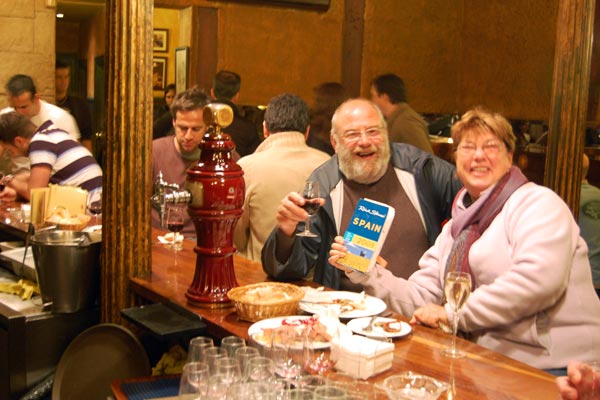
Travelers enjoying tapas and their guidebook. When blitzing tapas bars in Madrid’s best neighborhoods, it’s fun to find happy travelers putting their guidebook to good use.
Enlarge photo

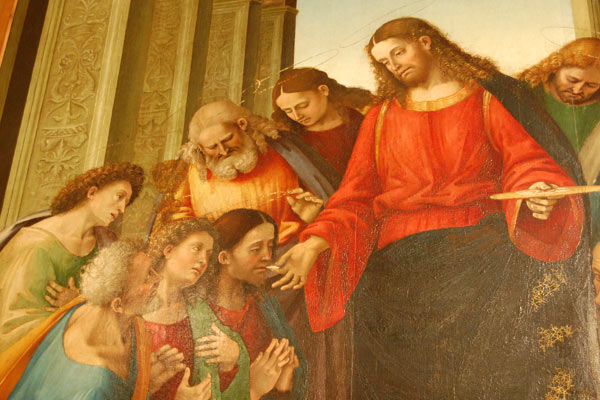
An amazing painting in Cortona.
Enlarge photo

Bright-eyed and bushy-tailed, I open the shutters and greet a new day in Volterra. In a week I meet the TV crew…
Enlarge photo

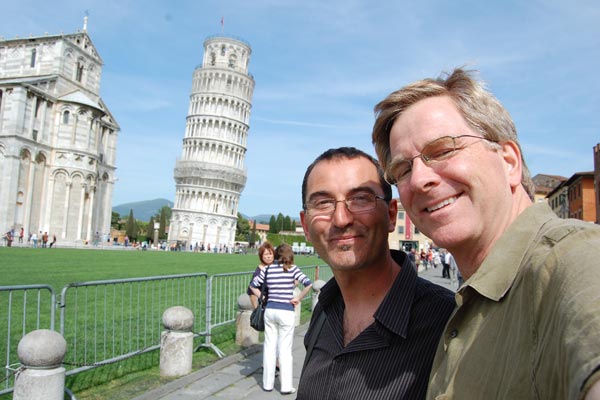
Dottore Vincenzo Riolo in Pisa taught me volumes about his town and is one of many excellent new local guides I met and will recommend in my guidebooks.
Enlarge photo

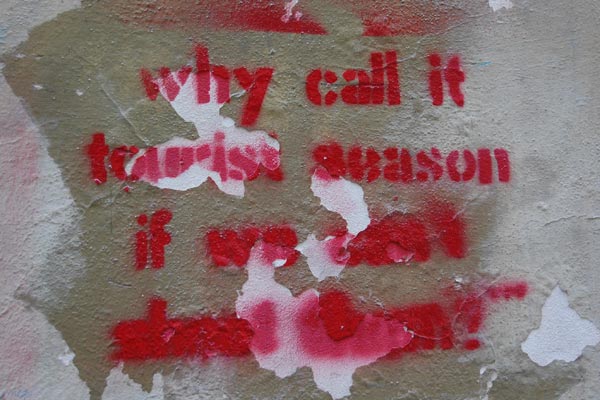
Why call it tourist season if we can’t shoot them? A scary welcome in Florence’s Oltrarno district.
Enlarge photo

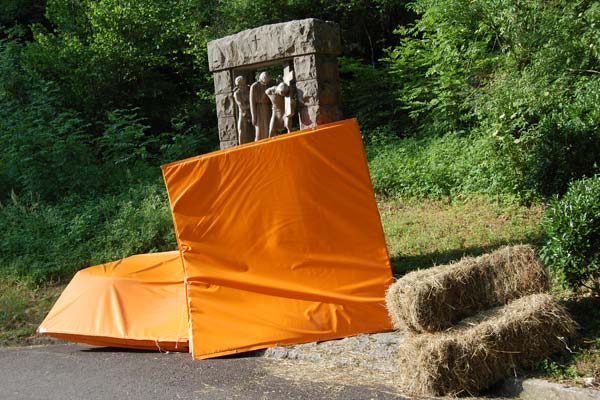
Station of the Cross, padded for protection, along the route of a bike race in Slovenia.
Enlarge photo

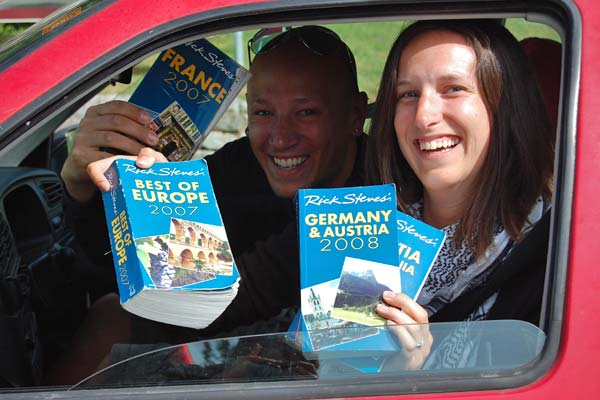
Happy road trippers with favorite guidebooks in Slovenia.
Enlarge photo

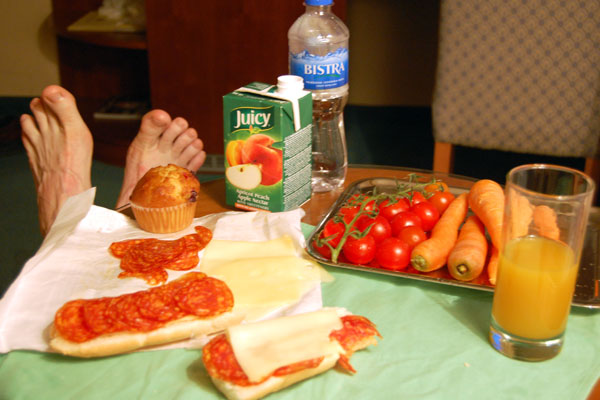
Cheap and delicious picnic, relaxing in my Zagreb hotel room.
Enlarge photo

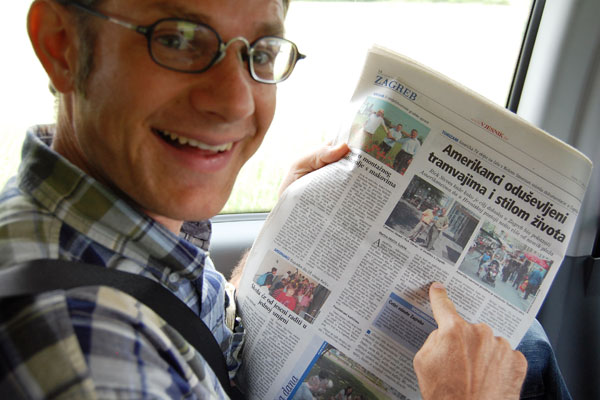
Cameron Hewitt (co-author of our Croatia & Slovenia guidebook) reads about himself, me, and our American film crew in a Zagreb newspaper. I guess an American film crew in Zagreb is newsworthy.
Enlarge photo

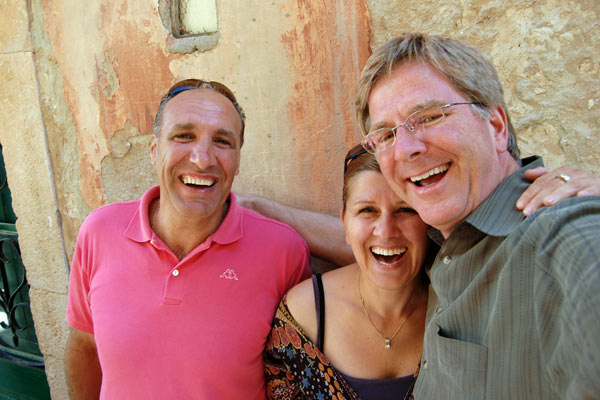
Croatian B&B hosts—clicking with new friends in Korcula.
Enlarge photo

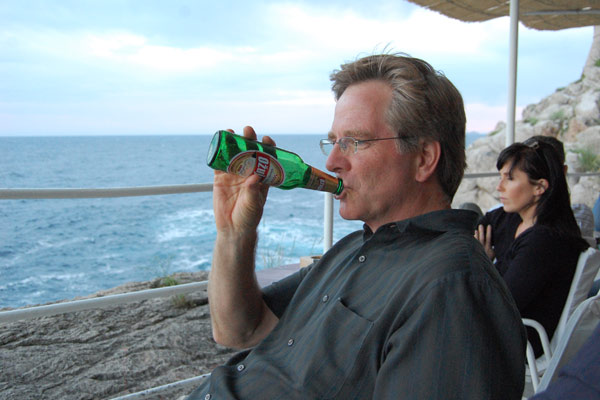
Day #70…Trip over, one last beer to enjoy a Dubrovnik vista and celebrate a smooth and productive trip before flying home.
Enlarge photo

Translucent Pigs’ Ears and Eating the Sea: Good Morning in Santiago

I’m tucked away in Santiago de Compostela, in the northwest corner of Spain. It’s my last day here before flying to Rome. I have a three-part agenda: see pilgrims reach their goal in front of the cathedral, explore the market, and buy some barnacles in the seafood section — then have them cooked for me, on the spot, in a café.

Whenever I’m here, I make a point to be on the big square, at the foot of the towering cathedral of St. James, at around 10 in the morning. That’s when scores of well-worn pilgrims march in triumphantly from their last overnight on the train — most finishing a 30-day, 500-mile hike from the French border. They finish their camino by stepping on the scallop shell embedded in the pavement at the foot of the cathedral. I just love watching how different people handle jubilation.

If Europe had a rain forest, it would be here. But instead it has a city made of granite painted green by moss. The historic and stony buildings of Santiago come in a watercolor green. Rainy as it often is, this morning the church is back-lit by the rising sun and, looking up, the weary pilgrim squints…small before God.

Routinely, pilgrims ask me to take their photo and email it to them. Then they say, “I’ve got to go meet with St. James” and — as has been the routine for a thousand years — they head into the cathedral.

Two blocks away, the market is thriving, oblivious to the personal triumphs going on over at St. James’ tomb. There’s something about wandering through a farmers market early in the morning anywhere in the world. It’s a chance to observe the most fundamental commerce: Salt-of-the-earth people pull food out of the ground, cart it into the city, and sell what they’ve harvested to people who don’t have gardens.


A yummy box of pigs’ ears. Buy them tonight at your favorite tapas bar.
Enlarge photo

Dried-apple grandmothers line up like a babushka can-can. Each sits on a stool so small it disappears under her work dress. At the women’s feet are brown woven baskets filled like cornucopias — still-dirty eggs in one; in the next, greens clearly pulled this morning, soil clinging to their roots. One woman hopes to earn a few extra euros with homebrews — golden bottles with ramshackle corks — one named “licor café,” the other, more mysteriously, “oruzo casero.”

Another row of babushkas in shawls sit before rickety card tables filled with yellow cheeses shaped like giant Hershey’s Kisses…or, to locals, breasts. The local cheese is called tetilla — that’s “tits” — to revenge a prudish priest who, seven centuries ago, told a sculptor at the cathedral to redo a statue that he considered too buxom. Ever since, the townsfolk have shaped their cheese like exactly what the priest didn’t want them to see carved in stone. And you can’t go anywhere in Santiago without seeing cheese tetilla. In fact the town is famous for its creamy, mild tetilla.

Stepping further into the market, I notice spicy red chorizo chains framing merchants’ faces. Chickens, plucked and looking rubber as can be, fill glass cases. The sound of cascading clams and castanet shrimp — red, doomed, and flipping mad — greets me as I enter the seafood hall. Fisherwomen in rubber aprons and matching gloves sort through folding money.

There’s a commotion at the best stalls. Short ladies with dusty, blue-plaid roller carts jostle for the best deals. A selection of pigs’ ears mixed with hooves going nowhere fills a shoebox. The ears, translucent in the low rays of the morning sun, look as if someone had systematically and neatly flattened and filed conch shells.


Barnacles are very expensive unless you buy them in the market and have them cooked to order. They’re worth both the expense and trouble.
Enlarge photo

I buy my percebes(barnacles) — at €25 a kilo, they’re one-third the price I’d pay in a bar. I get 200 grams for €5 and hustle my full bag over to the market café called Churro Mania. There, Ramon and Julia boil them for €3 per person, plus 10 percent of the cost of whatever you have them cook up. Feeling quite like a local — sipping my beer so early in the morning — I wait for my barnacles to cook.

Then, the climax of my morning: Julia brings my barnacles, stacked steaming on their stainless steel plate, as well as bread, and another beer. I’m set. Twist, rip, bite. It’s the bounty of the sea condensed into every little morsel…edible jubilation.

Haggis in Northern Spain

I’m in northern Spain working hard, but it is a little discouraging because so few Americans are traveling here. León and Burgos are great old towns with awe-inspiring cathedrals and plenty of colorful tapas bars. (I just found the Spanish twin to Scottish haggis — it’s called morcillaand comes without the skin. You’d think a dog got sick on your plate. Smear it on toast with a fine red wine. It’s quite tasty…if you like haggis…which I do.)

Sure, it’s great traveling here. But I want lots of people to use my work. And the chances of that here, relative to just about anywhere else in Spain, are about nil.

Anyone walking through town with a backpack is likely a pilgrim, heading like me (but on foot) from France to Santiago. (Some 80,000 are expected this year — I figure that’s about 500 a day through the season.) I play a game: When they walk past, I spin around to see the scallop shell dangling from their pack — as it has from the rucksacks of pilgrims for over a thousand years. I love the idea that the first guidebook ever written talked up “going local, packing light, and watching out for pickpockets” for pilgrims traveling the Camino de Santiago a thousand years ago.

My guide, Paco, is from Pamplona — a famously conservative town with a famously rowdy drunken brawl each summer when the bulls run. Today in León we walked by a sex shop and Paco said, “Not in my town.”

Pamplona is a center of the super-conservative wing of the Catholic Church, Opus Dei (with a university, medical science center, hospital, lots of money, and lots of power). Franco put it here to tighten Navarre’s connection to the rest of Spain. I commented on the contradiction of pious Pamplona being famous for its annual drunken brawl, and tied it to the notion of a PK (a “pastor’s kid”…often the troublemaker in middle school). Paco, who stressed that Opus Dei neighbors are welcome and respected, explained that they may believe sex is not for fun. But when they party…they really party. He then said, “We say, ‘In Spain, you could never say that that priest is not your father.’”

When Franco died in 1975, the end of his repression unleashed an orgy of pent-up hedonism. A decade of movies was known as the Destape(disrobed) period — when every Julia Roberts in Spain had to play topless. Today, these actresses look back and see the irony in the end of Franco’s repression being replaced by what they now see as another kind of repression.

In Spain, humor changes from region to region. Paco’s take: Andalusian humor is noisy and simple. People in the north have a raw, edgy sense of humor, Saturday Night Live-style. And in Barcelona, people love Woody Allen.

Paco, like everyone here, is high on Obama. Europeans are buzzing about his recent visit at the G20 meeting. Paco explained that the press is famously unimpressed by politicians. “And for the first time in memory, the press corps gave a standing ovation to someone…and for an American president!”

Paco’s degree is in marketing. I asked him about “the brand of America.” He said when his grandparents were young, French sold. For his parents, Italian sold. For his generation (which came of age in the 1980s), American culture sold. For young people today, China and Japan sell. (Not coincidentally, the Guggenheim Museum in Bilbao is featuring very popular exhibits by Chinese and Japanese artists.)

Paco said that back in the days of Ronald Reagan, people were charmed by American culture on TV and in the movies, and it seemed to match reality. In the last years, the American image on TV and in the movies didn’t match the uglier reality people saw on the news. To Paco and his friends, Obama isn’t the Messiah, but he has “the face of truth.”

I was impressed that Paco had the new edition of my Spain guidebook. He said, “Whenever we need an international book, Amazon.com is our answer.” They pay the same as Americans do — no extra for shipping. And rather than arriving in two or three days, the book comes in about 10.

Paco is from Navarre (in the north). He said, “We are shy and reserved, but when you talk to us, you open the door.” I have found this to be very true. He’s a good guide for his region, but he’s never been to Santiago de Compostela (the greatest city in northern Spain, just a day’s drive away). I ribbed him about this, but admitted that I’ve never been to Yosemite (and he has). So he ribs me that, since he’s traveling with me, he’ll get to Santiago before I get to Yosemite.

Partridge Makes a Good Red Wine a Bad Red Wine

I’m just a little drunk here after celebrating my two-day nip into France from Spain with a great dinner. Serge, a restaurateur clearly in love with turning people on to good food, asked me what kind of wine I liked. I said Medoc. He lit up, and brought me a bottle from 2003. He said, “That was a very hot year.” I said, “Yes. Wasn’t that the heat spell that killed thousands of French senior citizens who had no air-con?” He said, “Yes, tragic…but this wine is excellent.” So, my guard is down and I’m just throwing together a ratatouille (spell-checker no help with that one) of observations.

Of all the places I’ve been researching in Western Europe, I believe Spain is the one where smoky hotels and restaurants are the most prevalent. I did find a place that has water in the ashtrays to absorb some of the smell.

Another thought on the “art” (and not, as locals insist, the “sport”) of bullfighting: Newspaper stories on bullfighting appear not in the sports section, but in the culture pages.

In Spain and France, republicans are the progressive ones — those against the king or the dictator and in favor of the Republic. They get confused when considering American politics, where Republicans are on the conservative side of the political spectrum.

I’m always amazed at how stupid and demoralized museum guards seem. Surrounded by great art, they show no curiosity or initiative. Sure there are exceptions. And sure they have boring jobs. But they could learn where the El Grecos are and when the Picasso will return to its normal place.

In Spain, big museums now require groups to rent “whisper systems” for €1 per group member. This gives each person an earpiece and the guide a mic and transmitter. Guides love it because they can talk softly and all can hear, non-paying members can no longer freeload on their commentary, and they broadcast at a unique frequency that can be heard throughout the museum but only by members of their group — so no one can get lost. For the rest of us, it’s nice because we no longer hear the babble of guides in various languages telling their stories.

I just saw an etching of a garrote-style execution in Barcelona. They sit you in a chair with a metal band around your neck and put a crucifix in your hand. Then, as a priest prays for you and the public gawks, they slowly tighten the band until you strangle to death. I knew this happened in the Inquisition (16th century). But the date on this execution was 1894.

I’ve been getting used to Vista on my new, fast, powerful, and tiny laptop. There’s just one problem: When it’s plugged in, I receive a low-level shock from the wrist board as I type. My tech man back in the office explained it’s because my adapter doesn’t engage the ground prong on the three-prong American plug. (Glad I’m done having kids.)

It’s fun being in travel stride. Setting up the room is key. I review my pillow options from the varieties in the top shelf of the closet. It’s been cold, so I find the extra blanket. I am proactive about asking for a quieter room if I get a room on the street and a lower floor. It can make a big difference. I gather up all the promotional clutter and needless remotes and hide them in a drawer. (I have an ethic not to turn on the TV — that’ll be the end when I start cruising.) And life is so nice after dropping by a market and picking up some fruit, veggies, crackers, and juice (apple is best at room temp) to stock a little hotel-room pantry.

It seems hotels put an eco-friendly note in the bathroom saying, “Help us save the world. Hang towels to reuse, toss in tub to be changed.” I hang the towels…and invariably, the maids change them out anyway.

Here in Basque Country, it’s politically correct for anyone with a website who supports the Basque movement to use .com rather than .es (the suffix for España).

Hoteliers tell me the economy is so tight and things are so expensive for people that vacationing French wait until they know the weather will be good before committing to a visit.

When you eat so late in Spain, each lunch is a kind of break-fast. For several days I’ve worked six hard hours with barely a drink or nibble. (That’s why Spaniards have a kind of mini-pre-lunch late in the morning.) When I finally sit down for lunch and the beer hits the table, my body sucks it in with unprecedented gusto and appreciation.


Javier, whose dad is a famous Michelin star-rated chef in Toledo (Spain), does his best to corrupt me at his restaurant. It was a lovely evening of being taught the importance of matching food with fine wine.
Enlarge photo

The other day, the son of a famous local chef taught me a little gastronomy. Javier said, “Food with wine completes the circle. But you must do it right. Partridge makes good red wine bad red wine. Partridge and white beans…that’s perfect with white wine. You must think with your stomach.” I’m still learning. The whole matching wine with food thing has been frustrating for me. But several times I’ve got it right this last week…and lift off…it makes a believer out of you.