Barcelona Tumbles Down to Its Port

We’re halfway done with this September at sea! My western Mediterranean cruise returned to Barcelona after visiting ports in Italy. From Barcelona, I flew to Rome to begin Part 2 of this salty slice of Europe. So, stay tunedin the next couple of weeks, we’ll travel from Barcelona to Rome, and then on to Istanbul and the Greek Isles.

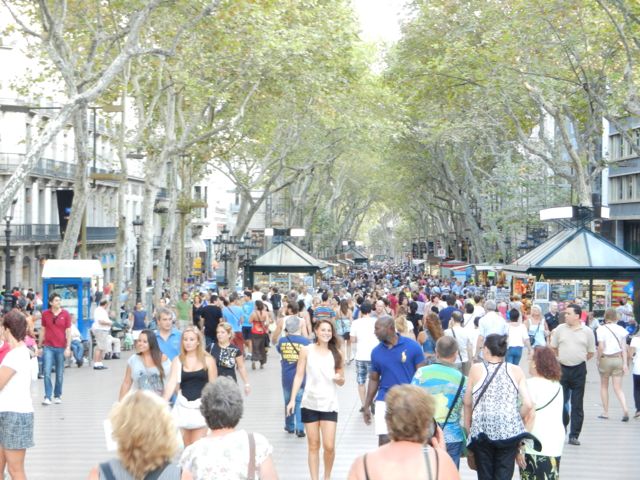
Cruise ships tie up in Barcelona just a ten-minute shuttle bus ride from the base of the Ramblas, a people-packed pedestrian boulevard always full of action. Human statues await your coins, shell-game teams await your cash, and pickpockets lay their traps. The latest scam: a drunken, overjoyed soccer fan puts his arm around you, wanting to celebrate his team's latest victory and dance...and meanwhile his fast fingers are working their way around to your wallet or purse.

A highlight of any Barcelona visit is its vibrant market, La Boqueria. Each year I visit and spy on Juan, who tirelessly poses for my readers as instructed in my Spain book. And each year, I take a photo of Juan posing with the photo of him posing in my guidebook.

I Know It's Midnight, But…

I really enjoy the emails people send me sharing magic moments and offering not only practical tips, but philosophical ones. Eric shared a magical midnight in Spain that will stay with him and his family for the rest of their lives.

When I travel, I know that serendipity is a friend. She leads me to unexpected magical moments that come with a warm welcome and leave me with a lifelong memory. We all need to take those crazy detours and embrace the experiences they offer. Here’s Eric’s letter. If it reminds you of a time you were proactive in making it happen, I’d love to hear about it in the comments.

Dear Rick,

I wanted to share a comment with Mr. Steves and the rest of your team. I have attended a number of sessions taught by Rick during your all-day travel events in Edmonds, as well as reading a number of his books. One bit of advice he shares that has always stuck with me is to be flexible ‘ and be prepared to go off the typical tourist route ‘ in order to experience the culture. That bit of advice was running through my head when the following occurred:

Last May, my wife, our 25-year-old daughter, and I travelled to Sevilla, Spain, to spend a week with our 21-year-old daughter who was ending her semester of studying abroad in Sevilla. The four of us had taken a side-trip to Granada for a couple of days, and were returning to Sevilla by bus. It dropped us off just before midnight, and we began the mile-and-a-half walk back to our Sevilla apartment. As we walked, we heard what sounded like amplified live music in the distance. At that point I asked myself, “What would Rick Steves do in this situation?”

I turned to the rest of the family and said, “I know it’s midnight, but let’s go find out where this music is coming from!”

They were all game, and off we went, following the music. We came to a large park that turned out to be the venue for a type of Renaissance Fair. Being Spain, at midnight the place was packed with people visiting various booths containing crafts and food. At the far end of the venue was a stage where the live music was coming from. It was a group of Spanish musicians playing Celtic music.

At this point I need to add that both our daughters have been trained in Irish Dance. In 2004, we’d travelled to Ireland, where one competed in the Irish Dance championships ‘ another two-week Rick Steves-inspired vacation that resulted in both daughters doing some impromptu dancing in an Irish pub in Doolin.

Okay, back to the story. As the group was coming to the close of their set, they announced that they were going to play an American song that, although not really a Celtic tune, had a similar beat. Then they launched into “Oh Susannah!” So here we were, watching a Spanish band playing an American song, trying to make it Celtic, and singing the American words with very heavy Spanish accents. It was an experience!
During the entire performance, a few people directly in front of the stage were dancing and moving to the music. All the while our eldest daughter was tapping her feet to the tunes.

Finally, the group announced its final number. As they began to play, our eldest daughter launched into her Irish dancing and moved to directly in front of the stage. As the band played, she danced, and the rest of the crowd parted into a large circle to watch her dance to the music. When it was all over, the band ‘ AND our daughter ‘ all received a great cheer and applause.

We would not have experienced and of this had I not asked myself: “What would Rick Steves do in this situation?”

Thank you to everyone at Rick Steves’ Europe for helping us to get more out of our vacations.

‘ Eric in Mount Vernon, WA

A Sweaty Saint, a Sommelier, and Marmite

Last week, sitting down to a traditional fried breakfast in an early-19th-century steel master’s mansion in England’s Ironbridge Gorge (birthplace of the Industrial Revolution), I reviewed ways people had spiced up and given meaning to my travels in the past month.

Collin, who ran the B&B I was enjoying, topped up my coffee and showed me a photo of an industrial wasteland with his stately brick home standing like some weary war survivor in its midst. Today, his delightful house stands in a lush river valley welcoming guests like pilgrims to the place where iron was first produced in the modern way. As his wife, Sara, brought my toast on a rack, I asked about the marmite. She explained to me what the beef-yeast spread was, and that “even the adverts admit you either love it or hate it.”

A few days before that in Paris, under dangling lamps and a heavy subterranean stone vault a block from the Louvre, I spent a tasty and fascinating two hours with Olivier, a passionate young sommelier. He makes his living explaining the fine points of French wine to travelers. Between the pouring and sipping, he shared the basics with random insights: “Riesling works well both in the Alsace and in Russia. A French Alsatian vintner was offered big money to make wine in Russia. He refused, saying, ‘Here, I have the privilege of being from somewhere.'”

A few days before that, in Finland, a man sat naked next to me beating himself with birch twigs while explaining the importance of opening the pores, stimulating circulation, letting out toxins, and relaxing in a place “where there are no bosses and all are equal.”

A week before that, I met Marianne from Berlin, who’d been hiking alone across Spain on the ancient pilgrims’ Way of Saint James. With her floppy backpack dangling carelessly from her tiny frame and backlit goldilocks, she talked with a pilgrim’s philosophy as if singing children’s rhymes. She spoke as if she were a real saint come to earth. Talking with her, I felt like I had just entered a Botticelli painting.

And, packing up after that Ironbridge Gorge breakfast, I was heading west…knowing that, in a couple of hours, I’d cross another border, where I just knew someone would tell me why in heaven they speak Welsh.

If there’s one thing that keeps me enthusiastic about traveling in Europe and teaching European travel, it’s the beauty of connecting people with people. Maybe it sounds trite. But that fact can’t be over-emphasized. If you’re not connecting with people in your travels, you’re missing out.

The Camino in Spain: Trod, Trek, or Trudge

I’m out on a dusty trail in Spain where pilgrims have trod for a thousand years.

We’re filming, and we debate words like that. Do pilgrims “trod,” “trek,” or “trudge”? They don’t trudge — that rhymes with “grudge.” Trod sounds a bit dreary; trek sounds a bit light. We end up saying “walk.” The trail — the Camino de Santiago a.k.a. the Way of St. James — is really full because this is a Holy Year, and the feast day of St. James is approaching. Pilgrims are timing their journey to arrive on that day in Santiago, where the remains of the saint are supposedly buried.

Witnessing this timeless quest and its elevated thinking is inspirational…and in striking contrast to where I was just one day earlier — Pamplona — for the crazy running of the bulls. (In Pamplona, a drunk guy in a bar explained to me that each of the six bulls that run in the morning meets its matador that evening in the bullring. Then, as if sharing a priceless tip with me, he said, “But a bull can escape that fate by simply breaking his horn on one of the barriers during the stampede.”)

Meanwhile, on the Camino, pilgrims come in all types. Prepackaged groups, which I think of as “pilgrim teabags,” have clean, matching T-shirts. Each hiker is issued a mass-produced walking stick with a decorative gourd tied to the top; each stick also has a dangling scallop shell with a brightly painted cross of St. James.

Other pilgrims are humble church groups from distant Catholic lands. We encounter an otherworldly group from Lithuania with its raspy, amplified chant-leader shuffling along. The group members are carrying an old boom box, a nearly life-size cross, and various statuettes. Eager to film them, we drive ahead and wait — as if preparing an ambush. Our cameraman scampers to get just the right vantage point while I sit in the car. Then, a few minutes later, with their intentionally monotonous chant, they walk by my open window — just inches from my eyes. I wish my eyes were a camera. While we get a great wide shot, that close-up pilgrim-pass-by is one of the most vivid images we’ve ever missed while shooting.

We stake out a position in a medieval village. This is the standard, ghostly quiet village pilgrims pass all along the route. Its only shop is a vending machine cut into a stone wall. An ancient woman scrubs her laundry at a creek-side place where women have done this for centuries. A shepherd scoots his gangly flock over a tiny bridge.

In this peaceful corner, our mission is to interview pilgrims about their experiences. We meet a New Yorker who has just hiked for days across the vast Spanish plain and learned nothing about life or himself. He is, in his words, “a little pissed off with it all.” And we come upon a bouncy flower child from Berlin — a 20-year-old girl hiking alone, singing to herself, and radiant with the value of this personal journey. She speaks to us as if she were a real saint come to earth. Talking with her, I feel like I have just entered a Botticelli painting.

An Englishman we meet is doing the trail in three successive years because he can’t get enough time away from his 9-to-5 job to do it in one 30-day stretch. While he walks, he has been reflecting on simplicity. Everyone we meet (except for the one pissed-off guy) is having a richly rewarding time. I keep thinking how a standard RV vacation — with its Swiss-Army-knife of comforts — couldn’t be more different than this chance to be away from the modern world with all that it entails.

Of course, I’m in the fast lane of normal, workaday life and just observing. (And my mind is in a completely different space compared to the pilgrims. Last night, as I was crowded by my hotel’s shower curtain, it occurred to me that no hotel in Europe has invested in the wonderful bent curtain rods that arc out — giving big Americans in need of elbow room a more spacious place to shower.) Each time I talk to someone on the Camino de Santiago, I’m inspired to find a way to set aside the month it takes to walk from France to Santiago. Someday I will.

In Santiago, we greet pilgrims as they enter the last stretch. A bagpiper stands tall under an arch, reminding us this is a Celtic corner of Spain. Playing the theme to Star Wars adds an incongruity to the ambience — reminding me of the challenges a pilgrim encounters as he or she struggles, often in vain, to leave the modern mindset.

But then, on the square in front of the cathedral of Santiago, I witness joy and jubilation sweep over those who finish this journey — as I do each time I’m here. Whether religious or personal, the commitment required to do this trip is great…and the rewards are even greater.

Feeling the Breath of the Bull on Your Pants

Like a cowboy at a rodeo, I sit atop my spot on the fence. A loudspeaker says — first in Spanish, then in English — “Do not touch the wounded. That’s the responsibility of health personnel.” A line of green-florescent-vested police sweep down the street, clearing away drunks and anyone not fit to run. Then the cleaning crew and their street-scrubbing truck make one last pass, gathering any garbage and clearing broken glass. The street — just an hour ago filled with throngs of all-night revelers — is now pristine, sanitized for a televised spectacle.

Sitting on the top timber of the inner of two fences (in the prime area reserved for press), I wait for the 8:00 rocket. I’m thinking this is early… but for the mob scene craning their necks for the view behind me, it’s late. They’ve been up all night.

Cameras are everywhere — on robotic arms with remote controls vice-gripped to windowsills, hovering overhead on cranes, and in the hands of nearly every spectator that make up the wall of bodies pressed against the thick timber fence behind me.

The street fills with runners. While you can wear anything, nearly everyone is wearing the standard white pants, white shirt, and red bandana. The scene evokes some kind of cultish clan and a ritual sacrifice. This is the Festival of San Fermí­n. Fermí­n was beheaded by the Romans 2,000 years ago, martyred for his faith. The red bandanas evoke his bloody end.

The energy surges as eight o’clock approaches. The street is so full, if everyone suddenly ran, you’d think they’d simply trip over each other and all stack up, waiting to be minced by angry bulls. The energy continues to build. There are frat-boy runners — courage stoked by booze and by the girls they’re determined to impress. And there are serious mozos — famous locally for their runs, who’ve made this scene annually for as long as people can remember. They’ve surveyed the photos and stats (printed in yesterday’s paper) of the six bulls about to be turned loose. They know the quirks of the bulls and have chosen their favorite stretch of the half-mile run. While others are hung over at best, these mozos got a good, solid night’s sleep, and are now stretching and focusing.

For serious runners, this is like surfing… you hope to catch a good wave and ride it. A good run lasts only 15 or 20 seconds. You know you’re really running with the bull when you feel the breath of the bull on your pants. Mozos, like Spanish bullfighting aficionados, respect the bull. It represents power, life, the great wild. Hemingway, who first came to the festival in 1923, understood. He wrote that he enjoyed watching two wild animals run together — one on two legs, the other on four.

Then it’s eight, and the sound of the rocket indicates that the bulls are running. The entire scramble takes about two and a half minutes. The adrenaline surges in the crowded street. Everyone wants to run — but not too early. As if standing before hundreds of red-and-white human pogo sticks, the sea of people spontaneously begins jumping up and down — trying to see the rampaging bulls to time their flight.

We’re filming the event, and have chosen to be near the end of the run — 200 meters from the arena, where, later today, these bulls will meet their matador. One advantage of a spot near the end is that the bulls should be more spread out, so we can see six go by individually rather than as a herd. But today, they stay together and make the fastest run of the nine-day festival: 2 minutes and 11 seconds.

Like a freak wave pummeling a marina, the bulls rush through. Panicky boys press against my fence. It’s a red-and-white cauldron of desperation. Big eyes, scrambling bodies, the ground quaking, someone oozing under the bottom rail. Then, suddenly, the bulls are gone, people pick themselves up, and it’s over. Boarded-up shops open up. The timber fences are taken down and stacked. The nine-day cycle of the festival, built around the 8:00 am Running of the Bulls, is both smooth and relentless.

As is the ritual, I drop into a bar immediately after, have breakfast, and join the gang watching the entire run on TV…all 131 seconds of it. Many mozos felt the breath of the bulls on their pants. Then, with the routine mundane demeanor of a TV weatherman, a nurse with a clipboard reviews that day’s wounded before famous mozos are interviewed about this particular run. Hours later, at about noon, I drop back into my hotel and notice the hallway is lined with “Do Not Disturb” signs hanging from door knobs. It’s Pamplona, the incredible Festival of San Fermín, and the Running of the Bulls. Here’s a photo essay of this unique event:

The Fiesta de San Fermín — better known to locals as El Encierro (“The Enclosing”), and even better known worldwide as “The Running of the Bulls” — ceremonially begins in front of Pamplona’s City Hall

Mozos — the serious bull-runners — traditionally wear white with strips of red tied around their necks and waists. While these outfits honor the martyrdom of San Fermín, they also evoke the dress of the butchers, who supposedly began this tradition. (The bulls, who are color blind, couldn’t care less.)

The mozos line up, nervously awaiting the 8 o’clock rocket shot announcing that the bulls have been released. Then…

…they scramble to stay out in front of the thundering herd.

The bulls charge down the street, while the mozos try to run in front of them for as long as possible before diving out of the way.

The Running of the Bulls is party time in Pamplona. While only 15 runners have been killed by bulls over the last century, far more people have died from overconsumption of alcohol. (Most participants just wake up with a massive headache.)