Enjoying Tapas in Barcelona

Barcelona is a popular place to start and/or end a Mediterranean cruise. Make sure to give yourself a few extra days to enjoy this vibrant place. And when you do, be sure to eat local style — tapas! This video gives a look at a Basque-style tapas bar, where all the delights are yours to sample on the honors system. Each little item is the same price (€1.80). When you’re ready to pay, just count the toothpicks to figure out how many tapas you ate.

If you can’t see the video below, watch it on YouTube.

Barcelona Tumbles Down to Its Port

We’re halfway done with this September at sea! My western Mediterranean cruise returned to Barcelona after visiting ports in Italy. From Barcelona, I flew to Rome to begin Part 2 of this salty slice of Europe. So, stay tunedin the next couple of weeks, we’ll travel from Barcelona to Rome, and then on to Istanbul and the Greek Isles.

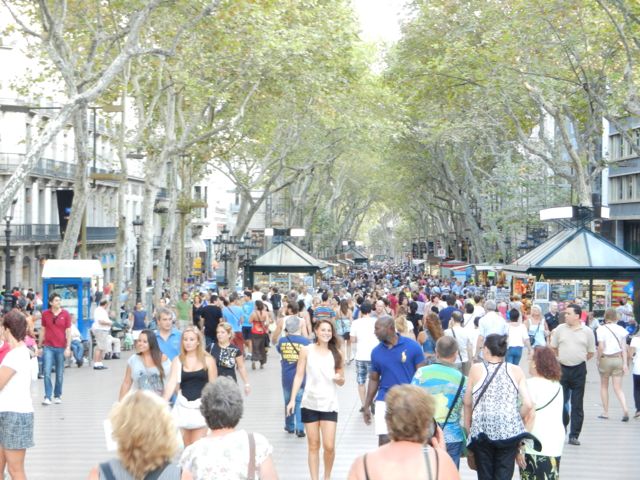
Cruise ships tie up in Barcelona just a ten-minute shuttle bus ride from the base of the Ramblas, a people-packed pedestrian boulevard always full of action. Human statues await your coins, shell-game teams await your cash, and pickpockets lay their traps. The latest scam: a drunken, overjoyed soccer fan puts his arm around you, wanting to celebrate his team's latest victory and dance...and meanwhile his fast fingers are working their way around to your wallet or purse.

A highlight of any Barcelona visit is its vibrant market, La Boqueria. Each year I visit and spy on Juan, who tirelessly poses for my readers as instructed in my Spain book. And each year, I take a photo of Juan posing with the photo of him posing in my guidebook.

Excuse Me While I Clean My Notebook…

Spain has fun with names. For instance, they call dried apricots orejones — now every time I look at one I’ll think, “Eeeww, big ears.”

One of my pet peeves is that Americans are the noisiest people in mellow and potentially romantic restaurants throughout Europe. The other day, back in Orvieto, I was jabbering away with some happy travelers I met with my guidebook when a local woman leaned far across from her table and gave us a classic “shhhhhhh.” Oops.

Spain has a class of educated professional workers whose wages can’t keep up with prices. They call them “Mileuristas” – meaning, the educated poor, earning 1,000 euros ($1,300) a month.

In Barcelona, we stumbled upon a small demonstration. The police were out in force — it seemed like there were more cops than demonstrators. I commented to my friend that this was not much of a disturbance. He agreed, saying, “Yes, but we like to demonstrate. When the Iraq war started, everyone was out. Barcelona was literally filled with people. The parade couldn’t happen. The streets were only people and nobody moved.”

Use what you design. Three times, I’ve stood up from my hotel toilet and knocked the phone hanging on the wall into the toilet. Anyone running a hotel should sleep in each room before renting it.

I had a nightmare. It was an Edvard Munch painting of 40 people walking their dogs.

For the rest of your lives, you’ll be reminded, “Don’t inflate your life vest until you’re out of the aircraft.” I don’t believe these life vests (or your floatable seat cushions) have ever been used in the history of aviation by a commercial jet “in the event of a water landing.” (Can anyone set me straight here?)

A Spanish friend of mine explained the “rule of seven nos.” When dealing with authority in Spain, you must ask sheepishly and meekly seven times – and get seven nos – before getting the go-ahead. In my TV production, this has worked many times.

Some Spaniards were lamenting the kind of leadership they felt was coming from Washington D.C. these days. We got talking about Clinton. Federico said, “Our king, Juan Carlos, is a whore addict…but nobody cares. He’s a very good king.”

Carrying around my European cell phone is like raising a child whose language I cannot speak. It makes all sorts of noises. I don’t know what to do. I just ignore them.

It occurred to me that if we all work together, we can change the pronunciation of gorgonZOla (pronounced like the lady your supermarket would) to gorGONzola. (Say it like Dracula. Say it like Juan Carlos.)

Pet peeve: a refrigerator motor disturbing an otherwise silent room. I get up in a midnight frenzy and find a way to unplug it. Last night I laid awake at 3:30 and realized I’m listening to a motor cool air.

The French are committed to the best holidays possible. To ease beach congestion, they split their country into three zones and stagger school holidays. In Spanish resorts they know which region of France is on holiday by who fills their beaches.

Traveling and seeing young families, you see how much in common parents have. I believe this is a huge step to peace and understanding between nations.

When I return home and give talks on Europe today, I think one theme will be, “Affluence channeled into good living.”

The Rolling Stones are coming to about the poorest country in Europe — Montenegro. Tens of thousands of kids are paying $50 each for tickets. The concert is sold out. I’m coming to Montenegro too…in just a few days…and nobody knows.
Barcelona and Spain’s Quebec

In Barcelona, a local told me, “Catalan is Spain’s Quebec.” Traveling here, you see how the people of Catalan have an affinity for other “stateless nations.” Locals don’t like to call their corner of Iberia a “region” of Spain…that’s what Franco called it.

They stress that they are a “nation without a state.” And they have a kinship for other people who didn’t get their independence when they drew the national boundaries. They live in solidarity with other stateless nations — finding Basque or Galician bars a little more appealing than the run-of-the-mill Spanish ones.

Even ATM machines are in solidarity, offering the correct choice of languages: Along with Angles, Frances, Castilla (Spanish), you’ll always find Gallic, Euskara, Catalan. Even though there’s likely not a person a year who would speak only Gallec (from Galicia, in northwest Spain) or Euskera (from Basque country), they give them the linguistic respect they would hope for in a foreign land.

Like many of Europe’s minor languages, Catalan is actually blossoming. It’s the language of the local schools, and these days, children here speak Catalan first…Spanish second.

A recent affluence has elevated the city. There’s barely a hint of danger in Barcelona’s once-frightening Gothic Quarter. I remember the city’s main boulevard, the Ramblas, when it was rich at the top and very rough at the port. Lurid prostitutes would line the street where it finally hit the harbor. Today, it’s rich at the top and rich at the port. And the only thing left of the prostitutes are holes ground by anxious high heels into the stone threshholds of brothel doorways that once faced the boulevard.

The toughest thing surviving on the Ramblas are the roving gangs of thugs who run the high-energy, extremely twitchy shell games. With spotters uphill and downhill and a full team of shills, nervous men scoot their dodgy peas. It’s amazing there are enough fools on the street to keep them in business.

My highlight with this Barcelona visit was less exciting — Pimiento de Padrón (or in Catalan, Pebrots de Padró)…lightly fried peppers salted and served piping hot. They’re a kind of Russian roulette for the taste buds as the eager eater knows that every once in a while, you’ll hit a super-spicy pepper.