Festive Barcelona Is Packed

My visit to Barcelona coincided with a particularly crowded and lively time: Holy Week and Easter. I enjoyed getting a Catalan take on this holiday.

Barcelona — Where People Stroll Like Sardines

Barcelona is one of the darlings of European tourism lately. It’s the biggest cruise port in Europe and one of the biggest in the world (as a starting or ending point for a huge portion of all Mediterranean cruises). It’s trendy for its Gaudí “Modernisme”— Catalunya’s answer to Art Nouveau. Catalunya is feeling its nationalist spirit. It’s well served by discount airlines. And vacationers — both Spanish and foreign — fill its streets, especially during its many festivals. I happened to be here over Easter weekend, and the boulevards were often human traffic jams.

Barcelona Bunnies
Barcelona Bunnies

Easter is a huge deal in Spain, especially in the south. Semana Santa (Holy Week) is one of the busiest and most festive times in Andalucía. But here in Catalunya, I found that Easter isn’t quite such a big deal. Catalans seem less religious, and the main duty of godfathers is to buy their godchildren overpriced decorative chocolate creations that fill shop windows. There was a Semana Santa-style parade, with teams of people trudging slowing down the street in tight formation, hidden under the huge religious floats they carried. But locals told me Catalans would never do this; these celebrants were from Andalucía, and travel each year to Barcelona to share their Easter traditions. While the churches may not have been overwhelmed with crowds, the Easter parade certainly jammed the streets.

Back in Barcelona, Where There’s Always Something New

I’ve left Portugal and have landed in Barcelona, where I’m sprucing up my new guidebook on this fun and fascinating city. A trip to Barcelona always comes with lots of learning for me — whether it’s the hottest dining and drinking trends (food tours and vermouth bars), the latest restored building in this city of bold and creative architects, or getting up to speed on the movement for the surrounding region of Catalunya to declare independence from Spain.

The theme in Europe over the last generation has been the rise of ethnic regions. As power gravitates to Brussels, the national capitals seem less concerned about their restless, would-be breakaway mini-states. For example, this year we’re hearing a lot about Scotland and Catalunya both seriously pursuing the possibility of declaring their independence from Britain and Spain, respectively. It’s always impressive for me to note that more people are speaking Europe’s small languages (Irish, Basque, Catalan, and so on) today than a generation ago. Talking to my friends in Barcelona about the practicality of having their children learn Catalan first at home and in school — leaving them with a native tongue that less than 10 million people speak in an aggressive and global world — none of them questioned the notion. Of course they’d speak Catalan…they are Catalans.

Here are pictures of three very different experiences I enjoyed on my latest Barcelona visit.

Last week I posted about a food tour I enjoyed in Porto, Portugal. Food tours— offering a mobile feast with several stops to sample a variety of local flavors for about the cost of a splurge dinner, all thoughtfully explained by a local guide — are a big trend across Europe. In Barcelona, as in many places, vermouth bars are all the rage these days. And as this photo shows, a refreshing glass of vermouth is complemented by a plate of local taste treats. Especially in Spain, this “tapas” style of eating and drinking makes for fun meals.
In Barcelona, the Ramblas pedestrian drag and the Gothic Quarter are understandably popular, but overrun with tourists. The new, happening quarter is El Born, just beyond the Gothic Quarter. A square called El Born (named for the tournaments once held there) faced a big 19th-century iron-and-steel market. In the 1970s, the vendors moved out, and the market was slated for demolition and redevelopment. But then they discovered the remains of a centuries-old neighborhood with a rich history:  In 1714, the residents here lost an uprising against the Spanish, and were forced to demolish their homes and carry the very stones that gave them shelter to the neighboring hill to build a citadel — from where the Spanish crown would assert their control over the people of Catalunya. The leveled neighborhood then provided a cleared-out no-man’s-land outside the fort, which later became a place of execution. Later, in more peaceful times, the space was made into a market. And in the last few years, they unearthed the remains of those original Catalans. Today, the El Born Market is an inviting and inspirational cultural center that tells its story well.
In Barcelona, the Ramblas pedestrian drag and the Gothic Quarter are understandably popular, but overrun with tourists. The new, happening quarter is El Born, just beyond the Gothic Quarter. A square called El Born (named for the tournaments once held there) faced a big 19th-century iron-and-steel market. In the 1970s, the vendors moved out, and the market was slated for demolition and redevelopment. But then they discovered the remains of a centuries-old neighborhood with a rich history: In 1714, the residents here lost an uprising against the Spanish, and were forced to demolish their homes and carry the very stones that gave them shelter to the neighboring hill to build a citadel — from where the Spanish crown would assert their control over the people of Catalunya. The leveled neighborhood then provided a cleared-out no-man’s-land outside the fort, which later became a place of execution. Later, in more peaceful times, the space was made into a market. And in the last few years, they unearthed the remains of those original Catalans. Today, the El Born Market is an inviting and inspirational cultural center that tells its story well.
In Francisco Franco’s time (until the mid-1970s), the people of Catalunya were not allowed to speak their language or fly their flag. So instead, they’d fly their soccer team’s flag. Then, once allowed, they flew their yellow-and-red-striped flag of Catalunya. And now you see many flags with a feisty addition: a blue triangle and a white star. This is inspired by the flag and spirit of the former Spanish colony of Cuba, which won its freedom from Spain in 1902. This Cuban/Catalan hybrid flag indicates that the people in this household support Catalunya's independence from Spain.
In Francisco Franco’s time (until the mid-1970s), the people of Catalunya were not allowed to speak their language or fly their flag. So instead, they’d fly their soccer team’s flag. Then, once allowed, they flew their yellow-and-red-striped flag of Catalunya. And now you see many flags with a feisty addition: a blue triangle and a white star. This is inspired by the flag and spirit of the former Spanish colony of Cuba, which won its freedom from Spain in 1902. This Cuban/Catalan hybrid flag indicates that the people in this household support Catalunya’s independence from Spain.

A Dozen Great Seaside Bars

With all the intensity in our domestic and political worlds lately, it’s a fine time for an escape — sunset glinting through the drink in your hand. Let’s fantasize about the best seaside bars in Europe. Whenever researching a guidebook chapter covering a port or seaside resort, I work hard to find the most romantic place to swizzle stick your vacation cocktail. Feel the breeze, smell the sea, enjoy the cry of the gulls, and let me share my favorites. These are each worth seeking out. (BTW, I’d love to read about your favorites. Please share.)

In Dubrovnik, Croatia
Cold Drinks “Buža” offers, without a doubt, the most scenic spot for a drink in Dubrovnik. Perched on a cliff above the sea, clinging like a barnacle to the outside of the city walls, this is a peaceful, shaded getaway from the bustle of the Old Town…the perfect place to watch cruise ships disappear into the horizon. Buža means “hole in the wall” — and that’s exactly what you’ll have to go through to get to this place. Filled with mellow tourists and friendly bartenders, Buža comes with castaway views and Frank Sinatra ambience ($4-7 drinks, summer daily 9:00-into the wee hours).

In Rovinj, Croatia
Valentino Champagne and Cocktail Bar is a memorable, romantic, justifiably pretentious place for an expensive late-night waterfront drink with jazz. Fish, attracted by its underwater lights, swim by from all over the bay…to the enjoyment of those nursing a cocktail on the rocks (literally — you’ll be given a small seat cushion and welcomed to find your own seaside niche). Or you can choose to sit on one of the terraces. Classy candelabras twinkle in the twilight, as couples cozy up to each other and the view. Patricia opens her bar nightly from 19:00 until as late as there’s any action. While the drinks are extremely pricey, this place is unforgettably cool ($8-11 cocktails, Via Santa Croce 28).
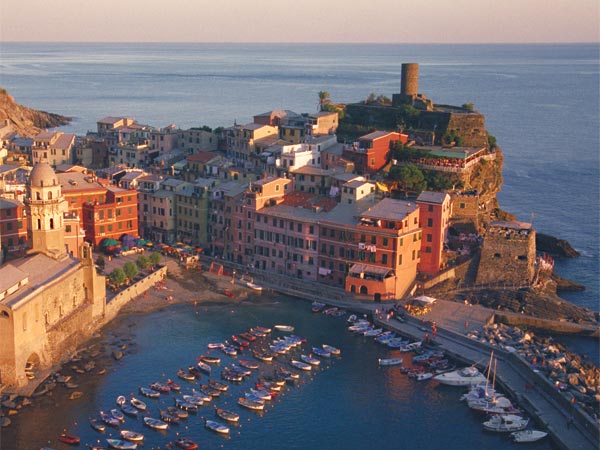
In Vernazza, Cinque Terre, Italy
Ristorante Belforte’s tiny, four-table balcony lets you sip your vino della Cinque Terre overlooking the Mediterranean from the edge of a stony castle. You can feel the mist from the surf crashing below on the Vernazza breakwater. And the views of the ancient vineyard terracing all around you makes the experience a highlight. From the Vernazza breakwater, follow either the stairs or the rope that leads up and around to the restaurant.

In Hydra, Greece
Kodylenia’s Taverna is perched on a bluff just over Kaminia’s pocket-sized harbor, which shelters the community’s fishing boats. With a glass of ouzo and some munchies, as the sun slowly sinks into the Saronic Gulf and boats become silhouettes, you can drink to the beauties of a Greek isle escape. It has my favorite, irresistible dinner views on Hydra: This scenic spot lets you watch the sunset with Kaminia’s adorable port in the foreground. Owner Dimitris takes his own boat out early in the morning to buy the day’s best catch directly from the fishermen. For meals, you can sit out on the shady, covered side terrace above the harbor. For drinks, sit out front on the porch. Relax and take in a sea busy with water taxis, hydrofoils that connect this oasis with Athens, old freighters — like castles of rust — lumbering slowly along the horizon, and cruise ships anchored as if they haven’t moved in weeks.

In Istanbul, Turkey
The double-decker Galata Bridge spans the Golden Horn, a historic inlet that separates the old and new towns of Istanbul. And all along both the horn and the bridge, you’ll find dozens of inviting, no-name bars. Find a place to nurse some Turkish specialties: Drink an unfiltered, highly caffeinated “Turkish coffee” (which leaves a thick coating of “mud” in the bottom) or a cup of tea, and suck on a water pipe — called a nargile (NAHR-gee-leh) — filled with flavorful dried fruit. As you enjoy your drink and your hookah, be sure to play backgammon with (or at least among) the locals. If you’re on the lower level of the bridge, you can look up for a fun view of dozens of fishing rods twitching along the upper railing. Watch your head — sometimes an amateur fisherman carelessly lets his catch swing under the top deck. And keep an eye out for the flicker of a little silvery fish, thrashing through the air as it’s reeled in by a happy predator.

In Salema, Portugal
One bit of old Algarve magic still glitters quietly in the sun — Salema. It’s at the end of a small road just off the main drag between the big city of Lagos and the rugged southwest tip of Europe, Cape Sagres. Quietly discovered by British and German tourists, this simple fishing village has three beachside streets, many restaurants, a few hotels, time-share condos up the road, a couple of bars, English and German menus, a classic beach with a paved promenade, and endless sun. The Atlântico — noisy, big, busy, and right on the beach — has long dominated the Salema beach scene. It’s known for fun drinks, friendly service, and a wonderful beachside terrace.

At Burriana Beach, Near Nerja, Spain
Ayo’s is famous for its character of an owner and its beachside all-you-can-eat paella feast at lunchtime. For 30 years, Ayo — a lovable ponytailed bohemian who promises to be here until he dies — has been feeding locals. Ayo is a very big personality — one of the five kids who discovered the Caves of Nerja, formerly a well-known athlete, and now someone who makes it a point to hire hard-to-employ people as a community service. The paella fires get stoked up at about noon and continue through mid-afternoon. Grab one of a hundred tables under the canopy next to the rustic, open-fire cooking zone, and enjoy the beach setting in the shade with a jug of sangria. For $7.50, you can fill your plate as many times as you like. It’s a 20-minute walk from the Balcony of Europe, at the east end of Burriana Beach — look for Ayo’s rooftop pyramid (daily “sun to sun,” paella served only at lunch).

In Villefranche-sur-Mer, France
In the glitzy world of the Riviera, Villefranche-sur-Mer offers travelers an easygoing slice of small-town Mediterranean life. Luxury sailing yachts glisten in the bay — an inspiration to those lazing along the harborfront to start saving when their trips are over. The Chapel of St. Pierre, decorated by artist Jean Cocteau, is the town’s cultural highlight.  Le Cosmo Bistrot/Brasserie takes center stage on Place Amélie Pollonnais with a great setting — a few tables have views to the harbor and to the Cocteau chapel’s facade (after some wine, Cocteau pops). Manager Arnaud runs a tight-but-friendly ship and offers well-presented, tasty meals with good wines (I love their red Bandol).

In Conwy, Wales
This Welsh town, watched over by its protective castle, has a particularly charming harbor. Conwy was once a busy slate port (back when much of Europe was roofed with Welsh slate, Conwy was a boomtown). But today the harbor is a laid-back area that locals treat like a town square. On summer evenings, the action is on the quay (pronounced “key”). The scene is mellow, multigenerational, and perfectly Welsh. It’s a small town, and everyone is here enjoying the local cuisine — “chips,” ice cream, and beer — and savoring that great British pastime: torturing little crabs. Facing the harbor, The Liverpool Arms pub was built by a captain who ran a ferry service to Liverpool in the 19th century. Today it remains a salty and characteristic hangout.

In Staithes, England
A ragamuffin village where the boy who became Captain James Cook got his first taste of the sea, Staithes (pronounced “staythz”) is a salty jumble of cottages bunny-hopping down a ravine into a tiny harbor. This refreshingly unpretentious town on the North Sea is gloriously stubborn about not wooing tourists. The town has changed little since Captain Cook’s days. Seagulls seem to have picked the barren cliffs raw. There’s nothing to do but stroll the beach and nurse a harborside beer or ice cream. The Cod and Lobster, overlooking the harbor, has scenic outdoor benches and a cozy living room warmed by a coal fire. In nice weather, the best option is to enjoy a drink, snack, or light meal (i.e., fish-and-chips) sitting at an outdoor table fronting the harbor.

In Solvorn, Norway
Walaker Hotel, a former inn and coach station, has been run by the Walaker family since 1690 (that’s a lot of pressure on eighth-generation owner Ole Henrik). The hotel, set right on the Lustrafjord, has a garden perfect for relaxing and, if necessary, even convalescing. In the main house, the halls and living rooms are filled with tradition. (Patriotic hymns sit at the piano.) While great for its accommodations, the hotel also serves dinner and drinks. I love to savor my coffee and dessert on the balcony with a fjordside setting — mesmerized by Norwegian mountains. Rather than jagged, they’re bald and splotchy, with snowfields on top and characteristic cliffs plunging into inky fjords. One night I took my strawberries à la mode onto one such porch and sat there long after my coffee cooled and ice cream melted. After dinner, I strolled through the village enjoying the blond cherubs running barefoot through the stalled twilight. Cobbled lanes led past shiplap houses to rock cliffs — their gullies and cracks green with trees.

In Barcelona, Catalunya, Spain
Before the 1992 Olympics, Barcelona’s waterfront was an industrial wasteland nicknamed the “Catalan Manchester.” Not anymore. The industrial zone was demolished and dumped into the sea, while sand was dredged out of the seabed to make the pristine beaches locals enjoy today. The scene is great for sunbathing and for an evening paseo before dinner. It’s like a resort island — complete with lounge chairs, volleyball, showers, bars, WCs, and bike paths. Every 100 yards or so is a chiringuito — a shack selling drinks and light snacks. Originally these sold seafood, but now they keep locals and tourists well-lubricated. It’s a very fun, lively scene on a balmy summer evening. This is a nice way to escape the claustrophobic confines of Barcelona to enjoy some sea air and the day’s final sunrays. A double-decker boardwalk runs the length of the beach, with a fine walkway up above. There’s a series of great seafood restaurants and cocktail bars with romantic, candlelit, beachfront seating tucked down below.

Porn Stars on Venetian Gondolas

Wrapping up my spring trip, I found a few stay observations and lessons gleaned from my time in Spain and Italy. When I’m researching my guidebooks, I pick up lots of fun bits, but they don’t all make it into the books. As I never know what will find a niche in a book until I work over the chapter, I tuck every thought that flutters by into my satchel. Here are a few fun fragments from the cutting-room floor:

Chatting with the owner of a thriving new eatery in Madrid, I commented on the speed at which the restaurant scene can change here. He noted, “Before the Internet, it took five years for a restaurant to get off the ground. Now, you can kick-start it with an Internet promotion, and it’ll be full in a month.”

Discussing the difficult aftermath of the Spanish dictator Franco and marveling at how everyone wasn’t against his fascist policies when it came to personal liberties, I asked my friend, “Who wouldn’t want freedom when Spain was evolving from fascism to democracy in the late 1970s?” The answer was brilliantly simple: “Only those who didn’t want others to have freedom.”

Flying from Madrid to Barcelona on Iberia Air, for the first time in my life, I was really mad at an airline. They had configured the seats so tight that I literally couldn’t fit my knees into my space. The experience reminded me of an evening I once spent alone with a wrench on a tour bus. I was meeting a tour group the next morning, and the bus I hired came with too many seats jammed into it. The seats slide on runners tightened into place by bolts. I spent several hours loosening each seat, taking out two sets, and rearranging the positions of the remaining seats. We did that tour with half our storage area under the bus filled with bus seats — but plenty of legroom for all on board.

Stepping off that too-tight Iberia plane in Barcelona, I realized I hadn’t even considered taking the Madrid-Barcelona train, which is now a nonstop bullet connection of less than three hours. In this case, the train would have saved me time, if not money, and given me plenty of stretch-out room…not to mention a delightful look at the countryside.

Even if I'm "full as an egg," there's always room for peppers in a Spanish tapas bar.

A good indication that a bar is a colorful local hangout is that it has the local football (soccer) team poster on the wall — a way for the staff to let customers know who they root for.

In towns with lots of foreign-study programs, you can see American teenagers poaching Internet signals on the sidewalk in front of American chains like Starbucks, KFC, and McDonalds. (These are more likely than European chains to offer free Wi-Fi for customers.) Students, who collect and share passwords and tips, are expert Wi-Fi poachers.

Riding out to the airport in Barcelona, my cabbie was pulled over and fined €50 on the spot for being slow to stop for an ambulance siren. He explained that, with the economic crisis, cops are coming down hard and fast on drivers in Spain.

I enjoy picking up little bits of folk wisdom in my travels. A local guide in Barcelona marveled at the low caliber of leadership in his country, saying, “En el país de los ciegos, el tuerto es el rey.” (In the land of the blind, the one-eyed man is king.) Talking about pain-pleasure ratios between cultures, another friend said, “He who gets up early is helped by God.” His wife countered, “No, getting up early doesn’t speed up the sun.” Later, in Italy, when a restaurateur wanted to give me more and more food, I said I was stuffed. He told me that in Italy, you say, “Sono pieno come un uovo” (I’m full like an egg).

After one of my researchers commented on how people were not that friendly in the Cinque Terre, I asked some locals about it. They talked about their experience in restaurants, saying, “Friendly is not the currency here. Waiters don’t want to know your name. They’re working hard. They’re grumpy to all. I just want them to get my food right.” The humor here is flavored with sarcasm, which can come off mean-spirited.

One year later, the cover of my Venice guidebook is still accurate — but there are plenty of changes inside.

I enjoyed more time than ever in Venice. And it occurred to me that you could pause anywhere in Venice, observe, and, from that single viewpoint, write an article. Leaning against a church’s leaning bell tower as a flock of birds flew just in front of my face, I jotted down a few notes: A group of Russians wandered by — rich men with their platinum-blonde trophies. They were silent but hooked up to their guide with ear buds and a “whisper system.” The crowd in the restaurant looked intentionally disinterested in the music as a roving Romanian accordionist pumped away while sussing out the potential of getting any tips. A solitary local waved his hands while pacing back and forth across a bridge and talking on his cell phone. Next to me, litter was growing out the top of a garbage can like a bum with a bushy head of hair.

As far as I can tell, there are no porn stars on Venetian gondolas. In fact, there are not even lovers on gondolas. Everyone is too busy reading their iPhones or looking into their cameras. Desperate to get someone kissing on a gondola for our TV show, I walked briskly along a canal to get ahead of what I thought was a potentially romantic couple. I got their attention, and motioned to our cameraman and did a charade of kissing as if to clearly ask them to give each other a little kiss as they approached. The man, pointing to the woman next to him, mouthed with silent yet exaggerated motions, “She’s my daughter.”

Vicky and Cristina! Gaudí’s Dream Is Coming True!

I’ve long said, “If there’s one building I’d like to see in Europe, it’s Gaudí’s Sagrada Família church in Barcelona…finished.” The church has been an epic work-in-progress for over a hundred years now, and in the last couple of years there has been huge progress. In fact, my breath was literally taken away during my visit today, as the main part of the church interior is enclosed and ready for worship. It was consecrated recently by the Pope. The stained glass needs to be put in (which will heighten the already magical ambience of its awe-inspiring interior), the towers need to be completed (the central one will be the tallest church tower in Europe by a long shot — functioning as a beacon to cruise ships far out at sea), and hundreds of condo dwellers need to be bought out so neighboring buildings can be demolished to make way for the regal esplanade, which will approach what promises to be the most exciting church built in our lifetimes. The hope: to finish the church by 2026—the 100th anniversary of architect Antoni Gaudí’s death. By then, it’s my bet that Gaudí will be sainted. If there is a miracle anywhere in the world of architecture, it is this building.

If you can’t see the video below, watch it on YouTube.