Dropping in on the Queen

In 1848, Queen Victoria and Prince Albert visited the Scottish Highlands and fell in love with this remote part of Britain. In that same year — as the rest of Europe was ensnared in anti-royalist, pro-democracy revolutions — England’s Queen purchased Balmoral Castle on a vast 50,000-acre estate. The Queen proceeded to embrace the Highland culture, which led to something of a renaissance in the local way of life in this northern part of Scotland.

Today, Queen Elizabeth II and her family still spend a good part of their summers here at Balmoral. And, for much of the season, the palace welcomes the public. However, access is limited: You can roam the gardens, see some exhibits in the stables, and visit a single big room in the palace. The admission fee includes a self-guided audio tour, which I enjoyed.


Visiting Scotland, you’ll inevitably visit a few royal palaces — but consider expanding your sightseeing to the castles of clan nobility. It seems each clan has a “spiritual heart” where ancient artifacts, documents, and lots of battle-dinged weaponry are archived, and much of it accessible to the public. I toured every palace-like castle we came upon, and I enjoyed them all. And if you’re a Mac-this, a Mac-that, or a Campbell, these ancestral homes can be particularly interesting. For example, Inveraray Castle (popular for its Downton Abbey connections — their Christmas special was filmed here) bristles with the weaponry of Clan Campbell.

This is Day 96 of my “100 Days in Europe” series. As I travel with Rick Steves’ Europe Tours, research my guidebooks, and make new TV shows, I’m reporting on my experiences across Europe. Still to come: Germany, Switzerland, and more. Thanks for joining me here on my blog and via Facebook.

Travel Memories Old and New in Scotland

Scotland is really hot in the travel business lately. It’s one of our bestselling tours and one of our bestselling guidebooks. And, after traveling a route pretty close to what we do on our tours (with the luxury of having one of our Scotland guides, Colin Mairs, all to myself), I’m seeing just what the kilt-and-whisky-powered buzz is all about.

Colin knows our Scotland tour itinerary down to the minute, allowing us to ambush a big Rick Steves tour bus of travel joy as it pulled in to Clava Cairns (just outside of Inverness). I got to pop into the bus and say to the happy gang, “Thanks for traveling with us.”

Traveling through Scotland, I’ve been impressed by the variety of sights, and how close together things are. In 12 days, I can’t remember a long, boring drive. There are the big iconic blockbuster sights, and there are the silly Loch Ness monster sights. (Actually, I enjoyed the Loch Ness Exhibition Centre — which analyzes how such a crazy legend could capture the imagination of so many generations of visitors.)

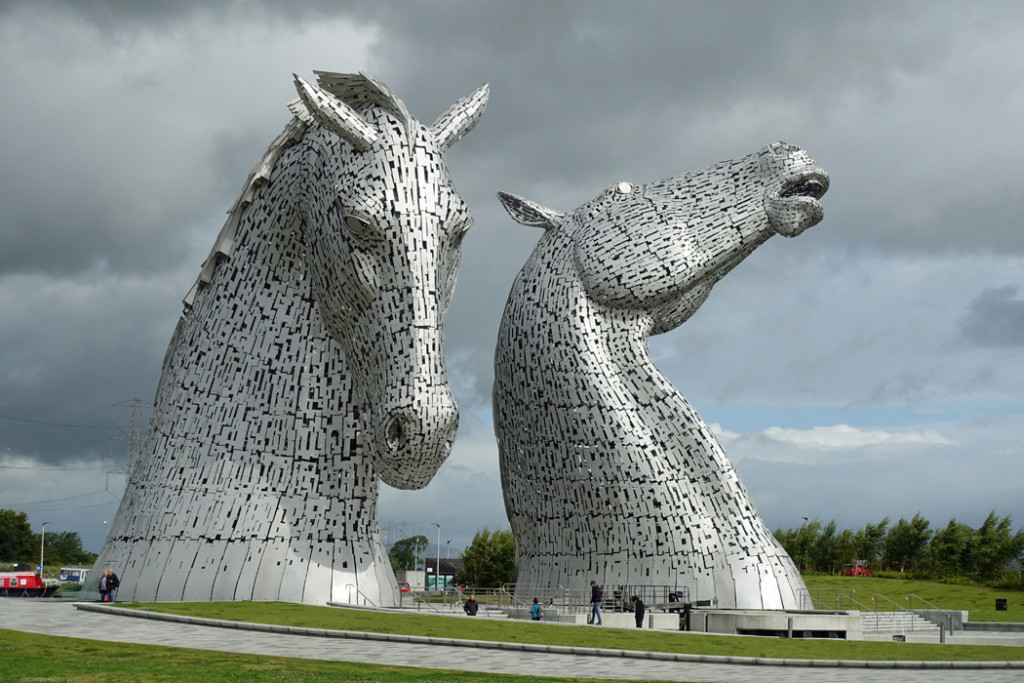
In the last decade or so, two new sights (both near Stirling Castle) have joined the parade of Scottish travel memories: The Falkirk Wheel opened in 2002. Rather than a series of locks, it gracefully raises boats 80 feet from the Forth Canal to the Clyde Canal with an innovative wheel. And a couple of giant steel horse heads, based on the mythic Kelpies, were built in 2014 and have become a symbol of the region around Stirling.

This is Day 95 of my “100 Days in Europe” series. As I travel with Rick Steves’ Europe Tours, research my guidebooks, and make new TV shows, I’m reporting on my experiences across Europe. Still to come: Germany, Switzerland, and more. Thanks for joining me here on my blog and via Facebook.

The Mystically Beautiful Isle of Skye

Nearly all travelers to Scotland visit Edinburgh. Many get to Glasgow. Those going farther north get their dose of the islands by sailing to Mull and Iona from Oban, and their dose of the Highlands at Glencoe. And many head for Inverness just to check nearby Loch Ness off their bucket list. But the mystically beautiful Isle of Skye — just two hours from Inverness — is worth the extra drive.

While most people visit the Isle of Skye as a harried day trip from Inverness (which is certainly better than no visit at all), you really need a minimum of two nights (based in the major town, Portree) and an entire day to explore.

On Scottish mainland just before the bridge to Skye, the iconic Eilean Donan Castle seems to herald the coming of Scotland’s ultimate scenic experience. (I still get a charge out of visiting places that make the cover of my guidebooks.) My guide, Colin Mairs, and I couldn’t resist a selfie here, books in hand. Walking around day after day, earnestly carrying our books — through villages, museums, and roadside attractions — we felt like a couple of travel missionaries.

colin mairs and rick steves with books at castle
Scotland has about a dozen classic scenes that are always featured on posters and calendars. Eilean Donan is one of them. Two more are on the Isle of Skye: the bridge at Sligachan, and the windy road to the windy bluff (that’s windy, not windy) at the Quiraing.

sligachan bridge

The bridge at Sligachan.

road to quiraing

The road to the Quiraing.

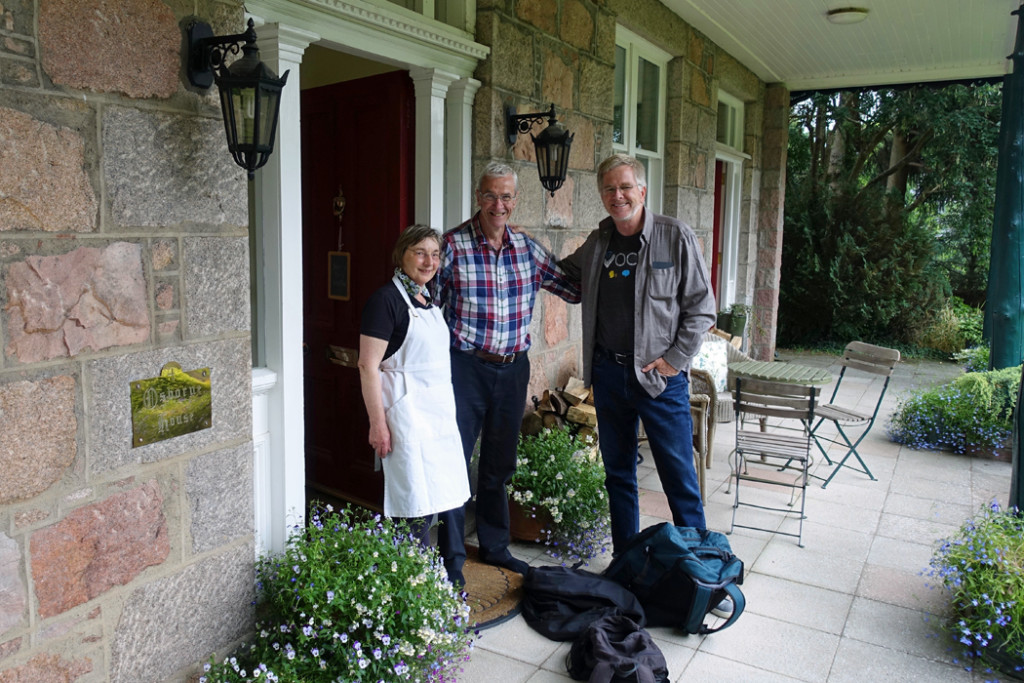
A delightful part of travel in Scotland is staying in B&Bs. I’ve enjoyed good, old-fashioned B&B hospitality (not to mention great prices) throughout our trip.

rick steves at b&b with owners

And my go-to meal is fish and chips. At Portree harbor, the chippy’s picnic bench is forever empty, as seagulls are famously aggressive here. Hungry diners are forced to eat literally standing up against the wall…or else a gull will swoop down for a slab of cod.

people eating fish and chips

Photo: Colin Mairs

This is Day 94 of my “100 Days in Europe” series. As I travel with Rick Steves’ Europe Tours, research my guidebooks, and make new TV shows, I’m reporting on my experiences across Europe. Still to come: Germany, Switzerland, and more. Thanks for joining me here on my blog and via Facebook.

My Best Boozy Discoveries in Scotland

I’m in Scotland, updating my Scotland guidebook — and I’m realizing that this is a land of booze geeks. Some of my favorite discoveries in Glasgow have been inviting whisky bars, run by people evangelical about Scotland’s favorite drink. (When it rains — as it often does — the showers elicit a cheery “That’s tomorrow’s whisky!” from the locals.)

On my tour around Scotland, I’ve visited a half-dozen whisky distilleries — from the Speyside region (where the iconic Glenfiddich and Glenlivet are produced) to the remote and intimate Talisker Distillery (opened in 1830 on the Isle of Skye).

talisker distillery

The Talisker Distillery. (Photo: Colin Mairs)

Each distillery was situated on a nearly sacred natural spring, and travelers were welcomed by a kilted guide who gave a tour followed by a tasting. I got to assess each and write them up for the next edition of the guidebook.

glenfiddich distillery tour

The Glenfiddich Distillery Tour.

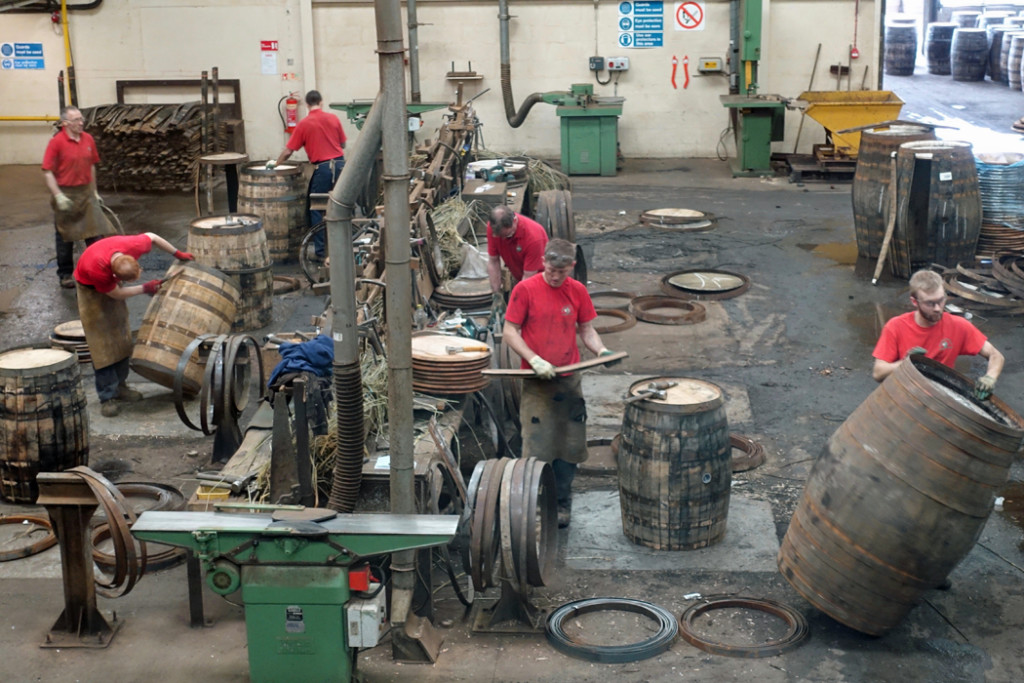
One highlight was the Speyside Cooperage, where I gained an appreciation of the role of oak in the distilling process, and got to watch as the busy coopers made whisky casks.

coopers at speyside

The Speyside Cooperage Visitor Centre.

Throughout my Scottish travels, I enjoyed Tennent’s Lager (“Scotland’s favourite pint”), and I’m adding a tour of their brewery to the guidebook. The Tennent’s Brewery Tour is perhaps the most exciting (if not the most politically correct) new experience in the Glasgow chapter. For three decades, Tennent’s decorated their cans with images of pinup girls who were known (fondly by many) as the “Lager Lovelies.”

timeline with photos of models

A “Lager Lovelies” timeline from the Tennent’s Brewery Tour.


Here’s a sneak peek at the new listing for the Tennent’s Brewery Tour in the upcoming second edition of Rick Steves Scotland:

Tennents Brewery Tour: Tennents, founded in 1740, is now the biggest brewery in Scotland, filling an 18-acre site. They give serious hour-long tours showing how they make “Scotland’s favourite pint” and fill 700 kegs per hour and 2,000 cans per minute (you’ll see more action Mon-Fri). It’s hot and sweaty inside, with over 100 steps to climb on your tour. When you’re done (surrounded by the “Lager Lovelies” —   pinup girls whose images decorated Tennents cans from 1965 to 1991), you’ll enjoy three samples followed by a pint of your choice (£10; tours depart daily at 10:00, 12:00, 14:00, 16:00, 18:00; to reserve, call 0141/202.7145 or book online at tennentstours.com, 161 Duke Street). Bus #41 stops in front on Duke Street and goes to George Square.

This is Day 93 of my “100 Days in Europe” series. As I travel with Rick Steves’ Europe Tours, research my guidebooks, and make new TV shows, I’m reporting on my experiences across Europe. Still to come: Germany, Switzerland, and more. Thanks for joining me here on my blog and via Facebook.
The Unforgettable Orkney Islands

I’m midway through my Scotland experience, but I just can’t get my first stop — the Orkney Islands — out of my mind.

My first evening (evenings are long at these Norwegian latitudes), I wandered down to the cathedral in Orkney’s capital, Kirkwall, and happened upon a stirring band of pipers and drummers. I watched as little local kids splashed in a cultural puddle created by the band, the wail of the pipes, the towering stony church, and adoring townsfolk…and I could almost see them absorbing into their DNA what it means to be Orcadian.

bagpipers

A band of pipers and drummers plays at Kirkwall’s St. Magnus Cathedral

Sightseeing on Orkney is a quirky mix of 20th-century world war sights and megalithic wonders from 3000 B.C. I drove past sunken war ships at Scapa Flow, one of the biggest natural harbors anywhere, and visited an adorable little chapel that Italian POWs built out of military scrap.

barriers at scapa flow

One of four Churchill Barriers built during World War II to protect Scapa Flow.

sunken war ship

A sunken war ship at Scapa Flow. (Photo: Cameron Hewitt)

church

The Italian Chapel, built by Italian POWs during World War II.

On the west coast of Orkney, I explored the Neolithic village of Skara Brae — and as the wind blew across the bluff, I understood why those early locals lived like moles in underground stone settlements.

skara brae

The prehistoric village of Skara Brae.

Then, doing my very best Chuck Berry duckwalk through a tight passage, I climbed into Maeshowe, the finest chambered tomb north of the Alps — and shared that mystical space with a tiny sparrow who made her nest there.

tomb chamber

The chambered tomb of Maeshowe.

It was all simply unforgettable.

___

This is Day 92 of my “100 Days in Europe” series. As I travel with Rick Steves’ Europe Tours, research my guidebooks, and make new TV shows, I’m reporting on my experiences across Europe. Still to come: Germany, Switzerland, and more. Thanks for joining me here on my blog and via Facebook.