Salema—My Favorite Stretch of Portugal’s Algarve

For several years, I’ve been wanting to return to the Algarve (southern Portugal), my favorite stretch of Iberian coastline. I’m generally in Iberia in April, when the beach towns are pretty dead, so I don’t bother. Being here in June this year makes a huge difference — it’s lively, warm, and a great place to relax (as I wind up an intense two-month trip). And even after all this time, my favorite Algarve town remains Salema.

The economic hard times seem to be hitting both Spain and Portugal very hard. I can see the sadness in the eyes of the people. A “tough times future” seems to be the diagnosis, and there’s no promising cure. The character of the idyllic fishing towns (like Salema) is changing. Fewer people are fishing, and government policies (regulation and taxation) have tightened up, causing the little widows to not bother renting their rooms. Gourmet restaurants and boutique accommodations are appearing in spite of the tough times, as fishing towns are becoming the playgrounds of the gated communities and golf clubs of the jet-setting international crowd, who stay on the hilltops a bit inland. Still, the children of the old fisherman — at least, the ones who don’t go to the big city in search of economic promise — continue to cook up the fish and man the weather-beaten fort. And Salema remains a delightful stop on any Iberian itinerary.

I hope you enjoy these images from my recent visit.

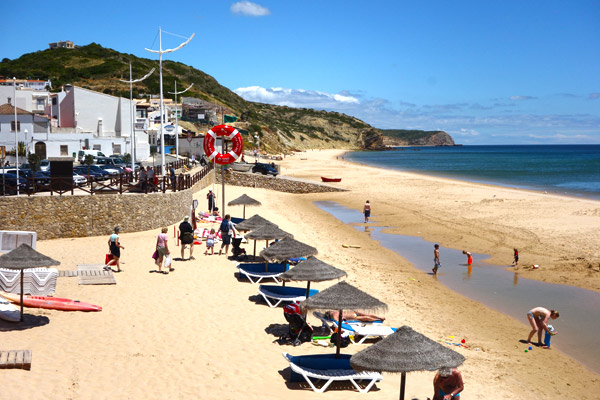
Salema, the Back Door jewel of the Algarve, comes with a delightful sandy beach overlooked by characteristic restaurants and the tranquil strum of a steady surf

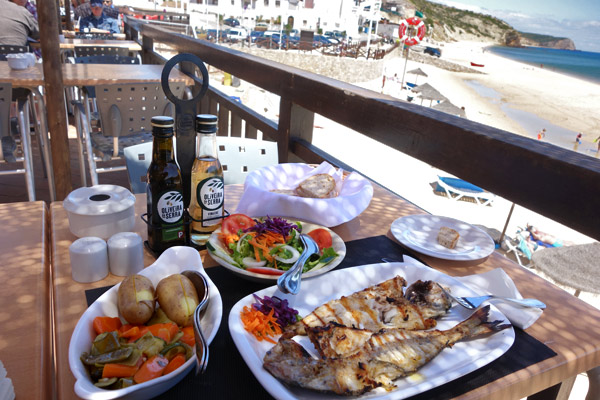
In beach resorts across the Mediterranean, competition is stiff. The fish is fresh, the vegetables are crunchy, and in the case of Portugal...the wine is green.
In beach resorts across the Mediterranean, competition is stiff. The fish is fresh, the vegetables are crunchy, and in the case of Portugal…the wine is green.

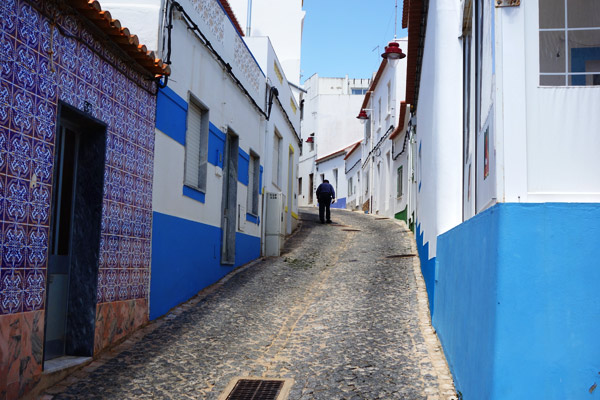
When I first came to Salema, in the late 1970s, I was driving a minibus of tourists. We’d park at the base of Salema’s “street of the fishermen” (Rua Pescador) and find rooms (quartos) in private homes for a few bucks each. Now the fishermen do more sitting and gazing at the sea than fishing (the business is done in bigger fish markets nearby, in Sagres and Lagos). The women have been terrorized out of running their small businesses by stricter (and necessary, as Southern Europe learns to pay its taxes) government regulations. There are fewer old-school, shoestring-budget backpackers to keep them in business anyway. Still, while it feels different, the street looks exactly the same.

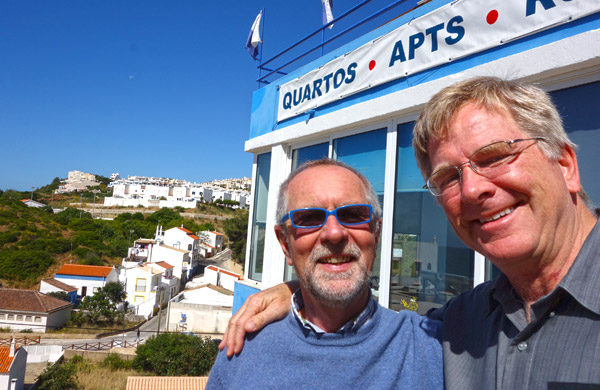
My friend John, from England, has run Pension Mare for three decades. I’ve been sending my readers there just about from the start, and we are like a team. I love his place. He lives in Bath and flew down to hang out with me as I updated my chapter on Salema. He was a great resource as I put the pieces of this town’s social puzzle together. This same weekend, John sold Pension Mare. The new owner promises to run it the same for my readers... but it’s a bit of a sad event for me.
My friend John, from England, has run Pension Mare for three decades. I’ve been sending my readers there just about from the start, and we are like a team. I love his place. He lives in Bath and flew down to hang out with me as I updated my chapter on Salema. He was a great resource as I put the pieces of this town’s social puzzle together. This same weekend, John sold Pension Mare. The new owner promises to run it the same for my readers… but it’s a bit of a sad event for me.

A Dozen Great Seaside Bars

With all the intensity in our domestic and political worlds lately, it’s a fine time for an escape — sunset glinting through the drink in your hand. Let’s fantasize about the best seaside bars in Europe. Whenever researching a guidebook chapter covering a port or seaside resort, I work hard to find the most romantic place to swizzle stick your vacation cocktail. Feel the breeze, smell the sea, enjoy the cry of the gulls, and let me share my favorites. These are each worth seeking out. (BTW, I’d love to read about your favorites. Please share.)

In Dubrovnik, Croatia
Cold Drinks “Buža” offers, without a doubt, the most scenic spot for a drink in Dubrovnik. Perched on a cliff above the sea, clinging like a barnacle to the outside of the city walls, this is a peaceful, shaded getaway from the bustle of the Old Town…the perfect place to watch cruise ships disappear into the horizon. Buža means “hole in the wall” — and that’s exactly what you’ll have to go through to get to this place. Filled with mellow tourists and friendly bartenders, Buža comes with castaway views and Frank Sinatra ambience ($4-7 drinks, summer daily 9:00-into the wee hours).

In Rovinj, Croatia
Valentino Champagne and Cocktail Bar is a memorable, romantic, justifiably pretentious place for an expensive late-night waterfront drink with jazz. Fish, attracted by its underwater lights, swim by from all over the bay…to the enjoyment of those nursing a cocktail on the rocks (literally — you’ll be given a small seat cushion and welcomed to find your own seaside niche). Or you can choose to sit on one of the terraces. Classy candelabras twinkle in the twilight, as couples cozy up to each other and the view. Patricia opens her bar nightly from 19:00 until as late as there’s any action. While the drinks are extremely pricey, this place is unforgettably cool ($8-11 cocktails, Via Santa Croce 28).
In Vernazza, Cinque Terre, Italy
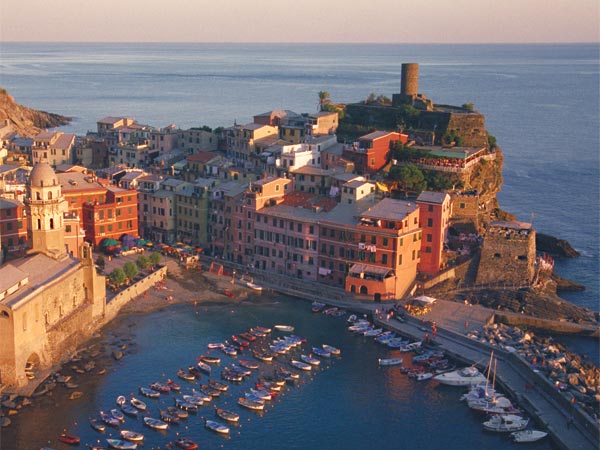
Ristorante Belforte’s tiny, four-table balcony lets you sip your vino della Cinque Terre overlooking the Mediterranean from the edge of a stony castle. You can feel the mist from the surf crashing below on the Vernazza breakwater. And the views of the ancient vineyard terracing all around you makes the experience a highlight. From the Vernazza breakwater, follow either the stairs or the rope that leads up and around to the restaurant.

In Hydra, Greece
Kodylenia’s Taverna is perched on a bluff just over Kaminia’s pocket-sized harbor, which shelters the community’s fishing boats. With a glass of ouzo and some munchies, as the sun slowly sinks into the Saronic Gulf and boats become silhouettes, you can drink to the beauties of a Greek isle escape. It has my favorite, irresistible dinner views on Hydra: This scenic spot lets you watch the sunset with Kaminia’s adorable port in the foreground. Owner Dimitris takes his own boat out early in the morning to buy the day’s best catch directly from the fishermen. For meals, you can sit out on the shady, covered side terrace above the harbor. For drinks, sit out front on the porch. Relax and take in a sea busy with water taxis, hydrofoils that connect this oasis with Athens, old freighters — like castles of rust — lumbering slowly along the horizon, and cruise ships anchored as if they haven’t moved in weeks.

In Istanbul, Turkey
The double-decker Galata Bridge spans the Golden Horn, a historic inlet that separates the old and new towns of Istanbul. And all along both the horn and the bridge, you’ll find dozens of inviting, no-name bars. Find a place to nurse some Turkish specialties: Drink an unfiltered, highly caffeinated “Turkish coffee” (which leaves a thick coating of “mud” in the bottom) or a cup of tea, and suck on a water pipe — called a nargile (NAHR-gee-leh) — filled with flavorful dried fruit. As you enjoy your drink and your hookah, be sure to play backgammon with (or at least among) the locals. If you’re on the lower level of the bridge, you can look up for a fun view of dozens of fishing rods twitching along the upper railing. Watch your head — sometimes an amateur fisherman carelessly lets his catch swing under the top deck. And keep an eye out for the flicker of a little silvery fish, thrashing through the air as it’s reeled in by a happy predator.

In Salema, Portugal
One bit of old Algarve magic still glitters quietly in the sun — Salema. It’s at the end of a small road just off the main drag between the big city of Lagos and the rugged southwest tip of Europe, Cape Sagres. Quietly discovered by British and German tourists, this simple fishing village has three beachside streets, many restaurants, a few hotels, time-share condos up the road, a couple of bars, English and German menus, a classic beach with a paved promenade, and endless sun. The Atlântico — noisy, big, busy, and right on the beach — has long dominated the Salema beach scene. It’s known for fun drinks, friendly service, and a wonderful beachside terrace.

At Burriana Beach, Near Nerja, Spain
Ayo’s is famous for its character of an owner and its beachside all-you-can-eat paella feast at lunchtime. For 30 years, Ayo — a lovable ponytailed bohemian who promises to be here until he dies — has been feeding locals. Ayo is a very big personality — one of the five kids who discovered the Caves of Nerja, formerly a well-known athlete, and now someone who makes it a point to hire hard-to-employ people as a community service. The paella fires get stoked up at about noon and continue through mid-afternoon. Grab one of a hundred tables under the canopy next to the rustic, open-fire cooking zone, and enjoy the beach setting in the shade with a jug of sangria. For $7.50, you can fill your plate as many times as you like. It’s a 20-minute walk from the Balcony of Europe, at the east end of Burriana Beach — look for Ayo’s rooftop pyramid (daily “sun to sun,” paella served only at lunch).

In Villefranche-sur-Mer, France
In the glitzy world of the Riviera, Villefranche-sur-Mer offers travelers an easygoing slice of small-town Mediterranean life. Luxury sailing yachts glisten in the bay — an inspiration to those lazing along the harborfront to start saving when their trips are over. The Chapel of St. Pierre, decorated by artist Jean Cocteau, is the town’s cultural highlight.  Le Cosmo Bistrot/Brasserie takes center stage on Place Amélie Pollonnais with a great setting — a few tables have views to the harbor and to the Cocteau chapel’s facade (after some wine, Cocteau pops). Manager Arnaud runs a tight-but-friendly ship and offers well-presented, tasty meals with good wines (I love their red Bandol).

In Conwy, Wales
This Welsh town, watched over by its protective castle, has a particularly charming harbor. Conwy was once a busy slate port (back when much of Europe was roofed with Welsh slate, Conwy was a boomtown). But today the harbor is a laid-back area that locals treat like a town square. On summer evenings, the action is on the quay (pronounced “key”). The scene is mellow, multigenerational, and perfectly Welsh. It’s a small town, and everyone is here enjoying the local cuisine — “chips,” ice cream, and beer — and savoring that great British pastime: torturing little crabs. Facing the harbor, The Liverpool Arms pub was built by a captain who ran a ferry service to Liverpool in the 19th century. Today it remains a salty and characteristic hangout.

In Staithes, England
A ragamuffin village where the boy who became Captain James Cook got his first taste of the sea, Staithes (pronounced “staythz”) is a salty jumble of cottages bunny-hopping down a ravine into a tiny harbor. This refreshingly unpretentious town on the North Sea is gloriously stubborn about not wooing tourists. The town has changed little since Captain Cook’s days. Seagulls seem to have picked the barren cliffs raw. There’s nothing to do but stroll the beach and nurse a harborside beer or ice cream. The Cod and Lobster, overlooking the harbor, has scenic outdoor benches and a cozy living room warmed by a coal fire. In nice weather, the best option is to enjoy a drink, snack, or light meal (i.e., fish-and-chips) sitting at an outdoor table fronting the harbor.

In Solvorn, Norway
Walaker Hotel, a former inn and coach station, has been run by the Walaker family since 1690 (that’s a lot of pressure on eighth-generation owner Ole Henrik). The hotel, set right on the Lustrafjord, has a garden perfect for relaxing and, if necessary, even convalescing. In the main house, the halls and living rooms are filled with tradition. (Patriotic hymns sit at the piano.) While great for its accommodations, the hotel also serves dinner and drinks. I love to savor my coffee and dessert on the balcony with a fjordside setting — mesmerized by Norwegian mountains. Rather than jagged, they’re bald and splotchy, with snowfields on top and characteristic cliffs plunging into inky fjords. One night I took my strawberries à la mode onto one such porch and sat there long after my coffee cooled and ice cream melted. After dinner, I strolled through the village enjoying the blond cherubs running barefoot through the stalled twilight. Cobbled lanes led past shiplap houses to rock cliffs — their gullies and cracks green with trees.

In Barcelona, Catalunya, Spain
Before the 1992 Olympics, Barcelona’s waterfront was an industrial wasteland nicknamed the “Catalan Manchester.” Not anymore. The industrial zone was demolished and dumped into the sea, while sand was dredged out of the seabed to make the pristine beaches locals enjoy today. The scene is great for sunbathing and for an evening paseo before dinner. It’s like a resort island — complete with lounge chairs, volleyball, showers, bars, WCs, and bike paths. Every 100 yards or so is a chiringuito — a shack selling drinks and light snacks. Originally these sold seafood, but now they keep locals and tourists well-lubricated. It’s a very fun, lively scene on a balmy summer evening. This is a nice way to escape the claustrophobic confines of Barcelona to enjoy some sea air and the day’s final sunrays. A double-decker boardwalk runs the length of the beach, with a fine walkway up above. There’s a series of great seafood restaurants and cocktail bars with romantic, candlelit, beachfront seating tucked down below.
Economic Crisis in Portugal: In Cod We Trust


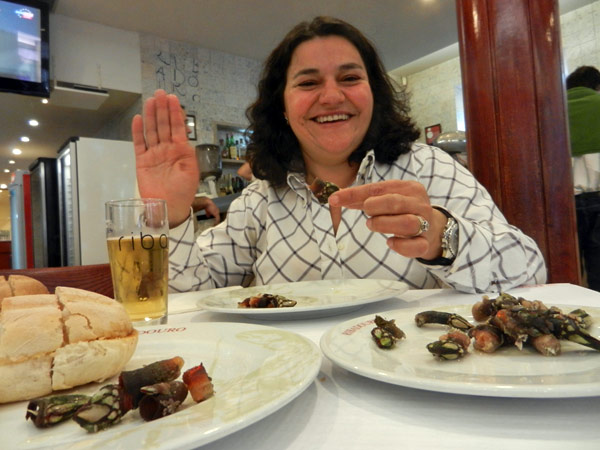
Back in Lisbon, the first thing I eat (with my wonderful guide, Cristina Duarte): barnacles. I love barnacles.

On my last visit to Lisbon, people were scampering to finish projects funded by the European Union. There was scaffolding everywhere as the buzz was, “This is the end of the easy money — use it or lose it, quickly!”

I should have known then, but there’s no free lunch — even in the European Union. Today, Portugal has come to its day of reckoning. The money has dried up, and the interest due on the debt is crushing the local workforce. Portugal’s 11 million people produce about $240 billion annually — nearly the same as Louisiana. But Portugal has about 14 percent unemployment. It once exported dried cod; now its top export is people.

Major projects in Portugal are not just stalled. They are stopped. The TGV-style bullet train from Madrid to Lisbon, Lisbon’s new airport, planned freeway expansion…all nice ideas…all stopped.

Last night, as we walked the newly pedestrianized streets of the Barrio Alto district, things were relatively quiet, even though 50,000 locals were packing the Lisbon stadium for the big, crosstown-rivals soccer match. During our stroll, my friend told me, “In pre-euro days, with the escudo as our currency rather than that deutsche mark in disguise, when there was no money for chocolate milk, we just made due with white milk. Until 1974, when we won our freedom from Salazar (Portugal’s Fascist dictator was overthrown in the “Revolution of the Carnations”), we were on the donkey system. Then we got the fever. With the EU, dazzled by German standards, we were encouraged to have faith in debt. Portugal was made drunk economically by those cheap European loans.”

Today Brussels sends the Portuguese not money but the “Troika,” a trio of managers from the EU, IMF, and European Central Bank who enforce austerity measures to get things on a sustainable track. That means higher tolls on more highways, a new 23 percent tax put on all restaurants, higher deductibles for hospital visits, and cutbacks in health care. Utilities such as electricity are being privatized. Retirement was just raised from 65 to 67 years. And the Troika made the government rescind a worker-friendly scheme of the revolution which took a year’s wages and broke it into 14 “months” rather than 12 to give workers a “bonus” each summer and Christmas. Now workers making over €650 (about $800 a month) get only 12 months’ pay. As this was never really a bonus but just a forced savings account, this amounts to about an 18 percent cut in pay.

Local politicians are fighting despair. To the Troika, the Portuguese, compared to the Greeks, are considered very quiet workers with a nice reputation and good behavior; they’re willing to take their medicine responsibly.

As for the traveler, despite the economic downturn, it’s wonderful to be prowling the streets of Lisbon after dark. Trendy and stylish little bars and restaurants are working hard for their customers. On my first evening in Europe, I’m already back in my research groove.

Wasting Away on the Algarve

Enlarge photo

To commemorate the Smithsonian Presents Travels with Rick Steves magazine — now on sale online, and at newsstands nationwide — Rick is blogging about the 20 top destinations featured in that issue. One of those destinations is Salema, on Portugal’s Algarve Coast.

I can close my eyes and feel the salty ambience of Salema: The tall, fresh-squeezed orange juice of the loss-leader breakfasts where I put my feet up on the rusty railing, gaze out at the sea, and wonder what I’ll do today.

Actually, since I’m usually in Salema updating my guidebook, my options are all work-related: find a desolate beach farther north, on the windy side of Cape Sagres; venture up into the modern part of town to see how soft prices are for the modern hotel scene; drop by expat Brits in the next town, where those on humble retirement accounts live like kings with everything you could want in Portugal except a sea view.

I do fantasize about just being here on vacation. Nursing a drink in a still-wet bathing suit. Going out with Sebastian to haul in the octopus pots. Hiking to the beach where you expose skin that’s never seen the sun. Getting to the point where you can competently discuss the quality of the fish soup in each beachfront restaurant.

I was going to say there are just a few places in Europe where I could savor a true vacation. But then, when I think about it, there are many. But for a beach break — simply wasting away in a European Margaritaville — it’s fair to call Salema, on Portugal’s Algarve, my favorite.

Travel Writer Cheats…Stunning the World

My friend Michael Shapiro recently did an (Google-able) article for the Washington Poston a little scandal caused when Lonely Planet author Thomas Kohnstamm admitted he cheated on his guidebook research chores. The media jumped on this to discredit the world’s greatest guidebook publishing company and Michael wanted my take on things. I thought you might enjoy the interview.

Michael: I’m working on a Washington Poststory about guidebooks and how they’re written. As you may guess, the jumping-off point is LP’s Kohnstamm and his recent comments about plagiarism, payment, trading positive coverage for favors, and his claim that he didn’t visit some of the places he wrote about.

Rick:It is a trust to write and research a guidebook. The formula is more shoe leather than genius. While LP is not updated as often as I’d like it to be, that is the nature of the book business when you are trying to stay in business. It’s not easy to both publish good guidebooks and be profitable. I have always found LP books to be among the best and fear this Kohnstamm thing is a bit of a anomaly.

Michael:Do you visit all the places mentioned in the books? If not, from where do you get the information?

Rick:I visit virtually every place mentioned in all my books. Lately, as our scope has grown, I have research assistants and co-authors helping. On a rare occasion I will list something as an option without visiting it but am careful to give it no opinion or assessment, just explain that it exists (e.g. an embassy, tourist office branch, or Laundromat). In these cases, I get the info from the tourist office or from people who run hotels who rely routinely and happily on that service for their clients. I guess my biggest “cheat” is listing a remote agriturismo someone I trust raved about. But, again, in this case I am careful simply list it with no assessment.

Michael:Washington Post travel editor KC Summers told me you’re open about taking freebies — do you feel this can affect your recommendations in any way? Are freebies or discounts inevitable? Do you disclose that you accept some discounts or freebies?

Rick:I take freebies. I know many journalists make a huge point about not taking freebies to avoid corruption (and then proceed to write as shills for the local tourist industry). My job is to sort through all the come-ons and deceptive advertising and bogus sights and activities and distill things down for my American readership, which has the shortest vacation in the rich world, along with a dollar in the tank.

I was in Portugal last week. In six nights in Lisbon, I slept in three different hotels — all for no charge. One was provided by the tourist board — a fancy “design hotel” which I did not like. Staying there affirmed my feeling that “design hotels” are passionate about “function follows form” — bad news for my travel priorities. The two other places have been in my books for years. One is reported (from my reader feedback) dirty. The other has prostitutes loitering on that block. By staying at each place, I’ll know them more intimately (the hotels). Ironically (and don’t tell them), a place that gives me a free room is more likely to be down-graded or dropped from my guidebook because by actually sleeping there I’ll learn about a noise problem in the wee hours, thin walls, or horrible breakfast that I might not discover with a quick visit. (I believe anyone who claims to actually sleep in all their recommended accommodations has a small book or is lying.)

Many small guesthouses have been in my books for years. I send them a quarter of their business and they would never want to charge me. I believe I am incorruptible when it comes to my listings. I have never hidden that fact that I take free rooms and a free meal now and then. One night last week I popped into three different fado bars to check out the music and ambience. I told them what I was doing, paid for nothing, and had a very productive night assessing where my readers might want to go for their local musical experience next year.

Michael:Beyond his inflammatory comments, Kohnstamm raised larger issues — not enough time to visit all the places listed, incentives to accept freebies that could affect judgment, and so on that he suggests affect many writers and guidebooks. Your thoughts?

Rick:My understanding is that guidebook researchers and writers are generally no longer getting royalties. This demoralizes a hard worker. I believe I’m one of the few travel writers today still getting royalties. That makes my pay based on the quality of my work and the long term loyalty I have to the project. I stick with my publisher and with my readers and with my guidebooks through thick and thin. Consequently, I make good money with the books.

Michael:How many titles do you now sell?

Rick:I have 30 titles on the bookshelves now and sell probably about half a million books a year.

Michael:How many total books per year are sold worldwide?

Rick: I have no idea. But I do know that 12 million Americans travel to Europe each year and I believe that the very best selling guidebook to any European country from the USA (which happens to by my Italy guidebook) sells well under 100,000. In other words, there’s plenty of business for all the travel guidebook publishers. The challenge for all of us guidebook writers and publishers is to impress upon the traveling American public that guidebooks are $20 tools for $3,000 experiences and to travel without one is classically pennywise and pound foolish.