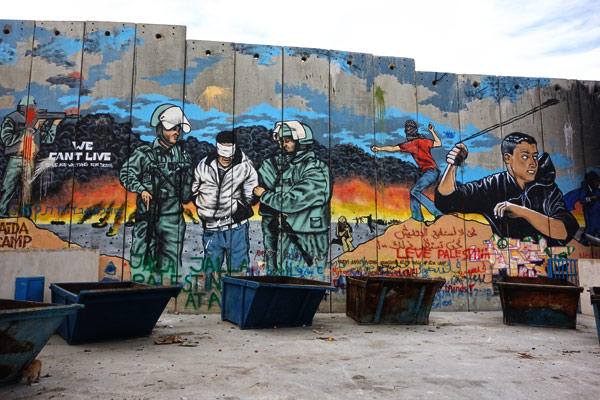
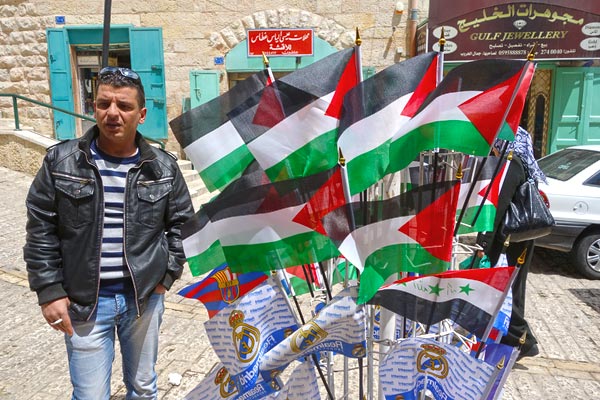
In the last decade Israel built a wall separating it from the Palestinian Territories in order to stop Palestinian terrorists from getting into Israel, and most people in Israel attribute the dramatic drop in violence since then to this barrier. Since the wall’s been erected, terrorism within Israel has gone down about 90 percent. While it has angered people around the world who care about the plight of the Palestinians, many Israelis would say, “Sorry about the inconvenience, but what’s a matter of convenience for Palestinians is a matter of survival for us.” While the wall is generally nicely finished on the Israeli side, on the Palestinian side it’s rough concrete punctuated by fortified towers. The concrete provides a big and inviting canvas for angry Arab artists and fascinating viewing for any visitor.
When Israel celebrates its Independence Day each spring, the same event is mourned as “The Day of Catastrophe” on the other side of this wall. While Israelis celebrate their independence by setting off fireworks and having big family BBQs, charred towers like this one are a reminder that, on the other side of the barrier, the anniversary is remembered differently — for example, it’s an excuse for angry Palestinian teenagers to stack tires against these symbols of occupation and set them on fire.Much of the art along the wall has a David and Goliath theme, with slingshot-wielding boys tormenting well-armed troops.There’s a big culture of hero- and martyr worship in Palestine. This woman, Leila Khaled, won notoriety by hijacking a TWA plane flying from Rome to Tel Aviv in 1969. Is she a terrorist or a freedom fighter? It really depends on who you ask.In this mural the imprisoned Fatah leader Marwan Barghouti is lionized. I was told that there’s a very good likelihood that the extreme Hamas party could beat the more moderate Fatah party in the next Palestinian election, which could in turn radicalize the West Bank as Hamas has radicalized Gaza. Moderates claim that if Israel would let Barghouti — the only Fatah leader with any charisma — free, Barghouti could help things stay on a moderate course. Many wonder why, if Barghouti could help moderation and Hamas would bring more extremism, Israel refuses to release Barghouti.
Israel has granted a certain amount of autonomy to the Palestinians, but with significant restrictions. The West Bank of the Jordan River, is divided into pockets of land classified into three zones: Areas A, B, and C. The land in Area A, while a relatively small percentage of the geographic area, contains most of the Palestinian cities and towns, and is free — it’s entirely controlled by the Palestinian Authority. The parts designated as Area B are mostly filled with infrastructure surrounding and connecting the islands of autonomy which combine to make Area A. Area B is under Palestine civil authority but is largely off-limits to Palestinian security forces. It’s mostly controlled by the Israeli military and seems to be designed so that if there’s trouble in any island of Area A — for example a terrorist attack emanating from that community — that community can be locked down and isolated in a snap by Israeli troops shutting down Area B. By shutting down Area B, the vast majority of the Palestinian population is bottled up in isolated urban islands throughout the West Bank. Area C, holding most of the West Bank’s uninhabited land, is under complete Israeli authority. While Area C is kind of a part of Palestine, there can be no Palestinian building in Area C without a permit from the Israeli Civil Administration — and that’s usually difficult to get. A problem with Area B is that, since Palestinian security forces can’t really work there and Israel doesn’t care to enforce Palestinian laws, it tends to be a more lawless place…and also serves as a convenient garbage dump.
Frustrating as the restrictions are, it is important to remember what an historic accomplishment it is that that the land in Area A is free and self-ruled, and has been since 1994.
I was told that the First Intifada led to the Oslo Accords, which established Areas A, B, and C as a transitional arrangement scheduled to be phased out in five years. When the deadlines were ignored, that lead to the Second Intifada (more violent than the first). And all that bloodshed meant the zone system became permanent, and the wall-and-settlement program was implemented.
Area C also includes Israeli infrastructure — like this fine highway — which cuts through the West Bank connecting Jewish settlements in Palestine with Israel proper. Palestinian license plates are green and Israeli plates are yellow. When times are good all cars are allowed. In troubled times, traffic is yellow plates only.
For Palestinians, living within the strict confines imposed by Israel after the Second Intifada can be frustrating. Both established and “flying” (temporary) checkpoints can make traveling from one Area A community to another very difficult. (Although during my visit, checkpoints seemed unmanned, and traffic was passing through without stopping.) For security reasons, Israel doesn’t allow Google to map the area. There is no reliable mail service between the West Bank and the rest of the world (many Palestinians keep an address with a friend in Jerusalem to work around this — but forget about getting any Amazon.com purchases delivered within Palestine).
Many hilltops in the West Bank are now covered with new, planned Israeli communities called “settlements.” They are connected to Israel by secure, well-built roads.
While most young people and professionals have smartphones here, there’s no 3G allowed in Palestine. As smartphones need an Internet connection to fully function, nearly every restaurant and café provides free Wi-Fi. Israeli settlements buried deep within the West Bank have 3G, so some Palestinians mooch off of this by getting an Israeli SIM card.
A big bold red sign marks the point where any road in Area B passes into Area A. It declares that passing this point is dangerous and that it is illegal for any Israeli citizen to do so. My hunch is that Israel’s concerned its citizens may be kidnapped by Palestinian extremists and then held for ransom in an attempt to negotiate the release of Palestinians detained in Israeli prisons. With this clear warning, Israel can, in good conscience, have a policy of not negotiating for hostages. Many believe a sad by-product of this policy is that it keeps people fearful and separated, and makes people-to-people connections more difficult between the two sides. I get the sense that the majority of people on both sides would like better relations. Walls and checkpoints are hurdles for this.
Here’s a spin tour of Bethlehem’s Manger Square, which fronts the Church of the Nativity. Sorry about the noisy wind buffeting. For my blog videos, I like to go with just one on-the-fly take.
If you can’t see the video below, watch it on YouTube.
Late on my first night in Palestine, after dinner with my guides, I came back to my hotel and met a dozen Lutheran pastors in the lobby. They were heading into a 2,000-year-old cave, upon which the hotel was built, for a devotion service and invited me along. I was really tired but followed my current travel ethic: If an opportunity presents itself, say “Yes.”
The pastors were just finishing a multi-year Pastoral Leadership Institute program. Their theme (as taught by English church leader Mike Breen): up, in, and out (“up” is relationship with God, “in” is relationship with community, “out” is outreach beyond their immediate community). I climbed down into the cave with them and enjoyed a wonderful hour of singing, reading, and sharing.
While our image of “no room at the inn” is brick and wood, the “inn” of Bible fame was very likely a series of caves. And “no room” meant a woman about to give birth would not be welcome in the main quarters, as it was an unclean thing. Mary was sent to the manger cave where the animals hung out to give birth to Jesus.
The next day I told my guide about the wonderful evening. He said, “Yes, but if you hear it as much as me, it is annoying.” Nearly all the tourism in Palestine is religious tourism.
If you can’t see the video below, watch it on YouTube.
If there was no border or traffic to deal with, you could bicycle from the Dome of the Rock in Jerusalem to the Church of the Nativity in Bethlehem in 15 minutes. Bethlehem is not a pretty town but it has a special energy. Most homes and businesses stand behind security walls and fences. The Arab market is colorful. And the skyline is a commotion of satellite dishes, minarets, and church spires.
Bethlehem is a ramshackle Arab city — sacred to both Christians and Muslims. At the main intersection, cars circle a memorial to locals (terrorists or freedom fighters, depending on your perspective) who are locked up in Israel doing life in prison.
Of course, Bethlehem is important to Christians because it is the birthplace of Jesus. Half of the Christians in the West Bank live in Bethlehem. In Palestine a century ago, about 20 percent of the people were Christian — now it’s not quite 2 percent of the population. There’s a Palestinian Christian diaspora, and hundreds of thousands now live in South America. Palestine was part of the Ottoman Empire until the end of WWI in 1918. During that war, most Palestinian Christians fled the draft — since the Ottomans were neither Arab nor Christian, these Arab Christians saw no reason to fight in their army.
Bethlehem’s skyline is decorated by steeples and minarets.
Because Palestinian Christians have been leaving in large numbers for years, the prospect of holy sites like Jerusalem and Bethlehem being without local Christians is looming as a real possibility. The Christians who remain in Palestine are mostly Greek Orthodox. Ecumenism is now necessary and embraced within the shrinking Christian community. With the rise of Islamists across the region making parishioners nervous, the church needs people to stay. Christian leaders meet monthly with Muslim imams to discuss growing extremism in the Muslim community.
Pilgrims wait to touch, kiss, and pray upon the spot where Jesus is believed to have been born. In the year 326, Roman Emperor Constantine sent his mother, St. Helena, to establish three churches in the Holy Land: Church of the Nativity, Holy Sepulcher, and one on the Mount of Olives. Today, Bethlehem’s Church of the Nativity is oldest because the others were destroyed, then rebuilt.
Not all Arabs are Muslims, a fact that surprises some. When meeting an Arab Christian, many tourists ask when their family was converted. The answer is usually, “About 2,000 years ago, back when Jesus’ disciples were doing missionary work around here.”
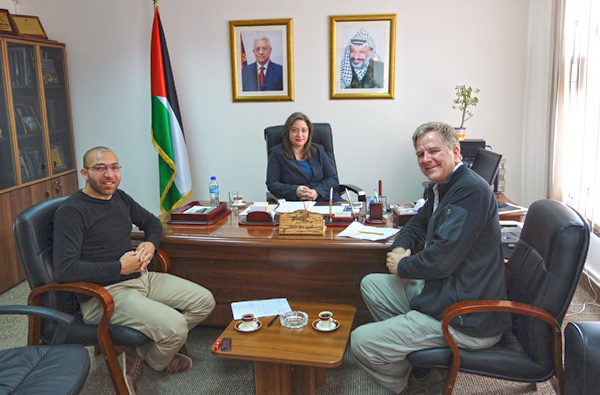
In Palestine, attempts are made to keep minorities (meaning non-males and non-Muslims) in places of importance. The Minister of Tourism — both a Christian and a woman — is a two-fer. (Composing only about 2 percent of the population, Christians actually contribute substantially to Palestinian society.) Both the Israeli and Palestinian ministries of tourism are supportive of my work (producing a TV show about the West Bank), because tourism is potentially a big economic boost on both sides of the border.
Bethlehem could be considered the fourth most holy site in Islam, as Muslims consider Jesus a major prophet and have a special reverence for Mary, who has a big role in the Koran. Because of the tension between Israel and Palestine, most Arab Muslims are not allowed to visit Bethlehem. But when things settle down, it’ll become a big pilgrimage destination for Muslims, and that will be helpful for the struggling economy.
This is the barrier, from the Israel side, that divides Jerusalem and Bethlehem. Every day, Arabs with special clearance pass through here for better-paying jobs in Israel.