Nablus is the second city of the West Bank in population and, like so many cities in the Middle East, it goes way back. The name is an Arabic version of its original name, Neapolis (New City) — it was founded by Roman Emperor Vespasian in A.D. 72. It’s a socially conservative city and feels that way. They say if you go to Egypt you must see the pyramids, and if you go to Nablus you must eat kunafeh — a shredded wheat, cheese, and syrup-soaked delight. I’m not one to put desserts in the category of ancient wonders, but kunafeh was the tastiest treat I’ve encountered so far in the Middle East. I made a point to eat it everywhere I could.
My guide, Husam, took me to Tanoreen, which must be the best restaurant in Nablus, where we enjoyed a fine city view and a local feast — chicken and vegetables cooked in a fire pit…and sweet kunafeh.Like any Palestinian city, the skyline of Nablus is dotted with black water towers. Palestinian buildings can be identified by the gear on their roofs. While Israeli settlers have running water whenever they like, Israel controls and limits water service in the Palestinian Territories. Consequently Palestinians have black water tanks on their roofs and top them off whenever the water is running. Each community has its concerns: They say the first thing an Israeli considers when building a house is a bomb-hardened safe room, and the first thing a Palestinian considers is building a cistern. Along with solar panels, Palestinian rooftops also sport satellite disks to connect to Arab and international satellites, which serve as their window on the world.
Nablus was considered a capital of terrorism during the Second Intifada. Its residents hit Israel hard, and Israel hit back hard. Its old town streets still show bomb damage. Today, Nablus feels unrepentant, and the town center is decorated with posters of what locals call martyrs. Looking into the eyes of these young men (many of them just teenagers) and seeing how they are portrayed heroically in such posters — and then imagining the anger and hopelessness of the poor street kids today — made me feel sad…and not very optimistic. But there’s always ice cream.
Visitors are welcome to tour both the mosque and the synagogue at the Tomb of the Patriarchs. Here is a quick walk through the synagogue and a peek at the tomb of Abraham. Look for the bulletproof glass that separates the Muslim and Jewish sides of the much-venerated tomb.
If you can’t see the video below, watch it on YouTube.
Hebron is a fascinating place. With about 250,000 people, it’s the largest Palestinian city and the commercial capital of the West Bank. Its people, while very conservative, seem to have some Crusader blood — you’ll see some blond hair and blue eyes. While the old town thrives with commerce, there is a palpable unease that makes just being here stressful. That’s because it has the Tomb of the Patriarchs — where Abraham, Isaac, and Jacob are all buried — which makes it holy for Jews, Muslims, and Christians…and sharing this peaceably is tricky.
The people of Hebron are seen as a bit different. They speak more slowly. Perhaps because of their Bedouin heritage, they have a tighter tribal community, and, I’m told, this is the only place you’ll find fresh camel meat at the butcher’s.
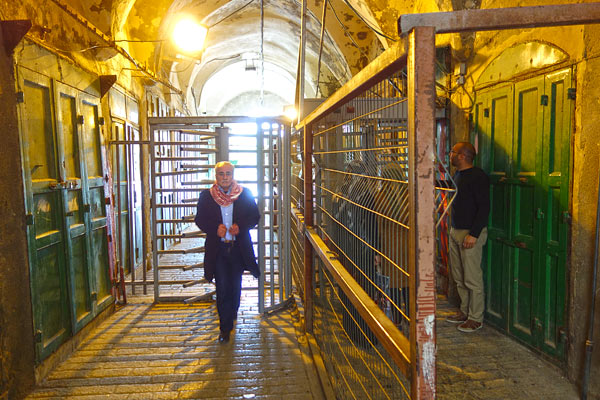
You see and feel the tension in Hebron. The center of the city is literally Jews atop Muslims — as both communities are committed to staying close to the patriarch Abraham whose tomb lies in the center. While Arabs take the ground floor, a group of about 400 Jewish settlers (many of whom are American) live above them. Because of the violent history of this town, there is a large contingent of Israeli security forces to protect the Jewish settlers. Going through security turnstiles and walking down the boarded-up “ghost street” was not enjoyable. While people choose to live here to be close to their patriarch, I wondered what Abraham would think about the inability of his feuding descendants to live together better.
A daily part of life in strife-torn Hebron is for residents to go through security turnstiles like this.
While this is a tough place for a Jew to live, those who do are driven by their faith, believing it’s important not to abandon the burial site of their patriarchs, the second most holy site for them after Jerusalem. The Tomb of the Patriarchs marks the first Jewish possession in the land of Israel. Abraham purchased the burial plot almost 4,000 years ago as explained in Genesis 23. Many times the temple here has been “repurposed” as a church or a mosque. Jews could not go beyond the seventh step on a staircase outside the building from 1267 to 1967. Since 1967, Jewish worshippers have had full access to the holy site. In 1994, during the Muslim holy month of Ramadan, a Jewish settler gunned down 29 Muslim worshippers here. Since then, the holy spot has been divided — half mosque and half synagogue — with each community getting a chance to pray at the tomb of Abraham separated by bulletproof glass.
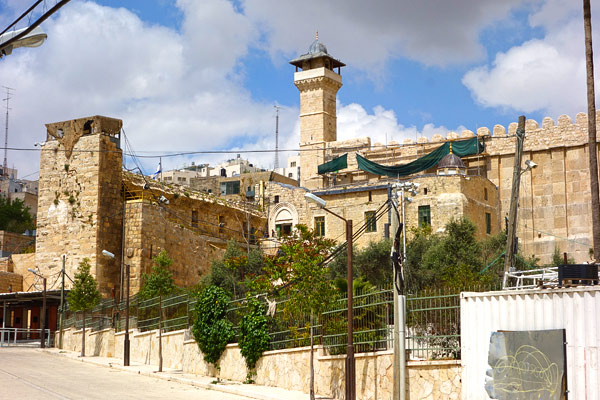
The Tomb of the Patriarchs is holy for both Jews and Muslims. It holds the much-venerated tombs of Abraham, Isaac, Jacob, and Sarah. Much of the building is an old Crusader church built on top of an enclosure from the time of King Herod. It is split to function as both a mosque and a synagogue.Like they pray at the Western Wall of their destroyed temple in Jerusalem, Orthodox Jews pray at the foundation wall of their temple in Hebron. As at the Western Wall, the stones here are “Herod Stones,” quarried and cut during the reign of King Herod and each with a distinctive carved border.In the Sanctuary of Abraham or Ibrahimi Mosque you can see a minbar. It’s a staircase representing how teachers spread the word of the Prophet Muhammad — a standard feature in mosques. This one is a rare original from the 11th century made of inlaid wood and no nails.The memorial tomb of Abraham comes with bulletproof glass and barred windows so that his two sons’ feuding descendants — Jews and Muslims — can respect his grave.
Hebron, while not very important politically and very conservative, is the biggest city and has the largest economic impact in Palestine. Its population generates about 30 percent of the West Bank’s economy. Because it has the tomb of Abraham, it is holy to both Jews and Muslims…and there lies the problem.
If you can’t see the video below, watch it on YouTube.
Frankly, Palestine is not a very pretty place. In hopes of scouting somewhere that looks good for our TV camera, I searched for natural zones. One place stole my heart — a natural preserve for hiking near the village of Battir west of Bethlehem. A fine trail snaked along terraces that defined this terrain in the time of Jesus. These 3000-year-old “Biblical Terraces” were lined with stately and graceful olive trees.
I also looked for beauty elsewhere. Like many Westerners, I’m fascinated and perplexed by the tradition of women needing to be covered in public for modesty. While it’s certainly not unique to Islam, you notice it a lot while traveling here. For Muslim men, it’s a sin to look lustfully at a woman who’s not your wife. Around here, hair is sexy, and in the strictest of Muslim societies, women carefully cover up every strand in public. (Of course, in the privacy of their own domestic world, they are welcome to be as sexy as they like for their husbands.)
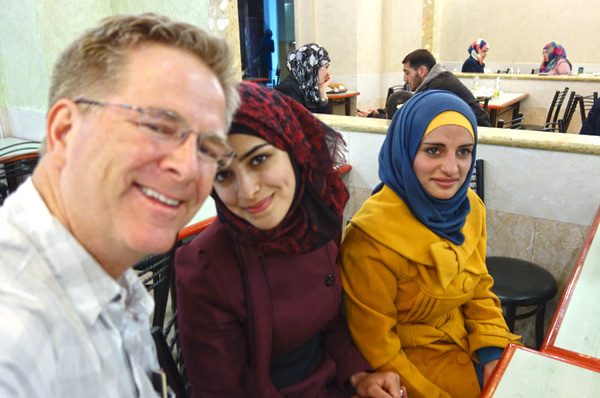
Three-thousand-year-old terraces and olive groves provide a peaceful pathway near Bethlehem. The olive tree, a symbol of steadfastness and faith in the future, has great significance in Palestinian society. The tree of poor people, it gives without taking. You plant it for your children, knowing that they will plant it for their children, too.Happily for many men, the scarf — while meant to downplay a woman’s beauty — has morphed into something stylish and sexy in itself. Women can be technically proper with their faith while still looking good. These days, scarves are worn like peacock tails. For many women, much care is put into coordinating their scarves, nail polish, hand bags, and lipstick.Modesty requirements are not unique to Muslims. Some conservative Christian women are expected to cover their heads in church. Some ultra-Orthodox Jewish women are expected to shave their heads and to wear a wig in public. And many Muslim women cover their heads. This woman, while technically covered, is dressed to kill.Many restaurants have a main room for men and a family room for women and children. My guide talked this place into letting us eat in the family section. I was surrounded by shy and demure young women wearing gorgeous scarves. My guide — a good-looking, young, and single guy — would never dare connect with a strange women in this environment. He wouldn’t even try. And if he did, he’d be shunned. But I amazed him by getting eye contact with Jasmine, joining her for a few flirtatious minutes and taking a photograph.In Palestinian society — like all around the Mediterranean in both Christian and Muslim lands — women stick together in public and so do the guys. These women in the conservative city of Hebron are sporting peacock scarves yet sticking together. Far more women wear scarves in Hebron and Nablus than in the more cosmopolitan Palestinian cities of Bethlehem and Ramallah.Young Palestinian men live with strict codes of conduct. In traditional families they’re expected to marry into their religion (Christian or Muslim), many marriages are arranged, and any physical romance comes very late in the game. In a few communities, mothers-in-law even expect to see a bloody sheet after the wedding night. I saw a couple walking down the street holding hands, so I asked my guide about it. He said, “They’re engaged. I saw the ring.”