It’s Like Holy Land Monopoly

From my experience traveling here, I’ve learned that it’s all about control of land. That’s the crux of the problem between Israelis and Palestinians, and symbols of that ongoing struggle are everywhere. Israelis are developing settlements — secure and fortified communities on the tops of hills — and, in doing so, are reaching far into internationally recognized Palestinian territory.

Supporters of these settlements make the case that developing this land is justified because the land was unused, and because the language of the treaty designating it Palestinian was open-ended (“until a final status agreement is reached”). And many Jews (and Evangelical Christians who are inclined to support them) believe it is God’s will that they occupy Biblical “Judea and Samaria,” which is what they call the West Bank. I chatted with several settlers to get their perspectives.

Terminology is a delicate dance in the Holy Land, and settlers (who don’t refer to themselves as that) have their own strict vocabulary. In the ongoing debate, many in Israel make the case that “Palestinians” are actually Jordanians, and that the word “Palestine” comes from the ancient Philistines — a completely different race from the Mediterranean. (It occurred to me that you could attempt to discredit plight of our “Indians” in a similar way.)

Across the West Bank, hilltops have sprouted tidy Lego-like communities...little boxes on a hillside. From a distance, you can easily distinguish Israeli developments (cookie-cutter, with uniform red-tile roofs, like these) from higgledy-piggledy Palestinian ones.
Across the West Bank, hilltops have sprouted tidy Lego-like communities…little boxes on a hillside. From a distance, you can easily distinguish Israeli developments (cookie-cutter, with uniform red-tile roofs, like these) from higgledy-piggledy Palestinian ones.
Settlements are planned communities — beautifully landscaped and designed, offering the same modern conveniences and efficiency you'd expect in an American gated community.
Settlements are planned communities — beautifully landscaped and designed, offering the same modern conveniences and efficiency you’d expect in an American gated community.
Over half a million Israeli Jews now live in settlements in the West Bank. These planned and secure communities come with all the comforts. And, with Israeli government subsidies for housing and transportation, young Jewish families can afford to live here and commute back to Israel proper. For many, it’s a deal too good to refuse.
I enjoyed meeting and interviewing this smart couple who are raising 10 children in one of Israel’s biggest and most modern settlements. Chatting in a café at their mall, they explained how the settlements make perfect sense to them. They acknowledged that the rest of the world may not like it (referring to the “rest of the world” as just another opinion). Describing their community as a "city" rather than a "settlement," they were clearly thankful to have a place to raise their children according to their values in a secure and affordable environment.
I enjoyed meeting and interviewing this smart couple who are raising 10 children in one of Israel’s biggest and most modern settlements. Chatting in a café at their mall, they explained how the settlements make perfect sense to them. They acknowledged that the rest of the world may not like it (referring to the “rest of the world” as just another opinion). Describing their community as a “city” rather than a “settlement,” they were clearly thankful to have a place to raise their children according to their values in a secure and affordable environment.
I enjoyed a beer and a chat with this resident of a simple and rustic settlement in the Jordan River Valley. He said he was here not as a Zionist staking Jewish claim to a land the Bible promised them, and not because attractive government subsidies made it economical, but because it was quiet and offered his young family a back-to-nature home with wonderful neighbors. “You never see the stars in Tel Aviv like we do here,” he told me.
In another settlement, I met a 24-year-old man who just bought his house and was thrilled to invite us in. He and his buddy gave us an interview on their balcony with a vast and unpopulated view. They made the same claim I'd heard from other residents of these settlements: The land was going unused anyway, so why shouldn’t industrious Israeli Jews develop it? They can pump in water from desalination plants and build a slick freeway infrastructure to provide a fine place for people to live. When I asked these young men if there’s a good and peaceful future in this region, I was struck by how matter-of-factly they said, “Only if the Palestinians move east across the Jordan River and into the country of Jordan.”
In another settlement, I met a 24-year-old man who just bought his house and was thrilled to invite us in. He and his buddy gave us an interview on their balcony with a vast and unpopulated view. They made the same claim I’d heard from other residents of these settlements: The land was going unused anyway, so why shouldn’t industrious Israeli Jews develop it? They can pump in water from desalination plants and build a slick freeway infrastructure to provide a fine place for people to live. When I asked these young men if there’s a good and peaceful future in this region, I was struck by how matter-of-factly they said, “Only if the Palestinians move east across the Jordan River and into the country of Jordan.”
Spending time in Israeli settlements built in the last decade or so in the West Bank, on Leave It To Beaver streets under the red-tile roofs of cookie-cutter homes, I felt as if I were in California. Gangs of happy-go-lucky children on their bikes were eager to befriend me, and there was a relaxed vibe.
With a Palestinian car, we couldn’t drive into this community. Walking to the gate of the settlement with our crew and a big camera, I asked, “Can we enter?” The guard said, “Why not? It’s a free country.” The guard next to him added, “God bless the American dollar.” As we were leaving, he said, “Enjoy your economy.” For some reason, I found myself pondering that odd farewell for the rest of the day.
Just like Palestinians have their political art, Israelis do, too. But it’s a little prettier. Decorating the parking lot of a settlement shopping mall, this mural shows the father of Zionism, Theodor Herzl (who, in the 19th century, was instrumental in establishing the notion that the Diaspora Jews scattered around the world since A.D. 70 are destined to have a Jewish homeland in the Holy Land with Jerusalem as its capital). The Hebrew here says, essentially, “Let the dream come true.”

Exploring Israel and Palestine — In Search of Understanding (and Some Great TV)

Earlier this month, my crew and I flew to Tel Aviv to film three new public television shows on the Holy Land: individual half-hour episodes on Israel and Palestine (part of our new eighth season of Rick Steves’ Europe, premiering in October of 2014); and an hour-long special on the Holy Land as a whole, designed to give context to the challenges of that region, and to help viewers better understand and empathize with the people sharing it (scheduled to air in mid-2014).  Over the next month or so, I’ll be posting every day right here about my experiences filming these new shows.

Hearing about my travel plans, several people have asked me whether I really want to wade into the quagmire of Israel and Palestine, where it seems like anyone who probes for the truth will anger people on one side or the other. Believing that the vast majority of Americans are not partisan on the issues here — and emboldened by the burgeoning movement among Palestinians and Israelis to find an enduring solution that gives dignity and security to people on both sides of the divide — I think this is an exciting and timely project. And, frankly, I’m tired of extremists exploiting social media to exaggerate their numbers, creating the illusion that a vocal fringe of our society is more legitimate than it actually is. With these new shows, my only agenda is to appeal to open-minded people who simply want to do some armchair travel, hear a variety of perspectives, and be given the opportunity to form their own opinions.

I was in the Holy Land this spring scouting for these new shows. Now I’m excited to head back and start shooting with our crew: my producer, Simon Griffith; two cameramen, Karel Bauer and Dean Cannon; and a cadre of both Israeli and Palestinian local guides, drivers, and helpers. We’ll be working in Jerusalem (bursting with history and culture); Tel Aviv and Haifa (so joyful and full of modern life); and Masada and Yad Vashem (which give poignancy to the Jewish struggle, from Roman times to the Diaspora to our own generation). Then, heading into the West Bank, we’ll be curious sightseers in Bethlehem, Hebron, Jericho, Nablus, and Ramallah — experiencing “reality travel” in places almost completely unknown to most Americans. We’ll walk in the sandal-steps of Jesus with Christian pilgrims at the Sea of Galilee, taking Bible stories to a new level. And we’ll learn about the Separation Wall and the settlements that vex the desire for peace.

With the help of local Israeli and Palestinian guides, we’ll make a point to listen to local voices on both sides of the issues. In Israel, I’ll be wearing my yarmulke and eager to learn. And in Palestine, I won’t be wearing my keffiyeh — but I’ll be equally ready to learn.

After several weeks of traveling throughout the Holy Land this year, it’s my hunch that the majority of both Israelis and Palestinians have come to the conclusion that violence is not the answer. And I believe that, while any sane person wants peace, a wise person understands there can be no real peace without justice. Like the destinations themselves, these themes will prove to be a fascinating area to delve into.

The Holy Land — which is “holy” to about a third of humanity — is a richly rewarding place to travel. Join me right here over the next month, as I’ll be posting every day about my explorations of this fascinating land. And share a link with your friends who might be interested in traveling along. Together, we’ll strive to overcome fear with understanding.

Happy travels!

DSC01693

Final Thoughts on My Week in Palestine

During my week in Palestine, I was in the care of three great guides: Husam Jubran (hjubranus@yahoo.com), Kamal Mukarker (kamal_mukarker@hotmail.com), and Iyad Shrydeh (iyadsh_2004@yahoo.com). Each is a proud Palestinian who works routinely with American tourists. They are all licensed guides (charging $300 a day, possibly with a car) who work like any guide in Europe. The big difference is that most of their clients are religious or political tourists. Frankly, I can’t imagine enjoying a trip here without the help of professional guides like these. With Kamal, Iyad, and Husam, I felt safe and got the absolute most learning out of each day.

With a guide in Palestine, you’re likely to find yourself invited into a family’s home for dinner. I had a great evening with Kamal (seated next to his mother). His mother is also a guide.

Traveling through the Holy Land, my heart is a shuttlecock, swinging from sympathy with Israel to solidarity with Palestine. I’m saddened by the people — like some who post on this blog and on Facebook — who are so hardened on one side or the other that they cannot allow themselves to find empathy with the society they consider the enemy. Even if one side is the enemy, it’s not the entire society but just its powerful or just its extremists. And the young generation on each side is simply living with the history it inherited. As is so often the case in tough situations like this, most people would be willing to find a way to coexist peacefully but extremists can only get traction by blasting out the middle and making things more radical.

Travelers entering Israel get a visa  — but it’s a separate sheet of paper clipped into your passport so that after your trip there’s no evidence that you’ve been in Israel (which is nice if you’re visiting some extreme Islamic countries). Palestine uses the same coins and currency as Israel and, strictly from a passport point of view, is like being in the same country. While crossing the border is complicated for Palestinians, for a Western tourist it's easy. Phones and ATMs work in Palestine as if you’re in Israel. There is plenty of good guidebook information for independent travelers in Palestine — either as part of Israel guidebooks or as books solely on Palestine. (Please note that I did not go to Gaza which is a much less tourist-friendly situation.)
Travelers entering Israel get a visa — but it’s a separate sheet of paper clipped into your passport so that after your trip there’s no evidence that you’ve been in Israel (which is nice if you’re visiting some extreme Islamic countries). Palestine uses the same coins and currency as Israel and, strictly from a passport point of view, is like being in the same country. While crossing the border is complicated for Palestinians, for a Western tourist it’s easy. Phones and ATMs work in Palestine as if you’re in Israel. There is plenty of good guidebook information for independent travelers in Palestine — either as part of Israel guidebooks or as books solely on Palestine. (Please note that I did not go to Gaza which is a much less tourist-friendly situation.)

When I consider the challenges facing the Holy Land, I think of the importance of Israelis and Palestinians having ways to connect. I’m haunted by the devastation the people of France and Germany suffered in World War I, and I’m equally haunted by the fact that few Germans and French on the front lines had ever met someone from the other country in 1914. I believe if they had met, studied, drank, and danced together, they would have found a way to avoid the slaughter.

Whichever side of the separation wall your heart resides on, you should be concerned that — as a result of the wall — people on both sides will not get to know each other. They will not understand that they all root for the same soccer teams. Israelis and Palestinians who are soccer fans, curiously, root for the Madrid and Barcelona teams — but they don’t even know the other side does the same thing. There’s no way mutual fans of Real Madrid could be mutual enemies.

In addition to Palestinian flags, this vendor is selling flags for FC Barcelona and Real Madrid — soccer teams that are extremely popular in Israel. I've also heard Muslim Palestinians and Israeli Jews refer to each other as cousins. While these days that might be a bit optimistic, both clans have the great patriarch Abraham in common.
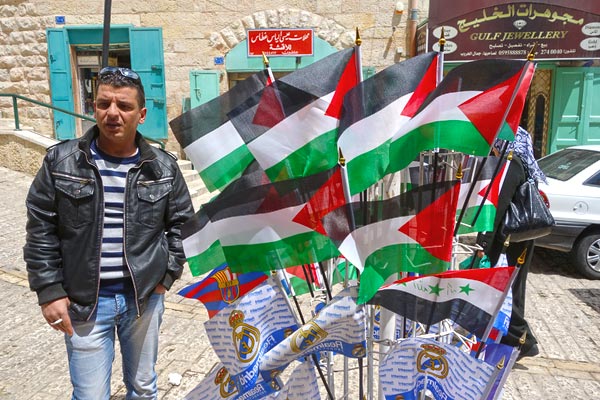
In addition to Palestinian flags, this vendor is selling flags for FC Barcelona and Real Madrid — soccer teams that are extremely popular in Israel. I’ve also heard Muslim Palestinians and Israeli Jews refer to each other as cousins. While these days that might be a bit optimistic, both clans have the great patriarch Abraham in common.

There’s a place on the Palestine side of the wall where passengers can conveniently change from a Palestinian car to an Israeli one. When I left Palestine, my Israeli driver waited there for my Palestinian driver to drop me off. I’ll never forget their handshake — in the shadow of an ominous Israeli watchtower painted black by the flames of burning tires and with angry Palestinian art on the wall. These men were each beautiful, caring people, caught in a problem much bigger than either of them. The exchange was little more than a suitcase shuttling from one back seat to the other. I watched as they quietly shook hands, looked into each other’s eyes, and said a solemn and heartfelt “Shalom.” After my week in Palestine, driving 300 yards through that security gate into Israel was like driving from Guatemala to San Diego. And I thought, “With all these good people, on both sides, there has got to be a solution — and a big part of it will be grassroots, people-to-people connections.”

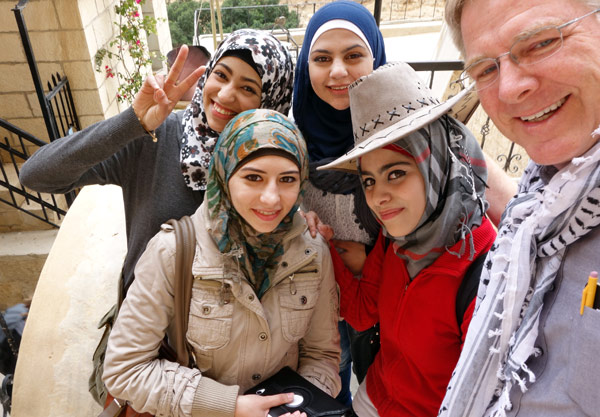
As always, by traveling to a country that seems hard to get your brain around, you realize it’s filled with people just like you and me (but who really know how to wear a scarf). Consider a trip to the Holy Land. And when you do, visit both Israel and Palestine. Do it for peace.

Old Germans, a New Wall, and Tears

I was having dinner in Bethlehem with a Greek Orthodox Palestinian family and two older German women who were retired Lutheran pastors. The Muslim call to prayer interrupted our conversation. We went out on the third-floor balcony to hear the confused cacophony of sounds coming from minarets on all sides.

Bethlehem’s skyline is decorated by silent steeples and singing minarets. The minarets crank up the volume and play five times a day.

My Greek Orthodox friends said the volume for the call to prayer in Bethlehem is particularly loud — it’s a kind of resistance to annoy the Israelis. They said about the man who sings the call to prayer: “It feels like this man lives with us. Five times a day he wails. Even God wants to sleep, but there’s nowhere to hide. In the summer, we must keep the door open, and it’s like he’s right here in our house. Early in the morning, the man who sings the call to prayer changes the words and adds, ‘It’s better to pray than to sleep.’ But we think God can wait for us. We Christians wake God only on Sunday.”

When the call to prayer finished, we continued our conversation about living on the wrong side of a “separation wall.” The German women reminisced about 1989 and the fall of “their” wall. One pastor recalled watching West German Chancellor Helmut Kohl cry for joy and thought, “Oh, how silly.” Then, when what had just happened sank in, she found herself crying too…she said that she fell to the carpet and cried all night for joy. These women come to Palestine every year and — 24 years later — the “wall tears” they now shed are of sadness.

Life in the Desert, Life in the Dead Sea

A big part of Palestine is desert, and much of it is below sea level. Nearly any tourist here will stop at the Wadi Qilt viewpoint for a look at the vast and awe-inspiring Judean Desert. Nomad communities fill dusty gullies with their ramshackle huts and tents. Children and sheep dogs follow their flocks of goats and sheep as the herds search for something to munch on. Modern water pumps are caged in and surrounded by barbed wire—a reminder of what is the most important natural resource around here. And desolate monasteries cling to remote cliffs as they have for 1,500 years. From this viewpoint, you drive down to the ancient city of Jericho and, continuing on as your ears pop, you come to the bottom of it all: the Dead Sea.

The Monastery of St. George, built on cliffs above a natural spring, dates to the 6th century. For 1,500 years, its monks have lived lives of isolation and meditation inspired by Jesus.
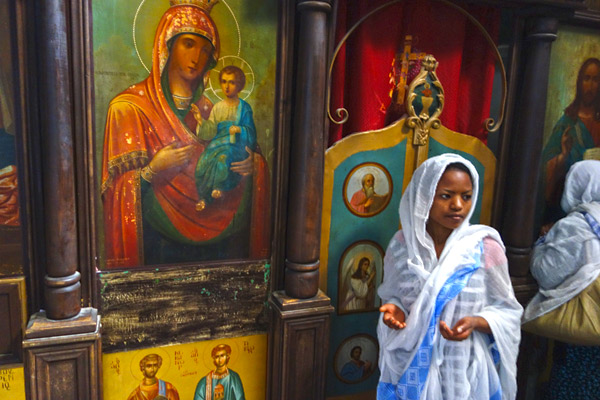
The Monastery of St. George is Greek Orthodox. Lots of pilgrims, especially from Ethiopia and Greece, hike here, light candles, and gaze at its icons for inspiration.
Palestinian Christians come to the Monastery of St. George too. While less than 2 percent of Palestine is now Christian, those who are come from families that have lived here as Christians since the 1st century.
The Dead Sea is the lowest place on earth — about 1,400 feet below sea level.  There is no ocean beach, lake, or riverbank in the West Bank where a Palestinian family can easily take their children. While Palestinians like to think part of the Dead Sea is in their territory, in reality, Israel (along with Jordan) controls its entire shoreline. When times are relaxed, Israeli guards give Palestinians access. Packed with bromine, magnesium, and iodine, it's one of the saltiest bodies of water in the world (about 33 percent). Tourists are more than welcome here, and they enjoy bobbing like corks in the super-salty water.  They also like rubbing its magically curative, black mud on their bodies. My guide took home a bag for his fiancé, as women believe the mud's minerals make their skin younger and more beautiful.
The Dead Sea is the lowest place on earth — about 1,400 feet below sea level. There is no ocean beach, lake, or riverbank in the West Bank where a Palestinian family can easily take their children. While Palestinians like to think part of the Dead Sea is in their territory, in reality, Israel (along with Jordan) controls its entire shoreline. When times are relaxed, Israeli guards give Palestinians access. Packed with bromine, magnesium, and iodine, it’s one of the saltiest bodies of water in the world (about 33 percent). Tourists are more than welcome here, and they enjoy bobbing like corks in the super-salty water. They also like rubbing its magically curative, black mud on their bodies. My guide took home a bag for his fiancé, as women believe the mud’s minerals make their skin younger and more beautiful.