A Revealing Peek at a Skinny-Man Shower in Venice

Forgive me for not dressing up for this, but while showering early one morning, the spirit moved me to share a peek at life as a tourist in Venice — and to show how the demand for private bathrooms in once-spacious elegant rooms has resulted in rooms that are less spacious and elegant, but more convenient.

If you can’t see the video below, watch it on YouTube.

Casinos and Small Change in Venice


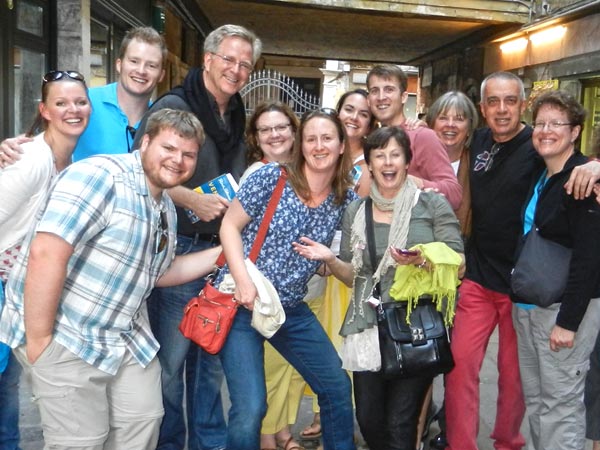
Checking in on local guides recommended in my Venice guidebook, I meet my friend Alessandro and his tour. Nearly every night, he meets a gang of my readers at the top of the Rialto Bridge for a pub-crawl dinner. Eating ugly things on toothpicks in a series of characteristic bars, all seemed to be having a blast.

I’m in Venice doing a few days of research for my guidebook and preparing for our TV shoot. I’ll be meeting my crew soon to make two new shows on Venice. I shaved the beard and got a haircut, and am excited to switch from guidebook-research mode into TV-production mode.

Venice feels wonderful. The city’s packed, there’s very little scaffolding to frustrate our filming, and I’m learning lots from great local guides.

Enjoying a walk, I decided that when you pass over a bridge, you should look both ways — as you may be hit with a lovely view. At a restaurant, I was offered wine sparkling or flat and water with or without bubbles. I like my water with bubbles and my wine without. It’s fun watching people in a restaurant carefully look like they are not enjoying the music when a wandering accordionist plays for tips.

Things are changing in Venice. I passed a characteristic old man with a cane…whistling “Yellow Submarine.”There were once four McDonald’s in town, but now there’s only one. Most of the glass trinkets that are sold are Chinese, and it’s undercutting the economy of the local glassmakers to the degree that there’s a strong push to encourage people to buy genuine Venetian glass with the Murano seal. The population continues to drop. An electric readerboard in a pharmacy window ticks down with each person who moves out or dies. Today’s population: 58,756. Yesterday, it was 58,759. Immigrants are taking the places of those moving out. Sometimes it seems that restaurants and market stalls are run by as many Sri Lankans and Chinese as Italians. There’s a huge increase in Russian tourists, and when a menu appears in several languages, one of them is often Russian. If you see a wedding party posing in front of a famous sight, it’s most likely a big shot from Eastern Europe or China, not a Venetian.

Enjoying a six-hour tour with Michael Broderick (Venicescapes) on Venice’s Age of Decadence, I learned that the notion of “Exceptionalism” is not unique to Tea Party Americans. Venetians believed that God led their forefathers across the lagoon to found a “New Jerusalem”. Unlike any other great Italian city, Venice was Christian from the start. When the Enlightenment challenged the whole notion of Christianity, it undermined the Venetians’ self-image, and the ever-conservative government wanted nothing to do with it. With the establishment of trade routes outside the Mediterranean and the ideas and spirit of the Enlightenment bringing on the modern world, Venice chose denial, and — like the string quartet on the Titanic (or climate change deniers today) — they just kept playing.
I also learned that every big shot with a palace needed a den of iniquity in the town center — a “little house,” literally a casino. That term originated here, although gambling was among the tamest of the activities that took place in many of those original casinos. Husbands and wives generally each had their own. Men did the business-networking thing. Women hosted entertainers, writers, and artists. While there were about a hundred casinos in Venice in the 18th century, almost none survive.

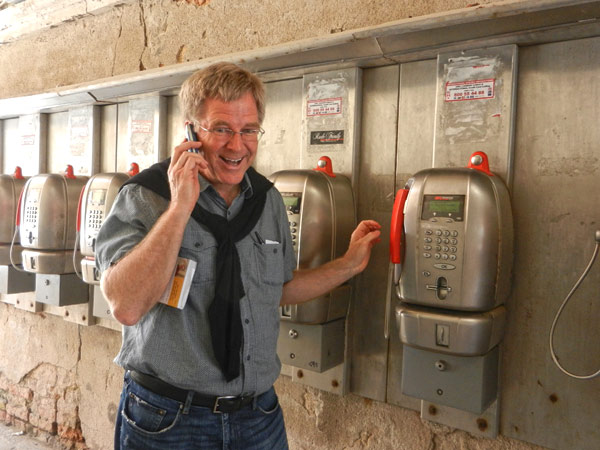
As nearly everyone (tourists and locals alike) has a cell phone these days, public phone booths — which used to be a much-appreciated blessing — are now a worthless eyesore.

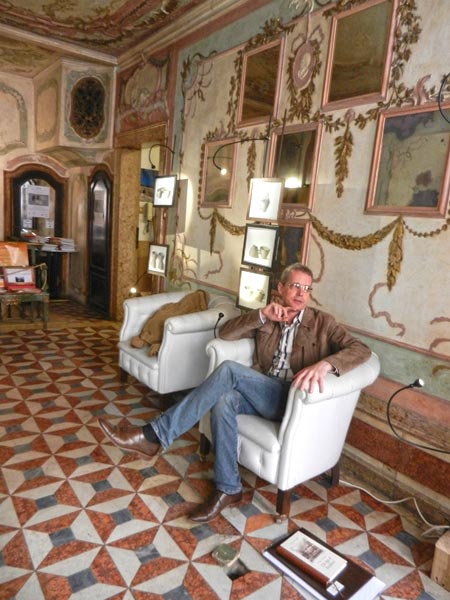
Tour guide Michael Broderick took me to the best-preserved casino in Venice...but there was nothing going on.

Mama’s Boys in Venice

Enlarge photo

To commemorate the Smithsonian Presents Travels with Rick Steves magazine — now on sale online, and at newsstands nationwide — Rick is blogging about the 20 top destinations featured in that issue. One of those destinations is Venice.

The challenge when visiting Venice is to see a community beyond the “adult Disneyland” quality of the experience for most tourists. If you know where to look, it’s not hard. Whether in the practical issues of actually living here, or in the unique characteristics of the people who make up the Venetian community, the city is more than postcard views and old buildings.

The cheapest place to moor your boat in Venice is a place without easy access. Boat owners climb along walls above canals like Italian cat-men to get to their private boats — the vessels that give them a parallel world apart from the tourist bustle.

If you’re excited about witnessing a high tide in Venice, be warned — the high waters bring out the elevated walkways and some fun memories…but they also force the city’s huge rats out of their secluded dens and into the open.

Handy signs on building corners let anyone who simply looks up know where they’re going, anywhere in town. But keep in mind that locals aren’t above using these signs to direct traffic to the seemingly logical route, while those in the know can get around quicker by unsigned, less congested alternate routes.

While Italian men in general can be mammoni (mamma’s boys), reluctant to leave the nest — to cut the cordone ombelicale (umbilical cord of a mama to cook and wash for them) — Venetians take this trait to unrivaled heights. Many men stay at home until their thirties. They leave only when they marry and are able to have another woman steer them through life.

I was talking with my Venetian friends, Antonella and Piero, over a glass of wine. The topic of conversation: macho and mammoni in Venice. I was impressed by the strong feelings Antonella had about the matter.

“What is macho?” she says. “There are no macho men in Venice. They are mama’s boys. We call this mammoni.”

Piero, as if he’s heard the complaint a thousand times, cries, “Ahhh, mammoni.” Pulling an imaginary cord from his belly and petting it rather than cutting it, he says, “It is true. I cannot cut the cordone ombelicale. I love my mama. And she loves me even more.”

Antonella says, “The Italian boys, 95 percent stay at home until they find a wife to be their new mother. Thirty, thirty-five years old, they are still with their mothers. Even if they move out, they come home for the cooking and laundry. This is not macho…this is ridiculous. ”

“Aaan-duh,” she continues, lighting a cigarette, “they want a wife exactly like their mother. If they find a woman like me, independent, with some money, perhaps beautiful, this is a problem.”

Piero nods like a scolded puppy. “Yes, this is true.”

Antonella says, “If I make my hair special and wear strong makeup, they will take me to dinner and take me to bed. But they will not look at me to make a family. They want to be sure their wife won’t leave them. A woman like me…it is too risky.”

Venice: Where Stuck Is a Blessing

Being in Venice with Europe’s airports shut down is like the art/cuisine/history equivalent of being snowed in at the cabin. The city is filled with two kinds of travelers — those who weren’t flying anywhere anyway, and those stuck. And those stuck are of two sorts — those anxious and upset, and those resigned to the fact that there’s nothing they can do about it…and are thankful that at least they’re in a great place to be stuck.

Imagine the clumsy flip-flopping going on, with all the people without hotel reservations who are stuck here filling in rooms for people with reservations who are not showing up. The train station was mobbed with poor souls waiting to buy tickets somewhere — long lines that hardly moved.

I’m having such fun here, and such a rich research experience, that I still shudder to think I missed being stuck in London by less than a day when I flew out just before the Iceland eruption.

I’ve met lots of Americans on the streets here. I enjoy reminding them that if they make the most of this opportunity to make their predicament a blessing, in five years they’ll remember the eruption as the reason they had such a great experience in Venice.

I spent my first two full days here not laying eyes on St. Mark’s Square. It’s the back lanes where this enchanting city is most enchanting. Today I needed to go to the place where the causeway from the mainland hits the island to check out the parking garage situation and see the new “People Mover” monorail (which opens this week and will shuttle people from the big car park to Piazza Roma). The traffic on Piazza Roma hit me like a big fart. As I dodged traffic on Piazza Roma, the contrast hit me. I realized what a charming world the Venetians enjoy, with no traffic noise and completely owning their byways as pedestrians.

I’ve spent three days pounding what must be my favorite pavement in Europe. Guides are sharing insights: Donkey meat sausage, asino, is a local treat. A many-generations-old sign cut into the fish market wall reminds merchants that sardines must be 7 centimeters long and Peocio (mussels) must be 3 cm long. Then someone graffitied Il Mio 3.7 cm (I’m sure it’s a rude joke, but I’m not that good with metric to know). Benetton just purchased the huge post office fronting the Grand Canal near the Rialto Bridge and will turn it into some kind of shopping mall.

There are now too many hotels in Venice, and prices are going down. With big hotels having to deeply discount rooms with Web booking services, most of my recommended hotels are lowering their guidebook prices for 2011. But prices are actually meaningless because things will fluctuate with demand, and demand is so unpredictable these days. While in the past I was quite exacting on getting the price, now I’m getting a ballpark price and encouraging travelers to email several and see who’s giving the best deals.

There’s a new “historic play” in town called the Venice Show. My hunch was that it was cheesy, but I needed to see some of it (as it’s heavily advertised, and hotels will push anything that nets them a kickback) to give it a yea or nay in my guidebook. My guide friend and I talked the girl at the desk into letting us pop in free for a bit of the $50 performance. She asked the woman who owned the show for permission, and she said in Italian (not knowing my friend spoke it), “I hope they’re not trying to screw us.” Not letting that sway my critique of the show, we watched half an hour of it and left thinking that it is she (with such lofty promotions) who is trying to screw tourists out of $50 for 80 miserable minutes of cheesy theater.

The buzz among music-loving travelers here is that the €25 Baroque music concerts performed by musicians in black-and-white suits (Intrepreti Veneziani is the best ensemble) are great — and those performed by musicians in powdered wigs and leotards are more spectacle.

My work highlight so far in Venice has been trying out two of my audio tours. I got out my iPhone and let myself guide me down the Grand Canal and through the Frari Church. Each tour worked perfectly — better than I dared to hope. In fact, sitting on the front seat of the vaporetto enjoying the narration of the palaces floating by was a delight. (It reminded me of how I used to commandeer the front view seats of the same slow boat down the Grand Canal back in the 1970s as a young tour guide and bark out a cruder version of that same narration to my groups.) And it was also a treat to jump off the boat to tour the Frari Church — so rich in art still exactly where those Venetian artistic superstars designed it to be enjoyed centuries ago — and enjoy it for my first time without needing to read from a guidebook.

In the Frari, I met a couple from California with iPhone buds and me in their ears, too. They had used my audio tours in Rome, Florence, and now here, and reported they worked great. Considering that we just released eight new tours (for Rome and London), I’m relieved the vision of these free tours being a big help to travelers is now a reality.

My new taste treat: Sgroppino, a traditional Venetian drink of squeezed lemon juice, lemon gelato, and vodka designed to finish off a meal. I hope all the people stuck in this town can find a new favorite local drink. And I hope those at home with trips threatened have happy news in the coming days.

Barefoot in Venice

Enlarge photo

It’s 1:00 in the morning. I’m in Venice and I’m a bit drunk. I feel like talking, but since there’s no one here but me in this room, I’ll blog. Yesterday I was in London. Today I researched the Venetian Lagoon (Murano and Burano) and spent the evening updating a dozen or so of my guidebook’s restaurant listings. In London, I spend my evenings visiting restaurants, then grab a sandwich and go home. In Venice, I spend my evenings visiting restaurants, then return to my favorite for a 10 p.m. dinner. This dining derby is my nightly ritual in Italy. When Pino, who runs the Antica Sacrestia, asked me how I like my wine, I said, “Complicato” — and he served up his house Amarone. I drank it like a monkey climbs a tree. Just when the branches were getting pretty bendy, he capped the meal with a glass of Sgroppino (a local cocktail specialty of squeezed lemon juice, lemon gelato, and vodka). “Sgroppino” comes from the Italian word for “to clean” (as in your palate).

One of my favorite Venetian guides (Michael from Venicescapes) spent the evening with me visiting eateries in two neighborhoods. We found a few to add to my book, and cut out far more. I’ve been cutting lots of places lately, determined to find truly unique eateries for my guidebook. Michael asked me what the standard was. I acknowledged it was a bit arbitrary but, beyond the obvious location and value concerns, I want a place that’s personality-driven, with a staff that will likely be there year after year. The place should have roots in the neighborhood, respect the local cuisine, and be accessible to travelers.

We spent most of the dinner talking about Venetian connections with the Reformation. More than “saved by grace” alone, there was plenty of economics and politics. (According to Michael, before the Reformation, the Vatican States had the lowest tax rates in Europe. After the Reformation — as German tithers could no longer be counted on to subsidize the Papal States — the Pope’s domain became the most highly taxed part of Europe.) It’s the theme of one of his new tours.

Finally, a couple from Austin sitting a few tables away came by to say hello. It turns out they are staying at Hotel Campiello — the place I wanted to stay, but (in part, due to them) was booked out this week. They shared their experience with my guidebook and explained how they were fascinated by our conversation. The result: Michael just got a job. He’ll meet them at 8:45 tomorrow morning at their hotel for a $275, six-hour historic Venice walk.

When you know where to look, there’s so much to see in Venice. An inverted corner of a beautiful church had an ugly iron fence cutting across it. Why? So people won’t pee there. In Gothic times, the architect couldn’t have imagined someone would urinate against the corner of his church. But this is a different age. Later we were walking on an unusually wide street. Oh…a filled-in canal.

Earlier today, on the island of Burano (famous for humble fishermen’s homes and squinting lace-makers), I noticed how the pastel colors of the homes are getting more and more vibrant. The place is just darling (an adjective I’ve never used to describe a town before).

In Burano, the rising sea forced the raising of the canal-side pavement. I could see a strip of fresh bricks above the water line. Some houses had a new step added from the sidewalk down to their door, while others just had a shorter door. Houses that could be made higher just got their ground floors raised — leaving them with shorter ceilings. Those that couldn’t were more susceptible to floods and stayed just as high, but now had a step down. St. Mark’s Square is about to have its pavement raised for the third time in history.

Last night, I flew out of Heathrow Airport. At dinner tonight, I learned Heathrow is closed today with the eruption in Iceland. Travel is like that. I’m giddy here in Venice.

After a sunny week in London, I landed last night here in a thunderstorm. Riding the boat from the airport through the dark lagoon into Venice, I hurriedly typed up the last of my London notes. Stepping ashore at Fondamenta Nuove, I noticed everything seemed particularly vivid in this beautifully decrepit cityscape: Pilings rotten at the waterline. Funeral boats with the iron casket rack on wheels lashed to the center of the hull. Chandeliers lighting top-floor ceiling frescoes of private mansions that would go unseen during the sunlit day. The white marble inlay that made the edge of the stairs over the bridges pop.

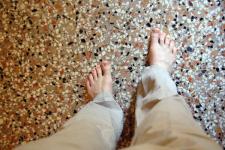
Once in my hotel room, my bare feet were greeted by the speckled “Venetian pavement” — that characteristic floor made of a broken hodgepodge of marble fragments, then polished. While some might mistake it for cheap linoleum, it’s far from that — it’s treasured here, and quite expensive. It flexes with the settling of the buildings…so costly to maintain, but so characteristic. My feet connected with the flooring in a way my feet have never before connected with flooring…happily grounding me with Venice.