Food tours are trendy and new for me. So, in the spirit of experiential sightseeing, I booked a four-hour food tour of Testaccio. Since ancient Roman times, the Testaccio neighborhood has fed the city of Rome. And it just seemed right to follow a foodie around on a ten-stops-in-four-hours, movable lunch feast. The tour was put on by Eating Italy Tours (see www.eatingitalyfoodtours.com), and I figured it was time and money (€65) well-spent. Our guide was excellent — and knows how to talk fast. Here she is explaining everything that we ate and experienced in less than a minute.
Please share your favorite food tours in Europe.
If you can’t see the video below, watch it on YouTube.
Arriving in Rome after six weeks in the Middle East was like coming home. It felt great. It occurred to me that I hadn’t had a glass of wine in a month. I fixed that in a hurry. It also occurred to me that, grand as Rome is, it’s also the capital of stupid stuff sold by vendors on the streets. Each year there’s something new. I’m glad the clattering crickets are gone. I miss the flaming Manneken-Pis statues. I can’t imagine anyone buying one of these chemical blobs — but they’re everywhere, so they must sell.
What are your “stupid things sold on the streets” memories, experiences, and (if you dare to admit it) favorites?
Yesterday we closed down the office at Rick Steves’ Europe to gather our staff together — all 80 of us. This annual meeting ensures that we’re all working in sync, and that our staff knows what my vision is for the coming year. After my “state of the company” address, each department shares what’s new for them. The day was both long and exhilarating.
Our marketing team has had a particularly busy year, and to share all their accomplishments, they played a video of an Italian family on the receiving end of all the travelers we’re sending them. While subtitles are necessary if you don’t speak Italian, this fun report from Rich and Rhonda in our marketing department illustrates the impact our passion for making sure our travelers have a rich cultural experience is having on Europeans. As I like to be unguarded and candid here on my blog, I thought I’d give you this insider’s glimpse at what’s new with us and our impact on Europe.
The Italian folks we eavesdrop on here are girding for more American visitors than ever as they frantically discuss our new 100-show DVD anthology, our new tour catalog, the new website we are constructing, the joy of being able to stream our lectures online, and the new “unguided” option our My Way tours offer.
We broke from our annual huddle with each of us determined to help as many Americans as possible enjoy maximum travel thrills per mile, minute, and dollar in 2013… even if it might overwhelm our Italian friends.
Happy travels and buon viaggio!
If you can’t see the video below, watch it on YouTube.
Where we travel and how we travel shapes our travel experience — obviously. And who we travel with does, too. I’ve been traveling quite a bit lately with a remarkable woman, Trish Feaster. We’re different types of travelers — and I’ve been struck by how those differences broaden and enrich my travel experience.
Trish is a linguist, while I am a confirmed monoglot. Her love of language has given my recent travels a new dimension. She’s a foodie, while I’m an “intermediate eater.” Her ability to get the same joy out of a menu that I get out of an art gallery has broadened my cultural experience (and even — a little bit — my waistline). And her emphatic joie de vivre tempers my workaholism in a way that — ironically — makes me especially productive as a travel writer. I find that now I experience, and write about, things that I wouldn’t have made time for if I were on my own.
Trish is an avid photographer as well as an inspiring writer. Her blog, The Travelphile, provides a showcase for her work. (It also gives a more candid look at my non-European travels than you’ll get on my own blog, as we enjoy lots of travel fun that has nothing to do with Europe.) I think her insightful blog entries complement my own, and she deserves more readers. To give you a taste of Trish’s writing, she’ll be occasionally guest-blogging here in the coming weeks. I hope you’ll enjoy her take on traveling; if you do, please follow her blog. Thanks.
A Place That’s All Your Own
One of the most annoying things about travel/tourism is that if you’re going to someplace that’s popular, everyone else is too. That means crowds, lines that seem to have no end, pushing and shoving, and odors that you didn’t think were humanly possible. With all of that mass of humanity, patience and a good sense of humor seem to melt away quicker than ice under a scorching sun.
Although most people would prefer to travel in low or shoulder season to avoid crowds (and elevated prices), for many, that’s simply not possible. One way to get around that scene is to not be in it. Find a better way to enjoy your travels by being in a place when there are few people and make it a place that’s all your own — even at the busiest time of the travel season.
This summer, because I’ve been working as an assistant guide, I have been, by necessity, out and about when everyone else is. While being on a tour has its privileges (such as guided tours with incredibly talented and smart local guides or entrances to sites/activities without waiting in line), it’s still next to impossible to avoid the fact that everyone and their mother is at the same place you are everywhere you go.
To have a more peaceful and intimate experience, I made a conscious effort to enjoy the places we visited either really early in the morning or really late at night. Now obviously I wasn’t getting into museums with an Early Admission Ticket like at Disneyland (Whoa, there’s a idea! Museums, get on that!), and I certainly didn’t do this every day. But, I did get to see places in ways that most travelers — or even locals for that matter — don’t. It takes effort and sometimes a little bit of planning (going to bed early so you can be up at 6 a.m., resting in the afternoon so you can be up until 1 a.m.), but it’s so worth it to watch the sunrise over a glassy lake, to be one of twelve people standing on the Mont Saint Michel causeway at midnight listening to the waves kiss the shores of the sandy bay, to dance like no one is watching in front of the Eiffel Tower, to smell the fresh cut hay just two miles away from the nearest castle, or to be the first person of the day to stroll through the main street of a town that is just on the verge of waking up. Even if you do it just to get a pristine photo without others blocking your view, you can have a really magical moment if you can find a way to enjoy a place all on your own.
Here are just some of the places where I took advantage of being out and about when the the crowds were getting their beauty sleep.
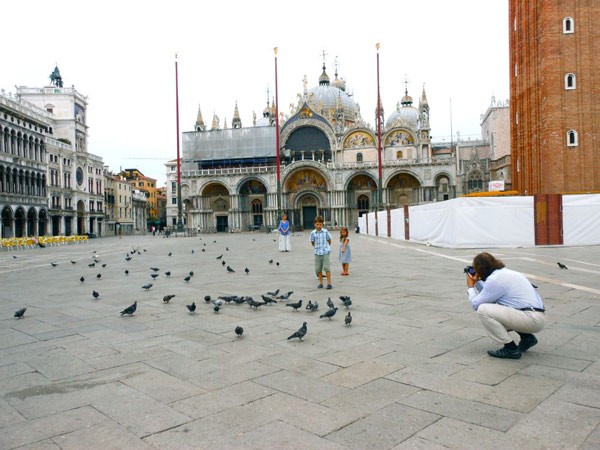
At 5:30 in the evening, what once was a empty square is peppered with a few too many people.
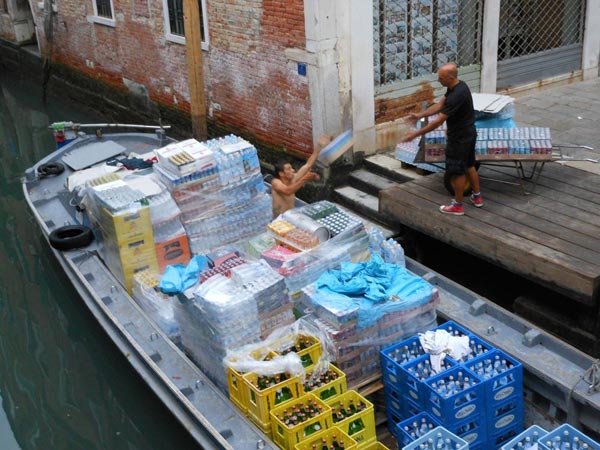
Early in the morning, boats haul their goods to merchants of Venice.
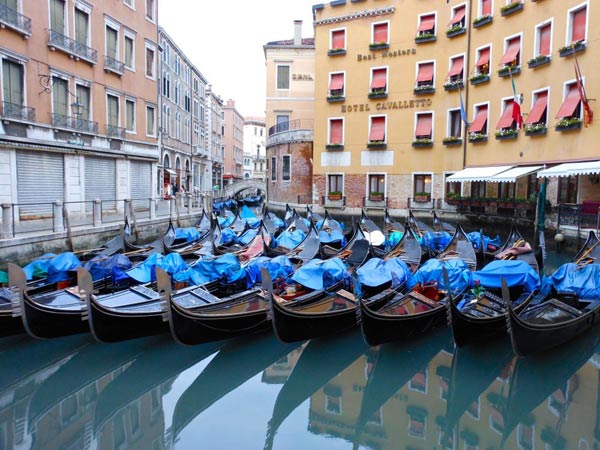
Gondolas nestle together in the cove of a canal in the early morning hours before the tourists arrive en masse.
This family and I had the same idea: get up early and have Venice all to yourself.
The peace and tranquility of Venice are best enjoyed early at morning or late in the evening.
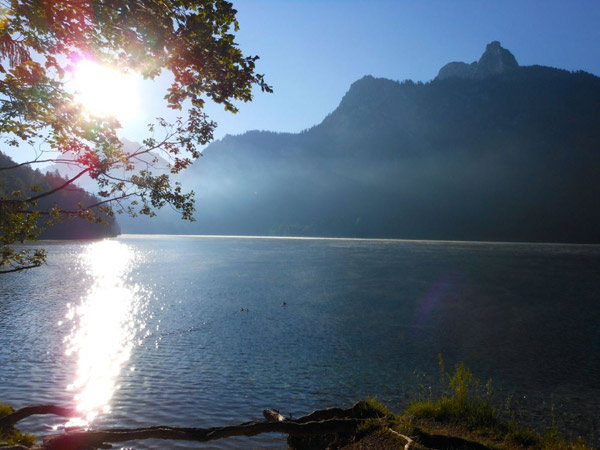
On this morning, I ran from Austria to Germany and was treated to a calming moment on a lake before joining the crowds later that day at Neuschwanstein Castle.
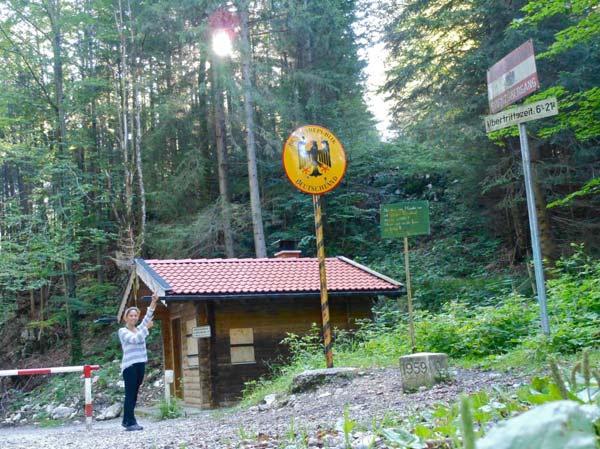
Even the Austria/Germany border guard wasn’t up and about at this early in the morning.
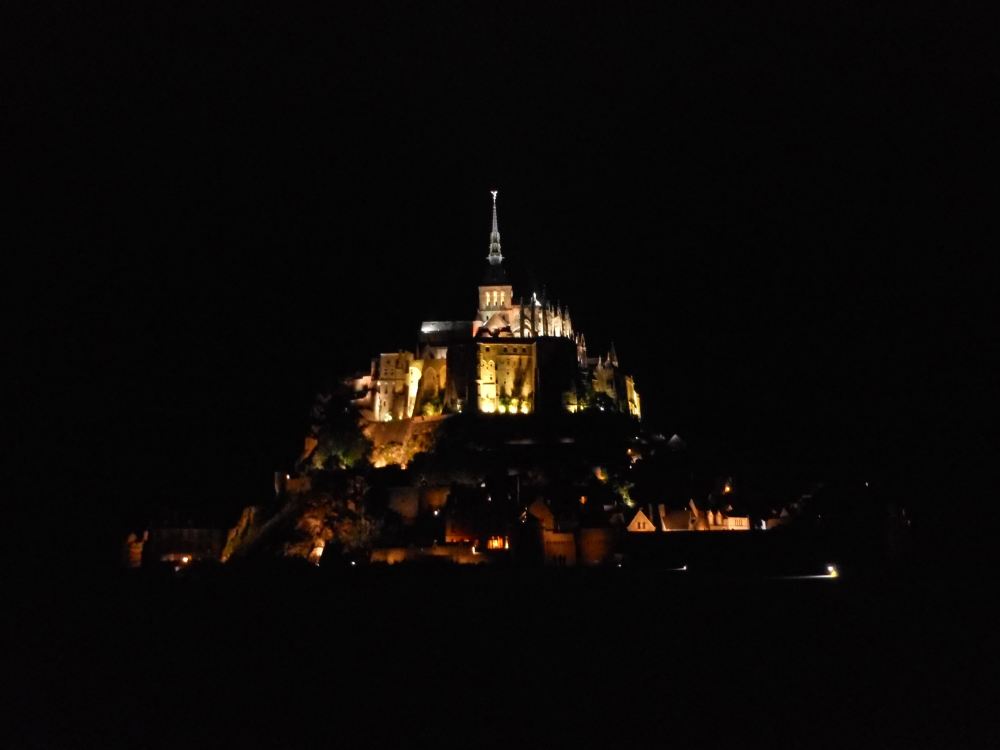
Le Mont-Saint-Michel has stood majestically as a beacon to pilgrims for centuries, and at night it is at its most striking and its most tranquil.
It’s hard to imagine that in only an hour from when I took this shot, this place was full of people standing practically shoulder-to-shoulder.
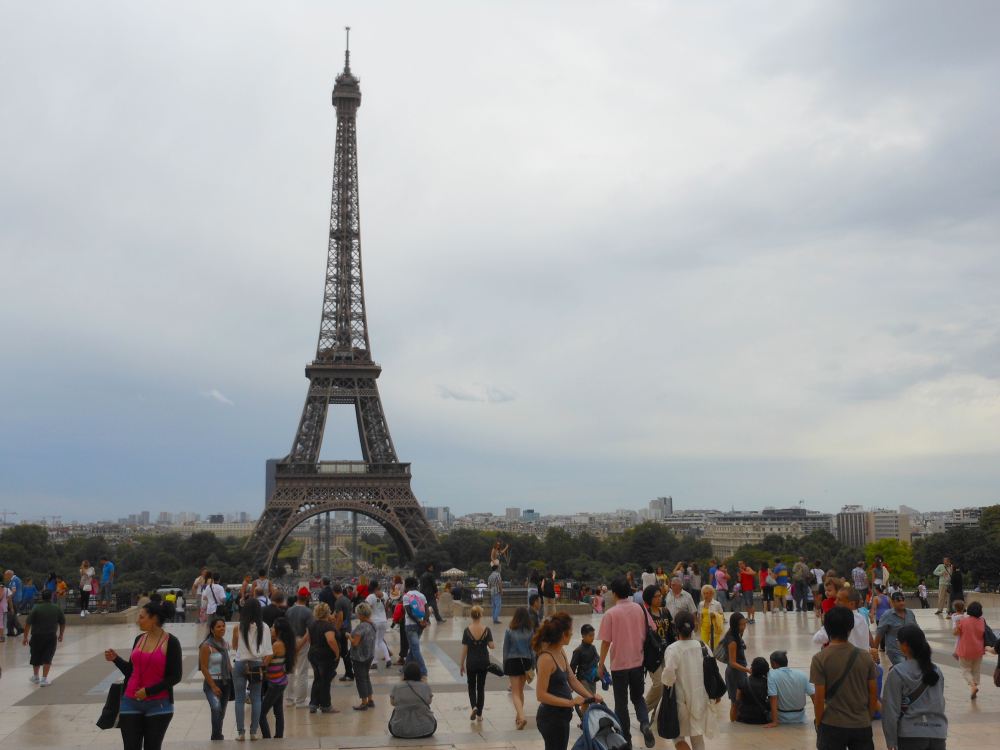
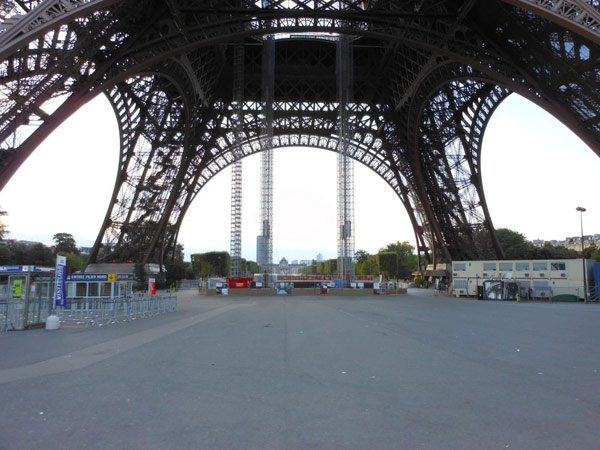
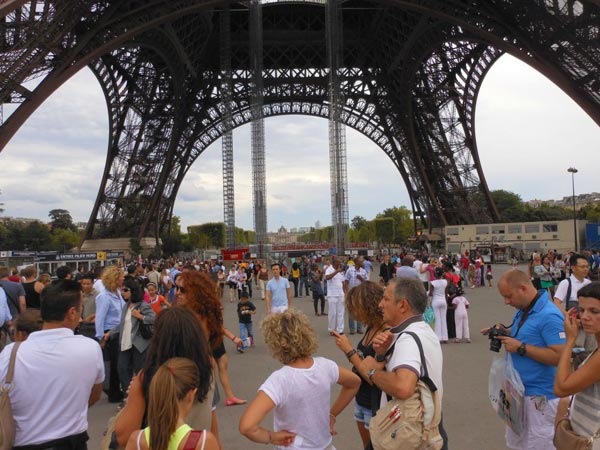
People were waiting for two hours just to buy their tickets so they could stand in line again to take the elevator up the Eiffel Tower.
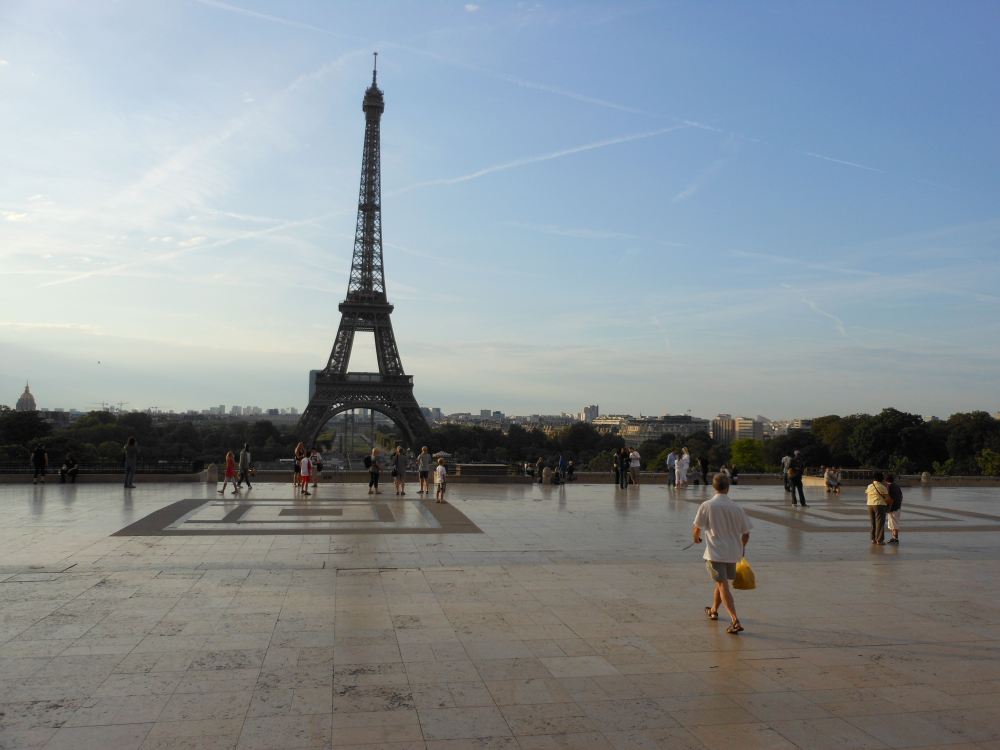
Early in the morning, you can get a nearly unobstructed view of the Eiffel Tower.
Today marks the 1-year anniversary of the devastating floods and mudslides that ripped through the Cinque Terre villages of Monterosso and Vernazza, burying their streets under as much as 12 feet of mud and debris. I have written about this disaster before, and more recently about each village’s remarkable recovery. Today I’d like to tell you a different side of that story — what happened to a group of travelers we had in Vernazza and Monterosso on that day one year ago, and how their tour guide’s hard work and focus helped them get through the crisis safely.
Our “Heart of Italy” tour’s free day in the Cinque Terre is normally devoted to hiking the scenic trail that connects the five coastal villages running from Riomaggiore to Monterosso. On the morning of the disaster, because of rain, guide Karin Kibby (pictured) and her group of 28 hopped on the train from Monterosso to Vernazza, where Karin arranged a tasty cannoli treat for everyone. As the rain poured down more heavily and ankle-deep water began rushing down Vernazza’s main street, some of the group decided to remain in Vernazza to wait out the storm, while the other 20 or so, along with Karin, chose to take the short train ride back to their hotels in Monterosso.
As is common with our tours staying in the Cinque Terre, this group was split between two hotels — the Villa Steno, up the hill from the train station, and the Pasquale (owned by the same family), located closer to the beach. By the time the train pulled into Monterosso, water was rushing down the hill fast and deep enough to block the path to the Villa Steno. Everyone ended up wading “downstream” to the Pasquale.
As the rain kept coming, stronger and stronger, Karin and her soaking-wet tour members sat in the hotel’s breakfast room, watching the water rise higher outside. Before long, a stream pushed its way in through the doorway, flooding the room. The group moved up, first to the stairway, then to the hotel’s upper floor. The power went out, and everything was plunged into darkness.
As tour member Paul Moss put it, “There’s something about extreme stress that can undo a person’s language skills.” The hotel’s staff, frantically coping with a situation that had gone from inconvenient to dangerous, gave up on English, and spoke with Karin in rapid-fire Italian. Their first concern, according to Paul, was something he’ll never forget: “None of us knew how bad the situation could get, but it was deteriorating rapidly and it had to be heartbreaking for the owners of the hotel, watching their investment and community being devastated. And at that moment they turn to Karin and tell her they are worried about not having enough clean sheets for everyone who will need to spend the night in shared rooms. All they cared about was the welfare of their guests! If that isn’t a WOW moment, I don’t know what is.”
The group was cold, wet and stranded — without power, food or plumbing. Half of them had none of their belongings, as their bags were still up the hill at the Villa Steno. And four were still somewhere in Vernazza. It was a situation ripe for fear, frustration and anger, but Karin’s leadership made all the difference. As one tour member put it, “Karin was literally our ‘port in the storm.’ I know how stressful our situation was for her. I believe that what kept us all calm and in control was our confidence in her abilities.”
Throughout the night and into the next morning, Karin kept in touch — in-person and via cell phone — with police, emergency workers, people at the train station, and our office in Edmonds, relayed constant updates to tour members, and made sure people had everything they needed. Early the next morning, she even led a commando-style mission of several volunteers, climbing over fences and rooftops (evading police who might delay them) to retrieve tour members’ luggage from the dark and abandoned Villa Steno up the hill. Once they had what they’d come for, they could more boldly (and safely) return via the streets, which were about six feet higher than normal, packed with mud and debris. Then, discovering they hadn’t gotten quite everything, Karin scrambled back up the hill.
Soon after returning, Karin gathered everyone up and led them to a special evacuation boat, which she had learned about as a result of her constant contact with everyone who could possibly be of help to her group. The boat, packed with shivering, exhausted travelers and locals, made its way through the debris-filled sea to the Vernazza breakwater, where the four “lost” members of her group (who’d made it through their own ordeal) awaited rescue. They were thrilled to see Karin at the bow of the approaching boat, waving her arms to welcome them.
One tour member summed up his feelings about Karin Kibby this way: “Karin is simply amazing — helpful, knowledgeable, smart, interesting, clear, personable and friendly under normal circumstances — calm, level-headed, even-tempered, confident, and decisive when everything is going to hell around her. I’ve known very few people like her in my life, and it was a genuine privilege both to have her as a tour guide, and to be caught in a disaster with her.”
One year later, Vernazza and Monterosso are nearly back to normal, the Villa Steno and Pasquale hotels are filled with happy guests, and Karin Kibby is a hero to a special group of Rick Steves travelers — including Rick Steves.