Guide Work in Rome

rick-steves-tour-guides-italy
With more than 600 Rick Steves tours a year, we have guides working all over Europe all the time. It’s an amazing pool of talent, passion, and travel savvy. They have their own digital communication portal and are constantly rendezvousing, sharing ideas, lessons, and having fun. For me, touring with Reid and Trish is a good chance to get in on the social end of things. Here (from left) guides Ben, Francesca, Trish, Reid (mugging for the camera), and me try out a new restaurant near Rome’s Campo de’ Fiori. (By the way, many of the photos on this blog are shot by Trish Feaster, whose own blog is at The Travelphile.com).

tom-eurocheapo.com-italy
There are plenty of people researching for various guidebooks and websites in Europe, and rarely do I feel a strong, kindred spirit with them. But meeting Tom, who founded EuroCheapo.com, was really fun. Tom is a hotel wonk; he’s friends with many of the same hoteliers that I’ve recommended for decades. He’s right up-to-date on the trials and tribulations hoteliers are suffering in this age of Booking.com and TripAdvisor. Even the most independent of hotel spirits are finding themselves “invisible” if they don’t enlist with booking sites (like Booking.com). I don’t understand how these various booking agents can justify taking 18 percent of a hotel’s gross income when you compare all the real investment and tangible expenses of running a hotel to a website. Here, over a fascinating conversation about the hotel business, Tom, Trish, and I are enjoying one of my favorite kind of restaurant: an enoteca (a place specializing in fine wine by the glass and simple, rustic plates of ingredients that pair nicely with the wine).
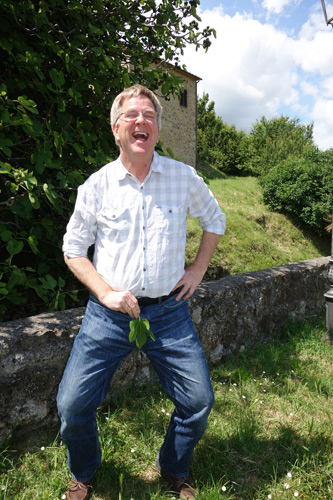
rick-steves-fig-leaf
As a tour guide, even when trying to vacation on a tour led by someone else (as I’m doing on this Best of Europe in 21 Days tour), I can never let a teachable moment go by. On this tour, each of our guides stops by his or her favorite hill town to break the long drive from Rome to the Italian Riviera (Cinque Terre). Reid stops at Massa Marittima–a delightful hill town that was new to me. Walking around its medieval walls, we came to a fig tree. After all the fig leaves we saw yesterday at the Vatican Museum, I just had to try one on. All I can say is, “They’re really sticky.”

Muscling through the Vatican Museum

In this video clip, I’m surrounded by a cacophony of tour guides explaining one of the highlights of the Vatican Museum’s collection, Raphael’s “School of Athens.” This is the last stop as they muscle their way through all the art to get their gangs to the coveted Sistine Chapel – just around the corner from here. In the video, I’m talking softly as to not disturb all the guiding going on…so you can barely hear me (turn on YouTube’s captions for subtitles). With emerging economies (China, India, Russia) and more cruise groups than ever, must-see cultural attractions like the Vatican Museum are jam-packed with tourists at all hours. Still, of course, these attractions are great experiences. This clip gives you a feeling of the crush of tour groups as we see the Raphael Rooms, which were done at the same time Michelangelo was creating the Sistine Chapel frescoes a few steps away.

If you can’t see the video below, watch it on YouTube.

Handling the Masses at the Vatican

One of the big challenges for groups or individuals traveling in Italy is to handle the mob scenes at the Vatican Museum. There are a few sights in Europe (Versailles and the Vatican Museum come to mind) where there’s almost no way to experience it without a constant and raging commotion of tourists. Even in the worst of crowds, these sights are correctly considered “must-sees.” It’s up to a smart tourist (or tour guide) to do whatever is possible to visit away from peak times or get reservations in advance when possible. Even with the crush of crowds, I find the Vatican Museum one of the most exciting in all of Europe. And the adjacent St. Peter’s Basilica is so big, it can handle the crowds (once you get through the security line to actually get in).

There is just one relatively small entrance to the Vatican Museum. You can find it by looking for a long, long line snaking around the towering fortified walls of Vatican City--still an independent country. Only sanctioned Vatican guides are allowed to take groups through the museum, and the tour must use sanctioned whisper systems. You’ll see boxes of these sets--each with a transmitter for the tour guide and 30 or so receivers for each tour member--ready for groups with reservations as they enter.
There is just one relatively small entrance to the Vatican Museum. You can find it by looking for a long, long line snaking around the towering fortified walls of Vatican City–still an independent country. Only sanctioned Vatican guides are allowed to take groups through the museum, and the tour must use sanctioned whisper systems. You’ll see boxes of these sets–each with a transmitter for the tour guide and 30 or so receivers for each tour member–ready for groups with reservations as they enter.
Thankfully the great art is higher than the tallest tourist. After the grand halls showing off some 15 centuries of art collected by the popes--and before the climax of the experience at the Sistine Chapel--you pass through a series of rooms frescoed by Raphael. The Raphael Stanza (or Raphael Rooms) are a great example of how the Renaissance popes embraced the classical, pre-Christian art and philosophy of the ancient world. Here in Raphael's "School of Athens," the great Greek thinkers from about 300 years before Christ are celebrated (and are portrayed with the features of the greatest artists of the Italian Renaissance from Raphael’s generation--around the year 1500).
Thankfully the great art is higher than the tallest tourist. After the grand halls showing off some 15 centuries of art collected by the popes–and before the climax of the experience at the Sistine Chapel–you pass through a series of rooms frescoed by Raphael. The Raphael Stanza (or Raphael Rooms) are a great example of how the Renaissance popes embraced the classical, pre-Christian art and philosophy of the ancient world. Here in Raphael’s “School of Athens,” the great Greek thinkers from about 300 years before Christ are celebrated (and are portrayed with the features of the greatest artists of the Italian Renaissance from Raphael’s generation–around the year 1500).
Museums across Europe are doing their best to handle the crowds. This sign, with "silence" in Russian and Chinese in addition to English, Spanish, and Italian, is a reminder of a big change in the last few years: Lots of people from emerging economies are tourists, too. Even if most people in Russia or China are too poor to travel, there are huge numbers of economic elites who can and do.
Museums across Europe are doing their best to handle the crowds. This sign, with “silence” in Russian and Chinese in addition to English, Spanish, and Italian, is a reminder of a big change in the last few years: Lots of people from emerging economies are tourists, too. Even if most people in Russia or China are too poor to travel, there are huge numbers of economic elites who can and do.
Thankfully, the Vatican lets tours (and slippery individuals) slip from the Sistine Chapel out the back and down this grand staircase directly to St. Peter’s Basilica without needing to retrace their steps way back to the museum's entry. From there, you must literally walk around the country (which is not so small when you’re on foot) to get back to St. Peter's. Slipping from the Sistine Chapel directly into the basilica is a huge time-saver if trying to visit the museum, Sistine Chapel, and basilica in one go. Thank you Vatican officials for offering this!
Thankfully, the Vatican lets tours (and slippery individuals) slip from the Sistine Chapel out the back and down this grand staircase directly to St. Peter’s Basilica without needing to retrace their steps way back to the museum’s entry. From there, you must literally walk around the country (which is not so small when you’re on foot) to get back to St. Peter’s. Slipping from the Sistine Chapel directly into the basilica is a huge time-saver if trying to visit the museum, Sistine Chapel, and basilica in one go. Thank you Vatican officials for offering this!

Rome Subway Submersion

As guides, we love the challenge of introducing 25 Americans to a new subway system. While we could hop on our big tour bus, it’s a great and empowering experience for our group–most of whom have never been in Rome and many who’ve never used a big city subway–to learn to do Rome as the Romans do. Here we get to the platform with one minute to spare.

If you can’t see the video below, watch it on YouTube.

Doing the Caesar Shuffle in Rome

With just under two days in Rome, our Best of Europe in 21 Days tour needs to be very well designed. We do what I call the “Caesar Shuffle” upon arrival (Colosseum, Forum, Capitoline Hill, and Pantheon). We go together to Campo de’ Fiori and disperse to find dinner on our own before embarking on the romantic night walk (lacing together floodlit spots like Piazza Navona, Trevi Fountain, and Spanish Steps). The next day is all about the Vatican (with the afternoon and evening free). After two exhausting days, we are ready for the Italian Riviera.

The main street of ancient Rome cuts authoritatively through the heart of the forum today like it did 2,000 years ago. I love to imagine the pageantry that filled this street when generals returned home after successful campaigns with all their booty, plunder, slaves, and caged barbarian kings to the delight of the crowds and the appreciative emperor.
Unlike other tour companies that just take the next available guide on the sight's roster, we carefully select our local guides. Francesca Caruso (who’s helped me with our guidebooks and TV shows, as well as tours, for well over a decade) is one of our favorites. With Francesca as our teacher and the top ruins of Rome as our classroom, our Caesar Shuffle is the best three hours of Roman history you could imagine.
Unlike other tour companies that just take the next available guide on the sight’s roster, we carefully select our local guides. Francesca Caruso (who’s helped me with our guidebooks and TV shows, as well as tours, for well over a decade) is one of our favorites. With Francesca as our teacher and the top ruins of Rome as our classroom, our Caesar Shuffle is the best three hours of Roman history you could imagine.
Various details help humanize Roman society of 2,000 years ago. I find this a particularly impressive sight: the only original doors from the ancient world still hanging and swinging on their original hinges. You’ll see these when you visit the Roman Forum (assuming you have a good guide or guidebook).