After the Flood: Small-Town Grudges and Mother Nature’s Nudges (Part 2 in a 3-Part Series)

I woke to the sound of miniature cement trucks and jackhammers. These were happy sounds to me, as physically, Monterosso and Vernazza are being put back together after the recent devastating flood. Socially, too, it’s been a time of reconstruction for both communities. Being small towns, they were rife with cliques and ancient grudges. With the challenge presented by the flood and recovery period, locals marvel at how everyone came together. Today, many locals enjoy better relations with old enemies, but there is a new divide: between people who joined in the community-wide effort, and those who only took care of their own business needs (or even left town during the chaos). In both towns, while a large percent of the businesses were essentially destroyed, lots of people and hotels that were on higher or luckier ground came through unscathed, losing only their water and electricity for a while. Some of them ignored their business needs and became heroically involved. And, as it goes in small towns, those who didn’t will long be remembered for turning their backs on neighbors in need.

People commented on how, having experienced this tragedy, they have a new empathy for distant people dealing with similar natural disasters. Others commented on how, now, every time there’s a big rain, anxiety sweeps through the community.

The tourist business in 2011 was very strong. October 25 was at the end of the season, when locals were ready for a much-needed winter break. While the flood hit at the perfect time from a business point of view, locals, already exhausted after a very busy season, had to immediately plunge into a nonstop rebuilding period, pushing to be ready for the 2012 season.

Vernazza's beach is swollen by mud from surrounding hills. Soon the hard-working tractor will be replaced by lazy sunbathers.

For travelers wondering if it’s OK to travel to the Cinque Terre, here’s my take: Three of the towns were unaffected (Riomaggiore, Manarola, and Corniglia). They have plenty of tourism and don’t need your business as much. I’d choose between the two flood-ravaged communities. Monterosso is completely ready. Vernazza, with a few hotels and restaurants already open, expects to be ready for prime time by June. Crews have worked tirelessly to get the trails put back together and the best hikes are wide open. This is a great time to visit, to both stoke and celebrate the recovery, and to be one of the first to enjoy the charms of either town, post-flood. There’s a camaraderie in the air and an appreciation of tourists that is palpable. Even in late April, over the course of several days, I saw countless travelers enjoying their visits as they would if there had been no flood.

Monterosso: Overloaded drainage canals and ancient streams swollen under the streets caused pavement to burst upward.

Monterosso's six under-street channels stand ready to allow future floods to flow unimpeded through town and into the sea without taking businesses and dreams with it.

The people of the Cinque Terre are being taught a tough lesson. It’s their beautiful land that brings the tourists. With the affluence brought by tourists, locals abandoned their land — leaving the vineyards unplanted and the centuries-old dry-stone terracing to crumble — for less physically demanding, more profitable work in tourism. (Grapevines are lighter on the land and have far-reaching root systems to combat erosion. Traditional vintners keep the stone terraces in good order.) But after a generation of neglect and abandonment (while the Cinque Terre enjoyed and profited from tourism), the land was washed by violent weather into the towns. It’s like nature was speaking: There will be no tourism to harvest without proper stewardship of the land. The question that remains: Will the lesson be learned, remembered, and heeded? (Tomorrow: the last in this three-part flood series.)

Groups of expat American women (who fell in love both with the towns and their men) are helping organize relief and communications in the aftermath of this disaster Rebuild Monterosso and Save Vernazza. For all the latest in both towns, see these websites or reach them through our Cinque Terre News page.

Cinque Terre Flood — Six Months After (Part 1 in a 3-Part Series)

On October 25, 2011, after a very dry summer, a freak rainstorm hit the Cinque Terre, an idyllic string of five Italian Riviera towns. Within four hours, the region got 22 inches of rain — a third of an average year’s total. Because of the topography and the ability of the flash flooding to drain, three of the towns (Riomaggiore, Manarola, and Corniglia) were undamaged, and two were devastated. Much of Monterosso and Vernazza were buried under three meters of mud and left without water, electricity, or phone connections. It was a day residents will talk about for the rest of their lives.

I visited on the six-month anniversary of the flood (April 25). In the next week, I’ll share my Cinque Terre experience here on my blog.

The day after the flood was hot and dry and everyone came together, starting a winter of digging out and rebuilding. In Monterosso six canals run under six streets to the sea. Debris from landslides filled these up, clogging things so the deluge went over ground. Trees, furniture, cars, buses, and tons of mud and rocks plowed through the city. Water pressure from drain pipes below caused streets to explode upward. Medieval wells in basements became geysers. Rivers of raging mud rampaged down the streets, stranding people, and ultimately leaving shops and restaurants on the main streets of old Monterosso and Vernazza buried.

The mud that buried Vernazza on October 25 destroyed every business on its main street.

Vernazza's mayor, Vincenzo Resasco, artfully and tirelessly kept the rebuilding of his town on track and people working together. Six months to the day after the flood, he proudly showed me the town's impressive progress.

With that first post-flood sunrise, tourists were evacuated, emergency workers came in, and locals rolled up their sleeves and began shoveling. Through the winter there were no weekends as they set out to rebuild in time for the next tourist season.

While April 25th, the six-month anniversary of the tragedy, was also was Italy’s Independence Day, and holidays here are normally sacrosanct, everyone was still hard at work.

The destruction occurred mostly along former ravines, where, historically, streams ran through the towns. In the last century, the ravines were covered with roads, and the water drained through canals under the pavement that, over time, were not properly maintained. Like congested arteries (made even worse with all the debris that washed into town), the drainage canals couldn’t handle the raging flow. Monterosso’s streets are now repaired. Big new grates allowing ready access to the canals and the sound of rushing water assure townsfolk that the streams are flowing unimpeded below.

Vernazza is built around one street (built over the stream in its ravine), with the surrounding hills like a funnel directing flash-flood waters right through the middle of town. After six months, the upper half of town still feels like a war zone, with no businesses open and many apartments and homes still unoccupied. But the harborfront has come back to life. Alpine engineers have been imported from Switzerland to analyze the drainage challenges and put nets above the town to protect it from more landslides. Thankfully, the structural integrity of the buildings is generally fine.

While both towns incurred about the same amount of destruction, Vernazza is smaller and more isolated, so a bigger percent was devastated. It was still rebuilding with most of its businesses yet to open. Monterosso, a bigger town with better access to the outside world, was essentially back up and running. Restaurants and businesses at street level in affected areas were gutted and today have replaced everything: tables, chairs, plates, walls lined with bottles of wine, stoves, and so on.

Chef Gino, of Monterosso's Ristorante al Pozzo, shoveled mud through the winter with his family. Now Gino cooks again. While many of his best bottles of wine survived — but with labels obliterated.

Nearly every business in Vernazza — mostly humble mom-and-pop shops — spent their winter literally digging out.

A week or so ago, the president of Italy came to Vernazza in a show of support. The town’s most venerable restaurant, which had just reopened, cooked him the region’s signature dish: pasta with pesto. The president enjoyed it so much, he’s flying the chef to Rome to cook and serve it at the presidential palace.

Talking with locals, a phrase I hear over and over is “piano, piano” (little by little). Little by little, they are rebuilding. I was told, “The reality of a tragedy like this is: Eventually the government aid dries up, the sympathy fades, and it’s just you and a shovel.” (Tomorrow, part two.)

A Rainbow of Art in Vernazza

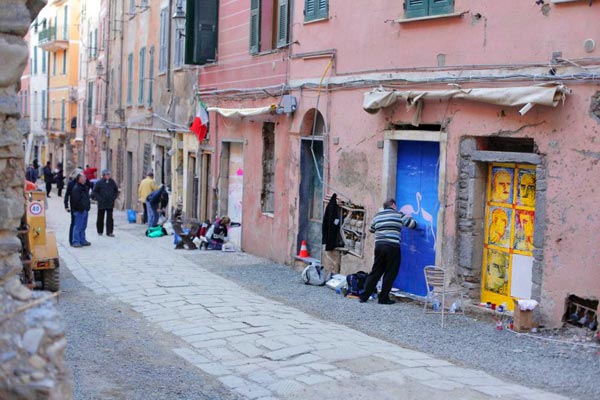
On the morning of January 6th, more than 50 artists descended on the damaged Cinque Terre town of Vernazza, armed with a vivid message of hope.

Organized by painter Antonio Barrani, their mission was called “Un Arcobaleno di Solidarietà per Vernazza” — A Rainbow of Solidarity for Vernazza. Each painter took a lifeless, boarded-up doorway along Via Roma…and transformed it into a work of art.

More than just decorating the Via Roma, this avenue of art is designed to inspire all who love Vernazza to play a role in her recovery.

As you page through these images, we’ll use the captions to bring you up to date on Vernazza’s recovery from the October 25th disaster — and what you can do to help one of our favorite villages in Italy spring back to life.

Visit Vernazza this  summer! It’s the best contribution a traveler can make. Can’t swing it?  Then imagine what you might spend on a day-trip to Vernazza.

Donate that amount to Save Vernazza or Per Vernazza Futura.

Either way, you’ll be a hero.

000_Vernazza
A Rainbow of Art in Vernazza - Photo: Mario Bertocchi.

001 Vernazza
More than 50 artists assembled in Vernazza on a chilly Friday morning. Photo: Bea Newton
002 Vernazza
Via Roma — recently freed from a grave of mud and rubble 13 feet deep — was lovingly decorated. Photo: Mario Bertocchi


003 Vernazza
Each artist had something personal to express... Photo: Mario Bertocchi

004 Vernazza
Vernazza may be down, but she's not out. - Photo: Mario Bertocchi

005 Vernazza
Passion, creativity and generosity will bring Vernazza back. - Photo: Mario Bertocchi

006 Vernazza
This village will be reborn, stronger than before. - Photo: Mario Bertocchi

008 Vernazza
Vernazza's water, electricity, gas and telephone lines are being repaired. Photo: Bea Newton

009 Vernazza
Her residents, evacuated since the end of October, are beginning to return. Photo: Michele Sherman

010 Vernazza
Her residents, evacuated since the end of October, are beginning to return. Photo: Michele Sherman

011 Vernazza
Vernazzans look forward to welcoming travelers back in late spring. Photos: Mario Bertocchi; Michele Sherman

012 Vernazza
The government and volunteers can only do so much. Photo: Bea Newton

013 Vernazza
Vernazza needs private donations to get the work done on time. Photos: Michele Sherman; Bea Newton

014 Vernazza
Vernazza also needs travelers to return this summer. Photos: Michele Sherman

015 Vernazza
You can play a role in Vernazza's rebirth. Photos: Michele Sherman

016 Vernazza
Pick one way to help, and you'll make marvelous things happen. Photos: Michele Sherman

017 Vernazza
Visit Vernazza this summer! It’s the best contribution a traveler can make. Photo: Mario Bertocchi

A Late-Night Walk Through Vernazza…Before the Flood

I was in Vernazza last May, updating my Italy guidebook. At 10 p.m. one night, after a long day of research, I enjoyed wandering through this magical town, playing with my iPhone video camera. I never could have imagined that the street I was walking on would, just a few months later, be under 6 to 12 feet of mud and rocks. At the end of my stroll, Chef Claudio at Gambero Rosso joins me in marveling at how Vernazza is indeed “molto bella.” Then he says ciao and grazie…sending his best wishes to all the Americans who keep this town employed. As the rubble from last week’s heartbreaking disaster is being cleared away, we look forward to doing that again. Learn more at www.ricksteves.com/news.

If you can’t see the video below, watch it on YouTube.

A Violent Rain Buries an Italian Friend

Thirty two years ago, I met two American college girls while hitchhiking in Switzerland. They were studying in Florence, and I asked them their favorite place in Italy. They surprised me by naming a place I had never heard of before: Cinque Terre. Curious, I headed south and discovered a humble string of five villages along Italy’s Riviera coast with almost no tourism…and, it seemed, almost no contact with the modern world.

After falling in love with what I consider the most endearing stretch of the Mediterranean coastline anywhere, I’ve gone back almost every year since. Of the five towns, spindly, pastel Vernazza has always been my favorite. Over three decades, I’ve grown up with the people of Vernazza, watched a young generation carry on with their traditions — and seen the town go through years of hard work to develop into a thriving haven for travelers looking for that pristine stretch of Italian coastline. Once rugged and magical, it became…comfortable and magical.

Then, on Tuesday afternoon, a torrent of rain came down and a flash flood thundered through the town, gutting nearly every business, and filling the ground floors with mud.

To learn more about what has happened, to view pictures of the aftermath, and to read message-board comments from people who were there, see my online November Travel News.

I spent four nights here last May, updating our guidebook chapter to the Cinque Terre. At the end of my stay, as I got on the train for Rome, I found myself actually thinking of Vernazza as a person…and as a friend. Of all the towns I know in Europe, this is the one that is, for me, a human puzzle in which I’ve figured out nearly all the pieces. I believe I know more people in Vernazza than in all of Spain. This week, as I read emails from Vernazzan friends and look at the horrifying photos and videos of the disaster, I feel I’ve lost a friend. In fact, looking at the photos — store fronts ripped off and fishing boats crumbled on rocks — I get this ghastly feeling that these are photos of a crime scene…and that nature has murdered my friend.

A routine I’ve long enjoyed with each visit has been to walk slowly from the top of town to the bottom, just before midnight. I’d savor the rhythm of the pastel colors and imagine the town back when a stream rushed down its middle. At some point, generations ago, the stream was put under the pavement. But it still flowed, draining water from the terraced vineyards that surround the town on three sides. I’d always stop at one point along the street where I could actually hear the soft sounds of that water still flowing beneath the road, from vineyards to the sea.

And this week, with a freakishly intense rainstorm — like a misplaced monsoon — torrents of water funneled from the surrounding mountains into the town carrying rampaging tons of mud and debris. That narrow street became a riverbed again, and Vernazza met a fate almost similar to Pompeii: the entire ground-floor of the town was buried.

Today, many of its people are evacuated, there’s no water or power, no communication, and the town is cut off from the rest of the world as roads and train lines are still being dug out. Businesses that Vernazzans had worked all their lives to build are washed away. Its church now houses only a mucky lagoon.

One of the joys of my work is sending travelers to Vernazza. And today I read an email from one Vernazzan who fears they may not rebuild and it could become a ghost town. But I think people are determined to dig out and bring life back to both Vernazza and its neighbor Monterosso. (The other three towns of the region — Riomaggiore, Manarola and Corniglia — because of their luckier topography, got through the storm essentially unscathed.)

I had planned to visit the town next April to film an updated version of my TV show on the region. Then I realized, there may be nothing to show. I was thinking I’d have to put the TV shoot on hold. But then I thought: no, I need to take the crew to the Cinque Terre and show the world the resilience of its people, the natural beauty of the region, and how its communities will carry on.

How can we help? Those who care about the region can donate money. (I don’t feel comfortable with collecting money, and it’s too early to clearly see which relief organizations will be involved.) 

I think, most importantly, the best thing we can do is keep Vernazza and Monterosso in our travel dreams and incorporate them into your next trip. Tourism is the life blood of these towns and, while they need and will get government aid along with charity from friends in the short term, they will need to rekindle their thriving economy in the long term. That involves you and me.

Along with not abandoning the towns of the Cinque Terre, we need to keep in mind that violent weather devastates many more “ugly sister” towns on our planet, where few people notice or rush to their aid. This happens in wealthy corners of our world — like Europe and the USA — and it happens in corners of our world where desperation is the grinding, day-to-day norm. And while many in America feel that acknowledging and addressing climate change is just too expensive for their bottom line, climate change is a reality. And its violent weather packs an even bigger punch, with more devastating consequences, in the developing world.

What will I do? I can keep singing praises for the Cinque Terre. I can dedicate the same promotional energy to it in the coming years that I have in the past decades — even if there will be a hard and ugly time of healing. And I will work to help explain to climate change deniers in our society that it is not “just a theory,” and its victims are real people.