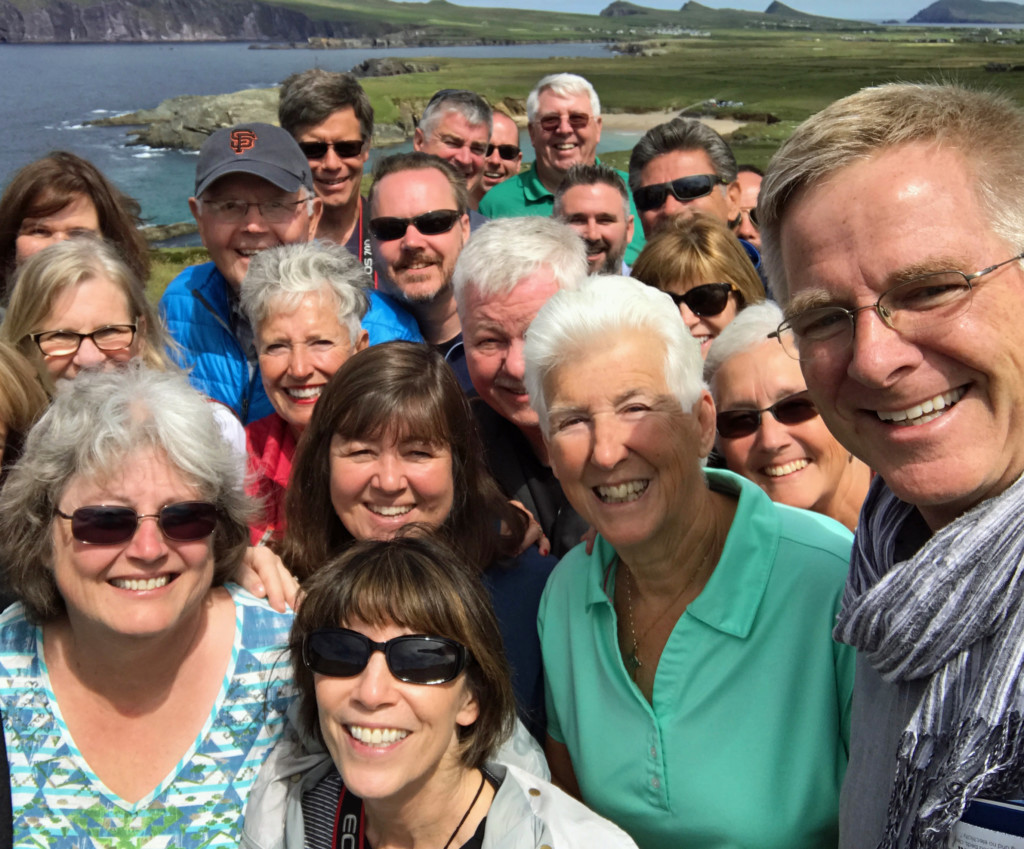
Driving around Slea Head on the westernmost tip of Ireland, I’m enjoying the travelers’ hat trick: Venturing along a tiny road, being out in the early evening when things are quiet and the light is nice, and having the company of a good local guide (to do the driving so I can enjoy the view). Without a local guide like Colm (of Dingle Slea Head Tours), you could drive right by the ruined famine cottages and the corduroy fields without knowing that those faint ridges are the furrows planted in 1848, then never harvested and never touched since. (As the population is less than half of what it was pre-famine, that land was no longer worth working.)
We took our Best of Ireland in 14 Days group on the Dingle Peninsula loop earlier. They’re in town enjoying some great seafood, but I just had to make the loop again — so peaceful and so quiet.
____
This is Day 68 of my “100 Days in Europe” series. As I travel with Rick Steves’ Europe Tours, research my guidebooks, and make new TV shows, I’m reporting on my experiences across Europe. Still to come: England, Scotland, Germany, Switzerland, and more. Thanks for joining me here on my blog and via Facebook.
I’m having a lot of fun traveling across Ireland on a Rick Steves Best of Ireland in 14 Days Tour. And I’ve been multitasking, using the tour as an efficient vehicle for updating our Rick Steves Ireland guidebook. With every free hour, I’m running around to check out the details.
One of the biggest challenges is sorting through the best restaurants in each town. In this clip, I’m enthusing about the legendary “Fishy Fishy Café” in Kinsale. You have to love a seafood restaurant that puts photos of the men who catch its fish on the wall. (I noticed three generations of Hurleys: Christy, Dave, and Desmond.) This meal is not cheap (about $25), but it’s really good. And biting into a slice of cake-like soda bread, I had one of those déjà-vu-of-the-tongue experiences — reminding me it’s great to be back in Ireland.
This is Day 67 of my “100 Days in Europe” series. As I travel with Rick Steves’ Europe Tours, research my guidebooks, and make new TV shows, I’m reporting on my experiences across Europe. Still to come: England, Scotland, Germany, Switzerland, and more. Thanks for joining me here on my blog and via Facebook.
Hello from the south coast of Ireland! I’m in Kinsale — a charming town of 5,000 people, 25 pubs, and a super-sized history. I’m here with a wonderful group of travelers on a Best of Ireland in 14 Days Tour. I had a lot of fun surprising them at the welcome meeting (I signed up under a pseudonym) and now we’re well on our way.
This little clip really shows the joy of a Rick Steves tour: great group, great local guide, great small town, no stress, and lots of learning and efficiency. Our local guide, the wonderful Barry Moloney, has just shown us the clever “Tumbler Cart” — an 18th-century service vehicle that made the rounds picking up the townfolk’s sewage, then went into the nearby fields to provide the farmers with fresh fertilizer. Now he’s explaining how, in a kind of “Cuban Missile Crisis of the 17th century” for Britain, the Spanish nearly took over this town, which would have given them the naval equivalent of the high ground over England.
This is Day 66 of my “100 Days in Europe” series. As I travel with Rick Steves’ Europe Tours, research my guidebooks, and make new TV shows, I’m reporting on my experiences across Europe. Still to come: England, Scotland, Germany, Switzerland, and more. Thanks for joining me here on my blog and via Facebook.
One of the big new attractions in Dublin is an interactive exhibit called Epic: The Irish Emigration Museum. I had never really appreciated the Irish diaspora until my visit here. With all the anxiety surrounding immigration in the USA today, it’s thought-provoking to learn how many people were just as wigged out about Irish immigrants 160 years ago.
In this little clip, I share how connecting with history in my travels helps give me perspective on current events at home. I’d love to hear about similar connections that you’ve made on the road.
Here’s a sneak peek at the museum’s listing in the upcoming 2018 edition ofRick Steves Ireland:
Epic: The Irish Emigration Museum tells the story of the Irish diaspora and celebrates how this little island has had an oversized impact on the world. While it has no actual artifacts, the museum is an entertaining and educational experience, filling the wine vaults in the basement of the CHQ Building (an iron-framed warehouse from 1820s where the customs house stood on the River Liffey). It uses an interactive, high-tech approach to explain the forces that propelled so many Irish around the globe. Twenty galleries immerse visitors in the emigration experience. Illustrious Irish immigrants featured include labor agitator Mother Jones, Caribbean pirate Anne Bonny, Australian bush bandit Ned Kelly, and musical Chicago Police Chief O’Neil. Historic photos of filthy tenements and early films of bustling urban scenes round out the plight of the common Irish emigrant. And all along, you celebrate the Irish heritage in music, literature, sports, and more (daily 10:00-18:45, last entry 17:00, one-hour tours at 11:00 & 14:00, at the modern pedestrian bridge, a few steps from the famine statues along the riverfront on Custom House Quay, tel. 01/906-0861, www.epicchq.com).
____
This is Day 65 of my “100 Days in Europe” series. As I travel with Rick Steves’ Europe Tours, research my guidebooks, and make new TV shows, I’m reporting on my experiences across Europe. Still to come: England, Scotland, Germany, Switzerland, and more. Thanks for joining me here on my blog and via Facebook.
I’m back in Europe, capping off my first day in Dublin at the Guinness Gravity Bar.
(If I sound a little loose in this video clip, it’s probably fatigue. After not sleeping a wink on the nine-hour Vancouver-Dublin flight, I landed at 9 a.m., dropped my bag at the hotel, and dove right into Dublin — the best way to deal with jet lag.)
The Guinness Tour is a pilgrimage for many. But while some love it, others are disappointed. It’s expensive, very crowded, and not really a “brewery tour.” If you’re planning a trip to Dublin, a good guidebook — one that accurately describes the tour without promoting or condemning it — will help you make an informed choice.
After my visit to the Guinness Storehouse, I wrote an update for my Ireland guidebook. Here’s a sneak peek at how the Guinness Storehouse listing will appear in the upcoming 2018 edition of Rick Steves Ireland:
Guinness Storehouse
A visit to the Guinness Storehouse is, for many, a pilgrimage. But over time, the historic artifacts on display have been replaced by glitzy entertainment, and many of its 1.5 million annual visitors find the vibe to be more like a Disneyland for beer lovers. Don’t expect conveyor belts of beer bottles being stamped with bottle caps; rather than a brewery tour, you’ll find huge crowds, high-decibel music, and dreamy beer commercials on wall-sized screens.
Arthur Guinness began brewing the renowned stout here in 1759, and by 1868 it was the biggest brewery in the world. Today, the sprawling brewery complex fills several city blocks (64 acres busy brewing 3 million pints a day). You’ll visit the towering Storehouse.
Cost and Hours: €20, includes a €5 pint; daily 9:30-19:00, July-Aug until 20:00 (last entry 2 hours before closing, last beer served 45 min before closing); enter on Bellevue Street, bus #123, #13, or #40 from Dame Street and O’Connell Street; tel. 01/408-4800, www.guinness-storehouse.com. All Hop-on Hop-off buses stop right at Guinness (your HOHO ticket gives you a €1 discount here). Lines can be horrible at peak times, both outside and at various stops within (that’s why online bookings are 20% discounted from 9:30 to 10:45).
Visiting the Brewery: The exhibit fills the old fermentation plant used from 1902 through 1988, which reopened in 2000 as a huge shrine to the Guinness tradition. Step into the middle of the ground floor and look up. A tall, beer-glass-shaped glass atrium — 14 million pints big — soars upward past four floors of exhibitions and cafés to the skylight. Then look down at Arthur’s original 9,000-year lease, enshrined under Plexiglas in the floor…and you realize that at £45 per year, it was quite a bargain.
As you escalate ever higher, you’ll notice that each floor has a theme: 1st floor is the Cooperage (with 1954 film clips showing the master keg-makers plying their now virtually extinct trade); 2nd floor for the Tasting Rooms (described below); 3rd floor for Advertising (including a theater with classic TV ads); 4th floor, where you can pull your own beer at the Academy; 5th floor for Arthur’s Bar. The top floor is the “Gravity Bar,” providing visitors with a commanding 360-degree view of Dublin, with vistas all the way to the sea.
The tasting rooms (on the 2nd floor) provide a fun detour. In the “white room,” you’re introduced to using your five senses to appreciate the perfect porter. Then, in the “velvet chamber,” you’re taught how to taste it from a leprechaun-sized beer glass.
Your admission includes a ticket for a beer. There are three places to use it: On the 4th floor, you can pull your own pint. On the 5th floor, at Arthur’s Bar, you have the most choice, including extra stout (4.2, carbonated); Dublin Porter (3.8, 1796 recipe); West Indies Porter (6.0, toffee flavor, 1801 recipe); Hop House 13 (4.1, a hoppy lager); and Black Velvet (half sparkling wine and half Guinness). And on the top floor is the Gravity Bar, where there’s the most energy and fun, but drinks are limited to the basic stout or soft drinks.
___
This is Day 64 of my “100 Days in Europe” series. As I travel with Rick Steves’ Europe Tours, research my guidebooks, and make new TV shows, I’m reporting on my experiences across Europe. Still to come: England, Scotland, Germany, Switzerland, and more. Thanks for joining me here on my blog and via Facebook.