Video: Alone with the Past at St. Brendan’s Oratory

(Warning: There’s an amazing leprechaun scene in this clip.)

I’ve been visiting the Dingle Peninsula for more than 30 years. With a new guide (Colm of Dingle Slea Head Tours), I learned of a new sight: St. Brendan’s Oratory. Dingle Peninsula is like an open-air archaeological museum. Imagine monks here, deep in the Dark Ages — over a thousand years ago — stacking these stones.

Anyone can be alone with wonders of the past…but you’ve got to get out and make it happen.

This is Day 69 of my “100 Days in Europe” series. As I travel with Rick Steves’ Europe Tours, research my guidebooks, and make new TV shows, I’m reporting on my experiences across Europe. Still to come: England, Scotland, Germany, Switzerland, and more. Thanks for joining me here on my blog and via Facebook.

The Dramatic and Beautiful Slea Head Drive

Driving around Slea Head on the westernmost tip of Ireland, I’m enjoying the travelers’ hat trick: Venturing along a tiny road, being out in the early evening when things are quiet and the light is nice, and having the company of a good local guide (to do the driving so I can enjoy the view). Without a local guide like Colm (of Dingle Slea Head Tours), you could drive right by the ruined famine cottages and the corduroy fields without knowing that those faint ridges are the furrows planted in 1848, then never harvested and never touched since. (As the population is less than half of what it was pre-famine, that land was no longer worth working.)

We took our Best of Ireland in 14 Days group on the Dingle Peninsula loop earlier. They’re in town enjoying some great seafood, but I just had to make the loop again — so peaceful and so quiet.

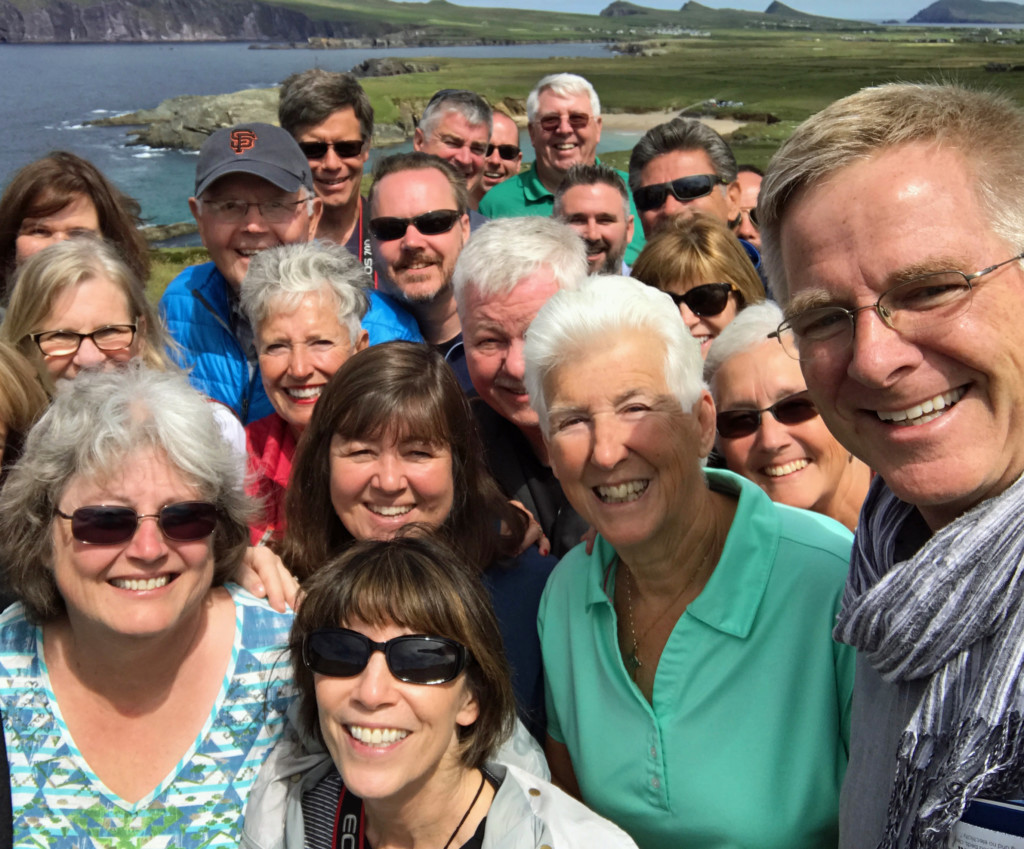
Rick-Steves tour group at Slea Head


____

This is Day 68 of my “100 Days in Europe” series. As I travel with Rick Steves’ Europe Tours, research my guidebooks, and make new TV shows, I’m reporting on my experiences across Europe. Still to come: England, Scotland, Germany, Switzerland, and more. Thanks for joining me here on my blog and via Facebook.

Dingle

Enlarge photo

To commemorate the Smithsonian Presents Travels with Rick Steves magazine — now on sale online, and at newsstands nationwide — Rick is blogging about the 20 top destinations featured in that issue. One of those destinations is Dingle, Ireland.

Kathleen was old and frail, but picked up her step as she led me to the small-town cinema. She declared, “Tom Cruise is a wee little guy.” Everyone was all abuzz about where he and Nicole Kidman had slept.

I was in the town of Dingle, on the west coast of Ireland. And tonight, in Dingle’s homey theater, it seemed the entire town had gathered to watch the premiere of Far and Away — a movie that was partly filmed right here in Dingle. As the movie played, each time a bit player from the village appeared on screen, a rowdy uproar erupted. Knowing where to look in the movie, you could see telephone poles decorated like trees.

The movie depicted tough times — the 1890s, when impoverished people from villages like Dingle flocked to the New World in pursuit of a better life. These days, of course, Dingle is riding high on Ireland’s economic resurgence. But all it takes is a pensive stroll through the fields to remember the earlier pain and struggle of this land. Picking up a clod of earth, my friend Tim, Dingle’s retired police chief, explained how even the dirt had to be made by struggling peasants — sand and seaweed carried here by human beasts of burden from the distant shore.

Dingle’s a humble town. Each day, it feels like the main business is rolling out the empty kegs and rolling in the full ones. They claim to have more pubs per capita than any town in Ireland. And each evening, I walk around the block like a guy choosing a dance partner, considering where I’ll enjoy a pint.

Dingle’s town mascot has long been a dolphin named Fungie. This playful dolphin is thoroughly milked to stoke tourism. But to me, it seems that Fungie just brings people to town for the wrong reason. You don’t come to Dingle to see a freak dolphin; you come to experience a Gaeltacht town.

A Gaeltacht (a place where Gaelic — the traditional Irish language — is spoken) is a kind of national park for the traditional culture. As a Gaeltacht, Dingle gets special subsidies from the government. A precondition of this financial support is that towns use their Irish (Gaelic) name. But Dingle (or An Daingean in Irish) has voted down this dictate from Dublin. I think changing it back to An Daingean would be true in principle to the Gaelic movement, but just plain bad marketing. (It’s fun to say Dingle, but An Daingean — pronounced “on DANG-un” — is hard to say and to spell.) As a compromise, signposts spell it both ways.

The tip of the Dingle Peninsula is marked by a chalky statue of a crucifix. It faces the sea, but it seems like about half the time, it’s actually facing a cloud with zero visibility being whipped by sheets of rain. I imagine cows here have thicker eyelids, evolved over centuries of sideways rain. The Gallarus Oratory, a 1,300-year-old church made only of stone, is famously watertight — unless the rain is hosing in sideways. I’ve been splattered inside. I’ve crept over the Conor Pass with zero visibility, ragamuffin sheep nonchalantly appearing like ghosts in the milky cloud. I’ve huddled in farmhouses abandoned in the great famine of 1848, awaiting a chance to step out. Yes, the weather is a force on the west coast of Ireland. But when the sun comes out, everything rejoices.
The pipes and fiddles play on.

A few years ago, I submitted the Madrid chapter of my guidebook and a new TV show we produced on Madrid to the local tourist board for a tourism promotion contest. While I knew I was promoting tourism in Spain far more than any other participant, I also knew I wouldn’t win. That was a few years ago. Just yesterday, my local guide friend told an anecdote about how my writing was ridiculed by the panel of judges as being just “too full of Franco.” (Tourist boards are all about fun in the sun and duty free shopping.)

I don’t think you can tour Spain properly without an understanding of how a brutal civil war followed by half a century of dictatorship impacted the society and leaves it scarred today.


Enlarge photo

Now I’m in Ireland. I just watched a powerful movie (The Wind that shakes the Barley) in a small town (Dingle) theater filled with local farm kids whose grandparents could have been the stars of the movie showing how a heroic independence was won after a 700 year long battle with the world’s quintessential colonial overlord (Britain) and the battle then morphed almost immediately into a civil war (fighting over how to deal with a Britain-ruled north).

Walking a Dingle street the next day with the retired local police chief, Tim, I worked to bring to life Ireland’s history using insignificant bits of a small town a world away from Dublin as a rack upon which to hang this understanding. A century ago the town’s police station was the Green Zone of English imperialism here, housing the dreaded Black and Tan forces who kept any Irish insurgency under control. It was burned and today only the red brick wall at its gate survives. Across the street a big, white crucifix stands memorializing where local boys were executed (firing squad) by the English “in the glorious struggle for a free Ireland.” This was erected after the Free State was established, but even back then they knew the struggle was on-going. It is dated 1916 to 19__. Ireland remains divided and the date remains poignantly open ended.

I enjoy history–I actually got my history degree accidentally, it was so much fun. And the history that inspires me most is from the last century–heroic figures who people alive today still remember. Churchill, chomping on a cigar in his bunker, keeping England fighting. Ataturk, muscling medieval Turkey from the buffet line of Euro-imperialism into a modern democracy.

Turks still remember the George Washington of their young nation. I have a Turkish friend (Mehlika) who was so dedicated to Ataturk that as a young girl she believed she’d never be able to fall in love with another man. Her father died of a heart attack during a moment of silence at a Rotary Club ceremony to remember what Ataturk did for Turkey. Even today, Turks see Ataturk’s image floating by in the clouds.

The sights and stories of small people (young and old) fighting Hitler, Franco, the USSR, or the Queen carbonate my European sightseeing. And, to any student of history, two things seem very clear: we can learn valuable lessons from history; and the resilience of a people’s cause, while easy for an imperialistic power to underestimate, is an impressive force.

The English burned the harps here in Ireland centuries ago. But the pipes and fiddles play on as today the Irish culture thrives.