Daily Dose of Europe: The Parthenon

Rising up from the teeming heart of modern Athens, this gleaming temple shines from the top of the Acropolis hill like a beacon…a beacon of civilization.

As America continues to suffer crisis upon crisis, it has never been more important to broaden our perspectives and learn about the people and places that shape our world. And for me, one of the great joys of travel is seeing art masterpieces in person. Learning the stories behind great art can shed new light on our lives today. Here’s one of my favorites.
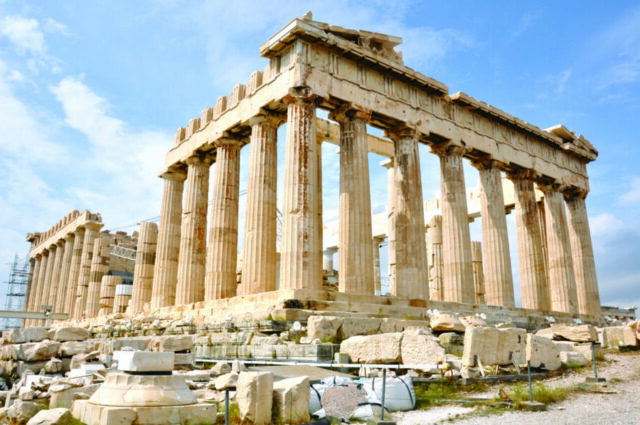
The temple — dedicated to the goddess Athena, the patron of Athens — was the crowning glory of the city’s enormous urban-renewal program during its Golden Age in the fifth century BC. After the Persian War, Athenians set about rebuilding the Acropolis, creating a vast and harmonious ensemble of temples and monuments with the Parthenon as the centerpiece.

Climbing the fabled hill, you reach the summit and, of everything there, bam: The Parthenon is the showstopper — the finest temple in the ancient world, standing on the highest point, 500 feet above sea level. Constructed about 440 BC, it’s massive, the largest Doric temple in Greece — about 230 feet long and 100 feet wide. It’s surrounded by 46 white-marble columns, each 34 feet high, 6 feet in diameter, and capped with a 12-ton capital.

But even more impressive than its sheer size is the building’s sheer beauty. The columns are in the classically simple Doric style — lightly fluted, with no base, and topped with plate beneath a square slab. In its heyday, the pure white structure was adorned with colorful statues and reliefs painted in vivid colors. Inside was a legendary 40-foot-tall statue of Athena (though now lost to history). All in all, the temple was a model of balance, simplicity, and harmonious elegance. It epitomized the goddess of wisdom, Athena, as well as the enlightenment of the Athenian people.

The architects achieved that harmonious effect with some clever optical illusions. For example, the Parthenon’s steps subtly arch up in the middle — to compensate for the sagging effect a flat line makes to the human eye. Similarly, the columns lean slightly inward to appear parallel, and they bulge imperceptibly in the middle to give a pleasing sturdiness as they support the stone roof.

The Parthenon’s builders used only the finest white Pentelic marble — 100,000 tons of it, brought in from a quarry 15 miles away. Unlike ancient structures constructed by the Egyptians and Romans, the Parthenon was not built by slaves, but by paid workers. The columns were made from huge marble drums, stacked like checkers, and fixed with metal pins in the center. Each piece of the Parthenon was unique — individually sized and cut to fit — then assembled on the spot like a giant 70,000-piece jigsaw puzzle.

The Parthenon, then and now, stands as the symbol of Athens’ Golden Age — that 50-year era of prosperity and enlightenment when the city laid the foundations for what came to be known as Western civilization. It’s one of the most influential works ever created by humankind. For 2,500 years, it’s inspired architects, sculptors, painters, engineers…and visitors from across the globe.

This art moment — a sampling of how we share our love of art in our tours — is an excerpt from the full-color coffee-table book Europe’s Top 100 Masterpieces by Rick Steves and Gene Openshaw. Please support local businesses in your community by picking up a copy from your favorite bookstore, or you can find it at my online Travel Store. To enhance your art experience, you can find a clip related to this artwork at Rick Steves Classroom Europe; just search for Parthenon.

Eyewitness Report: The Media’s Painting a Distorted Picture of Europe

We travelers know that the media can make faraway places seem chaotic or unsafe. One of our lead tour guides, Sarah Murdoch, shares her take on things from a smart, solo-woman traveler’s perspective in a wonderfully insightful blog titled “Adventures with Sarah.” In her latest post, she analyzes media-shaped images with her on-the-ground experiences in Rome (Jubilee Year mob scenes), Athens (refugee concerns), Paris (security issues), and London (after the Brexit vote). Sarah’s take is candid, fascinating, and answers questions that many of us logically have…and that’s why I’m sharing it here. Enjoy!

img_9943

Rick Steves Audio Europe: An Ancient Seduction in Athens

Warning: This video includes ancient nudity and general horniness! Along with updating my guidebooks when I travel, I enjoy giving my audio tours a “road test”. My audio tour co-author Gene Openshaw and I are always looking for ways to make the 45 tours in our Rick Steves Audio Europe™ app smoother and easier than ever. In Athens this past week, I’ve listened to myself whispering in my ear for four tours, and they all work great. As much as I love guidebooks, a museum or sight is much easier to enjoy when you can listen while gazing at what you came to see, instead of looking down and reading from a book. Here’s a two-minute sample (recorded on my iPhone) starring Aphrodite, Pan and Eros.

In April, we improved and expanded our free Rick Steves Audio Europe app. If you’ve got the old one, be sure to update it with the latest version (2.2 Apple; 2.0 Android) before your next trip! You can find the app here: ricksteves.com/audioeurope

Lots of people are making audio tours these days. What audio tours have you used? Where? Which ones have been most helpful for you?

Athens — Great Food, Big Economic Questions, and Hair on Fire

Every year it seems I go to places partly because naive and gullible Americans, whose worldview is fed by a diet of hysterical commercial TV news, are avoiding those places for supposed safety reasons. Of course, Greece has its economic crisis. But that doesn’t mean the 10 million people who live there aren’t living life with creativity and gusto.


boys eating.jpgI love to see students on the road. These two George Washington University students (enjoying a semester abroad) discovered the Karamanlidika by Fanis restaurant just like I did.


drakma.jpgThe big question on people’s minds here: Will Greece stick with the euro or return to the drachma? There’s a monument to Greece’s historic currency next to the mayor’s residence. For Greeks, the problem with being on the euro is that their currency is lashed to Germany, when instead it should have the flexibility to rise and fall in value as needed. Yet locals fear that if they go back to the drachma overnight, the value of their savings will drop by more than half. I wouldn’t want to count on a retirement here, but as a tourist you barely notice any economic crisis.


graffiti hair on fire.jpgAthens is not a pretty city. In fact, in conventional terms, it’s pretty ugly. But for locals, the graffiti is just there. They hardly see it. Given that graffiti is a reality, I do my best to enjoy it rather than ignore it.


street artist.jpgThere’s an unwritten rule among street artists/taggers that if a building is already painted they won’t mess it up. So, many businesses (like this insurance company) actually hire street artists to pre-emptively paint their storefronts.

Athens Yesterday and Today

It’s great traveling in Greece during the shoulder season — the days are lovely and warm (not hot) and the crowds are few. I’m here in historic, bustling Athens, home of the world’s top ancient site: the Acropolis. Athens, like Rome, went from being a major city in ancient times to nearly a ghost town, and then (partly because of its Classical heritage) grew into a major city again with a population of several million.

19th c athens.jpgAs a tour guide, it’s hard to describe Athens at the dawn of the modern age. This 19th-century Romantic etching does it well. Back then, the city was little more than a small town (today’s Plaka) built around its ancient ruins.


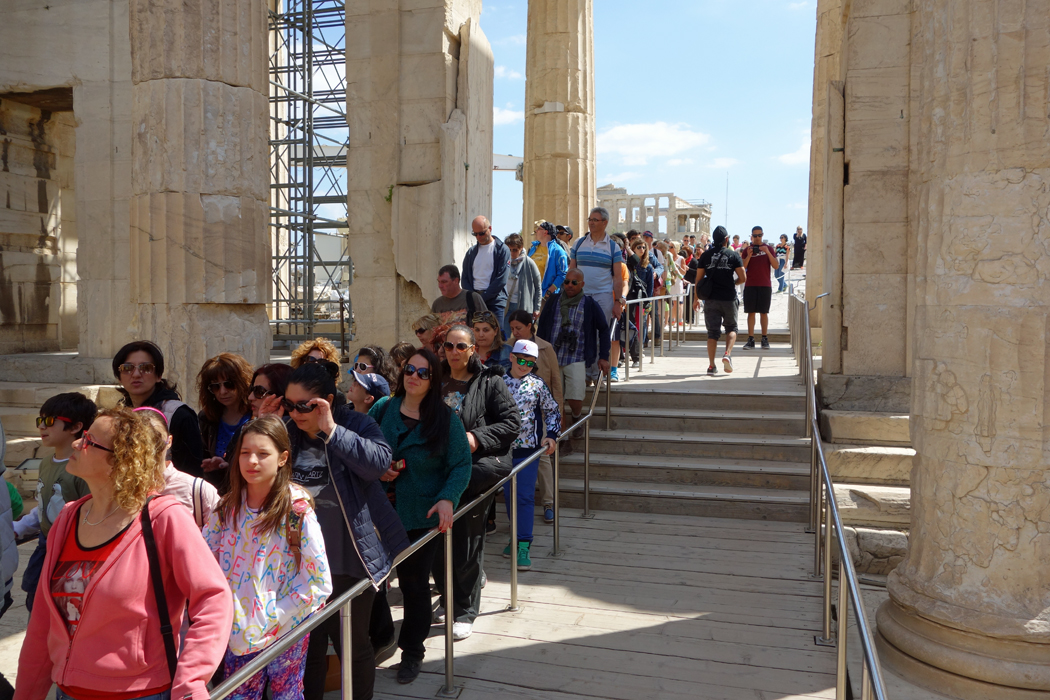
acropolis lines.jpgIn the city of Athens, even with its booming tourist trade, must-see sights, and cruise-ship crowds, there is only one sight where lines are a concern — and that’s the Acropolis. The good news: The Acropolis ticket is a combo-ticket that you can pick up at a number of other sights in town. Buy the ticket elsewhere and then use it to walk straight into the Acropolis. The cruise-ship groups get there first thing, but when I arrived around noon, the cruise-crowd rush hour was heading in the opposite direction.


arcopolis museum.jpgThe Acropolis experience is complete with a visit to the amazing Acropolis Museum. It basically takes all the surviving bits of carved marble (that didn’t end up in London) and sorts them out in a setting that is the size of the Parthenon. You look out the window and see the remains of the actual temple above and then, with great comfort, lighting, and information, you enjoy the art — quasi in situ.


talking to art.jpg Our challenge as travelers is to actually talk with the art.