Daily Dose of Europe: The Castles of Boyhood Dreams

The magic of Europe can make any traveler feel like a kid again. And one of my favorite places for that “king-of-the-castle” feeling is in the Bavarian and Tirolean Alps.

Even though we’re not visiting Europe right now, I believe a daily dose of travel dreaming can be good medicine. I just published a collection of my favorite stories from a lifetime of European travels. My new book is called “For the Love of Europe” — and this story is just one of its 100 travel tales.
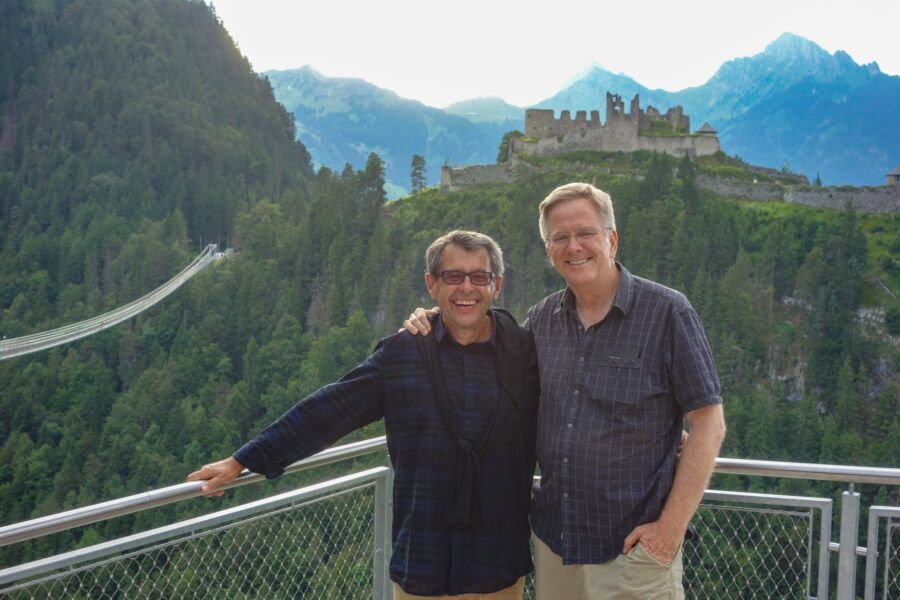
South of Munich in the foothills of the Alps is Hohenschwangau Castle. It was “Mad” King Ludwig’s father’s castle — and Ludwig’s boyhood summer home. When his father died, Ludwig became king. He was just a boy, 19 years old. And rather than live with the frustrations of a modern constitution and a feisty parliament in Munich reining him in, King Ludwig II spent his next years lost in Romantic literature and operas…hanging out here with composer Richard Wagner as only a gay young king could.

The king’s bedroom was decked out like a fairy tale. The walls were painted in 1835 by a single artist, who gave the place a romantic, Tolkien fantasy feel. Lounging nymphs still flank the window and stars twinkle from the ceiling. A telescope stands as it did for the king, trained on a pinnacle on a distant ridge where Ludwig dreamed of building his ultimate castle fantasy: Neuschwanstein. On my first visit here, squinting through that telescope at Neuschwanstein (which had also inspired a boy named Walt Disney), I could relate to the busy young king. Bound by schoolwork and house rules rather than a constitution and parliament, with a stretched-out turtleneck and zits rather than crowns and composer friends, I too built a castle.

What I had that Ludwig lacked was a father who imported pianos. Shipped from Germany, they came encased in tongue-in-groove pine, sealed in a thick envelope of zinc sheeting. My wooden tree house was my castle: walls decorated with romantic 1968 magazines, the nails shining through the ceiling just long enough to bloody intruding bullies taller than me. Taking full advantage of those sliding pine boards, I could see who was coming. With a shiny zinc roof, my palace was the envy of other little kings. There was no tree house like it. Then, someone purchased the vacant lot next to our house, and I had to tear my tree castle down. At the time, I considered it the worst day of my life. Not long after, I embarked on my first no-parents trip to Europe. Touring Neuschwanstein, I relived my loss.

On that same trip, just over the border in Austria near the town of Reutte, I found another castle: the brooding ruins of the largest fort in Tirol — Ehrenberg. This impressive complex was built to defend against the Bavarians and to bottle up the strategic “Via Claudia” trade route that cut through the Alps here, connecting Italy and Germany. One castle crowned its bluff while another was high above on the next peak. Exploring the ruins, I climbed deep into a misty forest littered with meaningless chunks of castle wall — each pinned down by pixy-stix trees and mossy with sword ferns. This once strategic and powerful fortress had somehow fallen apart and was slowly being eaten by the forest.

My friend Armin Walch, an archaeologist who lives in Reutte, had a vision to bring these ruins to life. He was born the same year as me and pursued his project like the Indiana Jones of castle scholars. Today, with European Union funding, he’s cut away the hungry forest to reveal and renovate what he calls the castle ensemble. And it’s open for business, enabling countless children to live out their medieval fantasies, leaping from rampart to rampart with sword ferns swinging.

On my last visit, I was honored for bringing so many visitors to this remote corner of Austria over the years. With Armin as the jovial master of ceremonies, the town’s hoteliers and tourism folks gathered in the castle like a council of medieval lords. Together we ate smoked game and rustic cheese with coarse bread. We swilled wine and clinked pewter mugs. I gave an impromptu speech about the wonders of Americans climbing through history far from home. Then I knelt before a man in armor who drew a shiny sword with my name etched upon it, and was knighted — Sir Rick, first knight of Ehrenberg.

The sword was my gift. It was solid and sparkled with sentiment. I loved how it felt in my hand as I swung it back and forth, cutting through the air — and how it symbolically wove together my tree-house childhood, my love of history, my longtime connection with Reutte, and Armin’s vision. But the last thing I needed was to be packing a big sword through the rest of my trip. So I requested that my sword stay in the museum as a special exhibit on the castle-loving boy from Seattle who fell in love with the Ehrenberg ruins and then grew up to bring decades of American travelers to Reutte with his guidebooks.

On the way back to my hotel, Armin took me to his house for a drink. As a talented architect, he had cleverly hidden his sleek, futuristic, and creative pad behind a humble old-town facade. It was a royal domain for his family — two kids cozy on the carpet and a beautiful wife. Armin had bedazzled her at the university in Vienna and brought her here to remote Reutte with promises of a queenly life and a bitchin’ castle.

Armin and I climbed boyishly to his rooftop — a perch he designed to view Ehrenberg. Together we shared a glass of schnapps flavored with local herbs and peered through his telescope at our favorite castle complex — now illuminated by powerful floodlighting. In his youth — before he excavated it — almost no one knew about the fortress that hid beneath the trees on the mountain. Nudging me aside, Armin took his turn squinting through his telescope. Happy as two boys in a tree house, like two Romantic Age princes, we marveled at this castle of his dreams.

This story appears in my newest book, For the Love of Europe — collecting 100 of my favorite memories from a lifetime of European travel. Please support local businesses in your community by picking up a copy from your favorite bookstore, or you can purchase it at my online Travel Store. You can also find a clip related to this story at Rick Steves Classroom Europe; just search for Neuschwanstein and Ehrenberg.
Rewatching The Story of Fascism in Europe

One summer evening, the American president ordered a park next to the White House to be cleared of peaceful protesters. He had just declared himself “the law and order president” and announced his intent to mobilize the US military to subdue dissent across the country. And he was about to show off with his own display of force.

The militarized police’s rubber bullets and choking gas drove back throngs of people who were in Lafayette Park lawfully, to protest police brutality. Once the smoke cleared, that president marched through the park, with an entourage of sycophants, and stood before one of the most historic churches in America. There he held up a Bible for a cynical photo op. He brandished the book (upside-down) as if he had never read it. “Is that your Bible?” a reporter asked. “It’s a Bible,” he replied with a smirk.

If I described this scene even a few years ago, you would never have believed that it was real. And yet here we are. As a Christian and a humanitarian, this scene offends me deeply. And as a privileged white man in America, the events of the last week have been a painful but important reminder that so many Americans are denied the basic rights that people like me take for granted every day. To me, “law and order” should mean that Black Lives Matter and all Americans deserve equal protection under the law.

Challenging times — like right now — call for strong leadership: a voice of unity, compassion, and mutual understanding. True leadership is nonpartisan, and in my lifetime, I’ve seen both Democrats and Republicans succeed in bringing together a fractured nation. But that’s not what we have today.

Two years ago, I produced a public television special called The Story of Fascism in Europe. I was driven by what I saw as uneasy parallels between our current political reality and the climate in 1930s Europe that gave rise to Hitler and Mussolini, and by my belief that we need to learn from that history. Today, those parallels have become impossible to deny.

The first 15 or 20 minutes of the special, as the seeds of fascism are planted in Germany and Italy, feel especially relevant in today’s America. Notice how the militarization of police and the scapegoating of “others” are textbook stepping stones in tipping a nation toward authoritarianism. Pay attention to Hitler’s “Brownshirts” and Mussolini’s “Blackshirts” — goon squads who hijacked otherwise peaceful gatherings to stoke dissent. Tune into how they called into question the legitimacy of a democratic system; how they, too, held up an unread Bible; and how they reassured supporters by offering simple solutions to complex challenges. Pay attention to how a fascist takes advantage of a crisis — or several — to consolidate power and to sow fear and chaos. And remember how Hitler and Mussolini both insisted that they, alone, had the answers for all of these problems. As they say, history may not repeat itself. But sometimes it rhymes.

One thing I learned as I researched and produced this special is that there are pivotal moments in a nation’s history when good and caring people can stand up against the rising tide of anger and fear that can lead to fascism. Or they can be complacent and wake up having lost their freedom. Our country is not too far gone…yet. But these coming weeks and months would be a good time for anyone who remembers the fate of Europe in the 1940s to organize, speak out, and vote in a way that helps keep us off that course.

For starters, be sure you and your loved ones, friends, and neighbors are registered to vote. (And during a pandemic, consider requesting an absentee ballot.) https://vote.gov/

Many ask, “What can I do?” Here’s one answer: In response to the systemic racism woven into our democracy, and to let the murder of George Floyd inspire us to bring something positive to our troubled society, this month my company is donating $50,000 to Lawyers and Collars, an initiative spearheaded by Sojourners that is working to defend voter rights in states where people of color are targeted. The goal: to support 1,000 black pastors and their allies who are ready in key states to protect the vote. In Alabama, Florida, Georgia, Michigan, North Carolina, Ohio, and Pennsylvania, they will mobilize their congregations and communities. If you’d like to join us, with even just a small donation, you can do it here: sojo.net/LCRS

Those of us who have the privilege of traveling to Europe have been blessed with an opportunity to get to know other societies — including ones that have lived through fascism — and to learn from them. Let’s bring those lessons home, and let’s do our best to provide grassroots leadership, as we find a way to heal our fractured country — with compassion, empathy, and real progress.

Watch the one-hour special: The Story of Fascism in Europe.

Daily Dose of Europe: Dürer’s Self-Portrait

Italian Renaissance artists get all of the attention. But don’t miss the huge talents of the Northern Renaissance — especially Albrecht Dürer.

The coronavirus can derail our travel plans…but it can’t stop our travel dreams. And I believe a daily dose of travel dreaming can actually be good medicine. One of the great joys of travel is seeing art masterpieces in person. And I’m currently featuring 10 of my favorites — including this one.

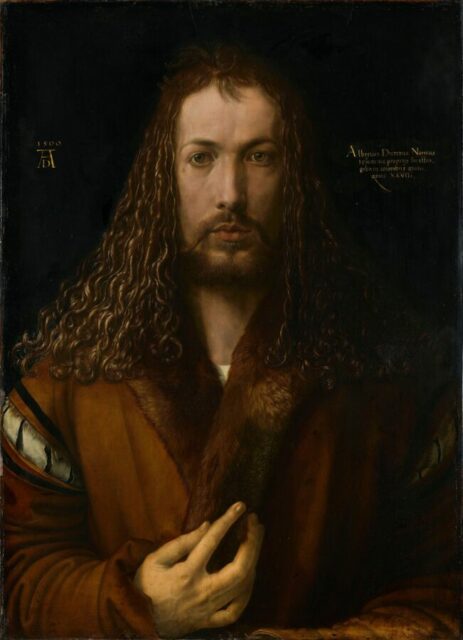
Albrecht Dürer was the first artist to paint a self-portrait. Here he stares out intensely — you can’t avoid his gaze. He’s decked out in a fancy fur-lined coat and perfectly permed hair. Dürer had recently returned from Italy and wanted to impress his fellow Germans with his sophistication. Dürer wasn’t simply vain. He’d grown accustomed, as an artist in Renaissance Italy, to being treated like a prince.

Dürer marks this snapshot with an exact place and time. To the left of his face is the year — “1500.” To the right is a Latin inscription saying “I, Albrecht Dürer from Nürnberg, painted myself with indelible colors at XXVIII years” (age 28).

Though still a young man, Dürer was now the most famous artist in Europe. His woodcut prints and engravings had been shared with thousands, thanks to the newly invented mass medium of the printing press. This painting has an engraver’s attention to detail. The hair is intricately braided into cascading ringlets. The skin texture is shaded just right. His well-cropped beard and finely curved lips are those of a handsome man. In the fur collar, you can see every individual hair. Dürer’s eyes radiate intelligence. It’s a very personal portrait of a real flesh-and-blood human being.

Portraits of real people were just coming into their own. During medieval times, only Christ and the saints were worth painting. Oh, a few kings and dukes got portraits, but these were usually photoshopped to show them in the best light. Artists never painted themselves. They were low on the societal totem pole, anonymous, considered blue-collar craftsmen who worked with messy paints.

But Dürer had visited Renaissance Italy, where he saw a revolution underway. Ordinary citizens were now deemed worthy to be depicted in all their everyday glory, warts and all. And artists — like Botticelli, Michelangelo, and Titian — were rock stars.

Dürer returned to Germany and created Europe’s first true selfies. This is a life-size, stand-alone portrait of himself, as rich and monumental and serious as any saint or king. In fact, look closely at Dürer’s intense, full-frontal gaze and raised hand. He looks exactly like a Christ from a medieval altarpiece, raising his hand in solemn blessing. This was the ultimate humanist statement. It focused on a man, not a saint, portraying him almost like Christ on earth — the artist as an instrument of God, carrying on his creation.

After Dürer, self-portraits became a thing. Raphael photobombed his own masterpiece, The School of Athens. Michelangelo painted his twisted self-portrait in The Last Judgment. Rembrandt’s self-portraits show the artist’s evolution — from unsure young man, to confident careerist, to brooding old man. Van Gogh added even more psychological intensity, and Picasso gave a backstage peek at his work process. Each artist’s self-portrait shows his emotional state, a glimpse at how beauty is born.

But ultimately, Dürer’s self-portrait is not a statement or a symbol, but just what it appears to be — a photorealistic snapshot of a very remarkable man. To hammer home his personal imprint, the artist signed the work with his distinct signature — a letter A arching over a D: Albrecht Dürer.

This art moment — a sampling of what we try to incorporate in our tours — is an excerpt from the full-color coffee-table book Europe’s Top 100 Masterpieces by Rick Steves and Gene Openshaw. Please support local businesses in your community by picking up a copy from your favorite bookstore, or you can find it at my online Travel Store. To enhance your art experience, you can find a clip related to this artwork at Rick Steves Classroom Europe; just search for Durer.

Daily Dose of Europe: Berlin’s Reichstag — Teary-Eyed Germans and a Big Glass Dome

Years ago, when I got my history degree, I said to myself, “I’d better get a business degree, too, so I have something useful.” But I’ve learned over the years that if more people knew more about history, our world would be a better place.

Even if we’ve had to postpone trips to Europe, I believe a daily dose of travel dreaming can actually be good medicine. Here’s another one of my favorite travel memories — a reminder of what’s waiting for you in Europe at the other end of this crisis.

History is constantly speaking to us. Travelers enjoy a privileged way to hear it — and sometimes an up-close chance to witness history in the making.

Whenever I see the restored Reichstag building in Berlin, I’m reminded of my visit in 1999, when it reopened to the public. For tourists unaware of history, it was just a new dome to climb, offering another vantage point on the city. But a knowledge of its past gives it far deeper meaning. It was in this building that the German Republic was proclaimed in 1918. In 1933, this symbol of democracy nearly burned down. While the Nazis blamed a communist plot, some believe that Hitler himself planned the fire. Whatever the case, he used the fire as a convenient excuse to frame the communists and grab total power.

After 1945, this historic home of the German parliament — which saw some of the last fighting of World War II on its rooftop — stood as an abandoned and bombed-out hulk overlooking the no-man’s-land between East and West Berlin. After reunification, Germany’s government returned from Bonn to Berlin. And, in good European fashion, the Germans didn’t bulldoze their parliament building. They respected the building’s cultural roots and renovated it.

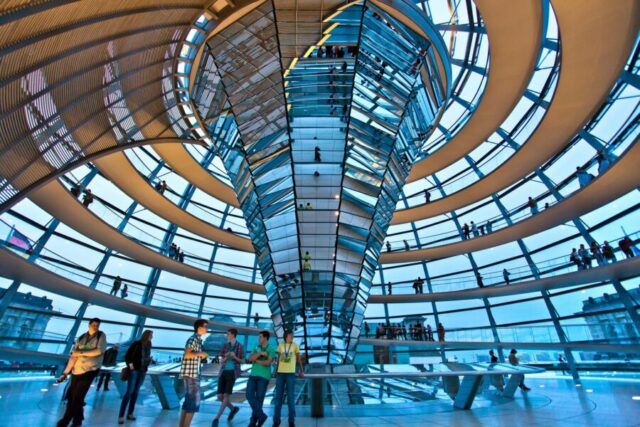
They capped it with a glorious glass dome, incorporating modern architectural design into a late-19th-century icon, and opened it up to the people. The dome rises 50 yards above the ground. Inside, a cone of 360 mirrors reflects natural light into the legislative chamber below. Lit from inside at night, it gives Berlin a kind of lantern celebrating good governance.

The Reichstag dome is a powerful architectural symbol. German citizens climb its long spiral ramp to the very top and look down, literally over the shoulders of their legislators, to see what’s on their desks. Jerked around too much by their politicians in the past century, Germans are determined to keep a closer eye on them from now on. And this dome is designed to let them do exactly that.

When the Reichstag first reopened, I climbed to the top of the dome and found myself surrounded by teary-eyed Germans. Anytime you’re surrounded by teary-eyed Germans, something exceptional is going on. It occurred to me that most of these people were old enough to remember the difficult times after World War II, when their city lay in rubble. What an exciting moment for them: the opening of this grand building was the symbolic closing of a difficult chapter in the history of a great nation. No more division. No more communism. No more fascism. They had a united government entering a new century with a new capitol building, looking into a promising future.

It was a thrill to be there. I was caught up in it. As I looked around at the other tourists, it occurred to me that most of them didn’t have a clue about what was going on. They were so preoccupied with trivialities — camera batteries, their Cokes, the air-conditioning — that they missed a once-in-a-lifetime opportunity to celebrate this great moment with the German people. I thought, “I’m living in a dumbed-down society.” And it saddened me. I don’t want to live in a dumbed-down society.

Powerful forces find it convenient when we’re dumbed down. As a society, we become easier to manipulate…easier to make money from. I vowed right there, in my work as a travel writer, that I would expect my readers to be engaged…and made smarter by their travels.

In mainstream tourism, we’re often encouraged to be lighthearted and avoid the serious. Sure, fun in the sun, duty-free shopping, and bingo can be a big part of your vacation. I enjoy it, too. But all this can distract us from a more important reason to travel. Travel can broaden our perspective, enabling us to rise above the advertiser-driven info­tainment we call the news to see things as citizens of the world. By plugging directly into the present and getting the world’s take on things firsthand, a traveler goes beyond traditional sightseeing. (And shortly after that inspirational Berlin visit, I wrote an entirely new kind of book that develops that notion, called Travel as a Political Act.)

When we travel, we have the opportunity to see history as it’s unfolding. With knowledge of the past, we can better appreciate the significance of what’s happening today. That’s something a lot of travelers don’t take advantage of…and it’s never been more important.

(This story is excerpted from my upcoming book, For the Love of Europe — collecting 100 of my favorite memories from a lifetime of European travel. It’s coming out in July, and available for pre-order. And you can also watch a video clip related to this story: Just visit  Rick Steves Classroom Europe  and search for Reichstag.)

Daily Dose of Europe: Battleground Bacharach

I’m thinking back on my favorite European memories, and my favorite Europeans…including Herr Jung, the German schoolteacher who passed away not long ago. When I close my eyes, I can still imagine Herr Jung walking me around his hometown…

Even if we’ve had to postpone trips to Europe, I believe a daily dose of travel dreaming can actually be good medicine. Here’s another one of my favorite travel memories — a reminder of what’s waiting for you in Europe at the other end of this crisis.

Cruising down the romantic Rhine River, we dodge the treacherous reefs that spelled disaster for ancient sailors distracted by the fabled Lorelei siren. We dock at the half-timbered town of Bacharach, where I jump out. Bacharach, wearing a castle helmet and a vineyard cape, is a typical Rhine village. It lines the river and fills its tiny tributary valley with a history you can hook arms within a noisy Weinstube.

“Bacharach” means “altar to Bacchus.” The town and its wine date from Celtic and Roman times. Local vintners brag that the medieval Pope Pius II preferred Bacharach’s wine and had it shipped to Rome by the cartload. Today, tourists drink it on the spot.

For each wine festival, Bacharach installs an honorary party mayor. He’s given the title of Bacchus. The last Bacchus, one of the best wine gods in memory, died a year ago. Posters left up as a memorial, it seems, show his pudgy highness riding a keg of Riesling, wearing a tunic, and crowned with grapes as adoring villagers carry him on happy shoulders. Bacharach’s annual wine fest is the first weekend of October, just before the harvest. Its purpose is to empty the barrels and make room for the new wine, a chore locals take seriously.

The festival is months away, but the dank back alleys of Bacharach smell like the morning after. I drop my bag at Hotel Kranenturm, then head back to the boat dock. I’ve arranged a private walk through town with Herr Jung, Bacharach’s retired schoolmaster.

The riverfront scene is laid-back. Retired German couples, thick after a lifetime of beer and potatoes, set the tempo at an easy stroll. I gaze across the Rhine. Lost in thoughts of Bacchus and Roman Bacharach, I’m in another age…until two castle-clipping fighter jets from a nearby American military base drill through the silence.

The Rhine Valley is stained by war. While church bells in Holland play cheery ditties, here on the Rhine they sound more like hammers on anvils. At bridges, road signs still indicate which lanes are reinforced and able to support tanks. As the last of the World War II survivors pass on, memories fade. The war that ripped our grandparents’ Europe in two will become like a black-and-white photo of a long-gone and never-known relative on the mantle.

I pause at Bacharach’s old riverside war memorial. A big stone urn with a Maltese cross framed by two helmets, it seems pointedly ignored by both the town and its visitors. Even when it was erected to honor the dead of Bismarck’s first war in 1864, its designer sadly knew it would need to accommodate the wars that followed: Blank slabs became rolls of honor for the dead of 1866, 1870, and 1914–18.

Herr Jung arrives and I ask him to translate the words carved on the stone.

“To remember the hard but great time…” he starts, then mutters, “Ahh, but this is not important now.”

Herr Jung explains, “We Germans turn our backs on the monuments of old wars. We have one day in the year when we remember those who have died in the wars. Because of our complicated history, we call these lost souls not war heroes but ‘victims of war and tyranny.’ Those who lost sons, fathers, and husbands have a monument in their heart. They don’t need this old stone.”

Rolf Jung is an energetic gentleman whose glasses seem to dance on his nose as he weaves a story. When meeting my tour groups for guided walks, he greets them as he did his class of fifth-graders decades ago, singing like a German Mr. Rogers: “Good morning, good morning, to you and you and you…” Like so many Europeans, he has a knack for finding dignity and pride in his work, no matter how grand or small the job. A walk with Herr Jung always makes me feel good about Europe.

As I ponder the memorial, he quotes Bismarck: “Nobody wants war, but everyone wants things they can’t have without war.”

Herr Jung looks past the town’s castle, where the ridge of the gorge meets the sky and says, “I remember the sky. It was a moving carpet of American bombers coming over that ridge. Mothers would run with their children. There were no men left. In my class, 49 of the 55 boys lost their fathers. My generation grew up with only mothers.

“I remember the bombings,” he continues. “Lying in our cellar, praying with my mother. I was a furious dealmaker with God. I can still hear the guns. Day after day we watched American and Nazi airplanes fighting. We were boys. We’d jump on our bikes to see the wreckage of downed planes. I was the neighborhood specialist on war planes. I could identify them by the sound.

“One day a very big plane was shot down. It had four engines. I biked to the wreckage, and I couldn’t believe my eyes. Was this a plane designed with a huge upright wing in the center? Then I realized this was only the tail section. The American tail section was as big as an entire German plane. I knew then that we would lose this war.”

The years after the war were hungry years. “I would wake in the middle of the night and search the cupboards,” he says. “There was no fat, no bread, no nothing. I licked spilled grain from the cupboard. We had friends from New York and they sent coffee that we could trade with farmers for grain. For this I have always been thankful.

“When I think of what the Nazis did to Germany, I remember that a fine soup cooked by 30 people can be spoiled by one man with a handful of salt.”

Herr Jung takes me on a historic ramble through the back lanes of Bacharach. Like any good small-town teacher, he’s known and admired by all.

Then we climb through the vineyards above town to a bluff overlooking a six-mile stretch of Rhine. “I came here often as a boy to count the ships,” he says. “I once saw 30 in the river in front of Bacharach.”

We look out over the town’s slate rooftops. Picking up a stone, he carves the letters “Rick” into a slate step and tells me, “Now you are here, carved in stone…until the next rain.”

Ever a teacher, he explains, “Slate is very soft. The Rhine River found this and carved out this gorge. Soil made from slate absorbs the heat of the sun. So, our vines stay warm at night. We grow a fine wine here on the Rhine.

“Today the vineyards are going back to the wild. Germans won’t work for the small pay. The Polish come to do the work. During the Solidarity time I housed a guest worker. After 11 weeks in the fields, he drove home in a used Mercedes.”

We pass under the fortified gate and walk back into town, cradled safely in half-timbered cuteness. My teacher can sense what I’m thinking: that Bacharach was never good for much more than inspiring a poem, selling a cuckoo clock, or docking a boat. Stopping at a bench, Herr Jung props his soft leather briefcase on his knee and fingers through a file of visual aids, each carefully hand-colored and preserved in plastic for rainy walks. He pulls out a sketch of Bacharach fortifications intact and busy with trade to show how in its heyday, from 1300 to 1600, the town was rich and politically important.

“Medieval Bacharach had 6,000 people. That was big in the 15th century,” he says. “But the plagues, fires, and religious wars of the 17th century ended our powerful days. Bacharach became empty. It was called ‘the cuckoo town.’ Other people moved in the way a cuckoo takes over an empty nest. For 200 years now, our town has been only a village of a thousand.”

In the mid-19th century, painters and poets like Victor Hugo were charmed by the Rhineland’s romantic mix of past glory, present poverty, and rich legend. They put this part of the Rhine on the Grand Tour map. And the “Romantic Rhine” was born.

A ruined 15th-century chapel hangs like a locket under the castle and over the town. In 1842, Victor Hugo stood where Herr Jung and I now stand. Looking at the chapel, he wrote, “No doors, no roof or windows, a magnificent skeleton puts its silhouette against the sky. Above it, the ivy-covered castle ruins provide a fitting crown. This is Bacharach, land of fairy tales, covered with legends and sagas.”

While military jets soar, Roman towers crumble. Herr Jung has since passed away. But the Lorelei still sings its siren song. Bacharach is a town with a story that I would never have known without a friend and a teacher like Herr Jung.

(This story is excerpted from my upcoming book, For the Love of Europe — collecting 100 of my favorite memories from a lifetime of European travel. It’s coming out in July, and available for pre-order. And you can also watch a video clip related to this story: Just visit  Rick Steves Classroom Europe  and search for Bacharach.)