I’m in Germany with my TV crew, filming a new one-hour special about 20th-century fascism in Europe that will air next September on public television. Over the next several days, I’ll be sharing photos and videos from behind the scenes.
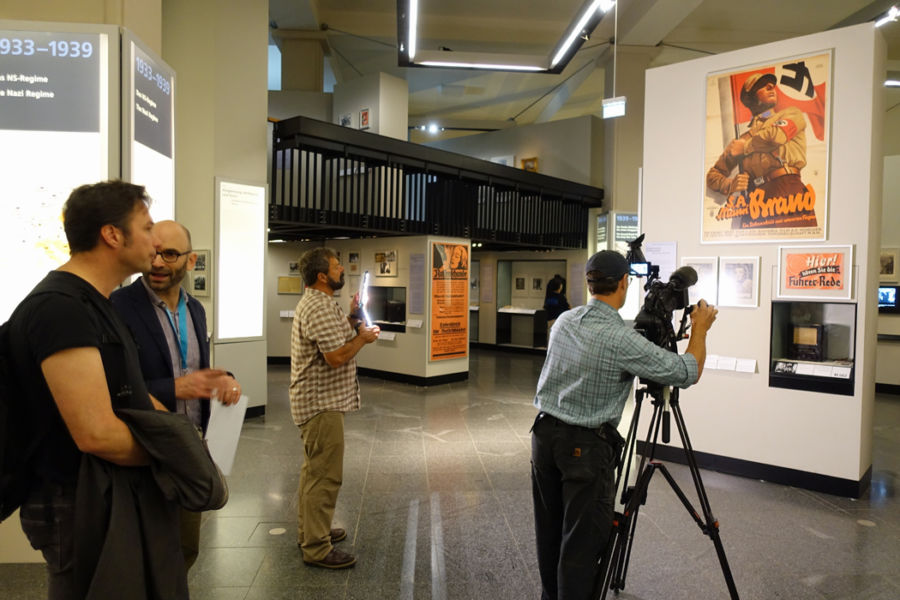
Here’s a look at the powerful propaganda art on display in Berlin’s Museum of German History (which has the best artifacts from the Hitler years I’ve seen anywhere in Germany):
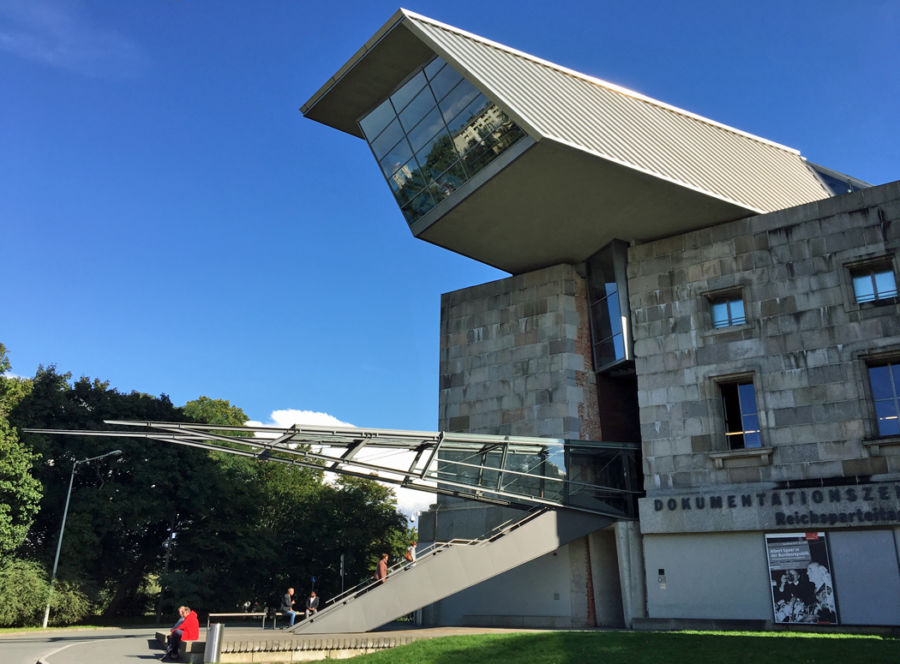
The entry of the Documentation Center in Nürnberg architecturally cuts like a dagger through Hitler’s massive, yet unfinished, Nazi Congress Hall:
A famous statue evokes the human suffering at Hitler’s first concentration camp, Dachau:
Here’s a short clip (with a daring little pun buried inside) from one of the new episodes of my TV show, airing now across the country on public television and online in the Watch the TV Show section of my website.
We had a fascinating time filming the Nazi Documentation Center in Hitler’s favorite city, Nürnberg. It’s fascinating (and, hopefully, instructive) to think of the tenor of those turbulent times in Germany and how Hitler came to power. His specialty: huge rallies, stoking the fears of angry masses (especially fears of minorities), and a dumbed-down message that repeated lies and insults until his followers started shouting them back. He had a passion for constructing buildings as bombastic as his speeches.
To this day, Germans ask: How could this have happened? Hitler was a master of media and the mass hypnosis of the German nation. His populist promises (coming on the heels of tough economic times) led to catastrophe. One positive that came from this: to this day, Germany works to make its electorate not dumbed-down, but smarter. Perhaps another positive: that we might take the lessons history wants to teach us a little more seriously.
I’m just wrapping up three weeks of filming in Germany, and I’m impressed by the souvenirs of its tumultuous history. Doing TV shows on Frankfurt, Nürnberg, Dresden, Leipzig, and Hamburg, you can’t avoid the flipside of Germany’s greatness. Here are a few historical artifacts that have stuck with me.
Outside of Leipzig is the wildest war memorial I’ve ever seen. This is the 300-foot-tall Völkerschlachtdenkmal. Just saying it makes you think “huge casualties.” It is the Monument of the Battle of the Nations, built in 1913 to commemorate the biggest battle of its day: when Prussia, Austria, Russia, and other allies teamed up to beat Napoleon in 1813. Half a million men were involved, and there were about 100,000 causalities. The powerful art and symbolism inside makes you weep and salute at the same time. Do you have a personal “most impactful war memorial” in Europe?
This statue, on Leipzig’s main drag, recalls the dual dictatorships — first from the far-right, then from the far-left — that Germany lived under in the 20th century. It features the flat-palmed Sieg Heil! Nazi salute and the proletariat’s raised communist fist at the same time. Meanwhile, the poor fellow who has little choice but to raise his arms scrunches down under his collar, hoping to somehow get through it all.
After spending ten days filming our upcoming public television special on Martin Luther and the Reformation, we were tuned into statues of Martin Luther. He seems to be on squares and in front of churches all over Germany. Here in Dresden, in front of the Frauenkirche, we met another Luther — hand on his Bible, as if reminding people of his mission to translate the Word of God from Latin into the people’s language, so all could read it for themselves.
At the Nazi parade grounds in Nürnberg, we stood on the tribune platform where Hitler stoked the fears and hatreds of 200,000 assembled Nazis. And then our guide took us inside the structure, through several huge, stark, gold-veneered rooms with massive dishes for devilish flames. As these rooms aren’t open to the public, we didn’t film them (because we have an ethic of not showing things on TV that our viewers can’t personally experience). But it was a chilling little side-trip.
I’ve left England and have made my way to Germany, where I’m filming new TV shows for our upcoming season. And my first stop is a beautiful town with some sinister connections: Nürnberg.
Hitler had a warm place in his cold heart for Nürnberg. Within sight of the castle of the Holy Roman Emperor, who ruled the First Reich, Hitler held his massive rallies to pump up the Third Reich. It’s amazing how much actually survives of the place where he threw mammoth propaganda spectacles to build community.
As we filmed this, we wondered if the word “community” was too positive — but Nazism was community, in both the inclusive sense and in the exclusive sense. With a classic fascist stance, Hitler made it clear: Either you were with him, or you were against him. Today, the rust and the stink of urine at his former tribune is a reminder of what present-day Germans think of this place.
Politicians writing a book before running for the highest office in the land is nothing new. Hitler did it with Mein Kampf — the sale of which is still forbidden in Germany.
My latest visit to Nürnberg — with its excellent Nazi Documentation Center — got me thinking about ways that Germany is still grappling with its Nazi past.
Spending the day with my German guide at the Documentation Center was intellectually exhausting. We explored Hitler-mania and the methods used to create the cult of Hitler (such as placing the dictator alongside Goethe and Beethoven in the pantheon of great Germans).
I find that older guides in Germany are less comfortable talking about the Nazi period. My guide was young and had plenty of ideas to share. Looking back on German society since World War II, he said, “There were three generations: the participants, the generation of unknowns, and the current curious and educated generation.” Today’s young Germans see the end of WWII as a liberation rather than a defeat.
The exhibits at Nürnberg’s Documentation Center illustrate how extremists rise in bad times. They offer easy solutions and scapegoats. And they push fear. In Germany’s roaring ’20s, Hitler’s support was at 2%. When the Great Depression hit in 1929, suddenly Hitler had a 37% approval rating.
The exhibits also show how totalitarian societies take over part of the parenting role and give kids hope for the future. Nazi youth organizations created a frame of reference. They dealt with the complexities of teenage life pre-emptively and on their terms.
I asked my guide about the “socialism” part of National Socialism (Nazism). He explained that National Socialism was born in the trenches of World War I. Germany was very developed around 1900, and its workers’ economy should have been ripe for Marx’s idea of a proletarian revolt. But WWI trenches brought together all levels of society (farmers, factory workers, teachers, doctors). The enemy of the people became not the owners of das Kapital, but foreign nations. It was workers as a nation against exterior threats spearheaded by a presumed Jewish conspiracy (as it was believed that Britain, France, and the USA all had Jewish power-brokers). And that’s where the “socialism” in National Socialism came from.
Discussing how post-WWII Europe compares with the mess in Iraq today, we considered how while the Nazi leadership was defeated, Nazi infrastructure survived the war and helped rebuild German society. In the case of Iraq, no societal infrastructure survived Saddam Hussein. While post-Hitler Germany became strong, post-Saddam Iraq faces a more difficult path.
So much can be learned from history. But too often, those who make it took other classes.