Italian Renaissance artists get all of the attention. But don’t miss the huge talents of the Northern Renaissance — especially Albrecht Dürer.
The coronavirus can derail our travel plans…but it can’t stop our travel dreams. And I believe a daily dose of travel dreaming can actually be good medicine. One of the great joys of travel is seeing art masterpieces in person. And I’m currently featuring 10 of my favorites — including this one.
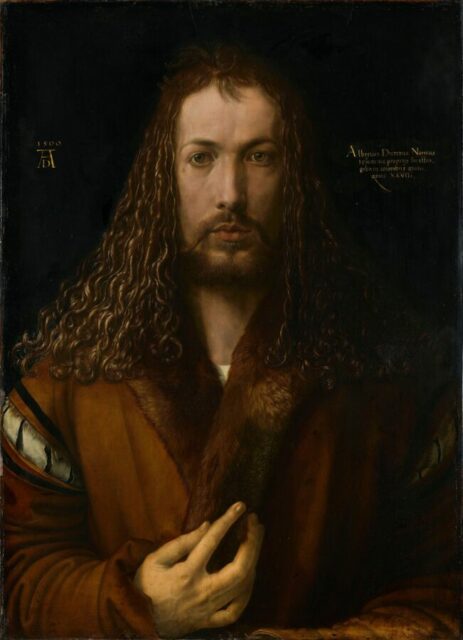
Albrecht Dürer was the first artist to paint a self-portrait. Here he stares out intensely — you can’t avoid his gaze. He’s decked out in a fancy fur-lined coat and perfectly permed hair. Dürer had recently returned from Italy and wanted to impress his fellow Germans with his sophistication. Dürer wasn’t simply vain. He’d grown accustomed, as an artist in Renaissance Italy, to being treated like a prince.
Dürer marks this snapshot with an exact place and time. To the left of his face is the year — “1500.” To the right is a Latin inscription saying “I, Albrecht Dürer from Nürnberg, painted myself with indelible colors at XXVIII years” (age 28).
Though still a young man, Dürer was now the most famous artist in Europe. His woodcut prints and engravings had been shared with thousands, thanks to the newly invented mass medium of the printing press. This painting has an engraver’s attention to detail. The hair is intricately braided into cascading ringlets. The skin texture is shaded just right. His well-cropped beard and finely curved lips are those of a handsome man. In the fur collar, you can see every individual hair. Dürer’s eyes radiate intelligence. It’s a very personal portrait of a real flesh-and-blood human being.
Portraits of real people were just coming into their own. During medieval times, only Christ and the saints were worth painting. Oh, a few kings and dukes got portraits, but these were usually photoshopped to show them in the best light. Artists never painted themselves. They were low on the societal totem pole, anonymous, considered blue-collar craftsmen who worked with messy paints.
But Dürer had visited Renaissance Italy, where he saw a revolution underway. Ordinary citizens were now deemed worthy to be depicted in all their everyday glory, warts and all. And artists — like Botticelli, Michelangelo, and Titian — were rock stars.
Dürer returned to Germany and created Europe’s first true selfies. This is a life-size, stand-alone portrait of himself, as rich and monumental and serious as any saint or king. In fact, look closely at Dürer’s intense, full-frontal gaze and raised hand. He looks exactly like a Christ from a medieval altarpiece, raising his hand in solemn blessing. This was the ultimate humanist statement. It focused on a man, not a saint, portraying him almost like Christ on earth — the artist as an instrument of God, carrying on his creation.
After Dürer, self-portraits became a thing. Raphael photobombed his own masterpiece, The School of Athens. Michelangelo painted his twisted self-portrait in The Last Judgment. Rembrandt’s self-portraits show the artist’s evolution — from unsure young man, to confident careerist, to brooding old man. Van Gogh added even more psychological intensity, and Picasso gave a backstage peek at his work process. Each artist’s self-portrait shows his emotional state, a glimpse at how beauty is born.
But ultimately, Dürer’s self-portrait is not a statement or a symbol, but just what it appears to be — a photorealistic snapshot of a very remarkable man. To hammer home his personal imprint, the artist signed the work with his distinct signature — a letter A arching over a D: Albrecht Dürer.
This art moment — a sampling of what we try to incorporate in our tours — is an excerpt from the full-color coffee-table book Europe’s Top 100 Masterpieces by Rick Steves and Gene Openshaw. Please support local businesses in your community by picking up a copy from your favorite bookstore, or you can find it at my online Travel Store. To enhance your art experience, you can find a clip related to this artwork at Rick Steves Classroom Europe; just search for Durer.